The Stock Market Is Overvalued, Here's What I'm Doing Now
These notes were generated by AI and may contain inaccuracies.
Portfolios are gaining in value, making tens of thousands, if not hundreds of thousands of gains. In the portfolio this year, up a combined $100,000 plus between the passive income portfolio and the story fund. Both are compounding steadily at different rates. Overall markets are up with the S&P 500 up 13.4%. That's far above average, showing a massive bull market. Concerns about tariffs erased, replaced by investor enthusiasm. Investors swung from depressed and concerned to incredible optimism, concentrated in big tech companies, the Magnificent 7, driving QQQ up 17.4% year to date. Strong year with markets up 13 to 17%.
While market continues up and companies get more expensive, five companies remain cheap, not keeping up with the rally, left behind undeservedly. These are still buys, not swept up in bullishness.
- Credit market concerning, investors like Howard Marks citing poor deals increasing risk.
- EA Electronic Arts going private in $55 billion LBO (leveraged buyout), biggest ever, primarily by Saudi Arabia's public investment fund. Implications for video game industry and microtransactions.
- President Trump implementing tariffs, renewed threat on movie industry: 100% tariff on movies made outside US. Questions on how tariff works for movies.
- Fail of the week: Woman charges $30,000 to name babies; customers are the fail.
S&P 500 surging 13% year-to-date, QQQ up 17%. Investors get confident, bullish, buy more, causing stock prices to inflate, leading to big bear markets. Rally twofold: companies growing earnings, multiples expanding, companies more expensive than past year or years.
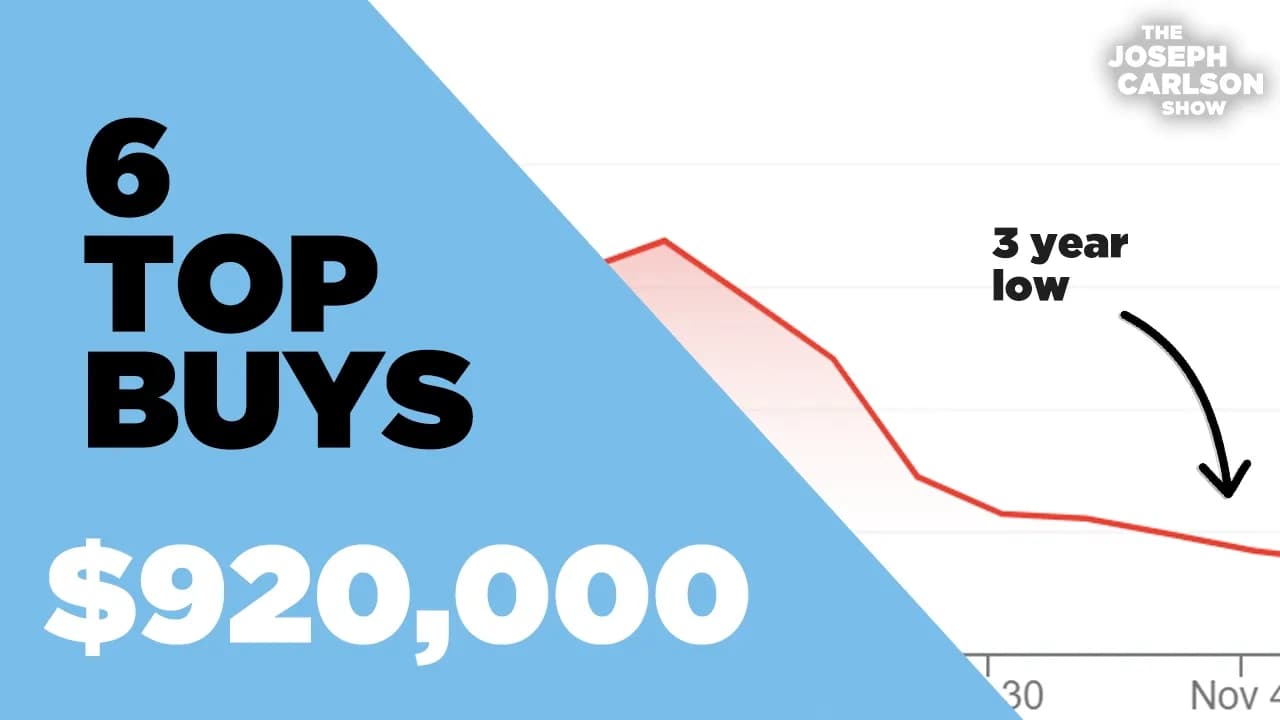
Blue line: S&P 500 forward P/E. Since 2008, far more expensive, partially justified. In 2008, cheap due to economy in shambles. As investors bought back, economy recovered, equities more expensive. Equities today generate higher margins, more profits than 10 years ago. Successful companies higher quality, deserving higher multiple. From 12-14 forward P/E to 20s. Post-2020 exuberance, S&P 500 to low 20s P/E. Then fell to 2022-early 2023. Examples: Microsoft $220 to above $500; Apple near $100; Meta $80 to $750; Netflix $750 to below $200, now $1,200 (6x from 2022 lows). Pink column highlights epic sell-off from excess valuations.
Valuations key indicator of returns. Not enough to buy high-quality; buy at attractive valuations for good returns. Examples: Netflix $200 to $1,200; Microsoft $220 to $500; Spotify $20B to $100B market cap. Buy when multiples compress. S&P 500 from 23 forward P/E to 16, a deal; buyers rewarded. Recovery since 2022 rewarding, e.g., Netflix biggest winner. Many stocks like Microsoft, Apple, Google from 2022 to now at 22-23 forward P/E, all-time high territory like 2021.
Mag 7 at 31 forward P/E vs. market 22, higher category, not most expensive ever.
Don't time market or sell high valuations. Become cautious when everyone super bullish, making money in every company. Still hold investments, buy cautiously, deliberately, focusing on reasonable valuations. Highlighting five companies worth strong consideration: two in portfolio, three not.
Recent sell-off, stock below $500/share. 27 forward P/E, 25 on 2026 earnings. Free cash flow yield 3.6% (3.4% adjusting for stock-based comp). Historical trailing P/E: today 37 P/E, one of lowest valuations (cheapest in 2022). Company stronger: diversified, wide moat, revenue growing 10-11%/year, EPS to peak despite no active market. Free cash flow near all-time highs, >$5B recent quarters, projecting up. Stock red year-to-date, gave up gains due to FactSet (market data) weakness. Not cheapest, but diversified high-quality at reasonable price, good entry.
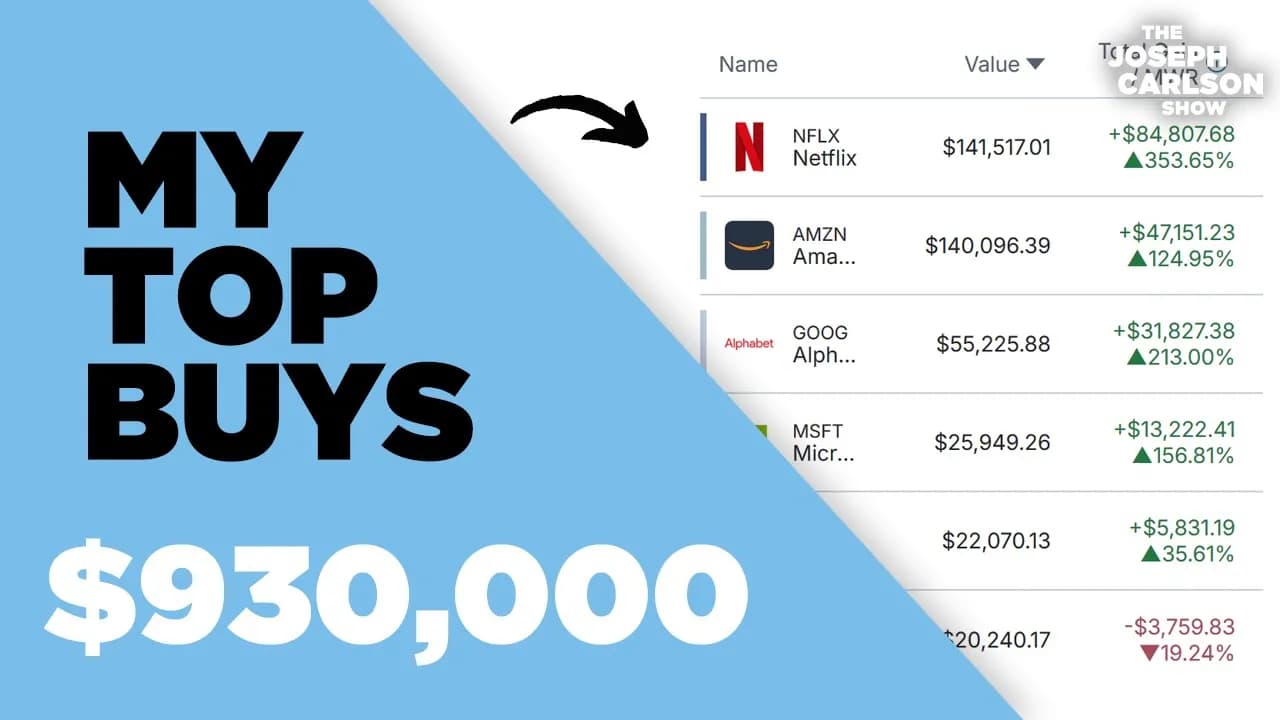
Big position $134,000, $41,000 green. Bought in 2022 sell-off. Bull case: secular compounder. Valuation: flat in 2025. 5-year up 40%. Revenue from $347B to $670B (doubled). AWS commitments $50B to $195B (4x). Free cash flow explosive: -$30B to +$48B in 12-15 months ($70B swing). EPS $1 (2022) to nearing $7. P/E mid-30s, near cheapest ever.
Concerns: competition (Google Gemini Nano, Canva). Gemini: text-prompt image editing. Canva: browser-based, user-friendly, exponential growth 100M to 170M users (2021-now), likely from Adobe users. Adobe seen as outdated, stodgy billing (annual lock-in, monthly). Hated stock: down 18% YTD, 26% past 5 years. Fundamentals: revenue 10-11%/year since 2014-15, quarterly 10.72%. Profitability increasing rapidly. Management buying back stock aggressively: 4% share count reduction YoY last quarter, from $5B to $12B/year buybacks. Trailing P/E 40 to 22, FCF yield 2.87% to 6%, P/S 11.26 to 7. Customer base growing, diverse (business pros, consumers, creatives, SMBs, enterprises). PLG motion expands TAM. At 15 P/E, 6% FCF yield, uniquely cheap vs. peers >30 P/E.
Compounding machine, down 17% YTD. 5-year +150% (beats S&P, QQQ), 10-year 560%. Model: acquires small niche software companies, implements best practices. Thousands of companies. Revenue growth 16%, profitable, FCF/share ~20% YoY.
Superinvestor favorite, niche: global online auction for salvaged/damaged vehicles. Fees on logistics, storage, title. Network effects with insurers. Down 20% YTD, from $63 to $44. 10-year ~1,000%. Valuation from 35-40 trailing P/E to 2022 levels. Proprietary software moat for operations.
Wall Street Journal: Credit market humming, worrying veterans like Howard Marks. Investors gobbling corporate debt despite low rewards. Frothy mood, priced for perfection, ripe for fall. Two bankruptcies (auto subprime lender, parts supplier) trigger concerns. No wider fallout yet, but with inflation, rising private credit defaults, gives pause.
"The worst loans are made at the best of times."
"The best loans are made at the worst of times."
High yield analysts compare to Star Wars garbage chute. Fate depends on economy. Benign environment could continue if inflation eases, no labor deterioration.
Jeremy Siegel: Strong data, trade deficit down, durable goods, GDP estimates raised for Q3. Tame inflation, stronger growth good for stocks.
Michael Sonnenfeld: Ultra-rich pulling back from risk assets (stocks, real estate), shifting to cash, fixed income. Preserve capital first, grow second. Target 3-7% returns to beat inflation vs. 10-15% compounding.
Now, moving on, we can get to some news
EA (Electronic Arts), the video game maker, is going private in a $55 billion deal with investors including Saudi Arabia's public investment fund (largest investor), private equity firm Silver Lake, and Jared Kushner's Affinity Partners.
Saudi Arabia has been acquiring US assets, e.g., starting LIV Golf to compete with PGA Tour by using wealth to buy out top players, shifting attention from PGA. They have ambitions in games and sports, leading this purchase—the largest leveraged buyout (LBO) of all time, using massive debt.
Speaker's view: LBOs are bad news. Examples of failures:
- Caesars Entertainment: Profitable but took on too much debt, couldn't service it, went bankrupt.
- Toys R Us: Could have survived without LBO; debt amplified risk, leading to bankruptcy.
- J Crew, Chrysler, and many others. Some succeed, but many fail.
Video game industry already plagued by microtransactions: Pay $30-$80 for game, then ongoing purchases (season passes, skins, unlocks, weapons, vehicles) needed to fully enjoy or compete. Companies do this for revenue in a tough industry.
Post-LBO, with heavy debt, pressure to monetize intensifies to cover billions in interest payments yearly. Microtransactions problem will worsen, especially for EA.
Not good news for video game industry; hopes to be proven wrong but dislikes this development.
President Trump renews threat of 100% tariffs on movies made outside the US.
"Our movie making business has been stolen from the United States of America by other companies, just like stealing candy from a baby."
Argues foreign countries undermine US film industry via tax incentives luring Hollywood to shoot overseas.
Unclear details: e.g., Netflix movie from South Korea with South Korean company—does it apply? Only movies filmed partly in US? Netflix shrugging it off pending details.
Article: "Meet the San Francisco woman that charges $30,000 to name your baby."
Taylor Humphrey (37) started posting online a decade ago about baby naming obsession as distraction from bleak period. Now has 100,000 combined TikTok/Instagram followers, portfolio of >500 names helped select. Top service: up to $30,000.
Framed as high-stakes baby branding, like naming a startup. One of ~12 professional baby naming consultants nationwide; only one in Bay Area (top market due to affluence/innovation). For moneyed parents, like selecting kitchen backsplash—personal but outsource to pro.
Clients: high-profile celebrities to anonymously rich, "regardless of the intricacies of their naming needs."
Services:
- $200: Email with personalized recommendations.
- Higher-end from $10,000: VIP treatment, add-ons like baby name branding campaigns, genealogical investigation for family names, think tank for top options.
"The only limits are your own imagination."
Speaker calls this a grift (rarely uses term, but fits): branding campaign for baby, $30k VIP to brainstorm/think tank, "baby naming journey," like picking backsplash.
Critique of wealthy: Distance from doing anything themselves, outsource everything (vacation itineraries, child care on trips, yard care, cleaning, cooking). Now extends to $30k baby naming—the least work possible.
Fail of the week: Not Humphrey (smartly exploiting demand), but customers paying $30k to outsource child's name.
Paying someone $30k to name your child is not only a failure, it's dishonorable. You're bringing dishonor to your family line. You and your spouse should pick the name, not a consultant, PR firm, or branding expert.
Keep Joseph Carlson in your library
Save the videos and channels worth coming back to, and find them again in one place.