The Truth About The AI Bubble
These notes were generated by AI and may contain inaccuracies.
AI economy stabilized with model layer companies, application layer companies, and infrastructure layer companies. Everyone is positioned to make a lot of money. There's a relative playbook for building AI-native companies on top of models. Previously, pivoting to startup ideas felt easier because waiting a few months often brought big announcements enabling new ideas. Finding ideas is returning to normal levels of difficulty.
Most surprising things seen in 2025. Changing of the guard in preferred LLM at YC during winter '26 batch.
Wrapped up winter '26 selection cycle. Asked founders: tech stack and model of choice. OpenAI was clear winner in previous batches (90+% initially), but declining. In this batch, Anthropic topped OpenAI.
Anthropic hovered at 20-25% through 2024 and early 2025, then surged in last 3-6 months to over 52%. Reasons: wins in vibe coding tools and coding agents, a large value-creating problem space. Anthropic models perform best, intentionally optimized as northstar per Tom Brown conversation.
Most use cases not coding, but bleedthrough effect from personal coding familiarity with Claude Opus or Sonnet influences application choice.
Gemini climbed from single-digit (2-3%) last year to 23% in winter '26. Impressed with Gemini 3.0 quality. Model personalities: OpenAI (black cat energy), Anthropic (happy golden retriever), Gemini (in between). One host switched to Gemini as go-to for better reasoning, replaces Google searches via grounding API and Google index for real-time accurate info (better than Perplexity).
ChatGPT sticky due to memory knowing personality and interests. Perplexity for fast web searches/research. Memory as moat for consumer experience. Gemini lacks ChatGPT's personality. Increased prompting/context engineering for life tasks (e.g., house buying: long ChatGPT thread with inspection reports to level playing field vs. realtor). Need for consumer apps to handle this. Still don't fully trust models without heavy prompting for high-value tasks.
Karpathy released LLM arena (manual tab version: compare Claude, Gemini, ChatGPT outputs, then cross-check). Startups arbitrage models via orchestration layer: swap models per release, use best for tasks (e.g., Gemini 3 for context engineering into OpenAI). Grounded in proprietary evals for vertical AI agents in regulated industries. New normal: benefit from model improvements like swapping Intel/AMD architectures.
Angst over value to models vs. apps. Claude coding launch suggested models entering apps, but Gemini surge commoditizes models, setting up strong year for application layer startups.
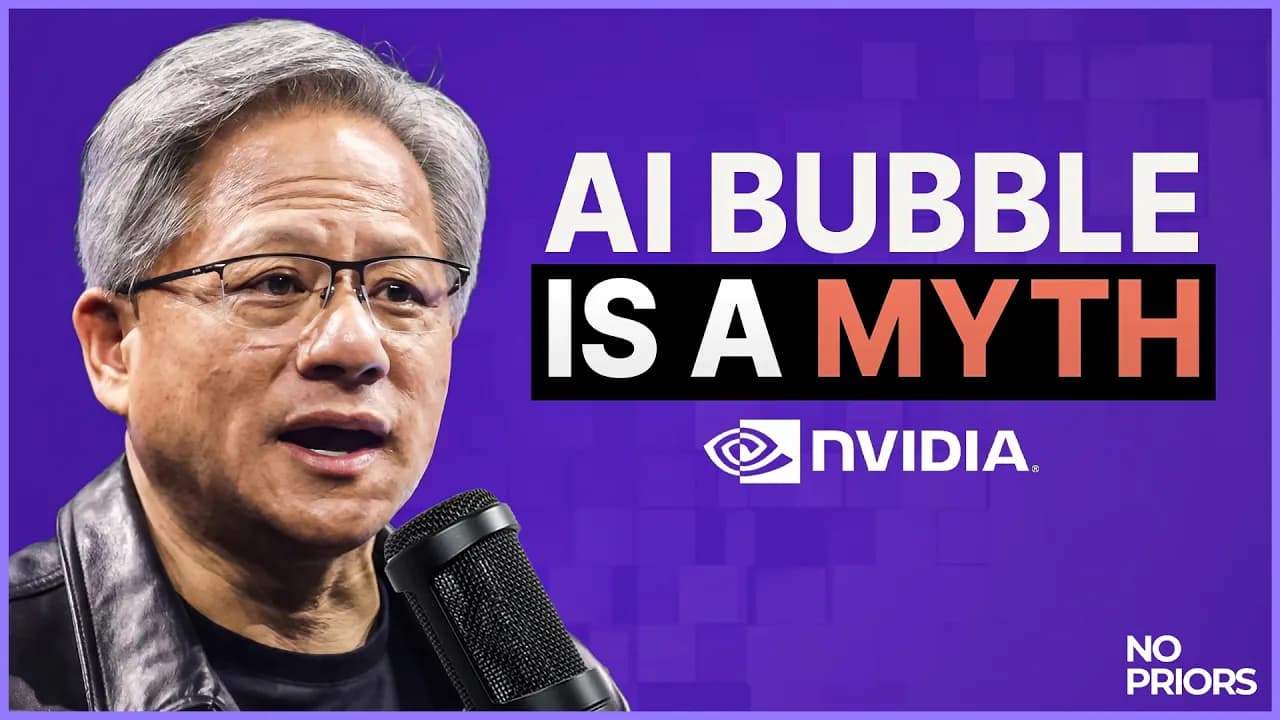
Negative Twitter comments on AI bubble (e.g., Nvidia-OpenAI roundtripping). To undergrads: not fake. Telecom bubble analogy: excess bandwidth enabled YouTube. AI glut creates opportunity; without it, higher prices/lower margins. Nvidia stock ~170s (long-term buy), but competition from AMD/TPUs means more compute. Competition among AI labs benefits application-level startups.
Bubble question relevant for Nvidia/Comcast equivalents overbuilding GPUs, not dorm-room YouTube-like AI startups. Even if Nvidia stock drops, good time for AI startups. Big cos (e.g., Meta) overinvest capex but must to stay competitive; glut persists for startups.
Carlota Perez book on tech revolutions: installation phase (heavy capex, feels bubbly: ChatGPT 2023 hype → GPU/data center buildout) transitions to deployment phase (abundance explodes). Good for founders building apps, not data centers. Internet analogy: telco overinvestment (dark fiber) enabled Google/Facebook in deployment.
Summer '24: StarCloud proposed space data centers, laughed off. 18 months later: Google, Elon doing it. Power shortages: Boom Supersonic uses jet engines for data centers (supply chain 2-3yr backlog). Land/regulations constraints (e.g., California CEQA abused). Escape: space.
- Space data centers.
- Boom, Helion for energy.
- Zephyr Fusion (new seed from Demo Day): 40s national lab engineers, Tokamaks/fusion in space (equations work for gigawatts).
Interest in model startups: big capital (e.g., Ilya SSI) or YC small models (edge devices, voice for languages). Trend increasing.
Like early YC SaaS explosion from dispersed startup knowledge. AI training from rare skill (OpenAI decade ago: researcher+engineer+business like Ilya/Greg/Sam) to common. More applied AI companies, models for tasks.
Open-source + RL fine-tuning creates best domain-specific models (e.g., healthcare beats OpenAI with 8B params on proprietary data). YC example outperforms OpenAI benchmarks. Need post-training infra; must keep iterating as GPT-4.5/5.1 surpass.
Started year observing founders' vibe coding; became giant category (Replet, Emergence). Verun Moan (ex-Google) released Anti-Gravity (high-production video with Sergey; possibly Nanobanana/videogen). Sundar Pichai discusses vibe coding/space data centers. Not 100% production-ready end-2025, but significant.
AI economy stabilized: model/application/infra layers all profitable, playbook for AI-native cos. Models incrementally improved, no major disruptions. Idea generation slowed to normal difficulty.
Do you remember the AI 2027 report, a doomer piece predicting society falling apart in 2027? They quietly revised it to remove the 2027 timeline but kept the title. Skepticism persists on the fast takeoff argument because even with scaling laws, progress is log-linear, requiring 10x more compute and topping out. This is good news. Human beings don't like change. In the previous episode, they debunked the MIT report claiming 90-98% of enterprise AI projects fail, revealing that 90% of enterprises don't know how to implement projects, let alone AI. This organizational inertia acts as a break on this powerful technology permeating society.
Society will absorb the technology gradually. Everyone has time to process it; culture will catch up, governments can respond thoughtfully rather than with knee-jerk reactions like stopping compute past 10^26. They're excited about the ARC AGI prize coming in winter 2026 as a nonprofit batch. A team climbing the ARC AGI leaderboard could accelerate progress.
Around this time last year, companies reached $1M ARR and raised Series A with just founders or one hire, which felt unusual. A year later, they didn't scale to $10M ARR without adding people; post-Series A, they hired actual teams. The playbook remains the same: companies are smaller for the same revenue due to hitting revenue fast and hiring bottlenecks, not needing fewer people. There's some efficiency effect, but not to the point of eliminating executives.
Examples include Harvey and Open Evidence, with incredible founders. For VCs, blocking out the 30 people on Sand Hill Road who write $10-100M checks creates a capital moat, securing the next Series A. Harvey faces competition from Lora (with skin in the game). In 2025, first-wave AI-native companies like Harvey broke out in 2023, did a victory lap claiming dominance, but wasted money on fine-tuning with no advantage. Investors benefited by owning more equity. Now a second wave like Lora and Giga challenges them; it isn't simple.
Two camps: AI makes everything more efficient, needing fewer people; or AI reduces production costs/time, raising customer expectations, requiring more hiring. 2025 leaned toward the second, with companies hiring as many as pre-AI due to heightened bars. Lora races Harvey, Giga races Sierra, competing for customers, bottlenecked on execution talent, not ideas. Era of one-person trillion-dollar companies isn't here yet but will trend that way eventually.
Prediction for 2026: companies under 100 people making hundreds of millions. Gamma reached $100M ARR with only 50 employees—a reverse flex highlighting revenue per employee inversion from traditional boasts.
Happy holidays and happy new year from all of us to you and yours. See you next time.
Keep Y Combinator in your library
Save the videos and channels worth coming back to, and find them again in one place.