These 8 Money Habits Are Quietly Keeping YOU Poor
In a Nutshell
The video exposes 8 money habits trapping Americans in poverty despite earning $1.7M over a career: pay yourself last (automate 10% to savings first), carry credit card debt (pay off 22-24% interest before investing), lifestyle inflation (track fixed income/expenses/net worth monthly), sneaky hobby spending ($1,100/mo = $600K lost over 20 years at 8%), excessive saving without investing (inflation erodes cash), overpaying taxes (max Roth IRA/$7,500, 401k/$23,500, HSA), and delaying investments (10-year wait costs $729K on $5K/year at 8%). Break free by automating savings/investments on payday, prioritizing debt payoff, controlling spending to build 3-6 months emergency fund then index funds, growing income via side hustles/raises, and using tax-advantaged accounts—start today for retirement wealth.
These notes were generated by AI and may contain inaccuracies.
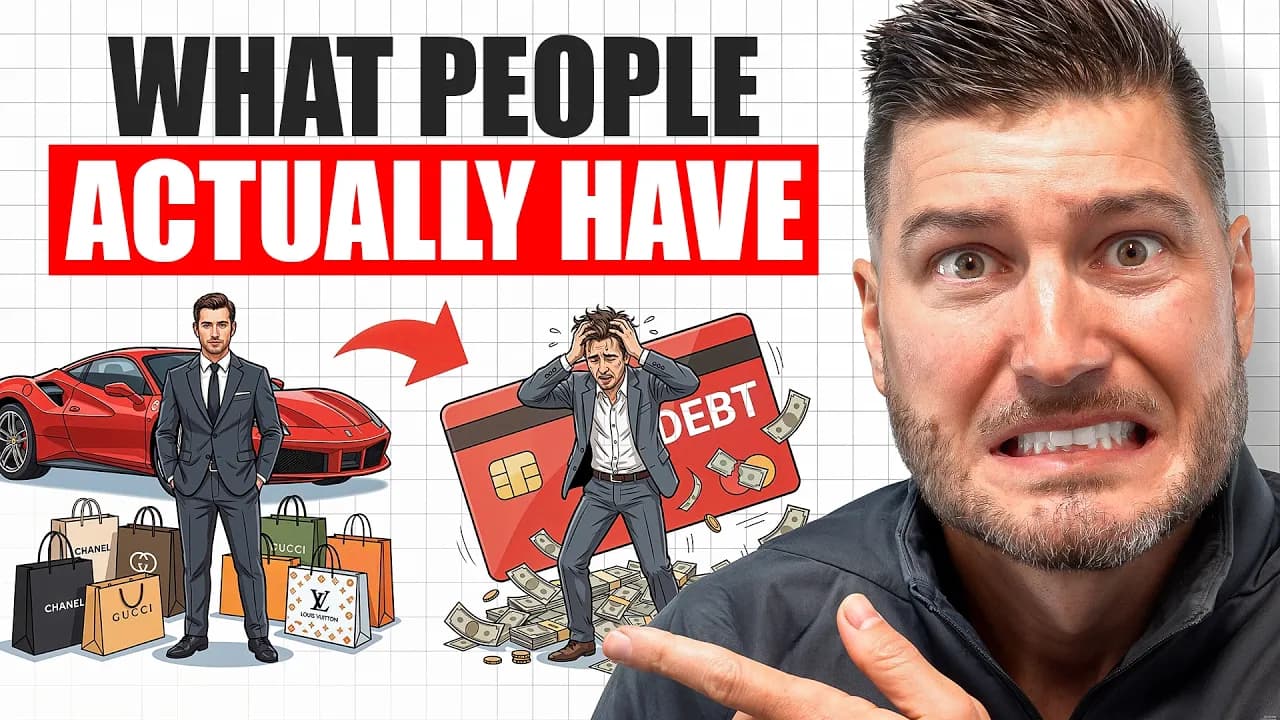
The average American earns $1.7 million over their career. The median retirement savings for people who have anything at all is $87,000. About half of American families have nothing saved—zero. That $87,000 is the best case scenario for many. This is not bad luck but the direct result of money habits that quietly work against you for years while everything feels fine. This video covers eight bad money habits and how to break free of them.
This idea from Robert Kiyosaki's Rich Dad Poor Dad is the foundation for everything else. Most people pay rent, car bill, phone, subscriptions, food, and spend on social life first. Whatever is left, if anything, goes to savings. Spending always grows to match what's in your account. If $200 is left at month-end, it gets spent. Willpower alone won't fix this.
Wealthy people reverse the order: As soon as you get paid, move at least 10% straight into savings before paying bills. Set it up automatically. Treat savings like a bill you can't skip—your future self needs it as much as anyone else. Start by building 3-6 months of living expenses, then invest the extra. Paying yourself first is essential.
The average American has about $6,500 in credit card debt. With interest rates between 22-24%, it costs about $1,430 a year in interest just to keep the balance from growing—like a hamster wheel. Credit card companies charge high interest while advertising cashback rewards, which only make sense if you pay off the balance monthly. If you carry a balance, rewards are just a small discount on the interest.
Rule: If you can't pay for something in cash right now, don't buy it on credit. Treat credit like cash. Exceptions: things that keep their value or make money (eating out or new clothes don't count). If you have credit card debt, make paying it off your top priority before anything else—the interest is guaranteed, investment returns are not. Paying off 22-24% debt is a guaranteed tax-free return. Prioritize this, as discussed in the last video.
Lifestyle inflation is a silent killer, like monetary inflation taxing your purchasing power. Spending rises with income, so the lifestyle gap never closes—no matter how much income increases, spending matches it. You can't reach a goal without knowing your starting point.
Smart, hardworking people struggle due to this. In the two-income trap video, dual-income couples in corporate America make high salaries but live paycheck-to-paycheck as lifestyle upgrades (nicer apartment/home, newer car, longer vacations) keep pace. You can be broke paycheck-to-paycheck or six-figure paycheck-to-paycheck—the quality differs, but it's still paycheck-to-paycheck. Every income increase resets spending to match, keeping the gap open.
Solution to lifestyle inflation: Know your real numbers, not guesses—monthly fixed income, fixed expenses, extras, and net worth (assets minus liabilities). Could you list all assets and liabilities in a box or spreadsheet? Net worth is a temperature check of financial health, more telling than salary.
People who build wealth track every dollar and make purposeful choices. Like a caloric deficit for fat loss: calories in vs. out, weigh food. Track income/expenses (calories) and net worth (weight on scale). Many avoid budgeting/spreadsheets out of fear of uncovering true spending, like hidden calories from sauces or late-night cookies. Those add up, explaining poor credit scores or body composition. Use diet analogies—discipline is key.
Hobbies like shopping (e.g., TJ Maxx), going out every weekend, upgrading cars/phones after lease are sneaky spending. Nothing wrong with enjoying money, but if you spend $1,100/month on non-goal items, that's $13,200/year. Invested at 8% return for 20 years: over $600,000—enough for retirement, rental property down payment, or family wealth.
"You can't take it with you."
Response: Give it to your kids. Don't cut everything—make unconscious spending conscious. Every dollar has a job; you're the CEO of your money.
Housing opportunity where demand meets broken system: Over 75% of Americans can't afford homes; country short 6.2 million homes. Europe has durable concrete/brick houses surviving wars; U.S. still uses 50-year-old wood framing that rots, burns, molds. Geoship redesigns from physics/materials science: bioceramic composite, geodesic geometry, non-toxic, fire/mold-resilient, 500-year design life. Engineering from Tesla, Apple, Toyota. California factory-built, certified pilot running. 3,400 domes reserved, $550 million deposit-backed pipeline. Raising via Regulation CF; everyday investors can join (early-stage risk, potential full loss—do due diligence, see offering circular in description/pin).
Savers lose purchasing power to inflation—like mice eating cash under bed or in drywall. In 30 years, a Honda Accord could cost $85,000; cash does nothing. Cash may not exist in 10 years.
Limit to saving: On $5,000/month income, max 30-40% ($2,000) savings—even impressive savers can't save to real wealth on average income. Saving is one part; uncapped are income growth and investments (stocks, real estate, private equity, side hustles). Don't be the NBA player broke after $100 million career. Control spending/pay yourself first, but grow income (ask for raise, side project, brokerage account, invest). Fastest to financial independence: Increase earnings while controlling spending—saving has ceiling, earning doesn't.
Biggest lifetime expense: taxes (25-30% of income over working years). Use legal tax-advantaged tools:
- Roth IRA: Up to $7,500 (2026), post-tax; tax-free growth/withdrawals in retirement.
- 401k: Up to $23,500 (2025, higher 2026) pre-tax, lowers taxable income now.
- HSA: Triple tax benefits (pre-tax in, tax-free growth, tax-free out for medical).
These are rules wealthy people use, not loopholes. Use before regular brokerage to minimize taxes.
Waiting feels minor but costs hugely. Reasons: next year, more saved, understand better, market calms, life stable, kids, etc.—then you're 40.
Example at 8% average return, $5,000/year:
- Start age 25 (Person A, 40 years): $1,295,000 by 65.
- Start age 35 (Person B): $566,000.
Difference: $729,000 from 10-year delay—that's your retirement. Savings at 2-3% lose to inflation (savers are losers). Keep investments in broad market index funds—time in market beats timing. Best time was yesterday; next best is today. No need for stock picking or fancy accounts—just start.
No finance degree, investing background, or high salary needed—just awareness and decision to change. Normal habits (pay last, carry balances, lifestyle inflation) lead to $1.7M earned but <$90K retired. For different results, make different choices now—not next week/holidays/when life slows.
Biggest impacts: Automate savings immediately upon payday (done forever); track net worth monthly (5 minutes)—turned chore into winning game.
Join Whiteboard Finance University: Courses on personal finance, real estate, stock market, live trades, weekly livestreams Thursdays 5pm EST (share portfolio/markets). $10/month for community/value. Link in description.
Thank you for watching. Share with a million friends. Have a prosperous day.
Keep Marko - WhiteBoard Finance in your library
Save the videos and channels worth coming back to, and find them again in one place.