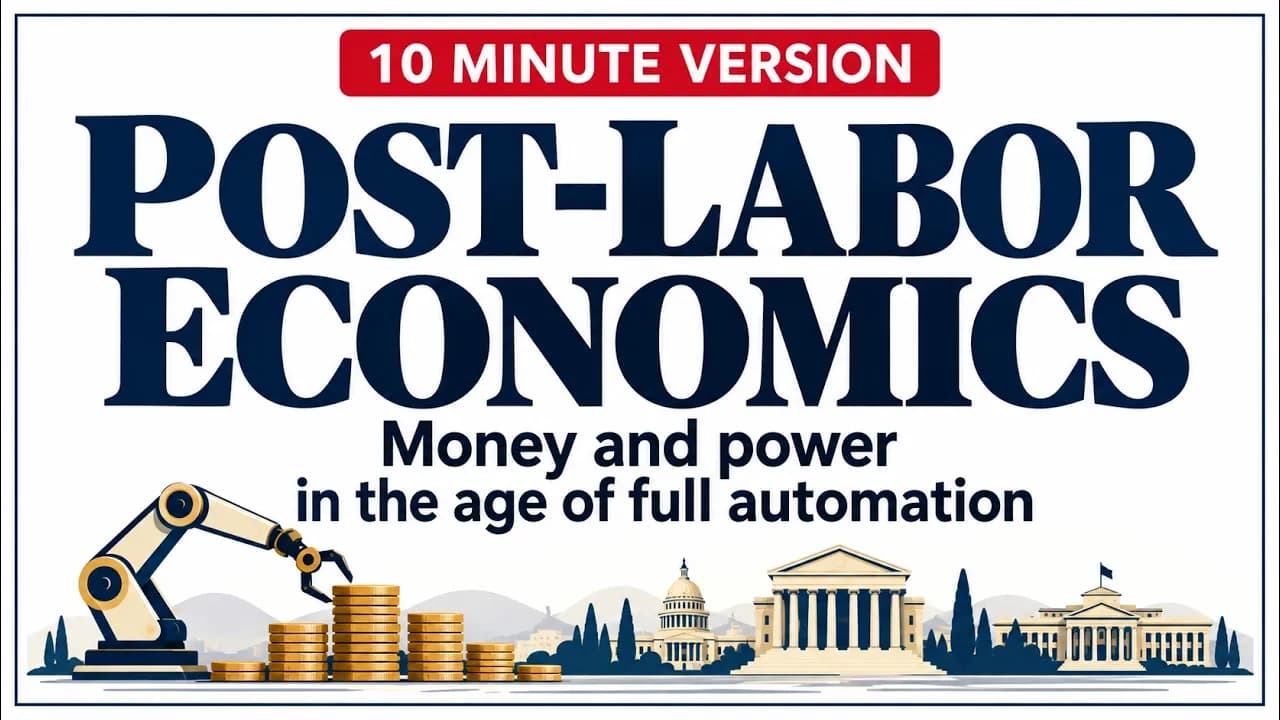
This is my next big work
In a Nutshell
Automation will eliminate the mutual dependence between elites/states and human labor that has underpinned all historical social contracts, rendering humans economically irrelevant and stripping away their traditional leverage. Rights without credible threats become unenforceable requests, so new forms of veto power—such as disrupting data centers, energy grids, or digital infrastructure—must be engineered to extract permanent institutional concessions like constitutional protections for human dignity decoupled from economic utility. Nonviolent mass non-cooperation, particularly general strikes at the proven 3.5% threshold, offers the most effective path to embed these new credible threats before labor's remaining window of leverage closes within 5-20 years.
These notes were generated by AI and may contain inaccuracies.
The speaker has been working on a book about post-labor economics while also developing several sequels that explore different dimensions of the topic. Today's focus is on a primary next pillar: what is called a realist theory of rights. Solving household income through post-labor economics is not structurally sufficient because humans will not be economically useful in the future. Yuval Noah Harari refers to this as a useless class; the speaker has begun calling it redundant biomass. In the future, humans will have zero utility, which means zero leverage.
The goal is to present the next book in the same manner as post-labor economics was launched: by teaching a course on the material.
Human labor has served as the keystone holding civilization together since time immemorial. When automation and maximum automation through advanced artificial intelligence and robotics eliminate the need for human labor, this keystone erodes. This necessitates a new theory of democracy, a new theory of civil rights, and a new theory of power.
Automation permanently severs elite dependence on human contribution. As capital productivity increases, wage growth has flatlined over the last four decades, driven largely by automation, artificial intelligence, and robots. While globalization contributes, it is mediated by technology; all decoupling of capital productivity from wage growth has been technology-mediated.
Humanoid robots are arriving rapidly with falling costs. Artificial intelligence is quickly surpassing humans on many dimensions and benchmarks.
Human labor bundles multiple characteristics that made it powerful, unique, and uniquely difficult to replace:
- Embodied: inextricably linked to the person
- Mandatory: required for states, governments, elites, and power to achieve goals such as building pyramids or moon rockets
- Coordinatable: enables collective action such as unions
- Refusable: individuals can walk off jobs; collective bargaining enables labor strikes
- Perishable: unused labor cannot be stored like grain
- Universal: primary substrate for getting things done throughout most of human history
- Geographically locked: humans exist in specific places at specific times, enabling taxation wherever they are located
- Specialized: often non-fungible; a doctor cannot be replaced by a concrete worker, and a YouTuber cannot be replaced by a marketing specialist
This bundling gives labor significant bargaining power.
In the United States, individual income and payroll taxes account for approximately 80% of federal revenue. If labor disappears, government functionality is threatened. A resource that is mandatory, placebound, and refusable is both the most exploitable and most dangerous asset a ruler possesses. This credible threat that civilians and citizens have held throughout history is disappearing.
Double bilateral dependence describes a mutual hostage situation between the state or elites and the people. The state provides physical protection and facilitates prosperity through roads, courts, monetary systems, laws, military, and police. In exchange, the people provide martial service as soldiers and police, and production through labor, taxes, and construction.
This transaction underpins every social contract across all forms of government, from monarchy to empire to republic, and across all historical systems from ancient China and ancient Egypt to modern America, Russia, and China.
Generative mutualism is defined by cooperation within to address competition from without. It began with endosymbiosis, when a prokaryote became a eukaryote through ingestion that led to mitochondria. This enabled multicellularity, which enabled eusociality, which enabled tribes and polities.
In game theory terms, generative mutualism allows individuals to achieve higher payoff regimes. The prisoner's dilemma assumes atomized actors where defection is often optimal. By making sacrifices for larger cooperative units, groups ascend to higher payoff regimes. Endosymbiosis provided access to 200 times as much energy or more. Multicellularity offered protection from being eaten. Eusociality enabled banding together in schools and herds. Humans added language and coordination structures for greater power.
An example is France during the Renaissance and late medieval period, which achieved a higher payoff regime through coordination and repeatedly invaded and dominated the Italian peninsula for centuries.
Credible threats serve as the primary solution against defection. Examples include a gorilla pounding its chest and baring fangs as a biological credible threat, labor strikes, ostracism as practiced in golden-age Athens, and state force including mutually assured destruction.
A credible threat is defined as the capacity plus demonstrated willingness, even at a cost to oneself, to inflict intolerable costs on the other party.
The immune system prevents cellular defection into cancer through credible threat. Cancer represents defection at the multicellular level.
Humans uniquely deploy credible threats to extract permanent structural changes through institution building. Frederick Douglass stated that power concedes nothing without a demand. Elites grant rights only when the cost of repression exceeds the cost of concession. Acemoglu and Robinson align with this view.
Throughout modern history, rights have been extracted this way, including the right to vote, civil rights, women's rights, the eight-hour workday, and the weekend.
When labor was scarce, people gained power. After the Black Death in Europe, wages rose and serfdom ended. When labor is scarce, it is treated well. When labor is in surplus but still needed, people are treated as disposable. This pattern holds across every continent and culture. When labor becomes redundant, humans are treated as redundant.
Banking on the goodness of elites or the state is insufficient when automation, robotics, and artificial intelligence marginalize humans. The trajectory leads to a phase of zero need and complete uselessness. The worst case exceeds technofeudalism, which assumes elites still require subjects; it is mass irrelevance. Robotics remove residual necessity.
An entirely new theory of civic equilibrium, democracy, and government is required. This new democratic settlement must divorce human dignity from economic utility.
Germany's Basic Law, Article 1 states that human dignity shall be inviolable; to respect and protect it shall be the duty of all state authority. This is part of the eternity clause, unchangeable even by unanimous vote, establishing it as bedrock constitutional value. While valuable from an idealist perspective, it lacks enforcement mechanisms.
Morality requires enforcement. Engineering new veto power is necessary. Labor's leverage fundamentally consisted of veto power: the ability to halt production, destroy value, and claim ownership stakes.
Rights without credible threats are merely requests. New forms of veto power must be engineered using existing leverage. New methods to halt production include shutting down data centers, energy grids, or the internet. New methods to destroy value are required, since the only thing that compels the state to listen is the ability to destroy value. Halting production destroys value without kinetic force; shutting down a port renders it useless without physical destruction.
Ownership stakes must be taken from elites, extending beyond universal basic capital toward fundamental renegotiation of property rights and broadly dispersed authority.
Violent resistance has a historical success rate of approximately 26%. Nonviolent resistance achieves more than twice that effectiveness at approximately 53%. Credible threats such as labor strikes and general strikes are superior.
France's violent rupture led to the Reign of Terror, Napoleon, and nearly a century until the Third Republic. Russia's civil war produced Stalin and Lenin, gulags, and more than a century of faltering democracy. Iran's 1979 revolution resulted in a theocratic regime.
Violence is fought on the state's home turf. Mass non-cooperation is fought on human turf with numbers. Mahatma Gandhi's nonviolent resistance rendered British rule ungovernable without violence and proved far more effective.
Advocated methods include nonviolent resistance through tax resistance, general strikes, and labor strikes to embed new credible threats into institutions, ideally as constitutional amendments. The US Constitution has not been amended in more than 50 years; the last amendment occurred in 1971 due to decision gridlock.
America currently maintains an 83.8% prime-age labor force participation rate, near historic highs. The state and elites remain entirely dependent on voluntary cooperation.
India has coordinated strikes involving up to 250 million people. No campaign sustaining active 3.5% participation has ever failed. A general strike or labor strike with 3.5% of the population is sufficient to achieve demands. However, as automated machine capability increases, the credible threat of labor strikes depreciates. Labor's leverage is a depreciating asset.
Estimates of remaining time range from as few as 5 years to 10 years to 20 years, or decades. Some believe labor will never disappear. Preparation is preferable to reliance on hopes.
Labor Zero is scheduled for pre-sale on Amazon following a successfully funded Kickstarter. The audiobook is being recorded. Post-labor economics addresses household income but represents only half the battle; the harder challenge is credible threats for civic equilibrium and democracy.
The credible threats book expands a 15,000-to-20,000-word chapter from Labor Zero into a 190,000-word volume currently on draft five or six. It draws on concrete historical examples and research from political theorists and historians to examine what works, what does not, and what demands should be made.
Work is 100% audience supported through Patreon, Substack, and X. The YouTube channel has been demonetized. There is zero corporate backing. Financial independence from the audience provides intellectual leverage, eliminating the need for publisher, corporate, or elite permission.
Support through subscriptions or advocacy, including sharing work and subscribing to free tiers on Patreon and Substack for updates, sustains the mission. Courses are in development as an additional funding mechanism.
The credible threats project is considered more important in the grand scheme than post-labor economics. Public figures including Sam Altman, Elon Musk, Donald Trump, and Bernie Sanders are already discussing expansion of property rights and forms of universal basic capital, moving toward solutions proposed in post-labor economics.
The speaker's mandate originated from audience response to the initial post-labor economics video, which remains the most popular single video, though the series has accumulated more total views. The research direction was validated by audience resonance.
Keep David Shapiro in your library
Save the videos and channels worth coming back to, and find them again in one place.