This Startup Wants To Catch Cancer Before It Spreads
In a Nutshell
BillionToOne, founded by two PhDs from a YC 2017 half-lab bench, uses synthetic DNA (QCTs) added pre-PCR to eliminate amplification noise, enabling their widely adopted prenatal test detecting single base pair mutations in fetal DNA from maternal blood—now processing 600k tests/year with 20% market share at $4B+ valuation. The same technology powers liquid biopsies for oncology: already detecting actionable tumor mutations in late-stage cancers, launching ultra-sensitive MRD tests for stage 1 patients within a year, and targeting early detection in healthy populations as the "holy grail" to prevent spread. They scaled via interdisciplinary hiring, small autonomous teams, AI-optimized labs for 2M tests/year, and a phased roadmap (prenatal → late-stage → early-stage cancer) that built revenue before tackling bigger markets.
These notes were generated by AI and may contain inaccuracies.
One in 11 babies born in America this year will be screened by a genetic test that didn't exist a decade ago. There are 3 billion base pairs in the human genome. In diseases detected from mom's blood like sickle cell disease and cystic fibrosis, usually only one base pair is different. Finding one base pair out of billions is the needle in the haystack problem, origin of the BillionToOne name. Their prenatal test is one of the most widely used genetic tests.
BillionToOne is less than a year away from launching an ultra-sensitive MRD test (minimal residual disease) for stage one cancer patients. The same technology could enable early stage detection before cancer reaches stage one. > Once we are there, technically we would have solved the holy grail of cancer detection.
BillionToOne was built by two PhD students, Oguzan and David, starting with half a lab bench and $300,000. They applied to YC in 2017. Now processing more than 600,000 tests a year with close to 20% market share. Went public late last year at over $4 billion valuation.
BillionToOne is a next-generation molecular diagnostics company detecting DNA in blood samples. Tissues shed DNA into bloodstream, including fetus DNA from mother's womb and cancer DNA as it mutates and grows. This enables diagnostics impossible a decade ago.
Core idea same since 2017 YC application: prenatal genetic test sequencing fetal DNA fragments in mother's blood for universal adoption. Before BillionToOne, detection required amniocentesis, invasive for high-risk pregnancies only.
Key insight: fetal and tumor DNA is dilute and rare, few molecules among billions. PCR amplification needed but adds noise drowning the signal. Solution: add synthetic DNA to patient sample before amplification. These quantitative counting templates (QCTs) measure amplification biases and errors at genomic locations, allowing removal from sequencing data. Converts biology problem to mathematical problem using machine learning.
Every tissue sheds tiny DNA fragments into bloodstream. Traditional tests amplify everything including noise. BillionToOne adds known synthetic DNA before amplifying, subtracts distortion to spot signals no other test can.
From PhD students to commercial test in 2 years. Oguzan (Stanford) and David (Rice University) met as undergrads. Approached cell-free DNA from first principles, realized noise reduction enables detecting sickle cell disease, cystic fibrosis, thalassemias from maternal blood. These are most common genetic disorders worldwide, potential to help millions.
Why first to do it: requires interdisciplinary approach bridging data analysis biases and chemistry of data generation. Scientists understanding chemistry aren't typically data scientists or bioinformaticians; they bridged the gap.
Within 6 months of YC, developed test and proven accuracy on samples. First lab was shared facility, half bench shared with friend startup. Struggled with chemical suppliers demanding bank accounts. First post-fellowship fundraising: $300,000 over 6 months in $10,000 checks, very paranoid about resources.
Launched June, 2 months later only one physician sending 1-2 tests/week. Emergency meeting: fired VP sales for hiring only one rep in 5 months, demanded 5 more reps in 3 weeks, trained over weekend, in field Monday. Shifted to marketing leads to patients to convince physicians. Inside sales director spent 30-45 minutes per patient educating on test differences. Got 1 in 5 leads back, proved traction to attract sales team.
State-of-the-art lab built 2022. Samples logged into laboratory information management system, tracked 5-7 days. Preserve identity processing thousands/day. Actual raw blood samples from patients. Accessioning was bottleneck; used AI and computer vision for accessioning in 60 seconds (human took 60 seconds/file), complete redesign.
Centrifuging separates plasma (contains cell-free DNA). Liquid handling robots with optics remove plasma layer only. Reagent lab manufactures proprietary QCTs added to every sample. Facility supports 2 million tests/year, one in three babies.
Combine fluids into one droplet, sequence thousand patient samples mixed together. Use barcodes marking each sample's sequences before pooling; computational demultiplexing assigns to patients.
Final lab step: computational analysis. Laboratory directors and genetic counselors review; 20 people discuss complex cases. Happy path samples auto-analyzed and reported.
Same technology for liquid biopsy cancer detection via tumor DNA in blood. Launched early cancer test commercially 2023, executing in two markets. One-year plan: prenatal genetics → late-stage cancers → early-stage cancers. Currently on step two (late-stage). Cell-free fetal DNA and tumor DNA fundamentally similar.
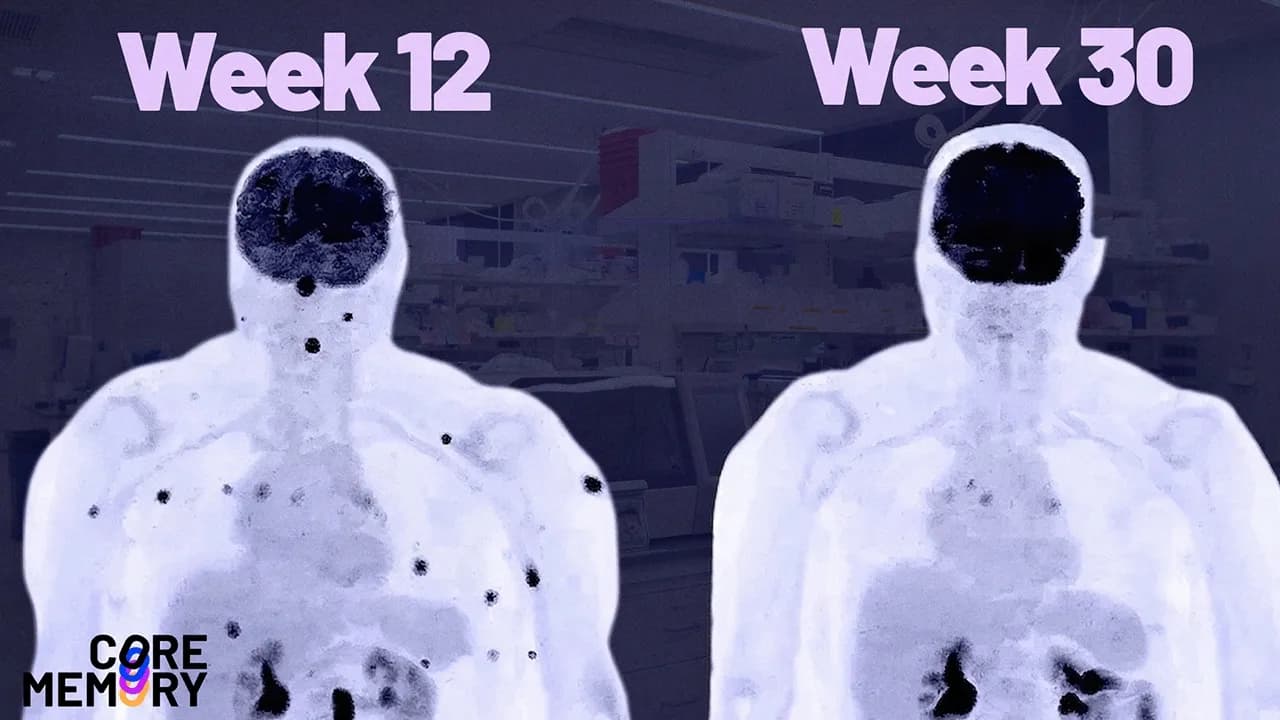
Starting prenatal enabled initial commercialization, resources for new tests. Patient story: 40s metastatic colorectal cancer patient out of options, hospice-bound. Northstar Select test found microsatellite instability in bloodstream tumor DNA, eligible for immunotherapy despite prior tumor biopsy negative. Cancer "melted away"; patient thriving, doctor now sends all cancer patients' blood tests.
Hire interdisciplinary people, not teams: accelerates work order of magnitude. Small R&D teams: principal investigator with 2-3 research associates, report directly to founders, own end-to-end product development. Fast iteration, no bureaucracy. Weekly founder time unblocking. Structure: many startups within company, each owning a product.
Three-step plan since 2018 like Tesla: prenatal → late-stage cancer → early-stage. Each step less capital intensive first for accessibility/affordability, then larger markets.
Step three: MRD for stage 1-2 cancer post-curative surgery. 20% have undetectable microscopic residual tumor DNA. Detects it.
Step four: same tech for early detection in healthy population, annual screening to find early tumors removable before spread. Holy grail of cancer detection.
Why successful: resource limits forced step-by-step vs. $1B+ for early detection without revenue. Proud of prenatal alone, but tech enables cancer impact for millions, biggest dent in 100 years.
Pressure is a privilege.
Hire for challenge: changing healthcare while growing fast and profitable is hardest thing, but proudest. Post-IPO, employees could retire but stay for growth/challenge.
Keep Y Combinator in your library
Save the videos and channels worth coming back to, and find them again in one place.