Top Developer Trends of 2025: AI Usage, Productivity, and the Rise of TypeScript
In a Nutshell
Senior developers gain far more productivity from AI than juniors because they delegate tedious tasks to AI while retaining ownership of core design and complex logic, whereas juniors treat AI primarily as a learning tool. Code quality concerns dominate AI adoption fears, with cognitive load shifting from writing to reviewing AI outputs, and organizations struggle to balance AI speed with security and maintainability. TypeScript leads the 2025 language rankings while developer productivity hinges equally on technical tooling and non-technical factors like reducing meetings and technical debt.
These notes were generated by AI and may contain inaccuracies.
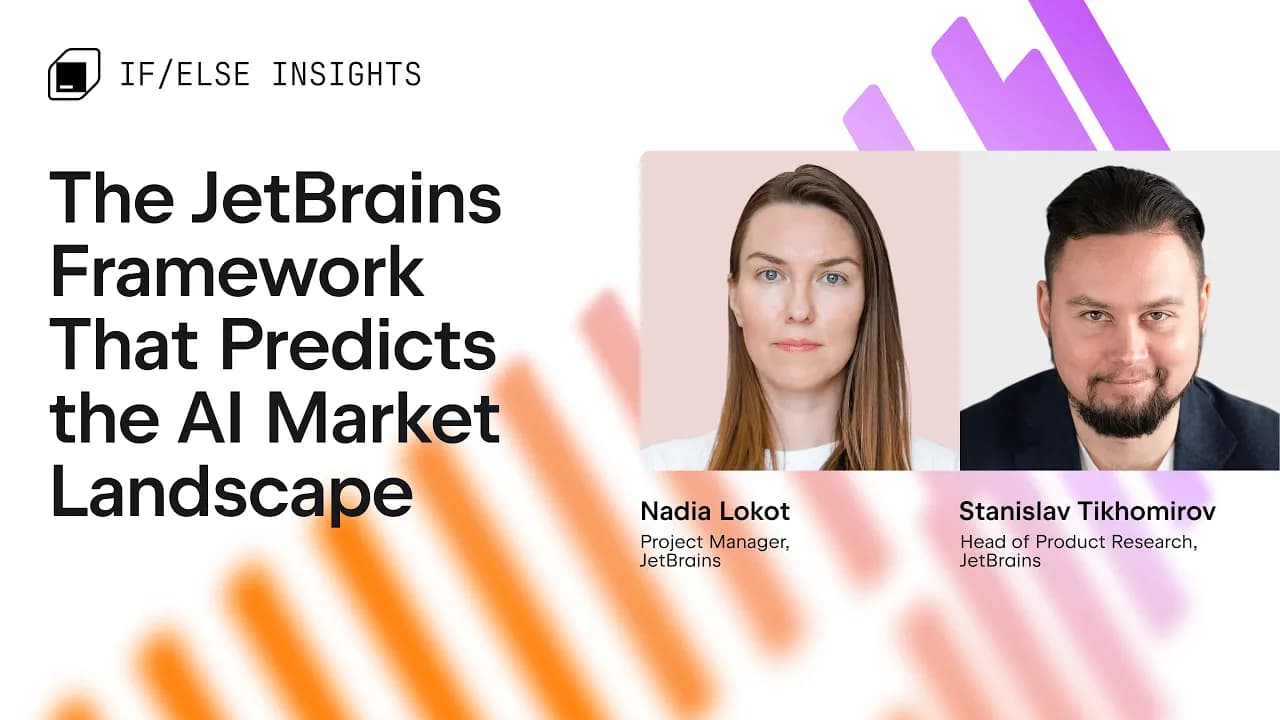
Nadia Lockot, research project manager and host of the EELS webinar series, introduces the annual developer ecosystem survey, which has been conducted for 9 years. The 2025 report is based on responses from more than 24,000 developers. Kira Bern, product manager from the go-to-market team, joins the discussion. Nearly half of the survey respondents have six or more years of experience, meaning significant portions of the data come from senior developers.
A chart shows the tasks developers are most likely to delegate to AI: writing repetitive code, searching for information online, and converting code to other languages. Developers tend to delegate tasks that are laborious and time-consuming. Kira explains that developers experience two types of high cognitive load tasks: tedious but not difficult tasks that cumulatively drain mental resources, and difficult or unfamiliar tasks such as writing code in a new language or codebase. Developers are happy to delegate the first category to AI. Converting code between languages is noted as a core capability needed for code modernization, converting legacy applications to modern languages or architectures. This represents a high-value but more demanding AI use case.
Developers seek augmentation rather than complete automation. Tasks that developers view as core to their professional identity, such as systems design and designing core logic, show the highest reluctance for complete delegation. This aligns with findings about the benefits of AI usage in coding, which center around speeding up work and improving productivity.
Significant differences exist between junior and senior developers in AI usage effectiveness. Multiple data sources show that although junior developers use AI more frequently, they use it less effectively in terms of productivity gains compared to senior developers. DX research tracking 135,000 developers at over 400 companies found that more senior developers are less likely to use AI daily, yet staff engineers save the most time with AI while junior developers who use AI more frequently save the least time.
Senior developers view AI as an overeager intern requiring supervision and strategic delegation. They use AI to speed up and automate tasks they already know how to do and are better equipped to evaluate AI outputs. Junior developers tend to view AI more as a teacher, using it primarily for learning. This explains why senior usage produces more measurable time savings while junior usage focuses on skill development.
Only 1% of developers expressed no concerns about AI when coding. The top concern is the quality of work AI produces. High-quality code is defined as readable, maintainable, and reusable with lower levels of defects and vulnerabilities. Low-quality code creates technical debt that slows development. Evidence on AI's effect on code quality is contradictory. DORA's survey of 5,000 developers showed improvements in code quality with higher AI adoption, possibly because AI tools produce cleaner code more consistently for simpler cases. However, DX research found that some organizations experienced improvements while others saw serious degradation of code quality with higher AI adoption, suggesting differences in development best practices and processes affect outcomes.
The second major concern is limited understanding of complex code and logic when making changes in existing complex, mature codebases. This task is inherently more difficult than generating greenfield code because developers must understand the existing code, architecture, and implications of changes. Stack Overflow research showed that developer trust in AI coding tool outputs fell over the past year.
With increased experience using AI coding tools, developers now recognize both strengths and weaknesses. The biggest current problem, especially for agentic workflows, is low-quality solutions that don't quite work. Developers must review, test, tweak, and often discard AI outputs entirely. Cognitive load has shifted from writing code from scratch to reviewing, testing, and validating AI-produced work. Traditional coding best practices like static analysis, test-driven development, and code review help validate and improve AI results.
Privacy and security concerns rank as the number one reason for AI bans at companies. For software companies, code represents core intellectual property. Organizations in regulated industries like healthcare and finance manage sensitive data and face compliance risks if data or related code leaves their security perimeter. Many customers request on-premises solutions or VPC deployment of AI coding tools. AI guardrails are being developed as safeguards to ensure AI systems operate safely. AI has been shown to introduce vulnerabilities mirroring those added by human developers because LLMs are trained on open source code containing various security vulnerabilities. Common examples include hardcoded secrets like passwords and API keys that could be leaked if passed to cloud-based LLMs. Vendors are introducing guardrails to filter such data and address security and privacy risks.
Tool usage with agents introduces new risks. Since the advent of MCP, tool poisoning has become possible where hackers introduce malicious instructions into MCP tool metadata used by agents. Giving agents more agency to solve longer-running tasks autonomously raises risks of unintended damage. Cloud Code introduced secure sandboxes where agents run locally without network or file access, enabling "YOLO mode" where agents operate autonomously. Otherwise, agents must check periodically with developers for command permissions, which negates the purpose of autonomous delegation.
Seventy percent of developers are likely to try coding agents in the coming year. Two major modes of working with agents have emerged. Collaborative mode involves working with a local agent in an IDE or command line, similar to pair programming with an interactive agent where developers work together on solution plans. Autonomous and asynchronous mode involves delegating tasks to a junior developer equivalent that requires verification of results. AI Pulse research found that 14% of developers use at least one command line agent at work. CLI agents like Claude Code appeal particularly to JetBrains users because they integrate easily with existing workflows and toolchains. CLI agents appeal more to senior and experienced developers, while junior developers tend to prefer tools like Cursor.
Cloud agents, also known as background agents, run autonomously and asynchronously in the cloud, handling full task delegation. However, async cloud agent usage remains low, with Google Jules and Devin at approximately 0.5% usage. Developers typically use cloud agents as features within more general coding tools like GitHub Copilot or Cursor rather than as standalone autonomous tools. Tasks delegated to cloud agents tend to be smaller, well-scoped, lower-value tasks such as fixing small bugs and failed tests. Developers report dissatisfaction with the quality and reliability of cloud agent results, as well as lack of control over execution and insight into agent processes. Unlike IDE agent mode with plan mode where agents generate plans for review before coding begins, cloud agents operate in one-shot solution mode without iterative planning.
The JetBrains Programming Language Promise Index is a composite score combining historical growth, stability, adoption, and user inertia. TypeScript, Rust, and Python lead the index for 2025. Python's rise tracks the growth of AI and machine learning. Rust and Go are becoming increasingly important in AI infrastructure and performance-critical AI system components.
Both technical skills including tools and proficiency, and non-technical skills including clear management, communication, and job design are equally important for developer productivity and developer experience. Non-technical factors like excessive meetings and constant interruptions cause context switching that takes developers out of flow state needed for deep work. Technical improvements through platform engineering include automating error-prone manual work like development environment setup and reducing development friction like long build times and code review cycle times. These improvements enhance software delivery throughput.
Code review exemplifies the intersection of human and technical factors. While the quality of developer feedback is essential, reviewing remains demanding and time-consuming. AI code review features help by identifying and organizing issues and automating fixes for simpler issues. Onboarding involves both technical factors like environment setup and non-technical factors like time from senior developers, where AI can accelerate both aspects.
A disconnect exists between what technical leaders want and what companies currently offer regarding fixing internal collaboration issues and reducing technical debt. Team leads are the primary drivers of improved developer experience and productivity according to approximately half of respondents, even at large companies with dedicated productivity teams. Team leads deal daily with non-technical issues like unclear communication and team collaboration problems that organizations appear to underestimate. Technical debt directly impacts team leads through increased stress and cognitive load from working in lower-quality codebases and slower feature delivery.
Top productivity metrics include developer engagement, developer satisfaction, deployment frequency, and developer sentiment. The SPACE framework mandates measuring developer satisfaction as one of three minimum dimensions for a rounded productivity view. DORA metrics including lead time for changes and deployment frequency measure development throughput. DORA research showed higher AI adoption improved software delivery throughput, but also found increased delivery instability measured through change failure rate and rework rate. AI mitigation features do not reduce instability harm. The majority of developers either don't believe their company's productivity metrics accurately reflect their contribution or are unsure. Only 22% know how their productivity data is being used. Despite this, 82% of developers are comfortable with productivity tracking, indicating the issue is transparency and clarity rather than oversight concerns. Software engineering complexity makes productivity measurement challenging, with definitions varying significantly across teams and organizations based on business type, priorities, and company size.
The primary message for 2026 is how organizations can move at AI speed without losing control over quality and security, and what software engineering best practices will be needed for the age of agents. Additional emphasis is placed on reducing cognitive load through better workflows and fewer meetings.
Keep JetBrains in your library
Save the videos and channels worth coming back to, and find them again in one place.