What is going on with AI?
In a Nutshell
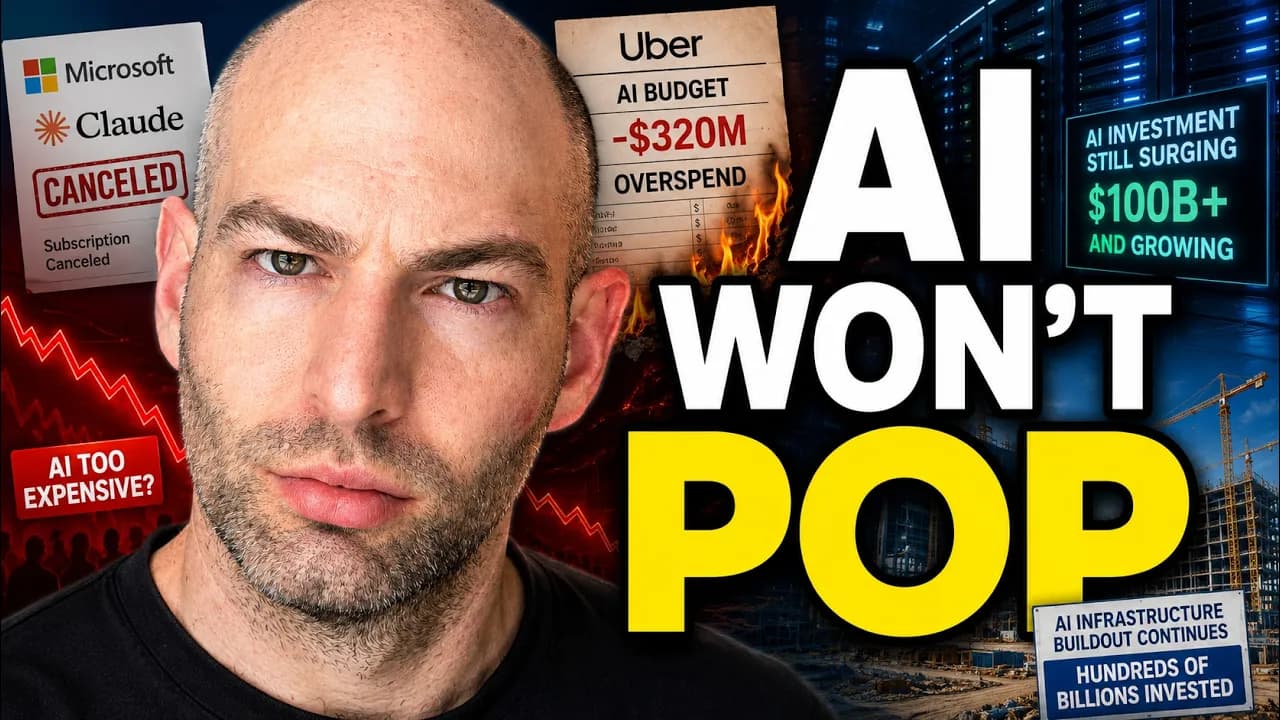
The AI data center buildout is the second-largest mega-project in history (behind only the Marshall Plan), privately funded like railroads, creating durable 50+ year assets unlike depreciating tulips or bubbles—GPUs resell and generate capex/opex returns, with local zoning handling noise/pollution without needing moratoriums. Critics like Cal Newport, an ivory-tower academic without industry experience, rely on outdated studies (e.g., MIT's 95% AI pilot failure rate, common for all tech; Daron Acemoglu's 20% task impact on pre-GPT-4 models) that lag 2-3 years behind real-world 10x+ productivity gains from frontier AI, as seen in industry anecdotes over flawed data. Current AI capabilities shine on YouTube/TikTok/Reddit, not academic papers; prioritize power-user experiences like parallel AI chats for research/modeling over skeptic narratives.
These notes were generated by AI and may contain inaccuracies.
Audience questions center on confusing information about data centers, AI bubble, and jobs. Focus on two areas: concrete data centers and narrative from Cal Newport.
Data center buildout, adjusted for inflation and as percentage of GDP, is the second largest mega project ever, bigger than everything except the Marshall Plan. It is the only privately funded one. Other mega projects: Manhattan Project, Apollo program, interstate highway system—all state-sponsored.
High private investment prompts bubble accusations, unlike government projects like Hoover Dam or space program (which faced protests as misallocation but not bubble claims). Railroads were a massive private buildout, took 15-20 years to cover costs and operate at sufficient margins.
Data centers last 50+ years as capital assets that appreciate like real estate. Distinguish from GPUs: GPUs depreciate but don't become worthless in two years—they work, can be resold, and are tax write-offs (amortized expense). GPUs pay for themselves via capex/opex benefits.
Investments create durable financial assets: Marshall Plan, interstate highways, railways, Internet buildout (overbuilt in dotcom era, companies failed, but full use came after 10-15 years; no 'Internet pause' from 2003-2012—e-commerce grew productively). AI buildout unlike tulip mania (tulips have no intrinsic value, expire quickly); capitalist buildouts yield useful assets.
Data centers are specialized warehouses with triple-redundant power. High-performance ones produce more noise/exhaust than older ones. Local zoning laws address impacts (decibel limits, environmental output)—exist to separate polluting industries from residences, as in early industrial revolutions (e.g., mercury factories). No need for statewide/federal moratoriums; use permitting and local elections/town councils.
Cal Newport: popular tech/business writer, writes in erudite academic style convincing to educated audiences. Never worked in private industry or offices he criticizes—went straight to higher ed/ivory tower. Right on some points (e.g., open office plans toxic, disliked except by extroverts appearing busy). Lacks lived industry insight.
American academia favors studying at arm's length for objectivity, avoiding subjective immersion. Valid for sociology/anthropology (e.g., outsiders notice cultural blind spots like Americans' trash food or Vietnamese norms). But academics like Newport, David Graeber (Bullshit Jobs, Debt: The First 5,000 Years, The Dawn of Everything) err by relying solely on books, science reports, randomized controlled trials—ignoring industry experience, modern experts.
Newport cites MIT study: 95% of AI pilots fail (most tech pilots fail—that's their point). Concludes AI is a nothing burger, questions cybersecurity experts via outdated studies. Studies use models 2-3 years old (GPT-3.5, Llama 2), confidently claim AI can't do X/Y/Z.
Example: Daron Acemoglu says AI does 20% of tasks—based on GPT-4, pre-reasoning, pre-GPT-4.5/GPT-5 era. Academic structural issues: 2-3 year paper publication lag; small budgets use cheap/non-frontier models. Professors/students contact influencers for real-time updates since papers are irrelevant/outdated.
If not actively in industry, credibility low on AI predictions. Academics dismiss power users (10x-100x productivity) as outliers (e.g., ignore Andrej Karpathy). Studies flawed: e.g., engineers 20% slower/more bugs with AI in familiar codebase—ignores onboarding friction; not real test of zero-to-product time.
Anecdotes trump data at cutting edge (Jeff Bezos: when anecdote disagrees with data, go with anecdote). Speaker personally 10x+ productive daily (learning, reading, research, modeling) via 10 parallel AI conversations, leveraging ADHD switching. Professors hide productivity gains to avoid alienating peers; students coerced against AI use (plagiarism fears), though some professors mandate it.
Ivy League/tech school papers (even MIT) lag 2-3 years behind Silicon Valley/social media pace. YouTube/TikTok/Reddit more current on AI capabilities than ivory tower publications.
Keep David Shapiro in your library
Save the videos and channels worth coming back to, and find them again in one place.