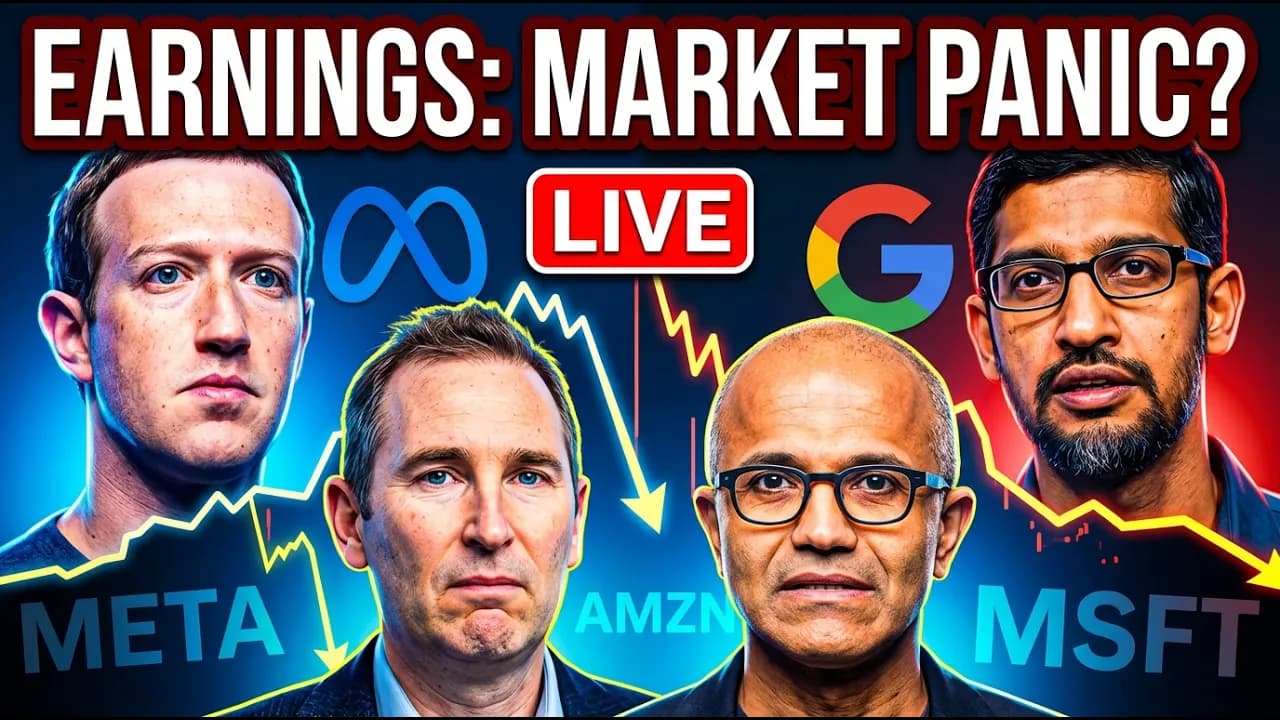
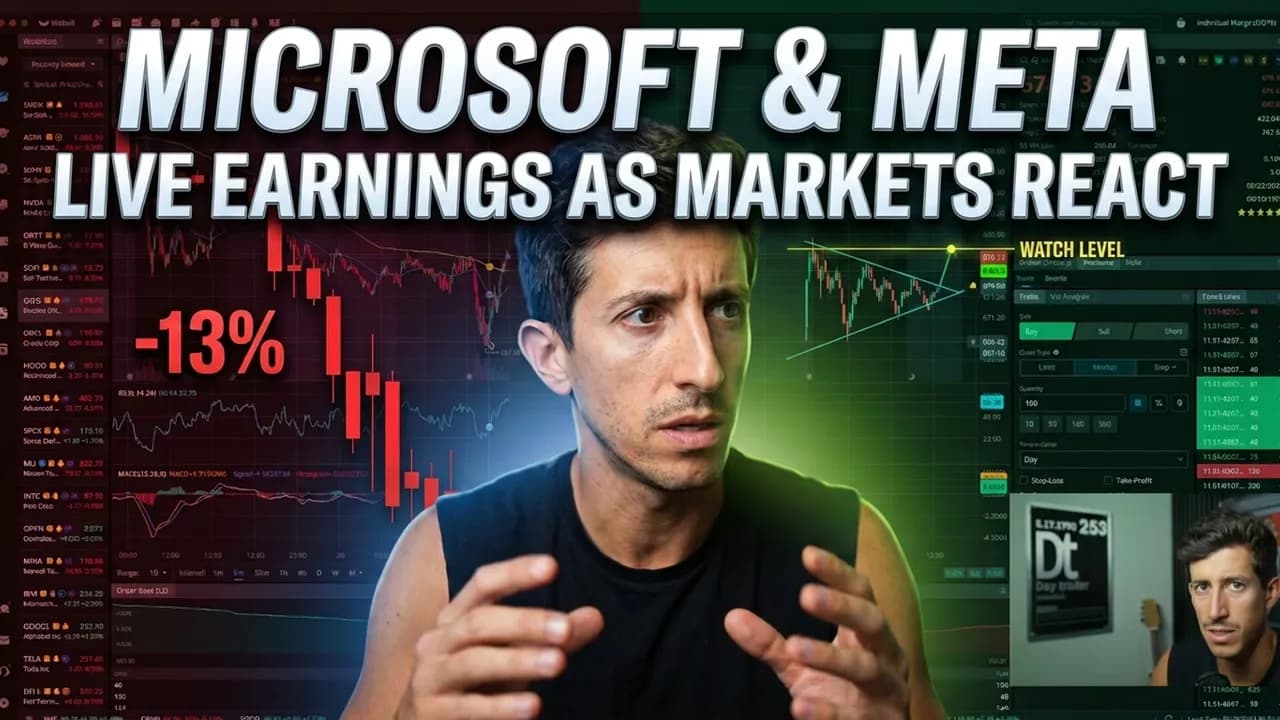
Why Did $META Crash 10% After Reporting Earnings?
In a Nutshell
Meta crashed 10% post-earnings because investors feared its massive AI capex spending without 2027 guidance, despite beating revenue and delivering strong ad metrics. The EPS miss was from one-time legal/severance charges, not operations. Meta's core bet is that overinvesting in AI now outweighs the risk of underinvesting, and investors must decide if they agree or see this as wasteful spending.
These notes were generated by AI and may contain inaccuracies.
Meta stock crashed 10% after reporting earnings, dropping from nearly $600 per share to lows of $518 before recovering to $546. The sell-off occurred shortly after the FOMC press conference as markets began a V-shaped decline, with QQQ down 2% on the day and another 0.5% in aftermarket hours.
Meta did not report terrible earnings. The company missed earnings per share expectations but beat revenue. The EPS miss resulted solely from legal and severance charges. Without these charges, Meta would have delivered a significant beat. Average price per ad and ad impressions both increased 12-14%.
Capex guidance was slightly narrowed, representing one of the largest concerns for investors. Meta provided no 2027 capex guidance, which investors interpreted as unwillingness to disclose potentially larger AI investment numbers. Markets dislike uncertainty, particularly when stocks trade at premium valuations. The failure to disclose guidance that Meta had previously provided created investor disappointment.
Microsoft provided a contrasting example by beating both EPS and revenue expectations while leaving 2026 capex guidance unchanged. Microsoft indicated it would remain free cash flow positive without aggressive AI spending. Markets reacted positively to this approach. Wall Street appears to dislike high capex spending, making this a key distinction between the two companies.
The MAG7 companies (excluding Tesla) trade at relatively low P/E ratios despite strong fundamentals. Meta generates $215 billion in revenue and $70 billion in net income, positioning it as a money-printing machine rather than a speculative stock. Meta, Nvidia, Microsoft, and Google represent fundamentally strong value opportunities at current valuations.
Meta's aggressive AI investment exceeds short-term returns, creating the core investor concern. Mark Zuckerberg has stated that the risk of underinvesting exceeds the risk of overinvesting, preferring to overinvest to secure Meta's position among top AI players. Previous Meta investments in Metaverse, Oculus, and goggles demonstrate both successful and unsuccessful outcomes from this approach.
Investors must decide whether they believe in AI overinvestment or view it as wasteful spending. Those bearish on Meta's AI spending have valid reasons for their position if they believe the AI boom represents a bubble. The current correction reflects investors beginning to derisk their positions. Those bullish on AI have corresponding reasons to remain bullish on Meta.
Meta can be purchased at approximately $546 per share following the gap down, with potential for further selling as Apple and Amazon report earnings. The current volatility represents short-term market reaction rather than fundamental change. Meta remains a fundamentally strong company despite the temporary uncertainty around AI investment levels.
Keep Ricky Gutierrez in your library
Save the videos and channels worth coming back to, and find them again in one place.