Why Secondary Markets Are Eating the IPO | All-In Liquidity Secondary Markets Panel
In a Nutshell
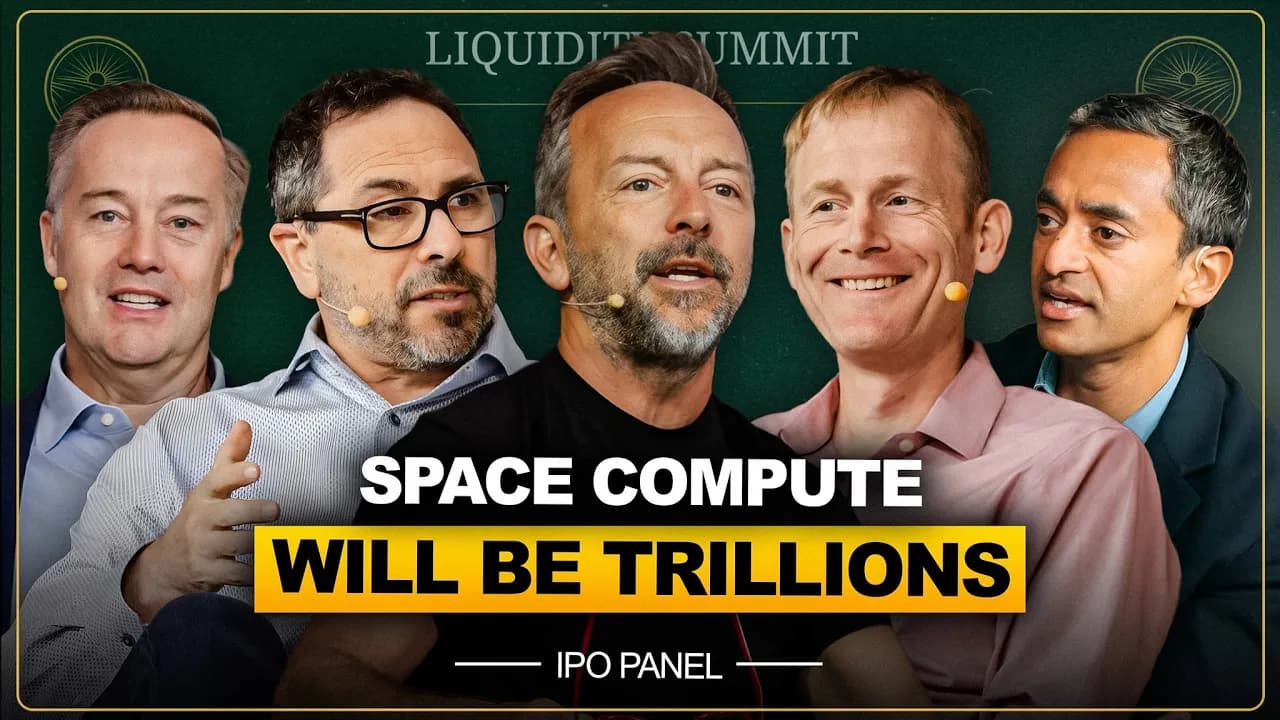
Panelists argue that secondaries have become the dominant liquidity path for late-stage private companies, now representing 31% of venture activity and trading at a 106% premium after years of discounts. This shift benefits employees and founders by providing cash without IPO pressure, while platforms like Forge and Schwab are opening access to retail investors through SPVs and interval funds. However, speakers warn that valuations are fully priced, late entrants risk becoming exit liquidity for mega-cap names, and durable returns will favor early, disciplined access to sub-$50B companies with real traction.
These notes were generated by AI and may contain inaccuracies.
The panel discusses private markets and secondary liquidity. Kelly Rodriguez, Forge CEO, states: "We see a world where the private market opens up and is accessible to any US and global investor." Nineteen companies in the private market AI basket have grown on average 300%. Gavin Baker, managing partner and CIO of Atreides, notes the ROI on AI has been positive. Brad Gerstner references the Invest America program, stating there is a historic moment to get everybody into the game of capitalism.
Brad presents slides showing VC capital flows over the last decade. The red line represents net effect where more capital has gone in than come out for approximately five years. Secondary market volume is at record levels. Later-stage companies are described as "quasi public companies" with daily buying and selling. Secondary transaction volume is now double the 2021 peak. Employee secondary activity is increasing. Secondaries now represent 31% of all primary venture activity in 2025. Secondaries compete with IPOs and acquisitions as principal exit mechanisms.
Secondaries traded at a discount to market in recent years, with buyers paying 80 cents on the dollar. Current pricing is at 106, representing a premium. This data excludes SPV activity including structures charging 10% load-in fees and double carry. The panel discusses impact on employees at companies like SpaceX, which runs orderly liquidity programs.
Gavin Baker discusses how companies staying private longer creates situations where employees are wealthy on paper but cash poor. This creates hardship after making sacrifices for seven, eight, nine, or fifteen years when employees cannot buy homes or afford nice things despite paper wealth of $10-30 million. Gavin states this liquidity is necessary and important given that companies will stay private longer.
Founders prefer staying private to avoid being under a microscope. Gavin notes there is a perception that private company life is easier with more freedom and ability to think long-term. Gavin disagrees with this perception. He references Mark Zuckerberg's comments about Facebook's internal debate between building apps versus pursuing HTML 5. Zuckerberg stated that had Facebook been public, the constant pressure testing from public market investors would have led to different decisions. The delay in going public made a significant difference in strategic outcomes.
Private investors often sell to management teams and may tell management what they want to hear to maintain access to future rounds. Public markets allow investors to buy or sell freely without this dynamic. Gavin notes that as a private company CEO, one is treated as the most special flower by investors and board members. Once public, the company becomes one of thousands. Exceptional CEOs like Elon Musk seek negative feedback, but most are not wired this way. Kelly Rodriguez notes the sycophantic nature of private markets is real.
Kelly Rodriguez was a private company CEO for most of his career and public company CEO for three years. He states the public company job is much less fun because the CEO becomes primarily an investment manager rather than a visionary product-first leader. Kelly notes SpaceX has been private for 24 years and has run liquidity programs for nearly a decade due to pent-up investor interest. Forge's deal with Schwab puts private company equity into well-managed, regulated SPV structures.
Kelly states Schwab represents 46 million investors and $12 trillion in assets. The pitch to companies is that this changes capital access and distribution when moving from private to public. Forge secured its first SpaceX SPVs in 2018-2019 with permission. As IPO approached, Forge discussed 30 million retail investors wanting $50,000 slices of SpaceX. Elon Musk publicly discussed broad-based distribution at IPO price, and Schwab was named for IPO allocations.
Brad Gerstner discusses the go direct movement and need for measured approach. He states concern about retail investors being told to YOLO into double fee structure SPVs. The goal is durable democratization built on trust. Brad notes 80% of America thinks private value creation is a scam where they are left out. He advises against putting all fresh capital to work after two of the biggest months in public markets, suggesting putting 30% of a $100,000 stack to work rather than 100%. He warns against blindly following trades into late-stage privates.
Brad states his firm is selling into the secondary market to generate DPI for LPs who invested in VC5, VC6, VC7, or VC8 seven or eight years ago. Venture capitalists traditionally think only about buying, not selling. With trillion-dollar private companies and Databricks at $200 billion valuations, VCs must consider when to sell and return capital to investors. Gavin notes selling in private markets requires conversation with founders who never like it and prefer it not be known. Public market sales are visible through 13F filings.
A third exit path exists beyond M&A and IPOs through secondary markets. Early-stage investors are now pari passu selling alongside founders at every opportunity. One investor's average investment entry is at $10-20 million valuations. The strategy is to begin selling at $500 million valuations alongside founders to recycle capital into next investments. Six or seven years ago, founders begged investors not to sell at peak valuations in 2021, citing loyalty concerns.
Kelly Rodriguez states Forge spent the last three years building a new platform so companies can plug in like listing on an exchange to offer liquidity. VCs on cap tables for ten years can offer LP liquidity through the platform. Forge brought a platform with about 3 million investors and is adding Schwab's 46 million investors. Today, trading individual shares in SPVs or directly requires accredited investor status. Products coming to market include interval funds and closed-end funds with 60 companies including SpaceX, with $500 minimums for unaccredited investors.
Closed-end funds are described as betting on FOMO because underlying asset values often have no bearing on reality of what shares are actually worth. Price discovery is a key component of the structural shift. Platforms allow VC LPs to recycle capital and put it back into next vintage funds.
Mean returns in venture will look incredible due to exposure to trillion-dollar companies, but median returns remain low. Firms without material exposure to these large companies face franchise risk as their DPI and returns will not be competitive. Some firms are writing call options on companies like Neuralabs out of desperation. Firms with exposure are being more disciplined. Long-only mutual funds can allocate up to 15% to privates per SEC rules but typically self-cap at 3-5-7%. Baillie Gifford was forced to sell SpaceX last year for regulatory reasons. When companies go public and lockups expire, they move out of the private allocation bucket, creating hundreds of billions in new late-stage demand.
The SEC chair discussed a sophisticated investor test that would democratize access. Kelly Rodriguez is asked about possibilities for venture funds being more tradable like secondaries. The discussion cuts off mid-sentence regarding what this would mean for LPs of funds managed by Brad, Chamath, and others if they could come in and out of funds the way
Secondary fund trading has existed for a long time, but blockchain and tokenization will make it more efficient. The key question is whether LPs in a fund holding valuable assets want to trade their entire fund position or simply exit the big winner within that fund. The view is that LPs are more likely interested in exiting the standout name rather than trading the full fund position.
Funds sometimes approach with vintage funds containing two companies that are 15 years old where they cannot clear the fund. This represents an application of liquidity to the market that is coming.
There is discussion about whether retail investors will serve as exit liquidity for three enormous companies and how to bucket and manage that risk. Valuations and multiples are being watched closely, with terms like "extraordinary" used as coded language for bubble conditions.
The retail investor entering this space should look down market at interesting opportunities that are not constantly featured on CNBC and gain access earlier. Retail investors who entered SpaceX in 2018 and 2019 at a $30 billion valuation are thrilled with their entry point.
When the market opens up, the focus should be on what to get into now that is not at the very top of the market preparing to go public.
IPO pricing has improved, with companies generally fully valued when they go public, though some remain massively mispriced. There have been cases where companies declined after going public.
After 25 years in the business, there are moments when public markets are undervalued relative to privates and moments when privates are undervalued relative to publics. Currently, everything in technology is pretty fully valued. Parabolic moves indicate things are not cheap, though this does not preclude further upside.
Technology has been a jagged line up and to the right over the last 15 years. Retail investors with staying power who can remain in a product through drawdowns will do fine. The problem is most retail investors yolo at the top when excited, often using 2x levered memory trades.
There are 14 ETFs launching on the day of the SpaceX IPO that are levered ETFs into SpaceX at approximately 1.75 trillion valuation. This signals that while the market may not be at the top, it is not at the bottom either.
Active management requires allocating accordingly and thinking about when people are panicking. When the market dropped at the start of the Iran war, the focus was on Anthropic revenues being off the charts and adding more dollars at risk to both Anthropic and public market stocks.
Current market moves are extremely concentrated in time, with a year or two of moves compressed into 30-60 days. This is nothing relative to 1999 and 2000, which was described as Vegas on a Friday night after way too many drugs. CMGI had no revenue yet its stock went from $2 to $2,000 over six months, bought Foxboro Stadium, appeared on the cover of Time magazine, and was out of business two years later.
The better comparison is 2021, where valuations got ahead of themselves. A normal 10-20% consolidation in public markets could mean high beta names down 30-40%, causing panic among those who just entered while longer-term holders would see it as a blip.
Excluding the top 10 private companies, panelists were asked to name a sub-$50 billion private company in the tens to few hundred billion range where they would want to buy a secondary position they do not currently own.
Brad highlighted the inflection growth category of companies over $3 billion but sub-$50 billion as the trickiest area of the investing landscape. These companies benefit from high valuations yet still carry binary risk, unlike Anthropic, OpenAI, and SpaceX.
Sierra, Brett Taylor's company, was mentioned as building Salesforce agent-native solutions for sales, marketing, and customer service. The downside risk is that OpenAI and Anthropic could eviscerate their hundreds of millions in revenue by entering the space directly. The upside is that these businesses have already built sophisticated agentic layers that could attract acquisition interest from Meta, Google, or others seeking to accelerate their agent capabilities.
Parlo, a European company in the same space, was also noted as interesting.
Revolut was highlighted after a compelling pitch. The speaker had previously owned Coinbase and Robinhood but had ignored fintech until hearing the Revolut case. Revolut is a neobank with a completely next-generation stack that rebuilds banking in the modern era and unbundles incumbents. This model has significant legs in a regulated market.
Revolut has tens of millions of customers, 14 lines of business, and is doing well in Europe while coming to the United States. The founder is viewed as an absolute star.
Arya and Driveets were mentioned as public investments in the networking space. As data centers become more specialized and complicated, increasingly specialized chips are needed. The disaggregation of inference, pre-fill, and decode requires chips to work together like a symphony, with the right chip for the right job at the right time. Reinventing networking is necessary, and these companies approach it differently.
There is an impending super cycle in infrastructure networking and silicon.
Neuroobotics, a European company in Germany, was highlighted as an AI-powered logistics robotics business. It is a quiet company with big investors, $100 million in revenue, and performing strongly outside the main Silicon Valley high-value real estate.
Vast was mentioned in connection with what Elon is helping put into space as launch costs decline. Direct investment was made on the cap table and through an SPV, with the belief that Vast will win in building space stations.
Zipline was discussed as Uber 2.0 in the drone delivery space. The thesis is that taking delivery costs from $15 to $5 and eventually $2 will drive consumption massively, and this will happen in the air. Drones had a false start that caused everyone to abandon the sector, but now the technology works.
A key innovation is that the drone stays up in the air and drops a tether with the box. The recipient grabs the tether and pulls it down rather than requiring the drone to land with spinning blades.
Zipline has had a huge impact on health outcomes in African countries by delivering medicines to small villages. The company focused on maternity care and cut maternal mortality rates by 90-95% in some countries. In villages with one midwife, an app allows pressing a button when a woman goes into labor, and an hour later a Zipline drone drops a refrigerated package containing modern medicine, blood, and supplies.
Zipline operated in Africa for seven years before coming to America. The hard part of making autonomous systems work is getting them into the world to gather real-world data, which is essential for AI. Getting approval to fly autonomously in American airspace is difficult, so starting in African countries allowed the company to build operational experience.
The investor initially turned down the seed round because the firm did not invest on that continent, lacked insight, and viewed hardware as hard. After staying in touch and learning from late-stage investing examples, the investor was able to participate and correct the earlier decision.
Keep All-In Podcast in your library
Save the videos and channels worth coming back to, and find them again in one place.