Why The Middle Class Is Financially RUINED
In a Nutshell
The middle class is shrinking from 60% in 1971 to 50% today, with savings at a dismal 4%, 27% lacking emergency funds, and over half living paycheck-to-paycheck—even high earners—due to stagnant median income ($85K), soaring housing costs (median home up 28% to $450K), and a 2026 perfect storm of energy shocks, tariff inflation, and a frozen job market. Homeownership, key to wealth (homeowners 44x richer than renters), is delayed to age 40 amid doubled mortgage rates, fueling financial nihilism and declining upward mobility. Counter it by targeting 15-20% savings, building a $1,000 emergency fund, paying off high-interest debt first, adjusting homebuying timelines, and sticking to boring basics like dollar-cost averaging investments over risky moonshots.
These notes were generated by AI and may contain inaccuracies.
Personal savings rate has fallen to 4%, smallest since before 2008 financial crisis. 27% of Americans have zero emergency savings, highest ever. More than half the country lives paycheck to paycheck, including those making over $100,000 a year. Middle class about to get screwed in 2026. People quietly falling behind despite doing everything correctly on paper. Need to act today to avoid traps.
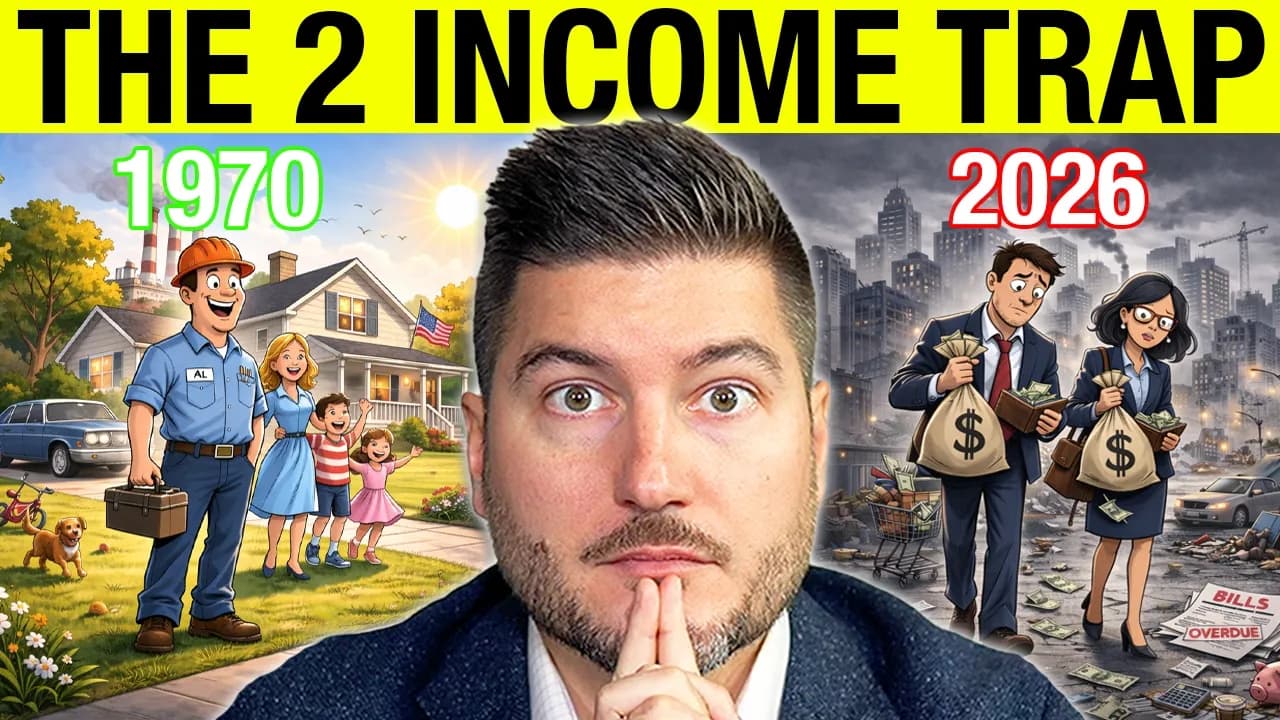
Headline: middle class disappearing. Middle class defined as household earning between 2/3 to twice median income. Typical American family earns $85,000, so middle class $56,000 to $170,000. In 1971, over 60% middle class; today 50%. Higher income households increasing, middle class total income decreasing. Fewer people in middle; top doing better, others fighting for smaller pie. Median income in 2024 same as 2019; treading water, stimulus used up.
Wealthy have disposable income to invest; asset prices rise, they capture gains. Richest 1% make twice as much as rest of world.
Energy Shock
International conflict caused oil prices to exceed $100/barrel most of year. Energy prices up over 10%, gasoline over 20% in one month. Pushed inflation to 3.3%. Housing 35% of inflation report, still rising while others come down.
Tariff Inflation
Goldman Sachs estimates tariffs push inflation up 1% through mid-2026.
Frozen Labor Market
2026 jobs market looks okay: layoffs low, unemployment 4.4%. But February lost 92,000 jobs, weakest in years. Fewer quitting due to fear of not finding new job. Companies not firing or hiring; frozen. Opposite of healthy economy where people switch jobs, negotiate salaries, move up.
1960: saved 10%. 1970: 12.8%. 1980: 11%. 1990: 8%. 2000: 4.7%. 2005: 2.9%. Now 4%, fallen off cliff post-2020 lockdown. Official rate excludes retirement, capital gains. Still, 27% no emergency savings (highest ever), 59% can't cover $1,000 without debt, 42% middle-class households can't cover $5,000 and recover. No cushion left as uncertainty rises.
Median home price since 2020: $317,000 to $450,000 (28% increase in 6 years). Mortgage rates doubled 3% to 6%. Need $120,000/year to qualify for median home vs. typical $85,000. Median first-time buyer age now 40 (was 29-31 decade ago). Renting cheaper short-term, but homeownership primary middle-class wealth builder. 2022: homeowners median wealth 44x renters; even without home equity, 17x greater.
Delaying purchase delays equity, appreciation, compounding. Gap between asset owners and non-owners grows.
Financial nihilism: economy no longer rewards rules (live below means, save 15%, index funds) yet can't buy house until 45. 73% risk money because no other option (2026 planning study). 50/50 shot of doing better than parents today vs. guaranteed in 1940s. Declining upward mobility unprecedented. Leads to bigger risks, higher chance of falling behind.
Counter: Brookings Institute says middle class increasing. Bottom quintile 25% more income 2007 vs. 1979 (gov transfers, health insurance, smaller households). Middle class shrinking because moving to upper class. US smallest middle class among similar nations but largest affluent and poverty classes; barbell distribution.
Real issue: investment gap. Investors make more, take risks with reserves to hold through fluctuations. Paycheck-to-paycheck can't risk.
-
Face savings rate: national 4%, aim 15-20%. Review expenses, cut non-essentials starting with housing, transportation.
-
Build $1,000 emergency fund. 59% can't cover; avoids 22% credit card debt.
-
Pay off credit card debt first: 20%+ interest is guaranteed return over any investment.
-
Adjust homeownership timeline: median buyer 40. Use time to increase income, reduce debt, invest consistently, save. Renting may be cheaper short-term.
-
Stop confusing desperation with strategy. Avoid moonshots; markets profit from them. Boring strategy: save extra, dollar cost average, invest consistently works long-term.
Middle class disappearing because income growth, housing, cost of living moved opposite directions; people not adapted. Get squeezed slowly: earn more but costs rise faster. Lower expenses, live below means, invest consistently, dollar cost average. Boring basics work with higher success likelihood than moonshots. Still in your control for 2026.
Keep Graham Stephan in your library
Save the videos and channels worth coming back to, and find them again in one place.