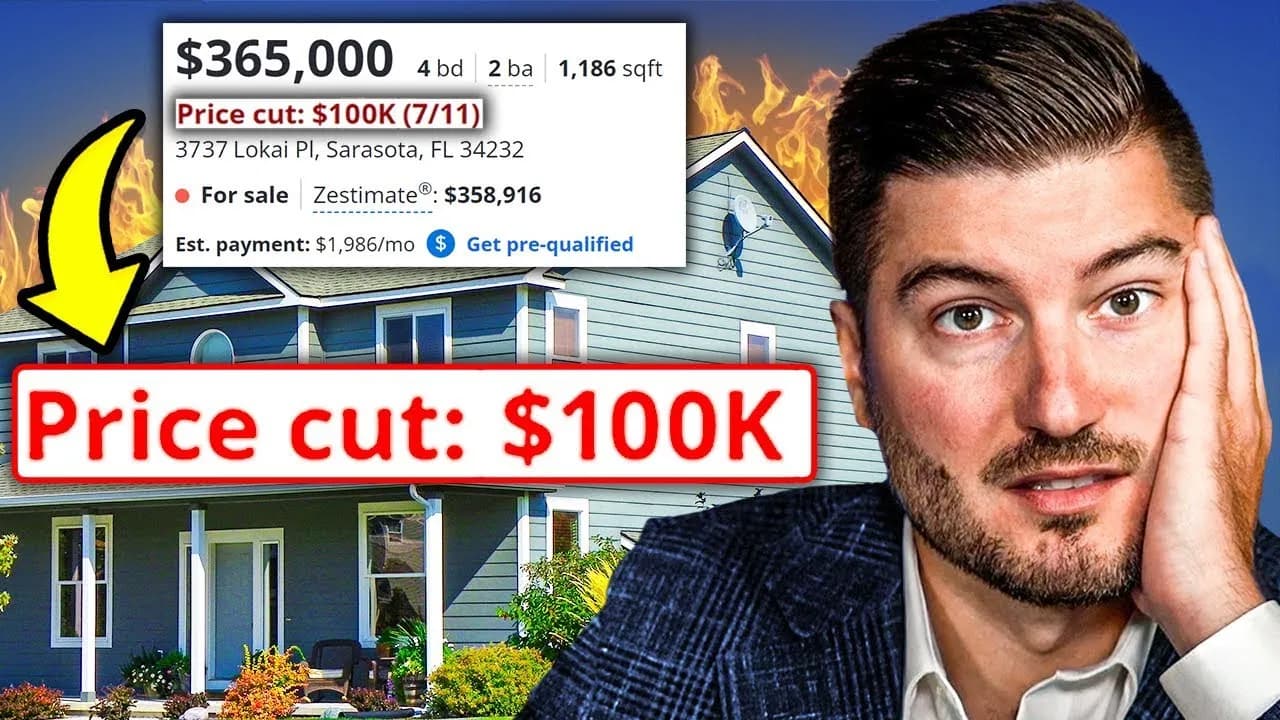
WTF Is Happening To The Housing Market?!
In a Nutshell
Morgan Stanley warns the housing market is resetting to permanently higher prices rather than crashing, as the lock-in effect keeps 70% of homeowners with sub-5% mortgages from selling and inventory remains frozen at 40-year lows. This creates a structural affordability trap where today's conditions—higher rates, tighter zoning, rising insurance, and stagnant wages—represent a new normal, not a temporary imbalance. The consensus is that buyers should stop waiting for 30% price drops and instead buy only if the numbers work for 7-10 years, since 2026-2027 will likely bring flat-to-slightly-rising prices around 5% mortgage rates.
These notes were generated by AI and may contain inaccuracies.
Morgan Stanley warned that the housing market is entering a total reset rather than experiencing a 2008-style crash. The new housing market features mortgage rates staying higher, affordability failing to recover, inventory remaining locked, and prices never falling enough to save the average home buyer. This means the crash many have been waiting for might not occur, and by the time this is realized, the opportunity to buy may already be gone.
Morgan Stanley periodically releases home price forecasts twice a year based on data trends and prices analysis. Their latest research indicates the housing market will no longer break in the sense of a 2008 crash, but instead enter a reset where prices keep going higher and stay there. The 30-year mortgage rate is currently at 6.5%, which is a 7-week low. The median home price reached $429,000, up 1.3% from a year ago. Housing affordability continues to worsen due to the lock-in effect.
Approximately 70% of homeowners have mortgage rates below 5%, and half have rates below 4%. This creates no incentive for homeowners to give up sub-4% mortgages for rates that would cost 50% more. Housing turnover is at the slowest rate in 40 years and has remained unchanged for 11 straight quarters. This creates a paradox where demand is weak due to unaffordability while supply is equally weak because no one wants to give up cheap mortgages.
Harvard released research confirming that the housing market is in a state where the conditions most Americans grew up believing were the norm may have been a one-time exception. After World War II, 16 million veterans returned simultaneously, prompting the government to use the GI Bill to provide homes with little to no money down, low interest rate debt, and federal backing. This created perfect conditions with cheap land, cheap debt, massive government support, fast construction, rising wages, and millions needing stability.
Today's conditions are the opposite of the post-WWII era: mortgage rates are higher, construction is slower, zoning is tighter, insurance is more expensive, and wages have not kept up with prices. Homeownership is becoming less like something earned through income and more like something passed down through inheritance. The housing market is shifting from those who work their way in to a system where one must already have help, already own, or fall further behind.
SoFi offers an everything app for smarter money management where users can bank, borrow, and invest in one place. Opening a SoFi checking and savings account with direct deposit enabled allows earning competitive APY with no account fees. New high-yield savings account holders with $1,000+ direct deposit receive either a $50 or $400 cash bonus. Users get paid up to two days early with direct deposit and access additional FDIC insurance up to $3 million through a network of participating banks.
Morgan Stanley predicts five key outcomes for the housing market. First, prices stay high because there's not enough supply and homeowners aren't stressed enough to sell, while prices don't skyrocket because affordability is already constrained. Second, the new equilibrium means the market has reset to a world where everything costs more and people must adjust, with 5.5% mortgages potentially feeling cheap compared to 6.5%. Third, increased rentals will occur as people locked out of buying shift demand to apartments, build-to-rent communities, and existing landlords. Fourth, the supply problem persists because even if affordability improves, it doesn't fix permitting, zoning, insurance, construction, labor costs, and land prices. Fifth, the chain reaction affects the entire economy as frozen housing markets lead to reduced spending on furniture, appliances, renovations, and related services.
Zillow's latest forecast predicts slight price declines in some areas like California, Florida, and Texas, while East Coast markets may see prices continue higher due to lower starting points. Realtor.com expects no major price correction but projects typical houses reaching $1 million by the time millennials reach retirement age in 25 years. CoreLogic anticipates 5.1% year-over-year national home price increases due to pent-up demand. Fannie Mae's three scenarios project home values rising between 5.3% and 21.6% through 2030, with a base case of 13.6% growth.
The general consensus expects 2026 and 2027 to feature sluggish sales with prices staying flat or increasing 1-3% depending on the area. When interest rates eventually decrease, more market activity may occur but could push prices higher. Long-term, home prices are expected to regain their average 1-3% annual growth, with mortgage rates settling around 5%. Even if homes appreciate 3% annually, inflation at 5% would result in a 2% real value loss.
The assessment concludes that Morgan Stanley and Harvard are likely correct, with housing prices unlikely to crash without a massive economic depression. The market is resetting to a higher and more expensive new normal. Recommendations include not waiting for a housing crash, as 30% drops are unlikely. If numbers work on a home that can be comfortably afforded for 7-10 years, purchasing is reasonable. Refinancing should be considered if rates drop later. Renting is acceptable if it costs less than buying and the difference can be invested. Homeownership is not necessarily required for long-term wealth building, and decisions should be based on current numbers rather than past conditions.
Keep Graham Stephan in your library
Save the videos and channels worth coming back to, and find them again in one place.