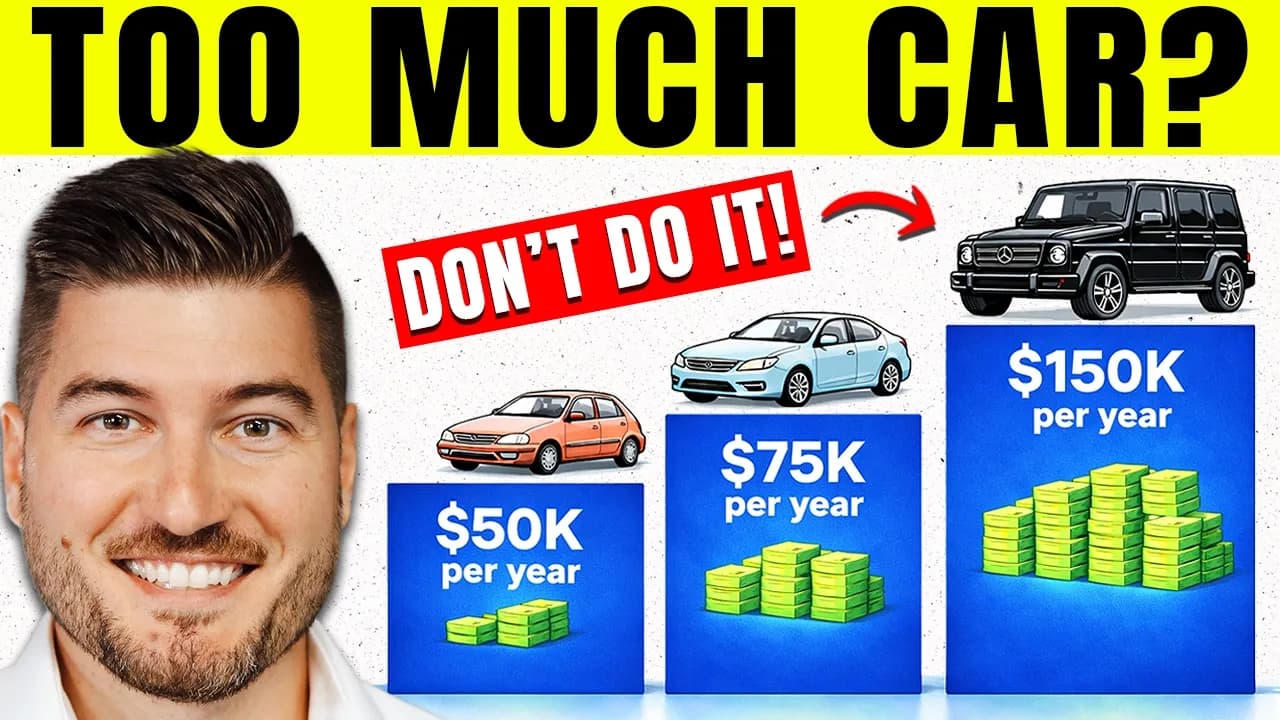
Your Car Payment Is Stealing Your Retirement (The Math They Don't Show You)
In a Nutshell
New car payments averaging $800/month over 7 years represent a massive wealth destroyer due to rapid depreciation (25% in year 1, 50-60% by year 5), hidden costs like interest ($9k+), insurance ($10k+ over 5 years), and maintenance, totaling $64k net for a $40k vehicle after resale. Buy reliable 3-5 year-old used cars (32% cheaper) from brands like Toyota/Honda to avoid the depreciation cliff, follow the "238 rule" if financing (20% down, ≤36 months, ≤8% of gross income), and drive 10+ years. Invest the $800/month difference in an S&P 500 index fund at 8% historical return to grow $2.8 million by age 65, turning "normal" car habits into retirement freedom.
These notes were generated by AI and may contain inaccuracies.
What if I told you that the single most socially accepted financial decision in America is quietly making millions of people broke? We obsess over $3 lattes. We cancel streaming subscriptions. We feel genuine guilt about $20 on takeout. But without blinking, we walk into a dealership and sign a contract for $700, $800, or even $1,000 a month for seven years, and we call it normal. Today, I'm going to show you the math that nobody at the car dealership 'stealership' will ever put in front of you. By the end of this video, the way you look at a car lot will be permanently changed.
A car is an asset. It shows up on your personal balance sheet and you can sell it for real money. The problem is not that it is an asset. There are two kinds of assets: assets that appreciate over time and assets that depreciate over time. A rental property usually appreciates, generates income, and historically increases in value. An index fund is an appreciating asset where compounding works in your favor for decades. A car is a depreciating asset with aggressive, predictable depreciation: about 25% in year 1. The moment you drive a new car off the lot, it loses value. By year 1, roughly 25% lost. By year five, 50-60% lost. Compare to a broad market index fund historically returning around 8% per year on average. One builds your future, one consumes it. That's why this is Grand Theft Auto.
Here's what makes the car uniquely dangerous: it loses value and demands resources every month—insurance, fuel, maintenance, registration, repairs. You are feeding an asset that is shrinking, like a financial black hole. Understanding that your car is a depreciating liability changes every transportation decision. Stop asking 'which car can I afford' and start asking 'how much depreciation am I willing to absorb and for how long.'
Nobody at the dealership shows you this graph. The moment you drive a brand new car off the lot, it loses 10-20% of purchase price. On a $50,000 vehicle, $5,000-$10,000 evaporates in under 60 seconds. Imagine a casino: you put $50,000 on the table, game hasn't started, dealer takes $8,000. You would walk out. But with a car, we do this voluntarily, celebrate it, post on Instagram. By end of year one, average new car loses 25% ($12,500 on $50,000). By year three, 50-60% lost. After year three or four, depreciation slows and flattens. The person who buys new absorbs massive loss so the next buyer gets it at a discount and rides the flat curve.
My wife and I buy used around years 3-5. We let someone else pay the first-year depreciation tax. We buy the same car, sometimes certified pre-owned, similar reliability, safety features, for a fraction of the cost. According to iSeeCars data, a three-year-old used car costs 32% less than new equivalent. On a $48,000 new vehicle, savings of over $15,000 for functionally identical transportation. This is the depreciation cliff.
You need a reliable car for family or work—missing work due to breakdown has real consequences. But the belief that you need new for reliability is a profitable myth. Reliability and expense are not the same. Consumer Reports reliability ratings (hundreds of thousands of owner surveys): most dependable vehicles are 3-5 years old. New vehicles are unproven; early production has bugs fixed by recalls and service bulletins by year three. Buy the last year of a generation, not the first. A three-year-old Toyota Camry with 40,000 miles is as reliable or more than new because it's proven, not a lemon. Toyota and Honda top long-term reliability. 3-5 year-old models from these brands are cost-effective proven transportation. Older Toyotas are fine; recent ones have recalls and feel junky. When you buy older, it's proven while someone else paid depreciation. Auto industry pushes 'new = safe, used = risky' for billions in revenue. Reliability is about brand, model, maintenance history, previous owner—not new car smell.
Scribe captures processes: hit record, do it once, it builds step-by-step guide with screenshots. Share link, export PDF, embed. Edit once, updates everywhere. 'Guide Me' walks users live on their screen. Used by over 5 million people. Head to scribe.how/marco.
Sticker price is not the cost—it's the entry fee. For $40,000 vehicle:
- Sales tax (national avg 7.12%): $3,000.
- Finance charge (~7%, 72 months): $9,000 (pure profit for lender).
- Insurance: new cars $2,000 more/year than used; over 5 years $10,000-$12,000.
- Fuel: 15,000 miles/year, 25 mpg, $3.50/gallon: $2,000/year, $10,000 over 5 years.
- Maintenance: oil, tires, brakes, repairs: conservatively $5,000 over 5 years.
Total: $79,000. After 5 years, car worth $15,000; net cost $64,000 ($13,000/year after taxes to move your body).
Negative equity trap: Most trade at year three on 60-month loan with little down—owe more than worth ($5-6,000). Dealer rolls into next loan. People carry ghosts of three bad trades. One fender bender or total: insurance pays market value, you hold deficiency.
Finance manager focuses on monthly payment, not total price, interest, or future value vs. owed. Uses 'four square': trade-in, vehicle price, down payment, monthly payment. Anchoring to monthly payment makes variables manipulable. Stretch $60,000 truck over 84 months at 7%: $850/month, total payback $76,000 ($16,000 interest). Worth $20,000 when title free (if you last), already in repair phase. Experian: average new loan 69 months (2024); 1 in 5 over 72 months—industry shift for max interest.
238 Rule if financing: 20% down, max 36 months, payment ≤ 8% gross monthly income.
Typical bad deal: zero down, 84 months, 15%+ of gross income—guarantees no wealth.
Real damage is opportunity cost—money destroyed by car payment instead of investing. Average new car payment $800/month ($730 per Experian, rounded up with insurance). At 25:
- Option A: New car every 5 years, finance, repeat to retirement.
- Option B: Buy reliable 3-5 year-old used (cash or near), invest $800/month in S&P 500 index at 8% historical. At 65: $2.8 million.
You're trading $2.8 million future freedom for new car smell—retirement at 55 not 67, college tuition, beach house. Requires one consistent decision early. See luxury SUV: driver signed away future for slightly newer car; investor at beach on bicycle.
Not telling you to drive embarrassing unreliable car. Current normal—financing depreciating asset at inflated price over 84 months, rolling every 3 years—destroys futures of hardworking people. It's normal decisions compounding against you, not lack of income. My wife and I drive paid-off cars; cash flow goes to real estate, market, saving for next car—most impactful boring decision.
Practical recap:
- Buy 3-5 year-old cars.
- Use 238 rule if finance, pay off fast.
- Drive 10 years minimum if possible.
- Invest the difference.
Whiteboard Finance University: courses on fundamentals, real estate, stocks; live trades, Thursday streams. Link in description.
Hey, if you really know what you're doing, you actually buy really nice cars and make money on them, but I decided not to mention that in the video.
Keep Marko - WhiteBoard Finance in your library
Save the videos and channels worth coming back to, and find them again in one place.