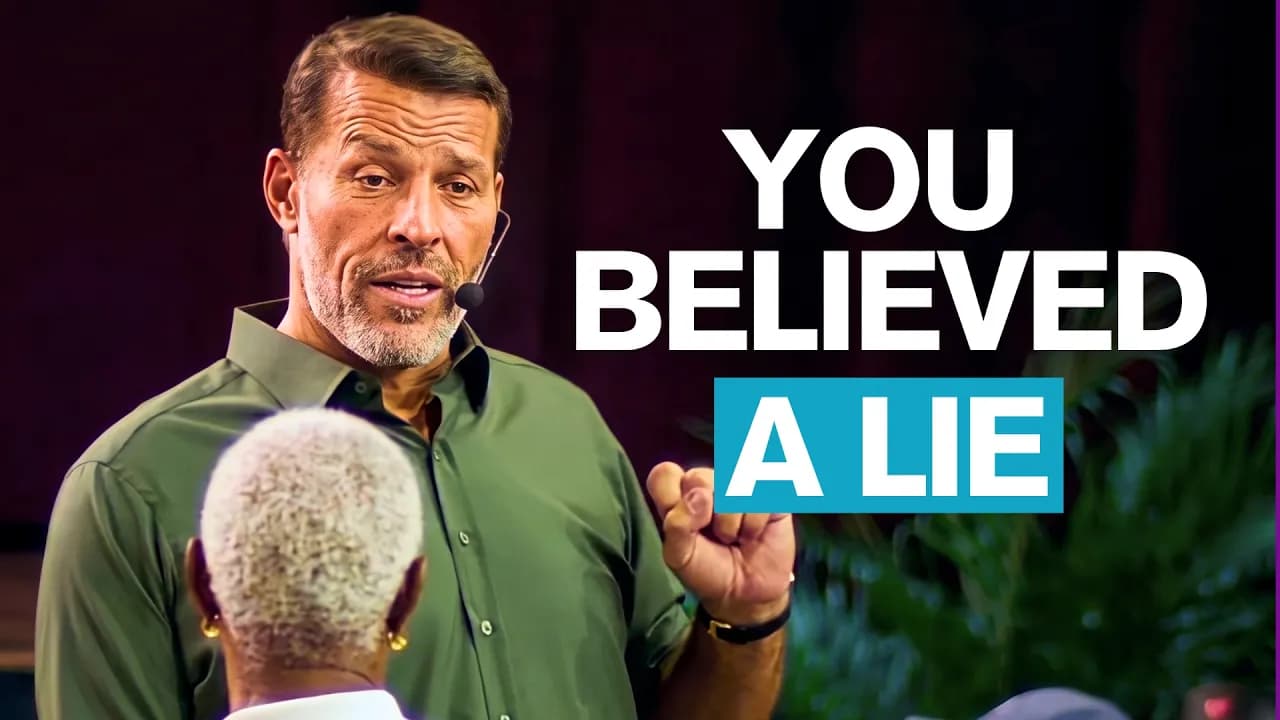
You’re Not Stuck. You’re the Problem. | Tony Robbins Full Intervention
In a Nutshell
Pixie’s core issue isn’t working capital—it’s her need for control, certainty, and significance rooted in past relationship wounds, which keeps her operating as self-employed rather than building a scalable, investable business. Tony shows that true growth requires releasing control, shifting from control to influence and trust, and aligning with partners or investors who bring complementary strengths. Until she stops protecting herself from vulnerability and starts focusing on others’ needs, neither her business nor her personal life will advance.
These notes were generated by AI and may contain inaccuracies.
There is no such thing as a business issue. It is always a personal issue. The chokehold on the growth of any business is the psychology and skills of the leader. Fear is the basis of all lack of progress.
Pixie is from Charleston, South Carolina. She is in business development focusing on distilleries. Business is good. The stated chokehold on growth to the next level is working capital.
Whenever someone has a limiting belief, approach with zero judgment. Many people hold beliefs they would have fought to defend ten years ago that now seem absurd.
Pixie has received investment offers but none at the price points or valuations she wants that recognize her value. She believes her business is more complicated than investors can understand. Her background in financial services causes her to emphasize risks so heavily that she talks people out of investing, even though she does not think the business is very risky.
It is not a working capital problem. It is a psychology problem. Her psychology is the need to protect investors at all costs. She is making the business too complex. It is not a business if it is not duplicatable; it is a job with a lot of risk.
Many people do not have a business; they are self-employed. Self-employed individuals get to call the shots and decide time, energy, and money allocation, but they remain operators, stay stressed, and never achieve freedom. They cannot sell the business because it is too complex or too dependent on them.
McDonald's does not make the best burger, yet it is the most successful company of its type because it built a system that anyone can join and operate. A business is a system of adding value. If there is no system that allows walking away, it cannot be sold and therefore is not a business.
Even if the owner does not want to sell, running the business as if it were scalable produces more profit, more choices, and more freedom.
Pixie runs a family business with nine children. Six of them run the distilleries as independent CEOs making operational decisions. Pixie handles rainmaking, building high-visibility brands, and negotiations. John Paul DeJoria is a friend.
Six people fell into Hoover Dam during construction and remain there. If you are not inside Hoover Dam, you are not stuck. The feeling of being stuck is pure psychology with nothing to do with the business itself.
The chokehold on growth is 80% psychology and 20% skills. Pixie built the business alone with no debt or investors and feels proud of this. However, no truly successful business of scale operates without investors or debt. Pride in having no investors keeps her thinking like an operator rather than an owner.
Pixie is scared. She fears losing control if she brings in investors. She has the illusion that she is in control. The need to control explains why she is alone. She values certainty and significance, which trap her. She connects with herself through pain, focusing on what she does not have rather than what she does have.
Pixie is not alone. She has six children running distilleries and nine children total plus five grandchildren.
There is no man in Pixie's life. This affects her significantly on a day-to-day basis. Business issues are always personal issues requiring internal shifts to reach the next level.
Fear is the basis of all lack of progress. Even fearless people discover fear when operating beyond their threshold of control because humans possess a two-million-year-old brain designed to look for what is wrong and fight, flee, or freeze.
Pixie fears losing control if she sells part of the business or takes investors. She is valuing certainty. Her pain story is that she has to do everything herself. She straps herself to the business and makes herself grow, but she gets tired of being strong.
Pixie worked extremely hard supporting a man, building a large business, having all the kids, and taking nothing. At the peak, he left. She feels she received no significance or recognition. She is angry about this history.
She knows what to do but is afraid to do it. She is living in the story of her past. The choices she made at the time fulfilled her on some level. She now has a family business she loves with children involved, yet she still carries the story of sacrifice and having nothing.
Pixie does not want to use her masculine energy all the time. She developed the masculine because circumstances required it. She has access to both feminine and masculine energies. However, she cannot be in control and maintain a relationship with a masculine man. This dynamic explains her being alone.
A masculine woman attracts a feminine man. Initial attraction may exist because she can control him, but eventually she loses respect and polarity. She then uses even more masculine energy.
Any person can access both energies, but each has a core. If the core is not respected, success still produces unfulfillment. Pixie's core is feminine, but she has been away from it. Feminine energy has more power when used properly. A truly happy feminine woman walking by can affect masculine men visibly.
Pixie is angry about lack of fulfillment and worried she will never achieve it. The business is clouded by personal issues. She is smart enough to solve the problem but resists losing control because she equates being out of control with pain.
The truth is that no one is truly in control. The most anyone has is influence. Getting great at influence creates the illusion of control. Even with children, full control is impossible.
The only way to grow a business dynamically is to release control. When the owner maintains control, they make all decisions. When mistakes occur, the owner takes over again. Growth requires allowing others to make choices and learn, even when outcomes are imperfect.
Pixie picks people she can control. Masculine men will not accept control. She has selected pleasers in the past and then resents them. There is a difference between pleasing a woman and being a pleaser.
True growth requires shifting psychology from control to influence, which is more collaborative. Pixie states she uses a partnership model, but reality shows she would accept partners only if she could control them. She talks investors out of deals partly because she does not want partners she cannot control.
Pixie wants to be huge. She wants additional capital to grow. She wants to feel validated enough to share her message with the world.
Wanting to be huge is driven by certainty and significance needs together. These two needs conflict. Doing something huge requires letting go of certainty and taking risks. One cannot keep one foot on first base while reaching third base.
Becoming huge will not resolve current doubts. The habit of thinking "I'm alone" will persist. Pixie started at roughly $10,000 in annual sales and now exceeds three million. Three million dollars places the business in the top 5% of all businesses globally.
Pixie pursues significance through size. Significance is never enough once achieved. The drive for more exists because humans are meant to grow. Satisfaction would stop growth. Growth enables giving beyond oneself.
Meaning comes from giving. Joy from food, alcohol, drugs, sex, success, or business alone has limits. When experiencing something great, the natural impulse is to share it with loved ones because human nature involves both growing and giving.
The woman is growing her business to be validated and feel significant after her partner left. She wants people to listen to her and prove her worth. Tony points out that no one listens unless you have something worth saying, and size alone does not create significance. Her business is already huge compared to most businesses. Her stated message is that through love and possibility, everything is possible, and partnerships are more important than anything. However, she is not living that message because she wants control rather than true partnership.
Her model is a cause marketing model in one of the most lucrative industries. She is an ordained minister running distilleries who does not drink. Every brand she launches uses a partnership model as a mini business. She is trying to figure out how to leverage the umbrella through franchising or selling off brands.
She admits she is afraid of failing. Tony notes that everyone has fear of failure, but not everyone is stuck. The difference is that she is afraid she will fail if she does not have control. She does not want to let anyone down and feels responsible. She also does not want to be let down by others because she feels let down by her former partner. Her former husband had different values than she did. The same level of thinking that got her where she is will not get her where she wants to go.
She is letting her wounds drive her instead of letting opportunity drive her. If opportunity was driving her, she would find partnerships, negotiate deals, and make things happen. She needs to let go of what happened with her former partner. It is over and she must stop the story and feeling sorry for herself about doing this alone. She chose him because she thought she could control him. She did everything for love and thought if she succeeded enough, he would love her more. As she succeeded, she became more masculine and he did not have polarity with her. They fought over control.
Tony explains that transformation requires specific elements. The first is satiation—things are going well but no longer reward at the same level. Life calls you to grow, and business is a spiritual game designed to make you grow because there is immediate feedback. You cannot fake it in business the way you can when meditating alone.
Most people will not grow with just satiation. She is satiated with doing business the same way, which is why she wants to change, but she is not executing. She is capable of making progress if committed. Life does not care what valuation you want—there is a marketplace value.
The second element is dissatisfaction—the same thing no longer feels good and becomes painful. This increases the drive to solve the problem. If dissatisfaction continues without resolution, it leads to the third element: an emotional threshold. This is when you realize something has been painful in the past, present, and future, and you finally make a move.
When you reach an emotional threshold, change becomes a must rather than a should, and you get an insight—a moment of truth. The truth has the opportunity to set you free, but there is one final piece. When insight happens, there is an opening for a breakthrough. You must jump through that opening even though you are not sure what is on the other side.
She has come to the insight and knows the truth, but she wants certainty and control. There is no control when jumping through an opening. She is afraid of what is on the other side, so she stays where she is. She waited too long and the opening is closing. Once it closes, the whole process must start over, which can take years.
Tony used to kick people through the opening, but they did not own the change. It is a conditioning process—you must make yourself do it enough times until you no longer hesitate. She wants absolute certainty about what is on the other side before jumping. She is not stuck—she is on a treadmill going in circles.
She defines huge as $100 million. Tony points out that when she reaches $100 million, she will get satiated again and compare herself to larger companies. She thinks if she gets big enough, people will listen. Tony states that people listen when you own and live what you are talking about, not because of size. Her message is confused because she is really saying that with partnership and control, anything is possible. Control and love do not go together.
Certainty and significance are not wrong, but the sequence matters. If you dial the right numbers in the wrong sequence, you do not reach the person. She is operating based on certainty and significance, wanting total control and wanting to be huge. These will never fulfill her. Growth and contribution would fulfill her, but she still wants control while growing.
One part of her wants to do something bigger and better on her own. Another part is angry about doing it alone. She is being pulled in multiple directions and cannot marshal all her resources because she is not sure who should be in charge. She wants to do it bigger and better on her own to get to 100% of herself and prove she did not need her former partner.
She did all of this for love, hoping he would love her if she succeeded. She hopes that if she becomes big enough, she will have love from people who will respond to her message. But people have their own lives and will not respond just because she is huge. Before UPW, she was driven by love and significance. After UPW, she realized she was driven by certainty and significance. Love is what she actually wants.
Certainty and significance are the wrong sequence for fulfillment. Growth and giving are what will make her feel fulfilled. If growth and giving were truly driving her, she would be operating differently. She is running on a program of certainty and significance. She wants to get big enough so that when she talks about her mission and vision, people will listen. Tony points out that when you get really big, some people resent your success. In today's culture, powerlessness and victimhood are seen as power. People will not listen because she is huge—her platform will not increase by reaching $100 million. That is a delusion.
Tony gives her 190 seconds to step through the opening. The question is what truth she needs to acknowledge and what illusion or delusion she needs to let go of so she can move forward.
The woman has repeatedly told herself that once her business reaches $100 million, she will finally be able to share her beliefs and have people listen and comply. Tony points out that this reveals she does not see her current life with family and business growth as her purpose. Her stated purpose is control and significance through a massive platform where others must listen.
Tony notes that this pattern is common and warns that even successful businesses can face downturns when seasons change. He emphasizes addressing internal issues now rather than waiting for an external crisis.
The woman states she does not want to be on her own but simultaneously wants to remain in control. Tony clarifies that she does not want to be alone in either her intimate relationship or her business. She believes that being intimately connected would provide the support needed to achieve anything.
Tony suggests the core issue may be the need for regular intimacy, noting that her trapped energy and control patterns might resolve if she focused on finding a partner rather than solely on business. He highlights the contradiction: true intimacy and orgasm require completely letting go of control, which conflicts with her need to remain in control.
Tony explains that women physiologically cannot reach orgasm while trying to maintain control, as orgasm requires complete surrender. Men, by contrast, can achieve orgasm more easily. The woman confirms she is functional in this area, referencing her nine children.
Tony observes her genuine smile when discussing intimacy, noting a visible shift in her demeanor compared to business topics.
Tony asks the woman to identify three true actions she needs to take rather than what she thinks she should say. He points out that focusing on what she does not want (being alone) prevents clarity about what she actually wants.
When she redirects to business partnerships, Tony stops her and asks why people invest more time in business than intimate relationships. The answer is that business feels more controllable, while intimate relationships involve opposite energy that cannot be controlled.
Tony states that successful business requires both trust and respect. Without these, energy stays internal, consumed by conflicts and positioning rather than serving customers. When trust and respect exist, energy flows outward to clients and growth occurs.
He explains that if a business is not growing, there is almost certainly a lack of trust or respect somewhere in the organization. This applies equally to intimate relationships.
To trust someone, their needs must be aligned with yours. Tony shares an example of structuring a business deal so that when both parties win, the partner wins substantially, and when things go poorly, the partner experiences significant downside. This alignment created a successful five-year relationship.
Respect comes from someone bringing something to the table that you lack. If they bring only what you already have, you may like them but will not respect them. The woman confirms this distinction resonates with her situation.
Tony observes that the woman wants absolute trust immediately rather than allowing trust and respect to develop over time. She avoids giving relationships enough time because she is focused on growing her business where she feels more control. This creates the feeling of being stuck.
He warns that without addressing these internal conflicts, any business strategies taught later will either not be implemented or will be abandoned when discomfort arises.
The woman describes committing a year to attend programs as giving something up. Tony challenges this martyr language, noting she repeatedly frames her actions as sacrifices. This language pattern keeps her feeling significant but prevents genuine happiness.
Tony clarifies that she is investing in herself, not sacrificing for others. She is not giving anything to him or the room; she is there because she believes it will help her. Using sacrifice language is a control mechanism that repels potential partners.
Tony explains that suffering occurs when attention stays on oneself—what one is not getting, receiving, or experiencing. Business success forces focus outward onto serving clients, which reduces self-obsession and allows flow.
He contrasts operators who remain self-employed (focused on personal control) with true owners who build culture and teams that function without them. Robbins Research, one of his 54 companies, has grown 20% compounded annually for ten years despite his minimal presence.
Tony describes shifting from asking "What would Tony do?" to asking "What is right?" based on shared values. This transition allowed him to give up day-to-day control while retaining influence in high-impact areas. He now seeks people better than himself in specific domains.
He stresses that the level of thinking determines future outcomes. Small shifts in perspective compound into entirely different destinations over months and years.
When asked how much time she spends actively seeking a relationship with a man she can trust and respect, the woman mentions attending dating sites and hiring a matchmaker. She reports going on dates approximately four times per week but has not found suitable matches, often judging partners as not understanding her business or being incompatible entrepreneurs.
Tony points out she focuses exclusively on whether others meet her needs rather than considering what she might offer them. This same pattern appears in her investor discussions.
Tony states that progress requires her to admit she is not in control, to become vulnerable, and to open up despite fear. Without this, neither her personal life nor business will advance meaningfully.
Even reaching $100 million while maintaining control patterns would leave the same underlying problems unresolved.
The woman wants at least a 10x multiple from investors. Tony explains this is unrealistic for a business with flat growth over nearly three years. Multiples are based on earnings or gross revenue depending on industry and scalability. Most businesses are valued on earnings, not revenue.
He advises seeking a strategic partner offering a 6.5x multiple who brings complementary skills and can help grow the company, rather than holding out for an unrealistic valuation that delays progress and keeps her alone longer.
Tony concludes that the consistent pattern is focusing on her own needs while neglecting others' needs—whether with potential partners or investors. She judges quickly to avoid vulnerability. This self-focus, driven by significance and certainty needs, is the primary reason she is not achieving her desires for love and growth.
He ends the intervention, thanking her for her time.
Keep Tony Robbins in your library
Save the videos and channels worth coming back to, and find them again in one place.