5 New Apple Watch Series 12 & Ultra 4 Health Features Explained!
In a Nutshell
The Apple Watch Series 12 and Ultra 4 introduce a redesigned optical heart rate sensor that enables continuous 5-second sampling throughout the day, including during movement, while maintaining 24-hour battery life through the S11 chip’s always-on processor. New dual HRV metrics—RMSSD for short-term recovery and SDNN for broader context—along with a personalized Readiness Score that factors in activity, sleep, and vitals, provide more detailed health tracking. Additional features include a beta Health Age metric that estimates biological age using multiple health data points, with hardware features launching now and the redesigned Health app with Health Age arriving in 2026.
These notes were generated by AI and may contain inaccuracies.
The sensor layout has been completely changed with a more efficient ring of photo diodes surrounding a new arrangement of green LEDs. These green LEDs are now more power efficient. The watch is now prioritizing green light not only during workouts but continuously throughout the day. Previous Apple watches generally tended to rely more heavily on lower powered infrared light for background heart rate measurements and often waited for relatively clean moments when you were not moving very much.
The Series 12 and Ultra 4 can now use green light to measure heart rate as often as every 5 seconds, including while you are moving. The red lights are still used for SPO2 measurements, though that might not be available in all regions.
This is the most practical important sensor improvement that Apple has introduced. The Apple Watch has always had great heart rate tracking during exercise, but these new improvements are about filling in those gaps between the background measurements and continuing to produce data while you're moving around without starting a workout.
Testing will focus on whether the watches continue reporting reliable heart rate when walking, climbing stairs, carrying around things, or just moving normally without starting an exercise. This is separate from workout accuracy.
The S11 chip has an always on processor that can handle these background tasks without constantly waking up the main processor. This helps explain how Apple can increase heart rate sampling so dramatically while the Series 12 still has a claimed 24 hours of normal battery life.
The new background frequency is 60 times greater than on the Series 11.
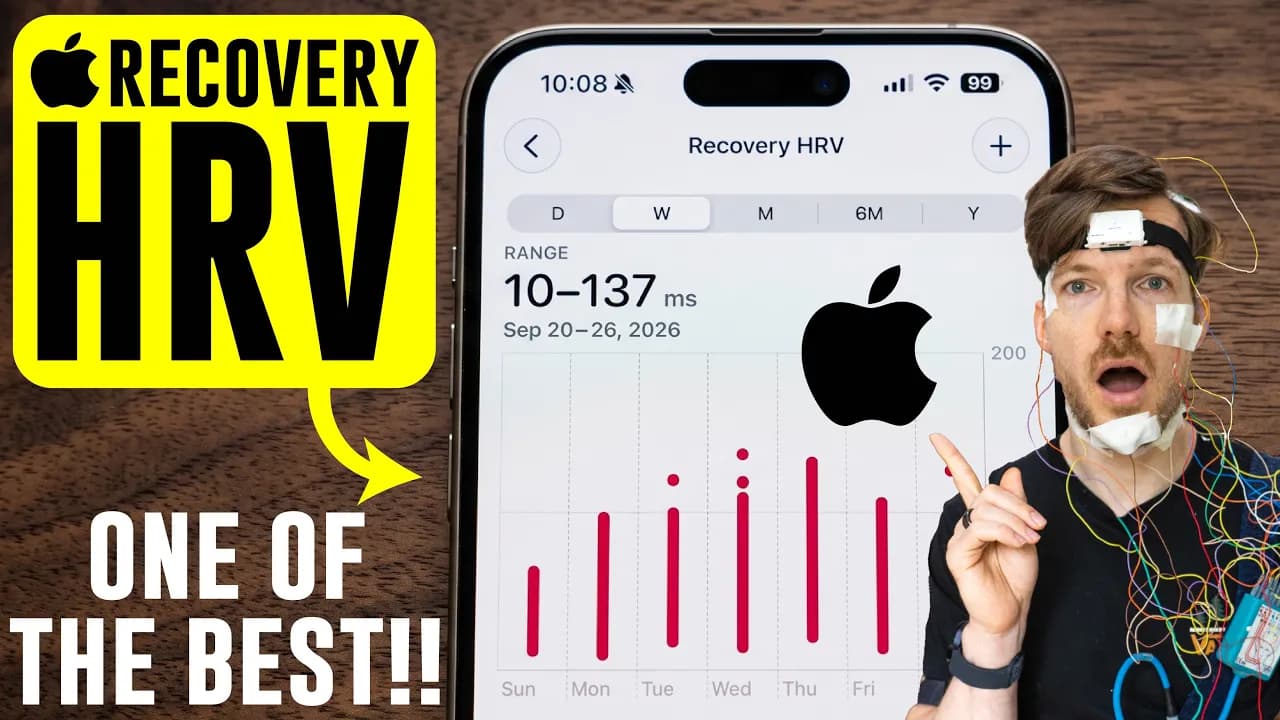
Apple is now separating HRV into two different types of HRV or more precisely two different ways of calculating HRV from the raw heart rate data. Recovery HRV uses RMSSSD, a metric commonly used to examine short-term stress and recovery. Overall heart rate variability uses SDN, which is intended to provide a broader, more long-term cardiovascular context.
The watch can access heart rate variability as often as every 5 minutes, although recovery heart rate variability is sampled while you're still. Apple is using these two different HRV values for different purposes.
Both measure the variation time between your heartbeats, but they look at the distances in a different way. RMSSD focuses on the change from one heartbeat interval to the next one. This seems to be particularly sensitive to rapid changes influenced by the parasympathetic or veagal activity, which is why many wearables use this to track short-term stress and recovery.
SDNN looks at the overall spread of all heartbeat intervals during the recording. It gives a much broader summary of the HRV, but it depends heavily on how long and under what circumstances it measured.
Until now, Apple Watch appears to have reported HRV primarily as SDNN in the health app. With the new recovery HRV metric, Apple now seems to be adding a measure intended specifically for that more short-term stress and recovery while retaining that overall HRV for the broader context.
Neither metric is better per se and you cannot compare their numbers directly. In both cases though, your personal trend is usually more useful than isolated numbers and comparing to other people. There will be both the RMSSD and SDNN value in Apple Health as well.
Readiness has three categories: activity, sleep, and vitals. It does not look at the absolute values from last night alone. It compares them with your personal history, including your recent workouts, previous sleep scores, and your normal range of vitals.
A workout or a large number of active calories can reduce your readiness during the day, even if you have a high readiness in the morning. Daytime vitals could influence it. For example, if your overnight measurements were normal, but your heart rate becomes unexpectedly elevated during the day without any cause, that might also reduce your score because this could be a sign of starting illness.
A nap can potentially modify your readiness as well. Your readiness score considers both daytime and nighttime vitals, as well as current and recent activity, workout effort, training load, and your sleep score history.
To get your first readiness score, it needs a lot of baseline data, including overnight wear for at least a week or so before, and you must also have slept with it the night before to get that value.
Health age can use things like heart rate, VO2 max, step history, exercise minute history, sleep score history, and both forms of HRV. You can also add optional laboratory values including LDL cholesterol and A1C to provide additional information.
Health age is currently described as a beta feature and will only release later this year. Your health age is expected to update weekly rather than changing every day. It's somewhat of a more stable metric. Potentially, that could make it a useful summary of your longer term trends.
The new hardware-based features are already at launch. These include the new redesigned health sensing system, heart rate measurements as often as every 5 seconds during the day, higher frequency HRV measurements, recovery HRV, and the updated heart rate and vitals experiences, readiness, and the new step counting system.
Some features may still require personal baseline data to build before they can produce any results in the app. The new watches use Watch OS 27, which was released on September 14th. Features that depend on the new health sensing system, such as the continuous 5-second background heart rate and recovery HRV, do require the new Apple Watch Series 12 or Ultra 4, and you will not get them by just updating your older Apple Watch.
The completely redesigned health app is coming later in 2026, when Apple plans to introduce new insights and longevity sections, including the health age feature and a more personalized health guidance. The health age at the moment is still in developer beta, so you need to be in that program to use it.
Apple has not yet publicly announced a more precise release date. Availability can also depend on your language, region, iPhone model, and the precise version of the software. US English is always first. Even after a feature officially launches, it may not be available to everyone at the same time.
Keep The Quantified Scientist in your library
Save the videos and channels worth coming back to, and find them again in one place.