Apple Watch Recovery HRV: REALLY GOOD!
In a Nutshell
The Apple Watch Series 12 and Ultra 4 deliver highly accurate overnight HRV and resting heart rate measurements, closely matching ECG chest strap reference data across 7-8 nights. Both models show minimal deviation on average—typically within 1 bpm for heart rate and only slightly lower HRV values—making their recovery metrics reliable for tracking. The Ultra 4 edges out slightly better consistency, but both watches perform well enough for practical use.
These notes were generated by AI and may contain inaccuracies.
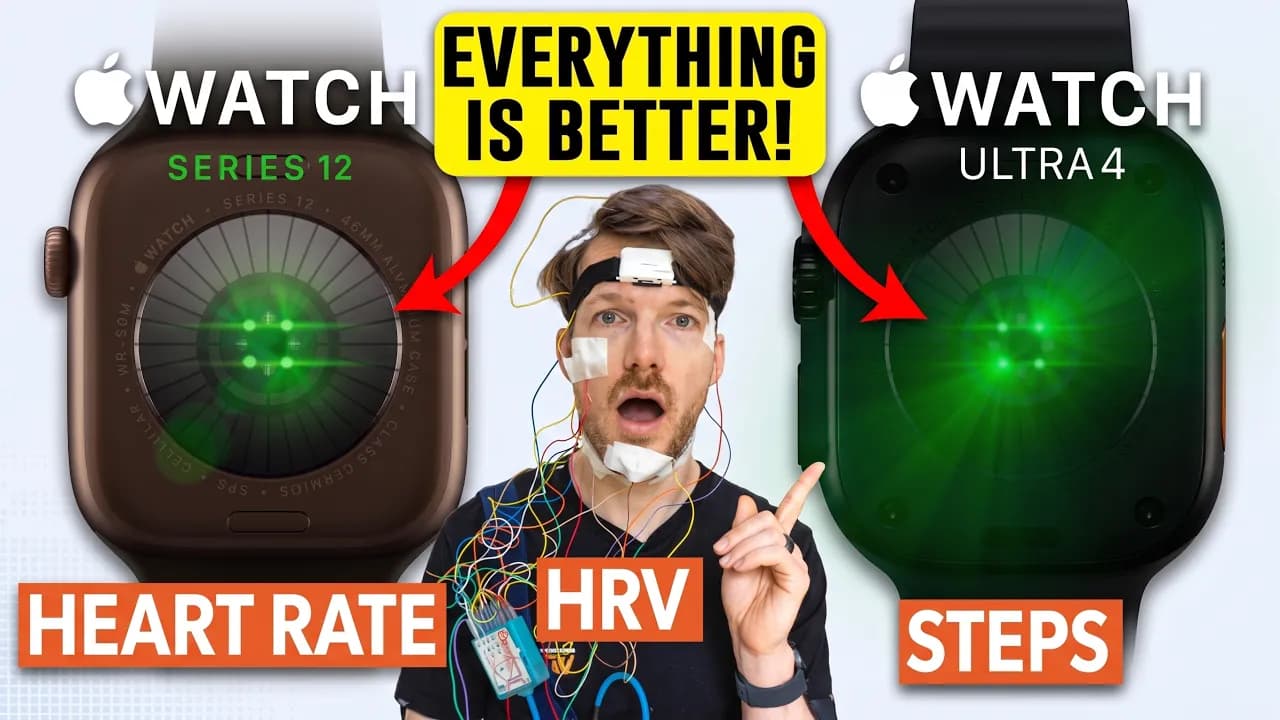
The Apple Watch Series 12 and Ultra 4 can now measure HRV (heart rate variability) which is different from the HRV metric Apple previously calculated. The watches still count the old scale as well, but this new scale is considered a short-range HRV. The goal was to test how accurately the Apple Watch Series 12 and Apple Watch Ultra 4 measure this scale, specifically looking at nighttime measurements.
The reference device was an ECG chest strap worn for approximately 7 nights. The study examined how accurate the Apple Watch measurements are compared to this reference, and also looked at the new overnight heart rate measurement. The researcher is a postdoctoral research scientist specializing in biological data analysis.
Each point on the graph represents one HRV measurement, with the horizontal axis showing results from the reference device and the vertical axis showing measurements from the Apple Watch Series 12. When devices are identical, points should fall on or near the black line, with the blue line representing the best fit for the data. The blue line is very close to the black line with some moments of deviation where the Apple Watch occasionally detected slightly lower HRV, but overall results are very good.
When calculating the average HRV per night and comparing it to the reference across 8 nights, the best fit line shows a very good trend. The slope of the blue line is almost exactly the same as the black line, though it may be slightly lower. This may be due to a few anomalies that lowered the average, but the overall trend remains very good.
Looking at specific nights shows the time since falling asleep on the horizontal axis and heart rate variability on the vertical axis, with Series 12 in red and reference in bluish-green. One night showed a very good match with minimal deviation. Another night showed some moments of deviation, though they were very slight. A third night displayed slightly larger deviation where heart rate variability was sometimes very low, possibly due to signal loss. Most nights show this pattern where the Apple Watch may be slightly high or slightly low, but nothing drastic.
For the Series 12, the heart rate variability measurement looks very good overall. The calculation appears to take an average over a full 10 minutes, with some assumptions made to make the comparison fair compared to other devices.
The Ultra 4 shows pretty good results overall, perhaps slightly better than the Series 12 with somewhat fewer points of deviation. However, nighttime averages again show slightly lower values on average. The study included 7 nights with similar patterns overall. On odd-numbered nights, the patterns follow each other well but sometimes the variation in heartbeats is slightly less.
For heart rate measurements, the Series 12 was examined in a relatively narrow range between 40 and 62 beats per minute. In this range, it matched very well with the reference device. When plotting averages over nights, the results match up quite well overall, though the inclination is slightly different. These are very slight deviations when looking at the average over the course of the night, with averages between 43 and 47.5 beats per minute. The biggest difference is only one beat per minute on average.
On individual nights, there is mostly a good match where the red line of the Apple Watch might be slightly lower than the blue reference line sometimes. Some jumps were detected by the Apple Watch but not by the reference. One night looked really good overall. Another night showed that low values are slightly lower and high values show slightly higher heart rate. The most erratic night showed a difference of approximately one to one and a half beats per minute at the lowest points.
The Ultra 4 shows a perfect match with the black reference line, and the best fit blue line matches almost perfectly. There are some moments of deviation, probably some jumps, and on average slightly fewer beats per minute, but these are really slight. The average over nights shows perhaps 0.5 beats per minute less registered on average due to jumps and lower values, but this is almost nothing.
Individual nights show very good patterns overall. Some jumps appear but the patterns are generally good. One slightly strange night shows a baseline that is a little lower with some jumps. The data was obtained directly from the Apple Health app. These moments of leaps may be the difference between Apple taking individual measurements versus continuous measurements with averaging, which would likely produce jumps.
Both resting heart rate and nighttime heart rate variability (recovery heart rate variability) should be very reliable based on both the Apple Watch Series 12 and Ultra 4. The researcher is very happy with these results and is working on a full review of both the Ultra 4 and Series 12 to be released soon.
Viewers interested in supporting the channel can use affiliate links for Apple Watch Series 12, Ultra 4, Whoop band, Eight Sleep Pod, or other Amazon purchases. Related content includes a video about Apple's new heart rate algorithm during exercise and a video about the all-new AC Pod 6.
Keep The Quantified Scientist in your library
Save the videos and channels worth coming back to, and find them again in one place.