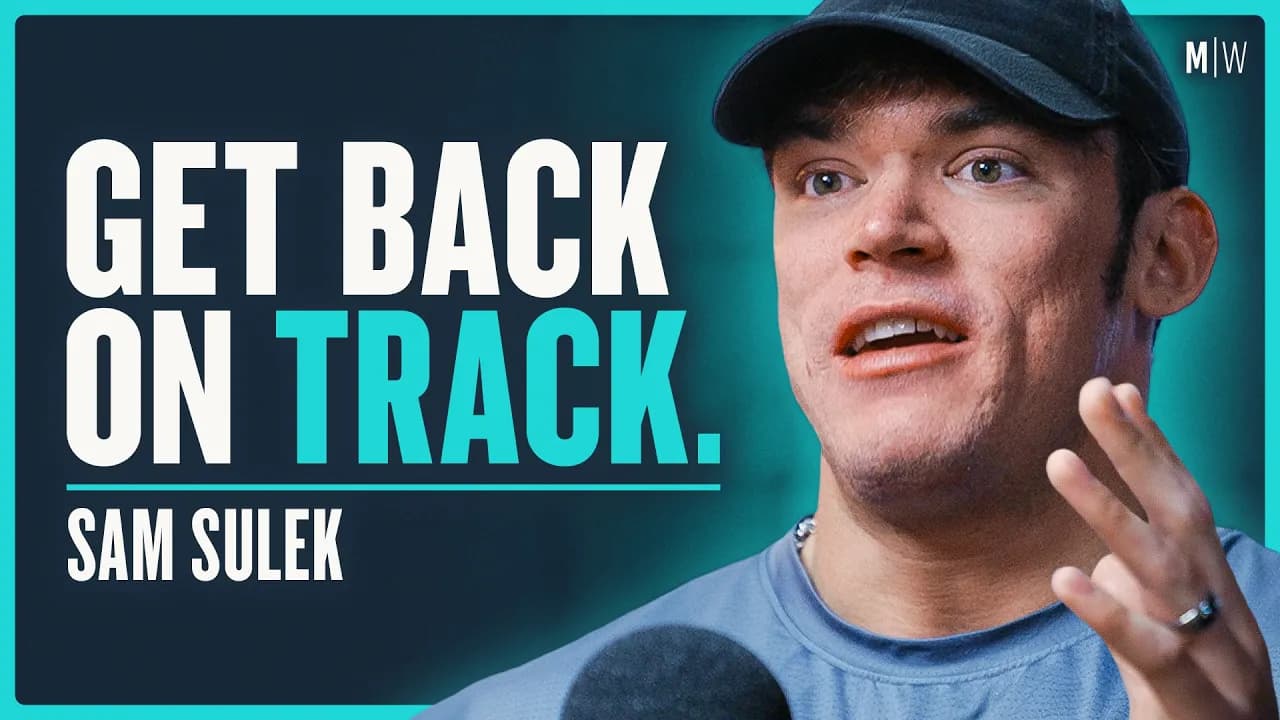
A heavy arms day with Sam Sulek.
In a Nutshell
Sam Sulek prioritizes arm development to match his already massive shoulders, arguing that big arms with small shoulders makes you look like a "fat guy" while big shoulders with small arms creates a football player aesthetic. He trains with minimal warm-up, pushes sets to true failure where form naturally breaks down, and uses techniques like rest-pause to maximize volume. His core philosophy centers on internal motivation—training for the satisfaction of getting bigger and stronger rather than external validation or competition pressure.
These notes were generated by AI and may contain inaccuracies.
Sam Sulek describes imagining himself doing squats where he puts the weight down on the safeties and passes out from going so hard. When asked if he's a masochist, he mentions his ears are ringing. He discusses his next competition and mentions training arms with someone saying "pray for me."
Sam mentions wanting to get back onto a diving board. He used to dive and recalls being able to do three and a half on the low board. At 200 pounds, he could jump up 10 feet in the air, but at 250 pounds it felt like wearing a weight vest and he couldn't spin as quickly.
When asked what he would do with a three-day split, Sam suggests combining chest and back, then shoulders and arms. He mentions he might skip shoulders since they're already big enough, noting the roundness of his shoulders exceeds his biceps and triceps, and he wants his arms to catch up.
Sam has a theory that big arms with small shoulders makes you look like a fat guy, while small arms with big shoulders makes you look like a football player. He notes that most guys who want big arms should probably get big shoulders first, as the reverse makes you look like you're just playing catchup and don't look like you train.
Sam mentions working at his YMCA's rock wall until age 14 and getting into rock climbing, including bouldering at fancier places. He notes he's not built for bouldering now.
Regarding warm-up routine, Sam says it's basically non-existent. He prefers to do what he's going to do lighter and gradually go heavy rather than doing a real warm-up.
Sam identifies triceps as the one movement where he has some OP strength. He mentions he's a lot better at it now compared to the first year's worth of tricep workouts. He loves doing this particular movement and appreciates a big stretch, holding positions for two seconds at the bottom and top of the movement.
Sam discusses how the first set sets the tone for the rest of the session. He compares it to January first of a gym routine - if you have a bad January 1st, you might as well skip the whole year. He mentions having sets where he racks the weight thinking he could have done five more, realizing he wasted time and needs to start over.
Sam emphasizes that a perfect set won't look perfect at the end. He criticizes the idea that every rep should look perfect throughout, calling it "put some more lotion on your hands, keep them soft." He references Dorian Yates' views on reps in reserve training and notes that holding yourself to too high a standard for form can increase reps in reserve.
He acknowledges there are limits - you can do a nasty set of curls but you can't do a nasty squat. He mentions that if someone is totally bringing it while maintaining perfect form with no accessory muscle movement, that's fine, but most people using perfect form as an excuse aren't pushing hard enough.
Sam switched his holding approach from a wider grip to bringing his hands together for more stability, comparing it to switching from a regular dumbbell curl to a hammer curl. He notes this allows for a couple more reps.
Sam discusses his approach to filming workouts, noting he wants to add the camera component without taking away from the workout. He mentions using bigger lenses because "the bigger the better" and finds it makes recording more fun and easier to do. He gets mixed comments about the lens choice.
Sam started lifting with a 30-pound dumbbell set in his bedroom next to his desk. He would play Fortnite and do 20 curls every time he ended a game, calling it the original 8-hour arm workout.
Sam advises against forcing kids into the gym, noting that pressure would turn somebody off to training. He mentions that kids forced to be Christian growing up often become "super cool atheist bro" types who hate religion. He suggests getting kids a trampoline or letting them play instead.
Sam warns against doing weighted side bends for abs, noting it will thicken up the side of your waist. He recommends doing weighted crunches straight down the middle for the front section instead. He mentions having done side bends before but now advises against them for aesthetic purposes.
Sam discusses proper dumbbell curling technique, noting that holding the dumbbell with hands at the top of the handle allows for cheating by making the weight lower. He recommends holding at the bottom of the handle for more bicep engagement since you're lifting it higher in the air.
Sam explains his approach to mind-muscle connection, wanting to put enough neural signals into his biceps without wasting bandwidth on forearms. He mentions using straps because he doesn't want to send neural signals to his grip instead of his biceps.
Sam mentions training in a gym without air conditioning in 78-80° weather while wearing long pants. He notes that last summer he could barely do it while bulking, but dieting this summer made it easier since he was already a little colder.
Sam prefers to do dips leaning way forward for chest emphasis. He mentions being tight in his upper body and worried about pulling his chest doing dips, noting he needs to work up to it. He references a CrossFit regionals competition that had 10 pectoral tears from dips.
Sam mentions having fully ruptured his Achilles 6 years ago and highly advises against it as a piece of lifestyle advice.
Sam discusses leg press technique, noting that even though squeezing at the bottom doesn't move the weight further since all weight goes through bones, the extra squeeze still provides benefit. He mentions the strength curve falling off quickly on this movement.
Sam likes the dip machine and mentions wanting an adductor machine, specifically the inward one since he gets enough medial glute work from other movements like squats and bent-over rows.
Sam discusses how doing clamshells or crab walks for rehab or sport makes his lower back feel nice, with the midsection feeling secured by stability work. He mentions that everybody's walking around arched and hunched, and he wants his back and below to grow while keeping everything above from growing excessively.
Sam discusses wrestlers in the UFC, noting how their lower back erectors look insane when they don't have singlets on. He mentions Chinese Olympic weightlifters doing 100-kilo behind-the-neck weighted GHDs and their backs looking nuts when they squat with completely upright torsos despite 300 kilos.
Sam loves rest-pause reps, describing doing a hard set, resting 3 seconds, going again, resting 3 seconds, and going again to accumulate more volume. He mentions this is particularly useful when traveling and not getting enough volume otherwise.
Sam discusses what minimum training volume would be required to maintain muscle and strength, noting that maintaining is much easier than growing. He mentions it would probably need to be upper/lower splits done ruthlessly.
Sam mentions there's nothing on the horizon for competitions. He wants his next show to be one he really wants to do, planning to gain weight slowly for 4-6 months while staying lean. If he decides he wants to be lean again, he'd get lean for his own sake and then potentially roll that into a show with 3 weeks notice.
Sam notes his validation doesn't come from shows, even though winning his first two was awesome. He mentions he would still be the same person without doing shows, possibly even bigger since he wouldn't have spent 6 months dieting.
Sam describes being internally motivated, liking the reward of simply getting bigger and being big and strong. He acknowledges that social validation probably helps as a performance booster even if it's not the priority. He emphasizes doing it for the fun of it.
There's a gym in Michigan with the first floor as a commercial gym and the basement as a dungeon setup. The facility used to be a bank, so it has a vault containing a squat rack and bench.
After heavy sets, some people experience ringing ears or tunnel vision. This sensation occurs more frequently with legs than upper body work. There's a mental visualization technique of imagining a squat set so intense that it causes passing out at the end without injury, using the safeties properly. This serves as mental motivation rather than an actual goal.
The motivation stems from knowing 100% effort was given rather than seeking discomfort. Training partners sometimes provide hype through yelling or physical encouragement like smacking backs during squats. The preference is for sets intense enough that onlookers question whether another rep is possible, only to witness additional reps completed. This aligns with wanting to create moments where people think "What the fuck is he doing? He's not going to do another one" and then seeing three more reps.
The Tom Platz approach influences training philosophy, particularly the desire to squat at public gyms with people present. The threshold for shocking observers is lower in commercial settings. There's consideration of scenarios where training partners might find someone pinned under a bar the next day, emphasizing the importance of safety equipment.
Rope extensions provide unique stretch to the long head of the triceps. The bottom-mounted rope setup with the cable going up and over is preferred. An alternative involves using an EZ bar at shoulder height with a leg braced against the machine, creating a locked-in position where the body is pressed against the equipment rather than balancing overhead.
Previous training included throwing dumbbells overhead while seated on a bench, which became limited by shoulder mobility over time. One incident involved attempting this movement and nearly hitting the ground when trying to bail out, resulting in being flipped over. Another incident occurred during university years at age 19 with 25 kilo dumbbells during incline press, where one dumbbell came down onto the face before being bailed out.
For the final set, the approach focuses on getting blood into the area rather than hitting complete failure, given the quality of previous rope extensions and assisted dips. The strategy involves going hard but not necessarily 100% intensity. This is followed by immediately transitioning to cable curls in a superset fashion after slamming the cable to the ground.
The session wraps up with additional sets and encouragement during the work. The training is characterized as a "Sam Sulek day" with high intensity throughout.
After training, there's a brief posing session in the gym. Some facilities have dedicated posing rooms, but good lighting is the main requirement. The session is considered complete with significant fatigue noted.
Current location considerations include whether to move from Ohio to places like Vegas or elsewhere. Texas is noted as being very hot during the visit. Vegas hasn't been experienced during peak heat. Montana's summers are appealing but the long winters make it impractical. New York is ruled out due to excessive activity. The ideal location remains undecided but would likely be somewhere warm without extreme heat, with the ability to set up personal gym equipment.
The ability to create a home gym setup is emphasized as preferable to relying on commercial facilities. The session concludes with appreciation for the training partnership and content creation.
Keep Chris Williamson in your library
Save the videos and channels worth coming back to, and find them again in one place.