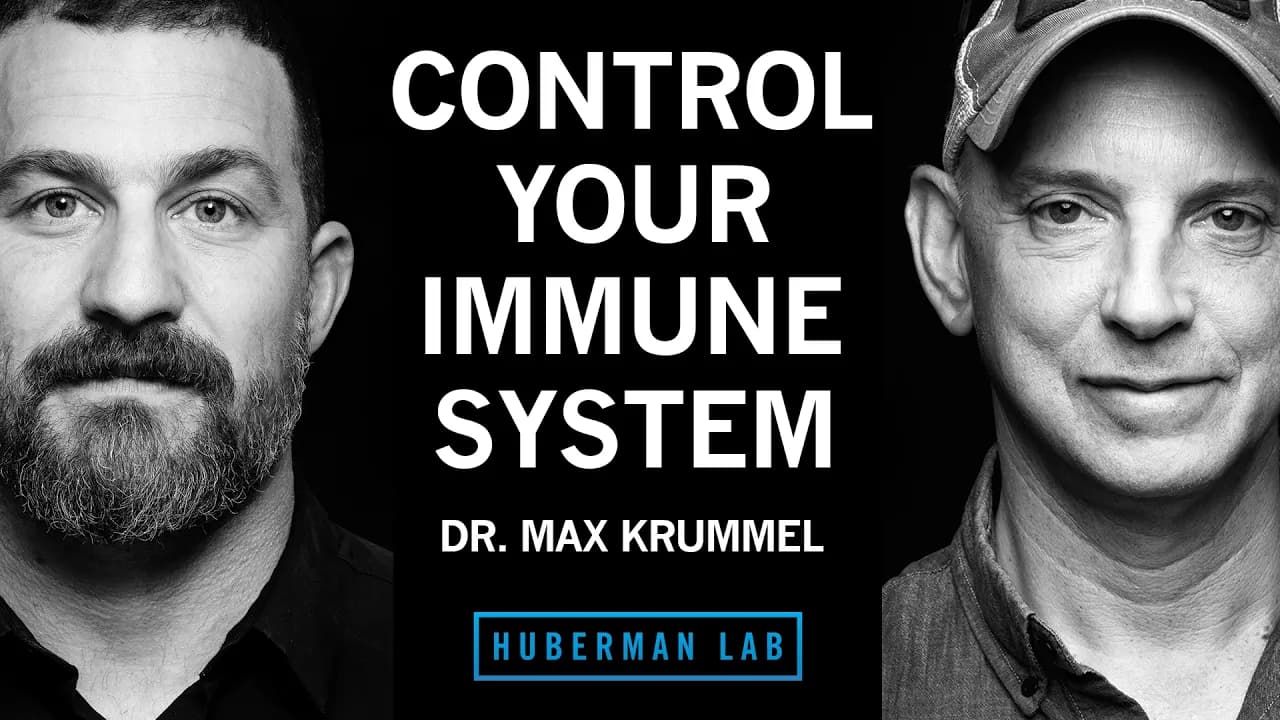
Avoiding, Treating & Curing Cancer With the Immune System | Dr. Alex Marson
In a Nutshell
Dr. Alex Marson explains the immune system's innate and adaptive arms (T cells, B cells) and breakthroughs like CAR-T cells—genetically engineered T cells using CRISPR to target and cure blood cancers like leukemia—and checkpoint inhibitors that unleash T cells against solid tumors like melanoma. Key cancer risks include smoking, UV exposure, charred meats, pesticides, and BRCA mutations; prevention emphasizes minimizing mutagens, while future therapies aim for preventive supercharged T cells and in vivo editing via lipid nanoparticles. CRISPR enables precise gene edits for immunotherapy, autoimmunity (e.g., lupus), and beyond, marking a paradigm shift from chemotherapy to programmable cells, with ethical limits on germline editing.
These notes were generated by AI and may contain inaccuracies.
Avoiding, Treating & Curing Cancer With the Immune System | Dr. Alex Marson
We're living in this amazing moment of biology where we can put a gene that encodes something on the surface of T cells that will make them programmed to search and destroy for cancer cells. This is largely known as CAR T cells, chimeric antigen receptor. This is a receptor that was designed in a lab does not exist in nature. When those T cells get reinfused into a patient the way that you get like a blood transfusion, those CARs are directed to go against cancers.
Welcome to the Huberman Lab podcast, where we discuss science and science-based tools for everyday life. I'm Andrew Huberman and I'm a professor of neurobiology and ophthalmology at Stanford School of Medicine. My guest today is Dr. Alex Marson. Dr. Alex Marson is a medical doctor and scientist at the University of California, San Francisco. He is developing new ways to reprogram the immune system to cure cancers.
Today we discuss how your immune system works, how autoimmunity works, and how gene editing and other new technologies can be successfully leveraged to defeat childhood and adult cancers. Dr. Marson is truly one of a kind in his understanding of the clinical aspects of cancer treatment, the science of the immune system, and in explaining the things that genuinely increase your cancer risk, many of which are surprising, and the actionable steps that we can all take to reduce our probability of getting cancer. In addition to the usual factors, smoking, UV light, and environmental toxins such as pesticides, we discuss the actual cancer risks that come from things like eating charred meats, airport scanners, and food additives, and how to gauge your individual level of risk. We also explore gene editing for reversing diseases, which until recently was science fiction, but now is a reality. By the end of today's episode, thanks to Dr. Marson, you'll have the most up-to-date understanding of the state-of-the-art science for cancer prevention and treatment. Knowledge that is certain to impact you or a close friend or family member in your lifetime.
Before we begin, I'd like to emphasize that this podcast is separate from my teaching and research roles at Stanford. It is however part of my desire and effort to bring zero cost to consumer information about science and science related tools to the general public. In keeping with that theme, today's episode does include sponsors.
Dr. Alex Marson, welcome. This is the first time that we're going to have a serious discussion about the immune system, cancer, and gene editing technologies on this podcast. So, I'm delighted that you're here. It's also great to see you again.
Andrew, this is the first time that we're going to have a serious discussion about the immune system, cancer, and gene editing technologies on this podcast. So, I'm delighted that you're here. It's also great to see you again.
Thank you for having me. Really, really good to see you. It's been a while. Let's start off with the big picture. How are we doing? How's biology looking? How's medicine looking? Are we on the fast track to much better things? Are we going to slog along for another 10 years before we have cures to the many concerns that people have about cancer, Alzheimer's, and the rest? Or are you encouraged by what's happening right now?
I think maybe there's some the general public doesn't quite know how excited biologists are about what's possible. And maybe we've overpromised. Maybe in the past we've said we're on the brink of curing disease and people haven't seen it. But something is materially different right now. And there is a convergence of so many different ways of understanding biology but then not having that stop at understanding but to actually intervene and at the root causes of disease.
Over the course of this conversation, I imagine we're going to talk about DNA sequencing, understanding cells, but going all the way to rewriting specific DNA sequences inside of the cells of our immune system. Doing this not one at a time, but testing every gene and understanding pieces of DNA throughout our entire genome to understand what controls our cells. and then being able to take that information and actually do something about it to boost our immune system to go after cancer to balance it for inflammation and autoimmunity. And that doesn't just have to be sort of searching for a pill. All of a sudden, we can actually talk to our own cells and give them instructions in the language of DNA and the language of molecular biology. And in some instances, this is being done with CRISPR, but it's also being done with lipid nanoparticles and vaccines. And we're still inventing new ways of giving these instructions. But all of a sudden, medicine is programming the behavior of cells in a way that's much more directed than was ever conceivable before. Like there's really a step function in what's imaginable and achievable in medicine.
Super exciting. Do you think that molecular biology and genetic engineering and/or AI are the reasons that things are on this accelerated timeline?
Yes is the answer. All of those things. I think we can do experiments at a different level of scale. we can generate data and then we have the computational tools including AI but we have computational sophistication to actually extract insights from massive amounts of data and historically biology was an observational science if you especially if you wanted to study things in humans there wasn't a way to intervene now all of a sudden we're taking human cells we're putting taking them into the lab and making genetic changes and reading out the consequences and directly being able to observe the effect. And we have tools to do this with imaging. We have the tools to do this with DNA sequencing. And we can take this all the way into clinical trials and see what are the consequences when we actually go after targeted DNA sequences and make our cells better at treating disease.
Would you mind educating us about the immune system a bit? the adaptive and the innate immune system, some of the major cell types, because I think those are going to form the kind of building blocks of our discussions about cancer and other things today.
Our immune system permeates almost every aspect of our health and disease. It is a system really in the sense of it it's involved in every part of our body that has evolved to protect us largely to protect us against infections, viruses, bacteria, fungus. all sorts of foreign invasions and our immune system has developed a balance that is when it's working properly doesn't recognize the cells that are supposed to be in the body but is finely tuned to recognize signs of things that shouldn't be in the body and to eliminate them. At its core that's the basic job of the immune system to recognize us versus non us.
Exactly. And you talked about the innate versus the adaptive immune system. Largely what we're talking about are white blood cells. We're talking about different types of white blood cells that are either inside of tissues or circulating in our bloodstream that go around and play coordinated and specialized roles in sensing when something comes in that is not us that's foreign that shouldn't be there. The innate immune system does it as is sort of thought of as the first alarm system that something's wrong. And with the innate immune system, which consists of cells like dendritic cells, macrophages, these are cells that are going around and they're looking for patterns of things that just generally aren't in human cells. some signs of damage, some signs of things that just shouldn't be there in a generic way in a healthy human. When those first alarm systems get triggered, all of a sudden these innate immune systems start releasing things. They change their state and they send off an alarm to other cells in the immune system and then they often recruit in the second arm of the immune system that you mentioned, the adaptive immune system.
We'll talk a lot about the adaptive immune system today. And the major players in the adaptive immune system are a group of white blood cells that are collectively known as lymphocytes. But we'll talk about B cells and T cells in particular, which are major groups of lymphocytes. We've been focused heavily on T cells. T cells play a central role in coordinating the fine-tuning of the immune response. One of the amazing things about the T cells is that each T cell naturally in our body. It's one of the few places where each cell will actually have a different piece of DNA that's not inherited in our germ line sequence. Each T cell will make its own receptor that is generated largely at random to go and sense something. And those sensors that get put on the surface of T cells are there to engage. And if they're engaged, it's a sign that something has been recognized as foreign. And so we have this incredible diversity of different T cell receptors that have developed on our T cells. Each one will have a different unique receptor on its surface. Each cell will have a different receptor on its surface. And the way to think about these receptors is that they're sensors when they're engaged, they send a signal to the T cell that okay, we found something that you've been programmed to recognize and program is recognized as foreign and if the immune system is working properly.
And are the genes that these T cells make as these receptors are those based on experience of the organism? Because you said that it doesn't come from the germ line, but we should clarify that the germ line is not about infectious germs in this context. The germline DNA is from the sperm and egg that were your parents. It became you. There's recombination of those genes. And then there's you all each and all. The T cells are making genes that neither your parents necessarily expressed nor that you were expected to express except based on what exposure to particular pathogens. Like why do they make certain receptors and not others?
Largely random. It actually there's the pieces of DNA at this part of the DNA actually recombine and get pasted together in unique ways. It's probabilistic and that's what allows us to have cells lying there in waiting for things that we've never encountered. If a bacteria might come into existence or a virus might come into existence that doesn't even exist now in nature, but we might have T cells lying there waiting that could be engaged by those proteins on the surface that viruses would introduce.
That's incredible. Would you mind mentioning the role of the thymus? These days I'm hearing more and more about we have a thymus and we lose a thymus. Would it be beneficial if we could keep our thymus around? So thymus is actually the reason the T cells are called T cells is the T stands for thymus and the thymus is an organ that it does sort of shrink as we age but at least in childhood it's it sort of lies by your heart and it is the place where T cells go in a key place of their education. So they have are making these sensors at largely at random and then in the thymus they get selected and they the ones that by accident are generated that recognize something that is supposed to be in your body if the T cell engages a natural target in the thymus those cells will die and so what emerges from the thymus should be and this is not perfect process but should be things that have emerged at random but then are selected to remove things that recognize your own body targets.
There's sort of a negative selection of the stuff that's you so that your immune system doesn't attack you and it knows you from non you.
Yeah, that's exactly right. There's actually both a positive selection and a negative selection. That's exactly the right way to think. The cells get will only emerge from the thymus that if they have a receptor on their surface that's there. So that's one positive selection, but if it engages with a self target in the thymus, it gets negatively selected. So what comes out are T cells that are there with sensors in place to recognize things that shouldn't be there.
Okay. So your thymus and your T cells get educated in childhood. And that's what you're working with except that the immune system can adapt and make antibodies to things it doesn't recognize. the antibodies come from the from the other type of lymphocyte. So now now we can talk about the B cells. B cells are this other type of lymphocyte that work in coordination with T cells and they're the antibody producing cells. So they actually have a similar process where they're generating different antibodies at random through a similar kind of recombination event. they have their own form of selection that they go through and then those antibodies can then be released into the bloodstream and are the basis for protection against infections after we get them.
What underlies the sort of efficiency and functioning of the immune system? I know I and many people are thinking, okay, we hear like our immune system gets activated or our immune system is impaired. The one thing that I'm certain supports the immune system is great sleep, right? And we just know this. If we don't sleep well or enough, we get sick. Is that because there's a known impairment of the immune system?
I wonder about this too. I mean, I agree. I've experienced that so many times of being run down and then feeling experiencing that I'm susceptible to infection, but I don't actually know the basis of that. I mean, it's kind of amazing how much we don't know about these determinants of immune health largely because they're often variables that are left out of the mouse studies that we're doing. We're studying largely steady state immune responses in mice. And I would say we don't haven't done a full exploration yet of all the types of ways that general health impinges on the immune system.
I had a postdoc named Sager Bapat who came to my lab with an interest in metabolic health and wanted to study the effect of metabolic health on T cells and there's some subgrowing stuff on this but it's another like what what are the determinants of it he did experiments in my lab where he exposed some an allergen something that irritated the skin and caused an allergic type reaction in the skin of mice. He did it in mice that were eating a normal mouse diet versus a high-fat diet that caused obesity. And what we saw was that it was actually not just a quantitative difference in the immune system, but actually a qualitative difference. The actual type of inflammation, the cell responses were different in the mice eating a high-fat diet. And I think we haven't done enough studies like that where we actually start playing with the variables of life and test them in a mechanistic way to isolate individual variants. What was interesting there was that the allergic reaction actually looked totally different in the obese mice and if we used surrogates that are for the types of drugs that are being used now to treat severe allergy. So we gave antibodies that block allergic responses. the normal diet mice would respond favorably to these. They didn't help the mice that had the obese high-fat diet response to inflammation and in some cases it actually maybe made it worse.
So I think that there are these systemic ways I mean clearly we know we our intuition tells us this strongly that systemic health can feed into our immune responses but I think it's still been underexplored in rigorous ways.
I realize I'm asking very top contour type questions for which there probably aren't specific answers, but we all know people that get sick all the time. And we know people who never seem to catch the bugs that everyone else seems to catch. Is there any understanding of what a more robust immune system is at the level? Is it more T cells? Is it the B cells engaged more quickly so they can generate antibodies more quickly? What is it?
These are great questions that I don't think have full answers. There's been a lot of work on genetic determinants and there's extreme cases where people have a genetic gap in their immune system where they're really susceptible to something that healthy people should not be susceptible to. And you see that there are certain types of infections that either happen or happen with a different type of severity in people with genetic deficits in certain branches of their immune system. And in some cases you can pinpoint that we just talked about the innate immune response, the adaptive immune response. You can see that certain genetic mutations that people inherit could influence one or multiple branches of that immune responses and the consequences that manifests itself with different types of infection. And I suspect that there's some spectrum of that that we see the really you can diagnose the really strong genetic consequences and then there might be a long tail of more subtle genetic that might be multigenic that we don't fully understand and then I'm sure that there's other determinants of health that are just multifactorial and so it's you know it also becomes this interplay between the health and then what you get exposed to by your environment.
Yeah. Speaking of which, I'm familiar with some studies from Stanford, I believe, where kids that have no exposure to peanuts get peanut allergies and careful subtle increasing exposure to peanuts essentially protects them against peanut allergies. So, is it true that when we're young that exposure to pathogens and different foods gives us a more robust immune system?
I think that there's the what we're exposed to and what we develop tolerance for is critically important during there's some windows of early life that I think are we're particularly susceptible to becoming tolerant and I think if we don't get the proper exposure to certain things all of a sudden our body can start to be hyper sensitive to them which manifests as allergies now there's this balancing act I think the fear of allergies makes people more hesitant to expose kids and I think you can it can get into these dangerous zones of you don't want to expose kids who are going to have a dangerous allergic response but on the other hand critical early exposure is part of how tolerance is maintained and I think peanut allergies there is strong evidence that exposure to peanuts can be beneficial in people who are not yet allergic.
What's going on with autoimmune conditions is this that the B cells and T cells are at probabilistic level that T cells developed some reaction so to speak a binding to cells that we naturally make that they shouldn't have. It's just like it happens.
I've always been intrigued by the idea that when the immune system is really ramped up people will experience autoimmune like symptoms. I experienced that as a master's student. I was working so much and probably not eating enough and drinking so much caffeine back then that I got some kind of funky skin lesion things. I went to the doctor and like, "Oh, you're starting to get some attack of the deeper layers of your skin. You just need to work a little less." And sure enough, did that trick?
It did the trick. But I was just it made me so keenly aware of how the immune system will for lack of a better word adapt to conditions and it was trying to keep me healthy and it overshot the mark basically.
I sort of walked you through at a first principle like how things are supposed to work. I told you okay there's this process of generating receptors on the surface of T cells. Antibodies get generated on B cells. They go through this positive selection and negative selection. That's a delicate balancing act and it doesn't actually work that way in practice. In practice, T cells escape from the thymus that do recognize our own self antigens and there's actually secondary mechanisms there to block that. But autoimmune diseases emerge when those normal checks fail.
This and I think it's a consequence that the immune system has two major responsibilities. It has to be primed to protect us from infections which would be fatal and be strong and recognize this incredible diversity of potential foreign dangerous things that we might experience. But it also has to not recognize our own cells. And it can miss the mark in both ways. And so autoimmune disease manifests in different tissues. If your immune system starts recognizing targets in your joints, it can cause rheumatoid arthritis. If it's in the cells that produce insulin in the pancreas, it causes type 1 or childhood diabetes. If it's the myelinated cells in the brain, it's multiple sclerosis. So, this is autoimmunity and inflammation of different kinds cause their own pathology. So, we want to the immune system is always these sort of two sides of the coin. Making sure that we're having strong responses to infection. We'll talk about cancer where we want to also strengthen our responses. But for autoimmunity, inflammation, allergies, we want to make sure that like our goal therapeutically in with drugs is to make
Make the immune system under control in a targeted way to avoid blanket immunosuppression, inducing tolerance against inappropriately targeted things.
Immune response to a cold virus is systemic. With a splinter, get innate response and pus localizing the wound. Invasive viruses like cold cause systemic effects: mucus production, headache.
Signal for systemic vs localized response depends on virus invasiveness. Immune cells secrete cytokines into bloodstream as chemical signals. Cytokines act locally or distributed, cause fever. Fever fights infection but makes one feel sick. Immune system balances responses; sometimes overreacts, causing negative consequences that resolve as infection clears.
Antibiotics are amazing for bacterial infections. Personal anecdote: sinus infection improved substantially in a day with antibiotics. Concern: overprescription leads to resistance. Question: does using antibiotics shortcircuit immune system development, requiring misery to build robustness?
No, antibiotics do not hinder immune robustness for susceptible bacterial infections. They are a miracle, curing diseases deadly in past generations. Risk: overuse leads to resistance, potentially ending this era without new antibiotics.
Underfunded area of medicine. Limited common antibiotics like amoxicillin. Anecdote: friend in UK with eye infection near posterior chamber risking vision; systemic antibiotics likely to save it. 100 years ago, would have enucleated the eye.
Potential trillion-dollar industry to save lives, but underfunded.
Cancer existed long before EMFs/radiation; not new. Recommend book: The Emperor of All Maladies, biography of cancer, records tumors back to ancient times.
Cancer: sophisticated genetic understanding. Mutations accumulate in cells. DNA programs healthy cells (e.g., skin cell stays skin). Mutations lose regulation; cell divides out of control, disrupts tissue, loses architecture. Further mutations lead to metastasis (spreading to distant sites).
Evolutionary process: cancerous cells acquire genetics for their well-being, grow at body's expense. Genetic disease of uncontrolled division.
Healthy cell mutates, produces daughter cells inheriting mutation, leading to tumor proliferation. Mutations happen constantly during DNA replication (imperfect); one daughter gets mutation.
Most mutations deleterious; cells die via programmed cell death (apoptosis), imploding. Problem: mutation benefits growth/division; cell proliferates, passes to daughters. Second hit accelerates to full cancer.
Accelerators:
- DNA damage exposure (e.g., smoking: chemicals cause lung mutations).
- Genetic predisposition (e.g., BRCA genes for breast/other cancers: start with one faulty copy, higher mutation risk).
BRCA not major numerical cause but high individual risk for certain cancers. Testing cheap, recommended with family history. Identified partly via rare male breast cancer cases.
Mutagens: smoking, sun/UV for melanoma (some sun needed, avoid excess/sunburn), vaping (worse than not), environmental/workplace hazards (lab chemicals/radiation pull DNA apart; radio-labeled experiments).
Paints/thinners, pesticides (higher rural cancer rates).
X-rays (dentist) cause mutations; tradeoff, avoid unnecessary. Airport scanners: low radiation, but frequent travelers/pilots have higher cancer rates (confounded by sitting).
Prefer minimizing exposure.
Mutagen changes DNA; increases cancer risk. Carcinogen increases cancer rate (closely related).
Charred meat bad (heterocyclic amines); meat implicated in colorectal cancer (data tricky due to confounders like sourcing/starches).
Nutrition studies messy; common sense: fiber good, ultra-processed bad.
Food dyes: high lab doses cause tumors in animals, but human exposure tiny fraction. Many potential carcinogens (e.g., table lacquer if ingested).
Confusion: mouse studies at high doses vs real-life risk. Start with clear risks (smoking, sunlight), then tail of unknowns (duration/amount).
People don't know risks; smokers avoid lung cancer, non-smokers get it. Mixed messaging erodes faith in medicine.
Cancer probabilistic; can do everything right and still get it (even without BRCA). Avoid attributing cancer to actions; be humble.
Conversations about the immune system culminate here in discussing cancer. Detailed mechanisms of immune system cell constituents were covered earlier. When the speaker graduated medical school in 2010, the dogma was to not waste time on cancer immunology—it was seen as a field going nowhere, possibly due to local bias in Boston. Mainstream cancer treatment was chemotherapy, toxins more toxic to cancer cells than healthy ones, forcing patients to endure horrific side effects. This remains the mainstay, though all want better.
Targeted drugs against cancer mutations were promising in medical school, measuring mutations causing uncontrolled cell division. Cell cycle inhibitors and signaling pathway drugs extended lives, but cancer mutates around them, developing resistance like bacteria to antibiotics.
A new paradigm uses the immune system's power, redirecting it against cancer targets. The immune system circulates through every organ, with white blood cells seeking anomalies. Immune cells exquisitely distinguish healthy from unhealthy cells. Achieving durable, precise immune responses eliminating cancer while sparing healthy cells is the goal—and no longer science fiction.
Checkpoint inhibitors (immunotherapy drugs) target PD-1 and CTLA-4 on T cells, natural brakes. Drugs release these brakes, strengthening T cells against cancer. Miraculous for certain cancers, especially melanoma—poster child success. Jimmy Carter had metastatic melanoma to the brain (death sentence); checkpoint inhibitors cured him, shrinking tumors. Large fraction of melanoma patients now respond, changing treatment. Other cancers respond to varying degrees.
Research focuses on genetically engineering T cells with lab-designed sensors, not limited to natural ones. Chimeric Antigen Receptor T cells (CAR T cells) stitch together artificial receptors not existing in nature. DNA encoding the CAR is delivered to T cells, producing surface proteins as sensors. Reinjected like a blood transfusion, they target cancers. Approved for certain leukemias and lymphomas.
In 2012, Emily Whitehead, age 8, with refractory leukemia failing all treatments and facing hospice, received experimental CAR T cells at University of Pennsylvania. Her T cells were extracted, modified using lentiviruses (modified HIV viruses delivering CAR DNA), and reinfused. She had ICU complications managed in real time; cancer disappeared. Lentiviruses enable long-lasting gene expression as shuttles, leveraging viral evolution. No overwhelming immune reaction to the virus. Emily is now cured, premed at University of Pennsylvania.
This shattered 2010 medical school dogma ignoring cancer immunotherapy. The immune system can be re-engineered against cancer and other diseases. 2012 also saw a Science paper by Emmanuelle Charpentier and Jennifer Doudna introducing CRISPR. Speaker started T cell lab in San Francisco that year, coinciding with CAR T proof-of-concept and CRISPR emergence. Lentiviruses were clunky; CRISPR enables precise genome edits in T cells.
Work developed CRISPR for T cells, identifying genetic changes optimizing immunotherapies. Now in clinical trials with CRISPR-engineered CAR T cells, targeting leukemias and challenging solid tumors (common cancer deaths). Tumors are immunosuppressive; additional CRISPR edits counter cancer's evasion tricks, making T cells resistant. On brink of precise cells melting cancers without chemotherapy side effects.
Few cancers peak in childhood (e.g., childhood leukemias like Emily's) during development. Most increase later in life due to accumulated mutations over time from cell divisions. Mutated cells often die; survivors evolve into cancer given enough time and damage.
Key is targeting, e.g., CD19 protein on B cell leukemias/lymphomas (cancers of immune B cells). Healthy B cells also express CD19, so CAR T cells kill both—but tolerable, as people live without B cells. Collateral damage manageable. Harder for pancreatic or brain cancers. Solutions: selective targets only on cancer, or multi-feature recognition (two-factor authentication). Tools exist to build sophisticated discrimination.
Ketogenic (low-carb) diets might help some cancers but worsen others. Still under exploration, similar to unproven claims for dementia (type 3 diabetes). Likely indirect benefits, not solving problems.
CRISPR illustrates unplanned discoveries changing biology. Arc 1: DNA understanding from Watson/Crick double helix, sequencing (human genome draft ~2000, multi-billion dollar project), falling costs enabling disease associations. But sequencing observes; needed tools to change sequences (prior: zinc fingers, lentiviruses).
CRISPR emerged from bacterial CRISPR repeat sequences. Bacteria have immune systems against bacteriophages (viruses). CRISPR recognizes/cuts viral DNA, distinguishing self from non-self. Repurposed: CRISPR-Cas9 (protein scissor + RNA guide) cuts any programmed DNA sequence, enabling cuts/pastes: remove bad genes, fix mutations, insert CARs. Used in plants (drought-resistant crops), all organs/diseases for molecular medicines.
CRISPR's edge: RNA programs the scissor to any sequence. So this and what's so special about
CRISPR-Cas9 allows near-perfect precision in designing RNA to recognize any DNA sequence through complementarity, enabling cuts at specific sites. RNA can be ordered online, arrives in days, mixed with Cas9 protein, and introduced into T cells the next day to cut any DNA sequence. Using the 2010 genome sequence, researchers select a genomic site, order RNA, create targeted CRISPR, make cuts or cut-and-paste edits, and observe cellular consequences like stronger or different responses in test tubes, disease models, or patients.
Precision of cuts: Cuts are highly precise but not perfect; the field tests for off-target cuts (e.g., unintended cuts elsewhere if targeting chromosome 6). High-fidelity versions minimize this. Risks include bystander effects like DNA chew-back or chromosome pieces falling off. Risk-benefit analysis is key for each disease; unintended mutations often cause cells to die naturally. Humility is required about unintended consequences.
Beyond scissors, CRISPR is re-engineered: CRISPR base editors (David Liu at Harvard) use a dead Cas9 (no double-strand break) with a deaminase domain for predictable single-nucleotide changes. Epigenetic editing (epi-editing) recruits enzymes to activate/inactivate genes without altering A/T/C/G sequences, mitigating scissor risks. These use CRISPR to recruit enzymes precisely.
For T cells, lentivirus was used historically: harvest T cells, introduce cargo, reinfuse. For non-invasive delivery to organs like brain, liver, pancreas, research focuses on trafficking CRISPR to specific cells/organs.
In 2012, labs adapted CRISPR from immortalized cell lines to primary human T cells. Key collaboration with Jennifer Doudna enabled purifying CRISPR protein and RNA into complexes, suspended in liquid, and delivered via electroporation (electrical pulses create transient membrane pores). Katherine Schumann optimized protocols (e.g., pulse lengths) for efficiency without killing cells. Now widely used, highly efficient; some cells die, but edited T cells predominate.
Grad student Theo Roth expanded to insert large DNA (hundreds to thousands of nucleotides), writing novel sequences precisely. This spawned Arsenal Biosciences (now in third clinical trial for solid tumors, upcoming for prostate cancer). Process: patient blood donation → ship to facility → electroporate with CRISPR-Cas9 → insert ~10,000 nucleotides encoding CAR receptors + resilience genes → grow/test/freeze → reinfuse like blood transfusion. Modified T cells traffic to tumors (e.g., prostate), persist, and fight cancer.
CRISPR can target canonical cancer mutations. Vision: infuse supercharged T cells with resilience genes + broad attack genes to short-circuit body-wide cancers preventatively (e.g., at age 52). Starts in high-risk late-stage patients for ethics; aim for safety, precision, cost reduction, earlier intervention with improved early detection. Gladstone UCSF Institute of Genomic Immunology launching philanthropic CRISPR trial for multiple myeloma with new genetic programs.
Future: in-body delivery without ex vivo processing. Options include engineered viruses (tropism modified for specific cells, avoiding immune responses), virus-like particles for DNA/protein delivery.
Lipid nanoparticles (LNPs)—formerly liposomes—advanced dramatically; used in mRNA vaccines (billions dosed). LNPs deliver genetic material, naturally target liver (used for liver genetic diseases). University of Pennsylvania company developed LNPs with T cell surface-targeting proteins: inject into blood, LNPs bind T cells, deliver mRNA for temporary CAR expression, creating CAR-T cells in vivo.
Pharma shifting to engineered proteins, LNPs, viruses, cells for root-cause treatment. mRNA vaccines exemplified scalable intervention: synthetic mRNA in LNPs instructs protein production temporarily.
Three major issues caused divide around mRNA vaccines: (1) mandates versus optionality—Americans resist being told what to do; (2) shutdowns differentially impacted people—some maintained paychecks and could work, others could not; (3) concern about how mRNA gets turned off after serving its purpose, targeting specific cells without perpetual expression in all cells.
mRNA acts as a temporary intermediate between DNA (source code) and proteins. DNA is transcribed into mRNA, which goes to the ribosome to template a protein but does not persist permanently. mRNA vaccines deliver this temporary template so cells produce a small part of the COVID spike protein for a limited time. Risks must be contextualized against natural COVID infection, which also transcribes viral mRNA in cells. Immunology experts enthusiastically received the vaccine.
COVID caused national trauma through deaths, economic shutdowns, and social disruptions, fracturing trust in vaccines and science. During isolation, optimism came from Operation Warp Speed under the first Trump administration, which streamlined science and regulation for rapid vaccine approval using multiple technologies. Simultaneously, trust in science eroded.
In 1793 Philadelphia yellow fever epidemic, Federalists (Hamiltonians) favored baths and gentle treatments, while Jeffersonian Democrats supported extreme bloodletting. Parties dissented on causes (contagion vs. sanitation). Epidemics unearth societal tensions, balancing trade-offs in pandemic responses.
Presidential Biographies Hobby
Dr. Marson reads presidential biographies sequentially (now up to WWII), spending time selecting from many options (e.g., admires Walter Isaacson).
Function offers 100+ advanced lab tests for heart health, hormones, immune function, nutrients, toxins like BPA and PFAS (forever chemicals). Provides doctor insights; e.g., detected elevated mercury, advised reducing tuna, increasing leafy greens, supplementing NAC and acetylcysteine for glutathione/detox—subsequent test confirmed success. Affordable, simple; waitlist 250,000+; early access at functionhealth.com/huberman.
Immunotoxins: Antibody tethered to toxin like saporin (infamous from umbrella assassination) targets cell surface proteins, killing only those cells. Works well experimentally but lacks full specificity/thoroughness.
Antibody-Drug Conjugates (ADCs)
Antibody targets cancer cell surface protein, delivering toxin/drug at high local concentration without systemic doses.
Radioimmunotherapies
Attach radioactive isotopes to antibodies for cancer targeting.
CAR-T Cells
Chimeric antigen receptor (CAR) uses antibody fragment as sensor on T-cell exterior to target cancer; T-cell kills and amplifies/recruits response.
Bispecific T-Cell Engagers (BiTEs)
Two-headed antibodies (e.g., BiTE trademarked by Amgen): one end binds cancer cell, other binds T-cell, bridging them without T-cell genetic modification. Some approved, others in development.
Understanding molecular structures enables Lego-like assembly: matchmake cells, attach cargos. Amgen (leader in BiTEs; Dr. Marson advises) uses AI to design synthetic proteins (not natural) that bind any cancer surface target for modular engagers.
Chinese scientist He Jiankui (Stanford postdoc alum) edited embryos for CCR5 deletion (natural mutation confers HIV resistance) to protect twins from HIV-positive father's sperm. Done via IVF: fertilized embryos, CRISPRed for CCR5 mutations (variable results), implanted despite imperfections. Alternatives like sperm washing reduce HIV transmission risk near zero. Consent and need questioned; announced proudly at Hong Kong CRISPR conference, met with horror. No peer-reviewed publication. Chinese government punished with house arrest; now reportedly free, restarting lab elsewhere.
Dr. Marson's Stance on Germline Editing
Hard line: no genetic edits passed to next generation (germline edits in embryos/sperm/eggs). Supports somatic edits (e.g., immune T-cells) where changes stay in those cells/daughters, not offspring. Concerns: enhancements (muscularity, memory via e.g., NMDA receptor in hippocampus, as in Joe Tsien's super-smart mice); fads eroding diversity (Pinterest-like trends); qualitatively different from IVF embryo selection/PGT for mutations.
IVF includes chromosomal normality checks (euploidy), parental/embryo sequencing for mutations. Companies like Bay Area's Orchid offer paid deep sequencing for disease gene risks (e.g., neurodevelopmental mutations linked to autism via animal data)—not causal but probabilistic. Sympathetic to protecting kids from severe diseases.
We want to protect our kids from suffering and disease. Pre-implantation genetic testing makes sense to avoid mutations or chromosomal abnormalities that impair lifespan or quality of life. Standard chromosomal testing misses many mutations, so deeper genome sequencing is used to fill gaps. However, some mutations clearly cause severe disease, but many are probabilistic and statistical. We're overpromising what can be delivered.
Using algorithms to determine which embryos are more desirable introduces a false axis. There are no categorically more desirable or less desirable embryos. Success is an interplay of genes, community, and environment, unknowable from DNA sequence alone. We want diverse people.
Michael Sandel, Harvard philosopher, wrote The Case Against Perfection (predates CRISPR). It's a meditation on what's lost when we think we can engineer toward perfection rather than embracing the beauty of chance and happenstance in our relationship with kids and ourselves.
The whole point of life is not to be a high performer. No very successful person lacks something they initially disliked or overcame, leading them to pursue things healthily, eventually embracing and being grateful for it. People told they're perfect their entire lives feel immense pressure, introducing fragility to the psyche.
Things we think are hardships or disabilities often make us who we are, adding sympathy and depth. Things we think make us perfect can hold us back or create limiting false ideas.
Most excited about intellectual enrichment in lab: clinical trials filling with hope, including a biotech trial for prostate cancer and an academic trial for multiple myeloma. Pipeline developing. CAR-T cells for autoimmunity: same CAR-T cells eliminating B cells in leukemia are showing incredible responses in early trials for lupus and other autoimmune diseases without changes.
Other autoimmune targets: rheumatoid arthritis, childhood diabetes (type 1), multiple sclerosis. Fibromyalgia is poorly understood and understudied.
Near future: decades of lab work advancing through clinical pipelines. Next wave: 30-person lab with ideas bubbling from grad students and postdocs via papers, conferences, late-night talks.
Progress since 2013-2014: struggled to get CRISPR via electroporation for one cut in T cells. Now, grad students routinely do CRISPR experiments delivering thousands to hundreds of thousands of different CRISP Rs into T cells from blood. Each cell gets a different modification, then race them (e.g., in tumor environment) to see which grow or have favorable markers.
Doing genetics like in fruit flies directly in human therapeutic cells to learn optimal genetic modifications.
Publicly released: used to race for one cytokine; now single-cell RNA sequencing measures all RNA (cell state snapshot) plus which CRISPR was used. Inactivated every gene in T-cell genome, readout consequences. Deployed at massive scale in primary human immune cells: 22 million cells, each with different CRISPR gene inactivated, creating a map.
Sequel to genome project: readout function of every gene, how it contributes to cell behavior. Basis for computational analysis, roadmap of cell wiring. Instruction manual for next-generation T-cell immunotherapies. Lessons actionable: tune, epigenetically edit, inactivate, add genes. Recipe book for what immune cell should recognize, where to go.
Should people bank T cells? Largely we have T cells. Exceptions: chemotherapy depletes them in some cancer patients. Getting better at reactivating/re-endowing existing cells. Not something to routinely do; Dr. Marson isn't doing it.
Yamanaka Nobel: revert skin cell to stem cell with Yamanaka factors (sometimes three transcription factors), then to neuron or pancreatic cell.
Banking fibroblasts reverted to pluripotent stem cells? Could generate needed organ cells if alive. Or cell bank of pluripotent hub cells for quick production (e.g., pancreatic islet cells).
Induced pluripotent stem cells (iPSCs): make into T cells for limitless supply, no blood draw needed. Shinya Yamanaka building immune-compatible iPSC bank for broad populations as transplant intermediate. Hope to make patient-matched iPSCs easily when needed.
Endless cell supplies, direct to any tissue, program epigenetically (Yamanaka factors dial between skin/embryo/other) and genetically (CRISPR). Programmable cells to regenerate or survey body, get to root of disease. Dr. Marson's imagination at intersection with immunology.
Moved lab in 2020 to Gladstone Institutes (nonprofit; grad students from UCSF). Recruiting conversation in president's office with Shinya Yamanaka and Jennifer Doudna (both labs at Gladstone), combining technologies for epigenetic/genetic programming.
Enthusiasm tangible; tools are here. Thank you to Dr. Marson for master class on immune system, cancer, technologies for immune improvement, autoimmune combat, molecular biology.
Heart and soul in work clear; right job. Request to return for next advancements.
Honor to discuss science in depth; joy in details, shared broadly.
Thank you for joining discussion with Dr. Alex Marson. See show notes for work links. Subscribe to YouTube (zero-cost support). Follow on Spotify/Apple, leave 5-star reviews/comments. Check sponsors. Comments/questions on YouTube (read all).
New book: Protocols: An Operating Manual for the Human Body (5+ years work, 30+ years research/experience). Protocols for sleep, exercise, stress, focus, motivation with science. Pre-sale at protocolsbook.com.
Huberman Lab on social media (Instagram, X, Threads, Facebook, LinkedIn) for science/tools.
Neural Network Newsletter (zero-cost, monthly): podcast summaries, 1-3 page PDFs (sleep, dopamine, cold exposure, foundational fitness). hubermanlab.com > menu > newsletter (no email sharing).
Thank you for interest in science.
Keep Andrew Huberman in your library
Save the videos and channels worth coming back to, and find them again in one place.