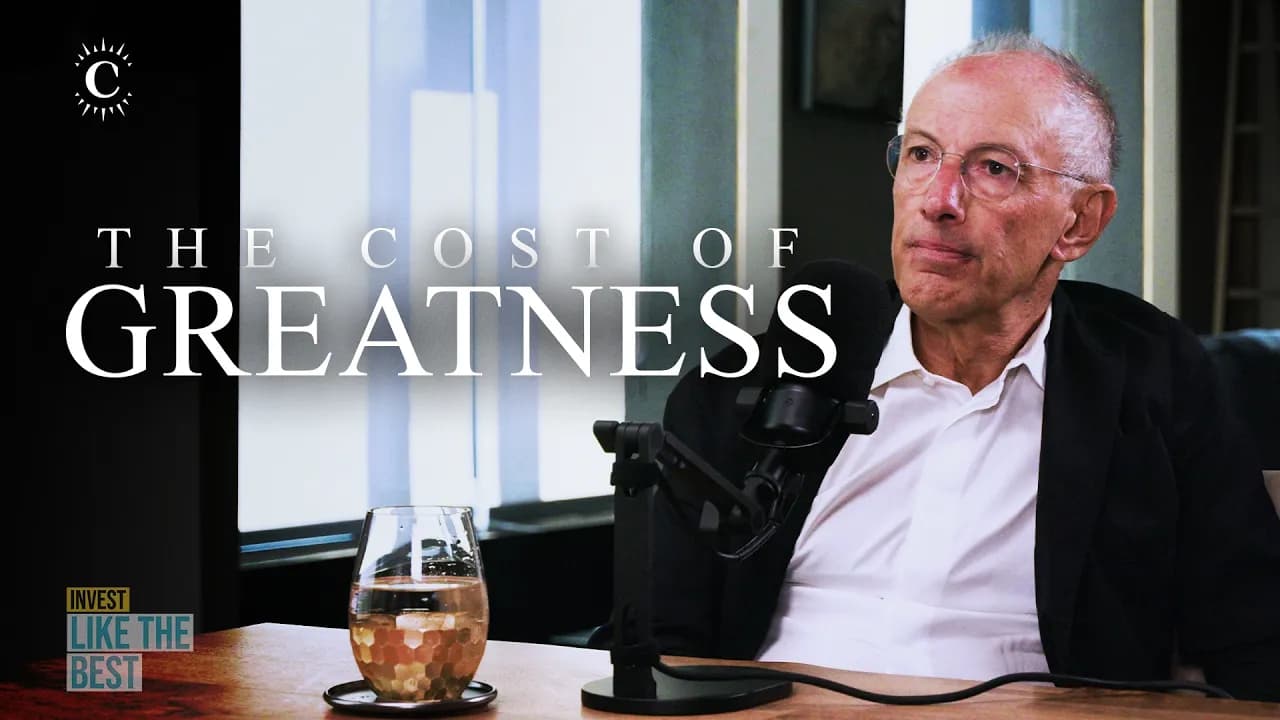
Axios Co-Founders Jim VandeHei and Mike Allen on the 2026 Midterms, AI, and Simplifying Your Life
In a Nutshell
Axios co-founders Jim VandeHei and Mike Allen predict Republicans will likely lose the House in the 2026 midterms, with the Senate still in play, and warn Washington is dangerously behind on AI regulation despite the U.S. holding a 6-9 month lead over China in the technology. They argue AI is a once-in-a-thousand-year opportunity that will reshape every industry and job, and that Axios has already adopted AI across the company to automate low-value tasks and boost productivity. Their new book "Simplify" teaches leaders to focus on three high-impact priorities, say no to everything else, and use the "Hell Yeah Rule" to protect time for what matters most.
These notes were generated by AI and may contain inaccuracies.
We are just at the very beginning of what will be the most chaotic, wild, 18-month period for any single human who's alive today. The episode opens with Christine Anderson, Global Head of Corporate Affairs at Blackstone, introducing the Monday Morning Meeting.
Today's lineup includes John Watson, a partner in Blackstone's Tactical Opportunities group, to explain neoclouds. Jon Gray's Market Views on YouTube covers the macro perspective. Guests Jim VandeHei and Mike Allen, co-founders of Axios, will discuss the 2026 midterms, how they built Axios, and their new book Simplify. Wayne Berman and Tom Nides join the Debrief on midterms implications for markets and business.
Neoclouds are infrastructure providers to the world's largest users of compute. They serve companies like Anthropic and OpenAI by providing integrated infrastructure services: buying accelerators or computer chips from NVIDIA or Google, putting them in data centers, and operating them at very high availability and very high scale.
Neocloud demand and compute demand is absolutely off the charts. For businesses selling compute, pricing is inflecting higher. Jensen Huang stated last week that 100% of GPUs around the world are fully utilized. Demand explosions are driven by emerging new technologies that rely on accelerated compute, foundational to the AI infrastructure build-out.
In 2022, after the ChatGPT launch, Blackstone worked with early neoclouds to understand their business models. CoreWeave approached in Q1 2023 with contracts from the largest compute users paying revenue per hour for compute. Blackstone set up a special purpose vehicle with 82,000 GPUs and the customer contracts, using rental payments to fund loan payments. This was pioneering compute financing.
Early financings trained the market to look to investment-grade balance sheets for compute financing. Now the view is emerging that compute itself is an asset class that should be financed commensurate with the economic value it creates. The question of whether accelerated compute will be important to the economy has been answered; the task now is treating it as a financeable asset class beyond just investment-grade customer contracts.
Mike Allen and Jim VandeHei are veteran political reporters from Washington Post, Wall Street Journal, and New York Times. They co-founded Politico, then left to found Axios a decade ago. They are among the best-sourced journalists in politics, business, and technology.
Maine is the key state to watch election night; Republicans might win there early. If Susan Collins loses in Maine, Republicans are finished. Few Republicans are making the case that anything good will happen. Republicans think they will lose the House, potentially badly. The Senate is legitimately in play.
Even if Republicans won everything, November 4th the day after midterms, the president is still a lame duck. Everything moves to 2028. AI and the data center conversation will be the leading edge heading into 2028. World events will fuel that conversation.
Affordability and the war are key, but fundamentally it's the economy, investment, and the future of business. AI technology has already seeped into every industry, every business, every job, every phone. The models companies are sitting on are vastly more powerful than people can fully appreciate. AI will have huge effects on how businesses are run, what the economy looks like, and therefore what politics looks like.
Washington is a lot slower on AI than charitable descriptions suggest. We will look back with shame that we didn't put far more forethought into this topic. The U.S. has a six-to-nine month lead on China on the most formidable technology probably created by mankind. The opportunity is to figure out early all the danger zones and set up a system so this technology works to the benefit of all.
All the things we worry about are right to be concerned about, but AI is also opportunity. For the next generation, there's never been a better time to start a business, try to cure disease, or start an organization. If you are a dreamer or a builder, there's never been a more magical time.
When starting something, you're trying to solve a problem. Twenty years ago at Politico, the problem was insufficient political coverage, lack of voice, and insufficient domain expertise by niche. That problem was solved. Then due to the Internet, brains were hit with taxation of bells and whistles, inquiries, emails, and texts. It became harder for people to get smarter on topics that mattered most, at the moment when more knowledge was needed across more topics.
Smart Brevity was the solution. The first two words of the Axios Manifesto: audience first. How is the audience changing? What does the audience need? Be obsessed with what they need. In journalism, people were taught to hide the good stuff. Smart Brevity says: pick one thing, know what your one thing is, write like a human, talk like a human, speak like a human. Avoid journalese, corporatese, bureaucratese, legalese.
Mike Allen has written a morning newsletter every morning, 365 days a year, for 19 years. Hitting reply on Axios emails goes direct to [email protected]. It's a human conversation. Audience first is why it works.
Three-plus years ago, Axios had intuition that AI would be bigger than people could fully appreciate. Having run media companies through the internet's disruption of news media, they were determined not to be victims again. The approach: learn the technology to put it to work, explain it to staff, explain it to kids and readers. Mike uses AI extensively for every MRI result and blood result, creating his own doctor version better than any doctor he's met. Every part of the company is looking at what can be automated.
Jim told Axios staff: I know many are skeptical and worried, but we are going to embrace this. Every person from day-one intern to Jim must become the world's number one expert in what AI can do to enhance their role and be a force multiplier for their superpower.
We are at the very beginning of the most chaotic, wild, 18-month period. This is a once-in-a-thousand-year moment. A thousand years from now, people studying history will study this moment. Everyone should ask: what am I doing in this thousand-year moment? What am I doing to understand it, engage with it, be a doer rather than passive?
Division in politics is way overhyped. Algorithms and TV screens have warped our view of the country. 80% of this country doesn't pay attention to politics, they like each other, they're good people who will be part of the rebuilding project. 80% of people agree on 80% of things, 80% of the time. That is not what we see on screens or hear in public conversation.
The U.S. is clearly winning the global AI race. It's essentially two players: the U.S. and China; everyone else is not in the game. China is more enthusiastic about using the technology and more optimistic about it. China has more state-driven application. The economic value will come from integrating AI into solar, cars, factories. The U.S. may be ahead on technology but behind on application.
AI unlocks humans to do what humans are best at: human expertise and human connection. Axios is hiring journalists like crazy because there's more opportunity in these times.
The easiest person to get on the phone is the President of the United States. Barak Ravid from Axios is the best global security reporter; sometimes President Trump calls him. The president has the reporter's number saved in his phone.
Sometime in the next two-to-five years, people won't go to websites, apps, or pick up newspapers. They will get all information on a personalized LLM that knows what they do, their interests, where they work, how they want news, when they want news, how they like clothes, where and when they buy them. In that world, high-end news and information will soar in value because if everybody has equal intelligence with AI, they will yearn for information that sits above and beyond that, and they will yearn for human connection.
Axios has local editions in 43 cities and is launching in 16 more. The guess is they will be in hundreds, if not thousands, of cities in the next several years. Content and human relationships connecting people in local communities and nationally is a pretty good business.
Jon Gray notes that if someone sends you a long email, they're asking you to do work. The value of human expertise, reporting, and experience that no LLM can match is what will matter. People are craving real dialogue that can't be gotten elsewhere.
Super journalists are people who know things others don't know, have expertise, have built followings and unique relationships. People with the screw loose who are maniacal about a topic and know everything about it are the favorite journalists because they tell you things you never knew, with enthusiasm. Those people will have tremendous value.
Everyone needs trust with clients and potential clients. Human connection is the great facilitator. Getting to know someone as a reader creates the bond and creates value. People may revert to trusted news organizations with proven fact-checking.
38% of 18-to-29-year-olds regularly get news from influencers with mixed credentials. The difference between an LLM and social media: social media is built on an algorithm that doesn't care if it's healthy or accurate. An LLM fundamentally doesn't work unless it's accurate and real. The incentive is that it needs reality, truth, fact. This may help clean up the information environment.
The book Smart Brevity is about communicating much more effectively. Simplify is the operating system adopted two and a half years ago about how to do more with less, focus on things that matter, and get rid of all the dumb things that build up inside companies and individual workdays.
Axios implemented AI to handle tasks that don't drive value, allowing employees to spend most of their time on high-value work. The company saw a magical response where productivity increased and employees became happier because they focused on work they're actually good at and work the company was proud of doing.
The big takeaway of the book is wanting people doing the right work, not more work. This insight came from both professional experience and life experience.
Two words that will change your life when someone asks you to do something: "I'm booked." You don't need to apologize or explain. It's respectful and true since there's not a day in your life that's not booked.
When someone asks you to join something or do something, if you're thinking "I guess I should" or "I probably should," then just say no. If you can say "hell yeah," then you're in because it's something worthy of your time and worth doing.
The book shows how to list the three things you need to do to crush it in your job, or the three things you want to do to be known for and be successful in your personal life. Key questions include: What are you uniquely good at? How can you maximize the amount of time spent doing that? How do you maximize what brings you joy? The Simplify power tools help accomplish this.
One founder noted becoming more maniacal and hard charging than twenty years ago, but better at finessing it. Previously burned hot with constant go-go-go energy that was noticeable to others. Running a company taught that nothing is ever as good as you think it is or as bad as you think it is.
Developed an approach of treating anything good or bad as intellectually interesting - going to solve it or overcome it. Learned to have calm while maintaining the fire. After selling majority of Axios to Cox several years ago, could have retired but instead work more hours, getting up at 3:30-4:00 in the morning and going all day.
One big lesson from running a company long-term is that leading people is a great honor and responsibility. Many people don't take it that way. In a position of leadership, all habits - good and bad - seep down overnight. This creates huge responsibility to carry oneself with dignity and class. You can be as ambitious as hell and still be a fundamentally really good person.
Both founders were English and Poli-Sci majors. When they were coming up, it was safer to color inside the lines. Now employers look for people who want to spin up a side project, or who are doing something interesting on X or YouTube even if not employed. Real opportunity exists because people were very confined by org charts and moving up the ladder. Being creative, willing to be a Swiss Army knife, willing to do a project someone hasn't told you to do, seeing what's sitting there - you can suddenly rocket up the chart.
The founders have been really good friends forever, talking 20 times a day from sunup to sundown. The job wouldn't be as fun without this partnership. One founder is ten times more effective because the other talks to every single person in power in the world all day and shares that intelligence, allowing focus on the company without having to do all the relationship-building.
These are once-in-a-thousand-year times. Both founders are on fire and excited to make a difference. Some might think they're on the back nine, but they feel like they're just getting started. AI possibilities and the stakes of these times make one founder love being awake and part of the action, can't wait to have new ideas and act on them.
Wayne Berman and Tom Nides, two creatures of Washington who have served in both Republican and Democratic administrations, joined to unpack the interview. They're known for having a little bit of fun at times.
The panelists predict election night will be unusually fascinating for a midterm election. Democrats are certain to take the House majority from Republicans. Senate races are so close and unpredictable that everyone's looking for the key race that will decide it all. Election night will be really fun to watch.
The Senate could come down to one or two seats, with Democrats potentially having a very good night. Two weeks before election, the possibility that Senate could go into Democratic hands seemed unlikely earlier. A blue wave or tsunami could be bigger than previous waves given current numbers. Even Republicans who won by seven points or less have problems if people are angry. Gerrymandering and district line changes make a tsunami like Obama's or George W. Bush's (45 and 66 seats lost) very unlikely.
Government works better with divided government because it forces people to work together. Very little serious legislation will get done given President Trump's veto power. Democrats won't have a supermajority under any circumstances. One area for potential compromise is AI, where there'll be pressure from both Democrats and Republicans to act. Divided government doesn't make very significant changes in the status quo.
Markets will react to high deficits continuing at 6% levels, affecting the bond market. No significant tax legislation or real regulatory efforts expected. The panelists will return throughout the season to discuss developments.
Keep Blackstone in your library
Save the videos and channels worth coming back to, and find them again in one place.