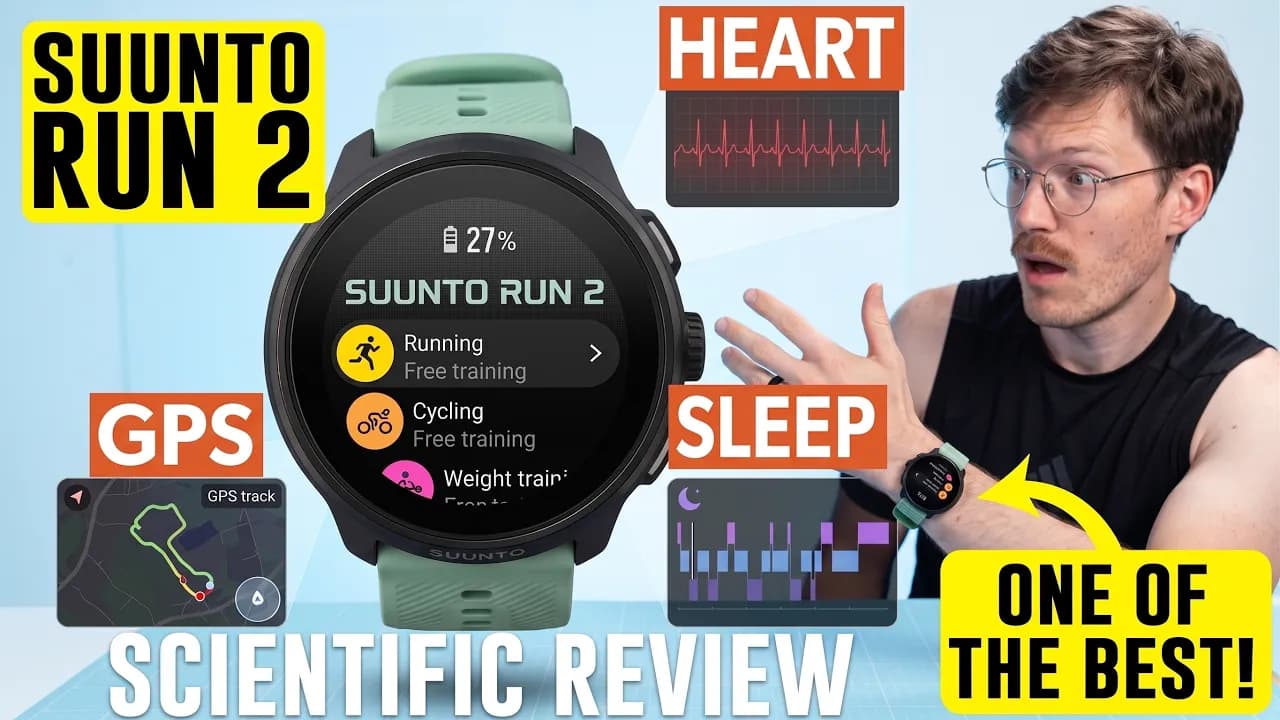
BEST Heart Rate: Suunto ECG Chest Strap! (Scientific Review)
In a Nutshell
The Suunto HRB2 ECG chest strap delivers near-perfect heart rate accuracy across cycling and running (R=0.99–1.00) and strong results for weightlifting (R=0.97) when tested against the Polar H10 reference. It supports Suunto-exclusive features like ZoneSense training intensity analysis and running posture metrics but only works with select newer Suunto watches; other brands receive basic Bluetooth HR data only. Priced at €99/$99, it’s a direct, reliable alternative to the Polar H10 for users invested in the Suunto ecosystem.
These notes were generated by AI and may contain inaccuracies.
Suunto launched the Smart Heart Rate Belt 2 alongside its new Run 2 watch. The device provides electrocardiogram measurements of heart rate and RR intervals. The name "Suunto Smart Heart Rate Belt 2" is abbreviated as "Suunto HRB2" for convenience in this review.
The Suunto HRB2 measures electrical activity of the heart and uses an algorithm to identify R peaks in the electrocardiogram signal. These peaks calculate heart rate and time intervals between beats. The device includes a six-axis motion sensor for measuring running posture, shielded electrodes for cleaner signal quality, an improved belt, and support for three simultaneous Bluetooth connections. The transmitter weighs 12.8 grams, detaches with a single press, and operates automatically once worn. A physical button allows pairing of new Bluetooth devices.
The device uses a replaceable CR2032 battery with 210 to 460 hours of battery life depending on enabled features and connected devices. It is water resistant to 30 meters depth and suitable for swimming, though Bluetooth performance is poor underwater and saltwater may interfere with measurements. The memory stores pulse data when the watch is away, functioning only with compatible Suunto watches.
The running posture features measure ground contact time, vertical oscillation, flight time, contact time to flight time ratio, and foot balance during contact. The belt supports Suunto's ZoneSense feature, which uses RR interval data to estimate training intensity and aerobic and anaerobic performance thresholds. These advanced features are not universally compatible with all devices.
Modern Suunto models including the Suunto 9 Peak Pro, Vertical, Vertical 2, Race, Run, Run 2, and Ocean series support heart rate, RR intervals, memory, and ZoneSense technology. The running mode feature is limited to the Vertical 2, Race, Race S, Run and Run 2 models. Some watches require dedicated sports modes or Suunto Plus for full functionality.
The belt connects to compatible Bluetooth devices from Garmin, Polar, Coros, and Apple. It streams heart rate data but lacks Suunto-specific features such as memory, running mode, and ZoneSense on non-Suunto devices. Older Suunto watches are largely incompatible despite some appearing to match the strap.
The Suunto HRB2 was tested against the Polar H10 ECG chest belt as a reference device. The Polar H10 underwent extensive testing with ECG signals and heart rate estimates manually checked for scientific accuracy. The Polar H10 was worn in its normal position with the Suunto belt placed directly underneath, representing a slightly less-than-ideal position for the Suunto device.
Both belts were used simultaneously during different exercise types, with direct comparison of heart rate values to determine reliability. The testing covered indoor cycling, running, outdoor cycling, and weightlifting.
Indoor cycling showed a correlation value of 1.00 between devices. All measurements aligned closely to the ideal match line with minimal deviation in the lower heart rate range, likely due to algorithmic differences. Trial sessions demonstrated perfect matching between the Suunto HRB2 and the Polar H10 reference throughout all cycling sessions.
Running tests also produced a correlation of 1.00 with all data points on or near the ideal match line. Trial sessions showed near-perfect matching with one instance where the Polar H10 detected a peak that the Suunto did not detect, possibly due to Polar H10 behavior rather than Suunto performance.
Outdoor cycling produced a correlation of 0.99, still considered nearly perfect. Upper heart rate ranges showed perfect matching with slight differences in average to low heart rate ranges. Some sessions demonstrated perfect matching while others showed variations in lower heart rate ranges, attributed to algorithmic differences in heart rate change detection. Brief signal loss occurred in one session, indicated by straight lines in the data, but overall compatibility remained nearly perfect.
Weightlifting proved most challenging due to wrist pressure and narrower heart rate range, resulting in an R value of 0.97. The Suunto device detected slightly higher heart rates at peaks compared to the reference. Some reductions appeared different, potentially due to heart rate calculation methods such as averaging the last second or two seconds. The Suunto device showed higher peaks but some troughs were not fully visible compared to the Polar H10.
The Suunto HRB2 was compared against previously tested devices including smartwatches. Correlation coefficients and performance rankings showed the Suunto HRB2 performed better than 99% of devices in indoor cycling, 97% in outdoor cycling, 100% in running, and 83% in weightlifting. Some competing devices encountered fewer difficulties but suffered from measurement interruptions. Apple Watches were noted to stop measuring heart rate when signals become unreliable, unlike the Suunto HRB2 which maintains continuous measurement.
The Suunto HRB2 accuracy is considered very good based on testing and can serve as a replacement for the Polar H10 without affecting smartwatch test validity. The device connects to three simultaneous devices like the Polar H10 but lacks ANT+ technology. The Suunto HRB2 is recommended for users wanting Suunto-specific measurements including running posture and ZoneSense features, particularly those owning or planning to purchase compatible Suunto watches such as the Run 2.
The Suunto HRB2 retails for 99 euros or dollars, comparable to the Polar H10's original recommended price. The Polar H10 may be found at lower prices due to its longer market presence. Both devices demonstrate nearly identical performance, with the choice depending on usage scenarios and ecosystem compatibility. The Polar H10 offers established reliability while the Suunto HRB2 represents a newer option with no encountered problems during testing.
Keep The Quantified Scientist in your library
Save the videos and channels worth coming back to, and find them again in one place.