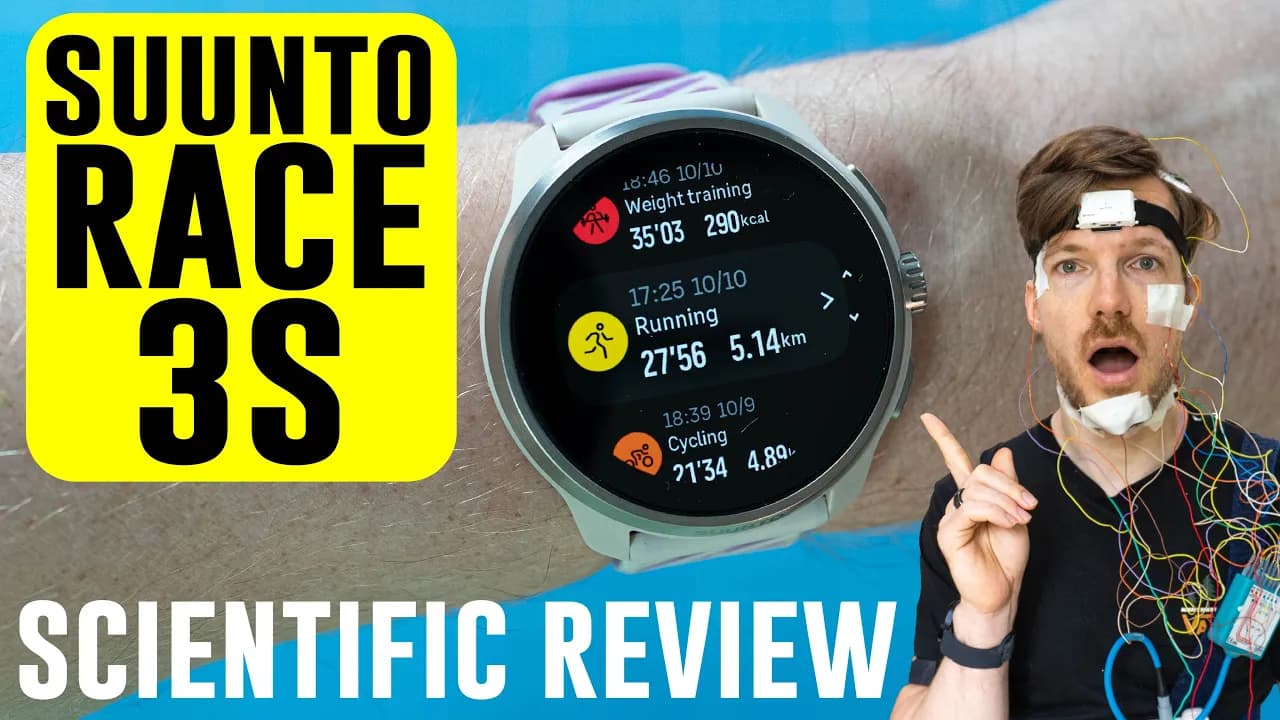
Suunto Run 2 Ultimate Scientific Review! A lot of value!
In a Nutshell
The Suunto Run 2 delivers excellent wrist-based heart rate tracking for cardio activities (R=0.98-0.99 vs. ECG chest strap) and strong dual-band GPS performance (score 85), making it one of the best values at €299-349 for runners and cyclists. Sleep tracking remains unproven with only two nights of data showing poor REM agreement (28%) but acceptable deep/light sleep results. Weightlifting heart rate accuracy is weak, requiring a chest strap for reliable readings in that context.
These notes were generated by AI and may contain inaccuracies.
At €299 or dollars, the new Suunto Run 2 running watch includes offline maps at a decent price. Heart rate tracking accuracy is great for this price point, making the Suunto Run 2 a watch that can be definitely recommended, though there are some limitations to discuss in detail. The focus of the review is on data quality, specifically testing heart rate tracking, sleep tracking, and GPS tracking.
There are two versions of the Suunto Run 2: a 4 gigabyte model for $299 and a 64 GB model for $349. Both support offline maps and music, with more storage allowing users to keep more data on the watch. Details from Suunto about mapping functionality and potential limitations are still pending, but the mapping has worked well for normal runs.
The three most important changes compared to the original Run One are dualband GNSS for better GPS tracking, an upgraded optical heart rate sensor with 12 channels (also seen in other Suunto watches), and increased screen brightness from 600 to 2,000 nits. The heart rate tracking showed great performance in testing.
The display remains a 1.32 inch AMOLED panel but is brighter. Battery capacity increased from 295 to 380 milliamp hours. Suunto claims up to 10 days of normal use and up to 24 hours in performance mode, compared to 8 days and 20 hours on the original watch.
The basic design hasn't changed dramatically. It's still a 46 mm watch with stainless steel and mostly plastic construction with a five atmosphere rating. Plastic benefits include being relatively light, which probably helped with good heart rate tracking performance. The new model is about 0.2 mm thicker, and the watch body is 3 g heavier at 35 g, representing relatively small differences.
Heart rate tracking was tested during exercise by comparing against a Polar H10 ECG chest strap reference device. The reference is plotted along the horizontal axis and the Suunto Run 2 along the vertical axis, with perfect agreement shown by points on or close to the blue line. The correlation value (R) of 0.99 was achieved, which is really high and good enough for most people.
Indoor cycling showed the Suunto Run 2 tracking heart rate perfectly across several intervals. A second session showed some minor issues at the beginning but otherwise a really small difference. A third session showed tiny differences at the beginning that were so minor they wouldn't make a difference for tracking heart rate.
Running is harder for optical sensors due to bumpiness and potential cadence lock issues, but the Suunto Run 2 performed well with a correlation of 0.99. Most points were on or close to the blue line, potentially even better than indoor cycling results. One moment of deviation occurred, and some dips were slightly differently detected, though this could be a definition question about current heart rate.
Outdoor cycling is where many devices struggle, but the Suunto Run 2 achieved a correlation of 0.98, which is amazing for outdoor cycling on a wrist-worn device. Most points were on or close to the blue line, with some deviation mostly where it detected slightly too low heart rate. This wouldn't change exercise behavior and represents very good performance compared to competition.
Weightlifting is where most devices struggle, and this holds true for the Suunto Run 2. In the higher heart rate range, it detected too low heart rate much of the time, missing many peaks during sets of exercises. For weightlifting, an external chest strap is recommended. Suunto has a new chest strap coming out at the same time as this watch that performed as well as a Polar H10.
Using correlation values for comparison across devices tested: the Suunto Run 2 performs better than 60% of previously tested devices for indoor cycling, better than 80% for outdoor cycling, and better than 89% for running. For weightlifting, it falls somewhere in the middle of all devices tested. A heart rate rating score of 98.7 gives a "great but almost perfect" rating for cardio exercises, excluding weightlifting from the calculation.
Nighttime heart rate tracking showed generally good agreement between the reference and Suunto Run 2, though the watch detected slightly higher heart rate sometimes. Only two nights of data were available due to accidentally not enabling sleep tracking. The patterns were mostly the same, with some spikes that might represent moments of getting out of bed. Heart rate variability testing couldn't be performed as the data couldn't be extracted from the Suunto app.
Sleep stage tracking results are super preliminary based on only two nights of data. Using Zmax EEG as reference: deep sleep agreement was 85% (better than expected, though expected to drop to 50-70% with more testing), light sleep agreement was 82-83%, and REM sleep agreement was only 28%. The overall impression is that REM sleep tracking won't be great but deep and light sleep might be okay. These results should be interpreted with caution.
GPS testing used the most accurate and battery-consuming general mode. Testing involved cycling or running the same route many times to see if signals overlapped nicely. Good overlap likely indicates good GPS tracking, while poor overlap indicates the opposite.
Running a rectangle route multiple times showed signals quite close together with minor jaggedness. Near walls that usually interfere with GPS tracking, the Suunto Run 2 performed well with only minor interference. A second run also looked mostly good with some deviation near walls but still very good overall performance.
Seven cycling trips to work showed signals super close together with very good tracking. Nine trips from work also showed signals acquired super quickly with generally super close tracking, though some deviation occurred near buildings and overhangs. Some deviations were due to actual construction or obstacles requiring route changes. The GPS tracking receives a score of 85, rated as "great" compared to competition.
Side-by-side comparison at peak brightness shows the Suunto Run 2 is brighter than the Run 1. For navigation, routes can be loaded and displayed offline on the device with clear map visibility. The compass can be calibrated, and GPS signal acquisition works properly. The maps look nice and clear on this relatively affordable device.
The Suunto Run 2 is not a perfect device, with sleep tracking potentially needing improvement. For cardio exercises like running, indoor cycling, and outdoor cycling, both GPS and heart rate tracking are great, with heart rate tracking representing some of the best seen for wrist-based wearables. Results are specific to the reviewer's body and environment, and checking other reviewers is recommended.
Keep The Quantified Scientist in your library
Save the videos and channels worth coming back to, and find them again in one place.