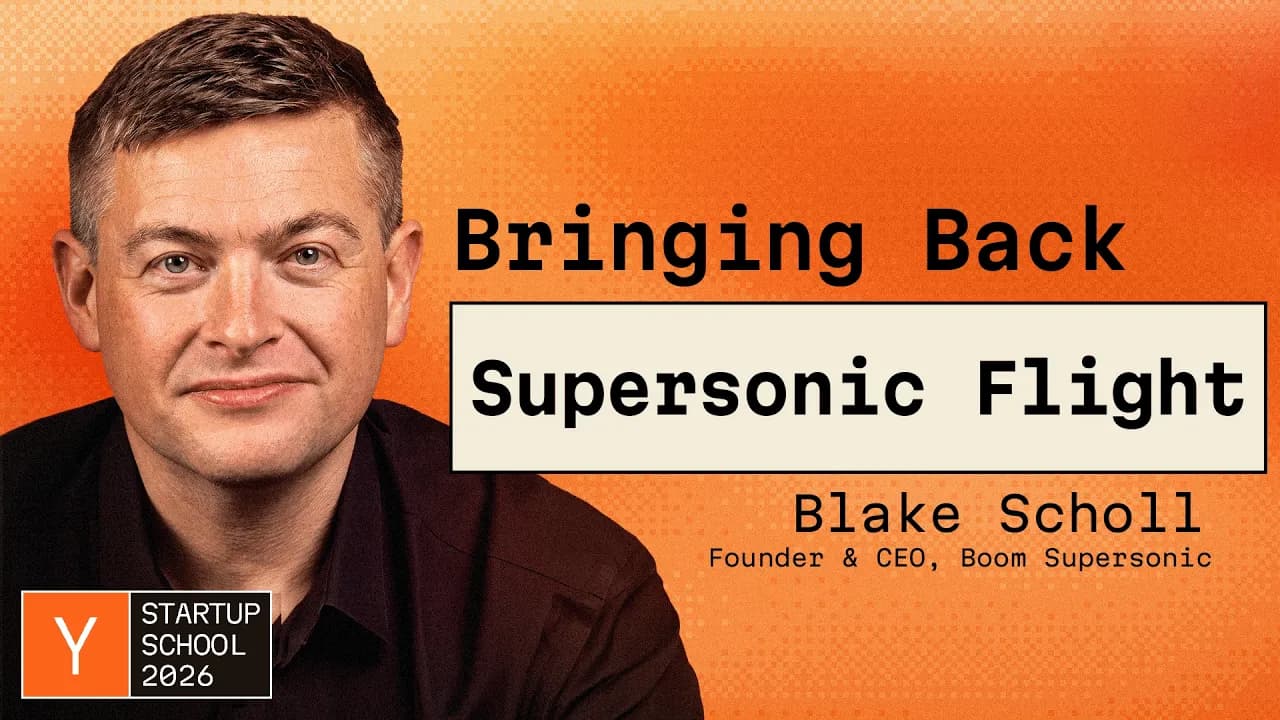
Blake Scholl: Why Plane Speed Stalled, Supersonic Commercial Flight, & Revolutionizing the Engine
In a Nutshell
Boom's XB1 became the first private supersonic jet to break the sound barrier, proving boomless cruise up to Mach 1.3 and triggering the end of the 1973 U.S. supersonic flight ban. After Rolls-Royce walked away, Boom vertically integrated its own Mach 1.7 engine, now producing 42 MW gas-turbine cores for behind-the-meter data-center power and scaling a factory to multiple gigawatts per year. Overture will fly paying passengers Mach 1.7 over water and 50 % faster over land, with a $3,500 break-even Atlantic round-trip and a four-year target to service.
These notes were generated by AI and may contain inaccuracies.
Boom Supersonic founder and CEO Blake Scholl presented the company's vision to fly at Mach 1.7 with 130 orders from major airlines. Boeing hasn't built a new airplane in 20 years. The company aims to bring back supersonic passenger travel and make the planet dramatically more accessible. The entire airplane was built by essentially 50 people. Courage is not being fearless. Courage is acting despite the fear. If there's no boom at all, there's nothing to argue about. The world needs supersonic flight. Passengers deserve it.
In 1969, humanity landed on the moon and flew an airliner through the sound barrier. More than half a century later, we can't go to the moon and can't fly faster than the speed of sound. The political legacy of Concorde was a ban on supersonic flight over the US. Boeing brought us into the jet age in 1957 with the 707. Their latest airliner is a literal carbon fiber copy of their first. Interns were born after the last time Boeing launched a new airplane in 2004. An alternate timeline could have allowed crossing the Atlantic in three and a half hours, with Sydney as accessible as Honolulu is today.
Twelve years ago, Scholl was a software engineer and ads guy from Amazon and Groupon. In 2015, he pitched Jeff Bezos on Boom's seed round, and Bezos passed. Bezos wrote in the 2015 Amazon shareholder letter that no matter how good an entrepreneur you are, you're not going to build an all composite airliner in your garage startup. The initial garage setup included a supersonic airliner mockup made from cardboard, plywood, and seats from Office Depot. In 2024, Boom became the first private company ever to build a supersonic jet with just 50 dedicated people.
When XB1 flew, it had the first supersonic installation of Starlink, allowing people worldwide to tune in watching a video filmed on an iPhone streamed via Starlink. XB1 became the first privately developed jet to break the sound barrier. The team demonstrated that supersonic flight could be boomless using a technique called boomless cruise that uses the natural refractive power of the atmosphere to redirect the sonic boom upwards. The sonic boom makes a big U-turn in the sky and never touches the ground, working up to about Mach 1.3.
After breaking the sound barrier, the team spoke with the president who agreed that if there's no sonic boom, there should be no ban on supersonic flight. The ban that started in 1973 ended June 6th of last year. The Supersonic Legalization Act passed the House unanimously and got out of Senate Congress unanimously recently, now needing to pass through the rest of the Senate.
One of the challenges was outsourcing engine development to a big company, which didn't work out. After breaking up with Rolls-Royce, the team decided to make their own engine from scratch. The engine is designed to run full duration at high power in a hot environment at Mach 1.7. They're manufacturing their own engines at scale starting from raw materials, going to parts including the most difficult ones like blades and vanes, then assembling them and running on their own test stand. The first vertically integrated jet engine core is getting assembled and will be in a test stand next month.
The supersonic engine technology has an unexpected application for data centers. By taking the fan off the front and putting a generator in the back, the engine can deploy 42 megawatts for behind-the-meter power generation. The supersonic engine core is designed to run hot so it doesn't need any water. The company is building the world's most advanced jet turbine factory in an undisclosed location that made its first parts last week and will scale to making multiple gigawatts per year. Over the next 5 years, they aim to add 10 plus gigawatts to the grid.
Round trip across the Atlantic at Mach 1.7 takes 3 hours with a break-even fare of about $3,500. The goal is 4 years, but being fast is more important than being predictable. Over land, flights will be 50% faster with no sonic boom. Over water, full speed is possible. The engine will be the most tested new jet engine ever made, thanks to being proven on the ground first.
There are tens of gigawatts of demand for the data center application in the inbox. The first engine will run next month and then be auctioned off. The company has never seen demand like this for anything else.
The company is called Boom because the sonic boom was never going to be the blocker. The airplane is called Overture. The goal is to speed up flights for every passenger from the president on a supersonic Air Force One to a supersonic private jet to supersonic commercial flights available to every class of passenger. When kids have to be convinced that it used to take 6 hours to cross the country, that's when success will be achieved.
Supersonic flight is not a partisan issue, with legislation passing Congress unanimously. The current administration moves fast - the sound barrier was broken on Monday, a tweet was posted, Elon reposted it, and by Tuesday there was an invitation to the West Wing. By Thursday, the airplane model made it to the Oval Office where it remains. The executive order took 115 days to get signed.
Keep All-In Podcast in your library
Save the videos and channels worth coming back to, and find them again in one place.