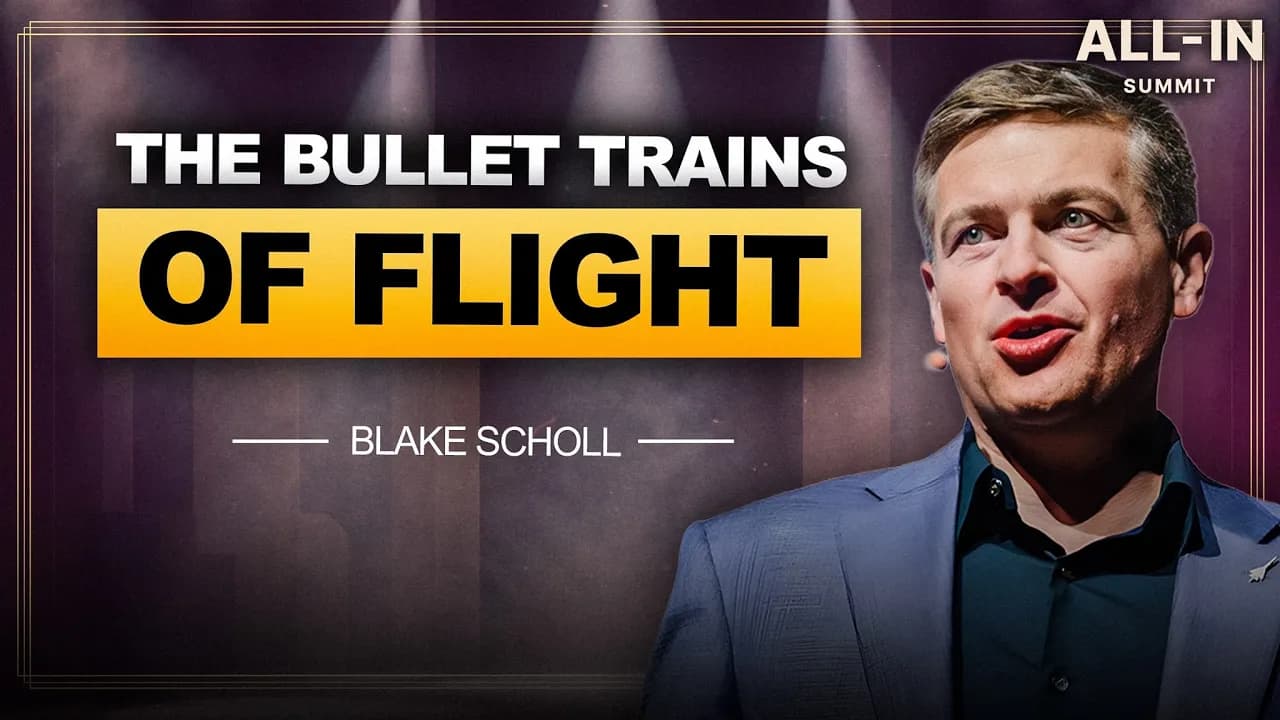
Blake Scholl: "The Future Was Supposed to Be Faster"
In a Nutshell
Boom founder Blake Scholl built the first privately-developed supersonic jet, XB-1, proving Mach 1.1 flight is possible outside government programs and triggering the end of the U.S. supersonic flight ban. He shows that hardware iteration can match software speed through vertical integration, all-digital manufacturing, and tools that cut part production from weeks to 24 hours. The core lesson: pick what you love, ignore advice to stay in your lane, and start now—self-belief and capability are earned by doing the work, not waiting for permission.
These notes were generated by AI and may contain inaccuracies.
In 1969, the first moon landing and the first flight of Concorde, the supersonic airliner, both occurred. Half a century later, neither capability exists commercially. The Wall Street Journal reported Lockheed now takes more than two years to build a new Patriot missile interceptor.
The Boeing 707 brought the jet age, while the 787, launched more than 20 years ago, offers no speed improvement. Prior to Boom, America never progressed beyond a mockup of a supersonic airliner.
The experience of gathering speed down the runway, climbing into the sky, and viewing the natural world alongside humanity's creations is described as profoundly moving. Yet this experience has been turned into something most people dread.
The first jetliners doubled the speed of previous air travel. Hawaii became a mainstream tourist destination once reachable from the US in seven, eight, or nine hours. Phil Knight founded Nike in the 1960s after a trip to Japan inspired him to import Japanese running shoes. The Beatles' first world tour in the late 1960s would not have been practical with slower aircraft.
A supersonic age would make crossing the Atlantic possible in three and a half hours and Sydney as accessible as Honolulu is today.
In his mid-20s, Blake Scholl set a lifetime goal of breaking the sound barrier. A Google News alert on supersonic revealed more progress in supersonic music than flight. The obvious candidate appeared to be a private business jet, but the US ban on supersonic flight eliminated the business case for Gulfstream. Boeing is not building new airplanes. In 2015, Jeff Bezos passed on Boom's seed round and wrote in the Amazon shareholder letter that airliners are something only big companies can do. Scholl's background was software engineering at early Amazon and founding an apps company acquired by Groupon; his aviation knowledge was limited to a Cessna pilot's license.
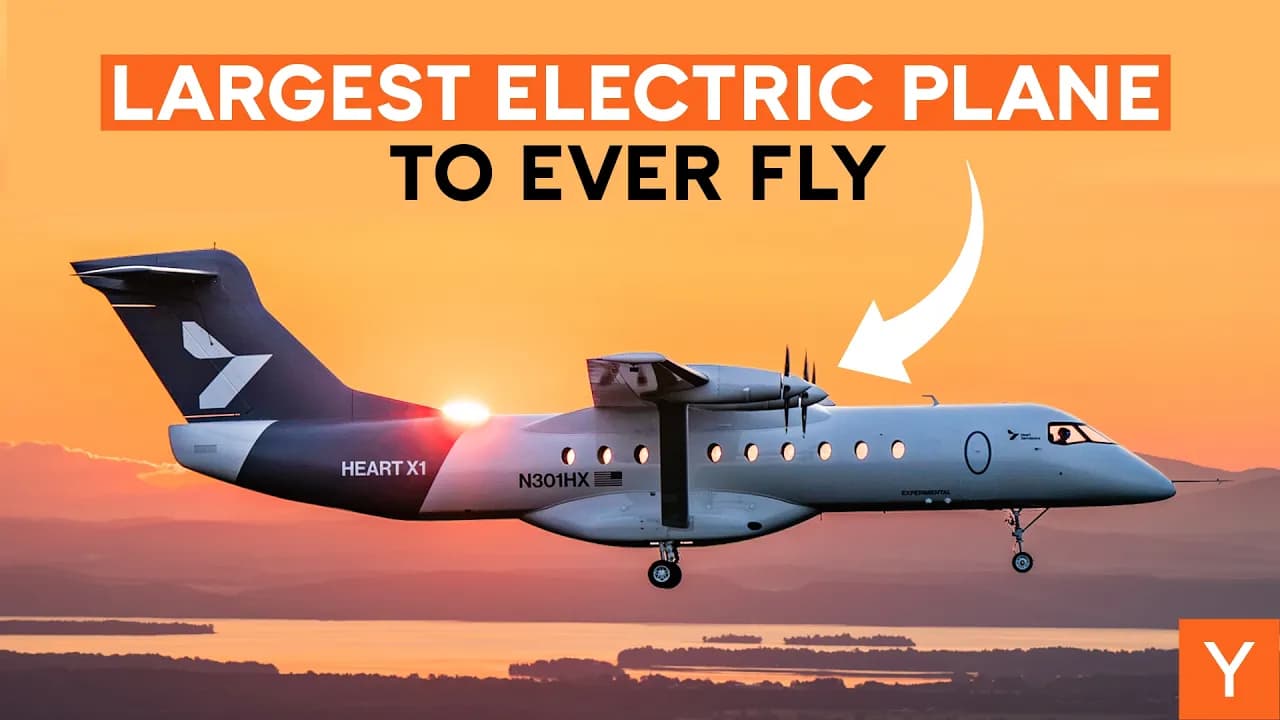
In 2014, work began with a cardboard and plywood mockup using Office Depot seats. By the end of the Y Combinator batch, a cardboard mockup of the first airliner prototype existed. The XB-1 prototype, originally called Baby Boom, was built to learn what it would take to create a supersonic passenger plane outside government or military programs. In 2023, XB-1 became the first independently developed jet to break the sound barrier more than a decade after founding.
During the flight in the Mojave Desert, control confirmed "Go for Excel to Mach 1.1." XB-1 achieved supersonic flight with no audible sonic boom on the ground. The principle demonstrated was Mach cutoff: breaking the sound barrier at sufficient altitude and appropriate speed causes the sonic boom to make a U-turn in the sky. Within 24 hours of the flight, an invitation to the West Wing arrived. Within 115 days, an executive order made supersonic flight legal again in the US. A bill to make the change permanent passed the House unanimously and cleared the Senate Commerce Committee with a unanimous vote.
XB-1 was the first privately developed supersonic jet, the first supersonic jet made in America, the first human-piloted airplane to land solely on augmented reality with no natural runway view, and the first supersonic air-to-air live stream filmed on an iPhone and streamed via Starlink. The XB-1 team consisted of 50 people.
The approach was to make hardware development resemble software development by reducing iteration cost. Makeboom allows defining an airplane in a configuration file, running a whole-aircraft simulation in minutes to evaluate range, fuel burn, passenger capacity, and trade-offs. Bladeunner enables a couple of engineers to change a turbine blade design in real time and see structural and aerodynamic behavior instantly.
An in-house machine shop allows a digitally designed engine part to become a prototype in about 24 hours. An engine test stand is located half an hour from the engineering and manufacturing facility. A superfactory is under construction; in January the building was empty, and six months later the first machines were installed with production engine parts beginning in a couple of weeks.
Vertical integration of propulsion enabled the supersonic engine to be adapted and sold separately as Superpower, a natural gas power turbine. The first Superpower turbines are under construction and will reach the first customer in less than 12 months.
The XB-1 supersonic flight was livestreamed via the first supersonic Starlink installation. Millions watched worldwide, including classrooms where children reacted visibly. The next chief engineer of another supersonic jet may have been among the viewers.
The belief that every technology is created at the earliest possible moment is false. Supersonic flight technology existed long before Boom was founded and the company could have been started ten years earlier, but nobody did it. Founders should pick problems they want to solve and treat "why now" as answered by the decision to start now.
America cannot beat China by repatriating the same manufacturing that left. The strategy is to invent the next wave of manufacturing. China hollowed out US tool-and-die capacity; Boom is developing all-digital manufacturing processes that eliminate tooling, allowing a turbine blade to move from digital design to finished part in 24 hours with no tooling.
AI has reduced the cost of software development, enabling custom engineering tools that previously would have been unaffordable. Amazon succeeded partly because it built in-house software that fit its operations exactly. AI lowers the barrier for any business to create software that fits perfectly. Physical-world AI remains limited; programming CNC machines is still highly manual, and effective AI for industrial automation has not yet appeared.
The last startup to build a commercial airliner was Douglas Aircraft in 1921. The industry has been dominated by large companies with poor cultures. The challenge is finding people who are technically competent, good culture fits, and experienced.
Blake emphasizes the importance of valuing early career talent, particularly young, ambitious, and smart individuals who have not been shaped by legacy aerospace companies. He prioritizes hands-on people who have built things, are smart, get things done, and remain optimistic. At senior levels, it becomes even harder to find the right talent. When building a company, promoting from within allows people to grow up in the company's own culture, which is significantly better.
From Boom's perspective, delivering on physical AI for manufacturing would be transformative. Scholl envisions a large-format manufacturing capability that could go from a CAD design to an automatically QA'd part with one machine without a programmer. He states there is no reason to believe this is impossible—it simply hasn't been created yet.
When asked whether early hardware startups in regulatory gray zones should engage regulators before deploying or deploy first and legitimize after, Scholl clarifies there is no one-size-fits-all answer. The approach is highly contextual.
He contrasts two examples: Uber's strategy under Travis, who ignored regulators and built a customer base to use as leverage against regulatory attempts to shut them down. Scholl believes Uber could not have succeeded by befriending regulators first, as the entrenched taxi industry was actively using regulators to block competition.
Scholl identifies this as a common pattern in regulation: it often does not come from well-meaning efforts to protect the public, but from entrenched, lazy interests that avoid competition and seek government power to eliminate competitors. He calls this deeply unethical, noting it happens frequently.
Aviation presented a different context. There was no entrenched enemy—Boeing had its own self-inflicted problems and viewed Boom as unlikely to succeed. This allowed Boom to fly under the radar. Given the safety-critical nature of the product, engaging regulators early made sense.
When starting the company and building XB-1, Scholl approached the FAA directly, explaining what they were doing, why it mattered, and asking for help. They invited the FAA to provide feedback on plans before finalization and welcomed visits to see anything they wanted. This approach resulted in the approvals process for XB-1—normally stretching months even for an R&D airplane—being completed in 90 minutes. They received the first-ever permit for flying a civil supersonic airplane before the aircraft had even flown for the first time.
Scholl highlights Steve Jobs' Stanford commencement address as containing the best advice he ever received. Jobs emphasized that great work requires working on something you love and not compromising—holding out for the thing you truly want to build. This connects to hiring: the most important quality to seek in people is whether they care. Skills and knowledge can be taught, but caring cannot be taught to someone who doesn't care.
Scholl's mother advised him not to start Boom, suggesting he should work on something he knows something about. This is common well-meaning advice. Scholl shares that his first company focused on mobile e-commerce because his resume suggested expertise in that area—he knew how to do it but didn't know what mobile e-commerce should be, and he didn't care about what they were building. He produced high-quality apps but had no product vision and wasn't enjoying the work.
Scholl concludes that the worst advice is to work on what you know. Knowledge can be changed, especially in a world with personalized AI tutors. Anyone with passion and dedication can learn new knowledge and skills. What cannot be easily changed is what you love. Passion is not changeable, and there has never been more reason to work on what you love.
Boom took about ten years to break the sound barrier. Scholl does not recommend following their path. The company nearly died multiple times, and it took more time and money to reach proof of concept than expected.
With hindsight, they were very early to deep tech. If they had known on day one what the community knows today, it would have taken two or three years rather than five. The key lesson is about iteration—specifically, integrating and iterating at the product level. XB-1 was an extremely challenging prototype. Instead, they should have planned something simpler and easier that would provide multiple shots on goal, allowing faster discovery of both engineering and requirement mistakes.
Founders should work on the most exciting thing they can imagine themselves doing. If a startup idea calls to you day and night—even if you're unsure you can pull it off—you should go build it. If you don't have such an idea, work with the best people you can find on the problem you're most excited about solving.
The magic happens early in your career when you find the intersection of what you love doing, what you can become really good at, and what matters to the organization around you. When all three align, your career goes vertical.
At early Amazon, Scholl worked on something Jeff Bezos cared about that mattered to Amazon. At age 23-24, he had a $300 million P&L on a project one of the world's greatest entrepreneurs cared about. When he made mistakes, significant people at Amazon helped him learn and avoid failure.
Scholl did not have self-belief on day one. He had nowhere near the resume to build a supersonic airliner. When he told friends, their eyes would roll back and oxygen would leave the room. One friend told him to call back when he had something less "pie in the sky."
He reflected on founders he admired—Steve Jobs, Bill Gates—and particularly something Bill Gates said in the 1970s: his goal for Microsoft was to put a personal computer in every home and on every desk running Microsoft software. This was at a time when personal computers mostly didn't exist.
No one taps you on the shoulder and gives you permission to do something incredible. The only way to know what you're capable of is to pick something, work really hard at it, give it everything, and stop worrying about whether you can do it—putting all mental energy on how to do it. Self-belief came later. Self-doubt is normal; you have to put it aside, do it anyway, and become the person you need to become.
Scholl has enormous respect for Jeff Bezos. One thing Amazon did exceptionally well was thinking very long range while maintaining incredible operating discipline in the moment. Bezos made seven-year business plans, tackling things that seemed bizarre to the rest of the world. He was laughed at internally and by his board when launching Amazon Web Services, and laughed at for e-commerce—yet both succeeded.
A company's character, particularly a public company, is revealed by its quarterly behavior. Amazon would never massage choices to make earnings look good in a quarter; they made long-term cash flow decisions. At the same time, there was incredible operating discipline—goals, operational excellence, focus on the here and now.
Doing both together—a long-range vision and day-to-day operational excellence—is unusual and rare, but what great companies are made of.
Scholl emphasizes knowing the difference between knowing enough to pass a test and really understanding something. In school, he got mostly good grades but didn't understand half of what he was doing—not really deep down, not from first principles.
When learning aerospace engineering, he bought textbooks and did remedial Khan Academy physics and calculus. He maintained a "confusion list" of things he didn't think he really understood, even if he could answer test questions plausibly. His goal was to take one thing off the confusion list each week. The list grew without bound, but it created mental awareness of the difference between really getting something and waving hands at it.
When there's something you don't know that you need to know, stay on it and do whatever it takes cognitively until you have internal clarity.
Scholl believes AI doomerism is deeply wrong and confused. His advice is don't worry about it—just go do useful things.
He rejects the notion that software engineering is dead. At Boom, they need far more software engineers in a post-AI world because the cost of software development has dropped. Anyone, including hardware engineers, can now become a coder. Software engineers are needed to ensure architectures are right, make sense, and are coherent. Their need for software engineers has gone up as the cost has gone down.
What matters from first principles is discovering what's useful, learning how to do it, creating something real, working with other people, and being multi-disciplinary. At Amazon, Scholl worked on software for marketing specifically to learn marketing. Finding ways to see things from multiple perspectives matters, but mostly go find something you want to create and create it.
Scholl rejects the premise that in hardware, experience wins. This is a lie told by old people at big dumb companies, and it's not true. He advises young engineers to go build real things and have hobbies. If interested in airplanes, do RC model airplanes. Learn not just how to design things, but how to actually make them.
Barriers are not actually that high—you can just go do these things. Don't try to become a deep expert; the moment you become an expert, you're steeped in the past and useless.
However, there is one thing about experience that matters. At Boom, a young engineer can do something they've never done before or something nobody has ever done before. But if somebody has done it before, the rule is you have to find one of those people, call them, and ask for their advice. You don't have to take it—you just have to hear it. It's rare that experienced, accomplished people won't take that call and give advice.
There is no one-size-fits-all. If you have a startup you desperately want to start—even if you're not sure how to do it, even if you worry you might fail—but you can't get the idea out of your head, you should go start it. Don't wait. The world is full of great companies started by young people and great companies started later in life.
Scholl started Boom at 33. He started his first company—an internet service provider—in his parents' basement in high school because he wanted a better internet connection and needed to finance it. Right out of college, he didn't know what startup he wanted to start, so he went to Amazon and got great experience.
Don't start a company just to start a company—that's a recipe for misery. The worst thing is starting a company you don't love and getting stuck. Successful founders running successful companies they don't love feel debt to employees and investors. It's very hard to replace a founder CEO, so they become trapped. Start a company only if it's one you want to keep.
Founders do not need to move to San Francisco. Scholl moved from San Francisco to Denver to build Boom because building in the physical world affordably at scale was not feasible in the Bay Area.
However, there is enormous benefit in being surrounded by other ambitious people. No ecosystem is better than San Francisco's. Unless there is a specific reason not to be in an ecosystem, you should be in one—San Francisco, LA, Austin—around people who will inspire you.
Look for side projects. When Scholl was about 15, he got his first real software job at what was probably the only software company in Cincinnati because he'd built some things on the side.
At Boom, they hire early-career people with no work experience if they have done something else demonstrating they are extraordinary. There is a job opening called "Your Dream Job"—create whatever you want to go do, but tell them something extraordinary about yourself. If you don't have work experience, show the most impressive thing you've built on the side, with pictures.
The best people find ways to do things at abnormally young ages. The notion that you have to be a junior in college to get an internship is nonsense. All the best people got internships way earlier, and you can too.
Scholl believes in work-life harmony rather than work-life balance. The notion that life and work are in opposition doesn't make sense. If you have meaningful work, it is a big part of your life and the meaning of your life. You should find work that you love and that is meaningful—not just punching in and punching out.
He has never found that when there was one more thing he wanted to add to his life, he couldn't find a way to do it. When he started Boom, he had three kids under the age of two. It wasn't easy, but he made it work. You can have a family, be a good dad, and be a good CEO too.
Being a parent and being a good CEO is synergistic. Sometimes he takes a parenting lesson and applies it at work, and it's the exact same leadership lesson. It cross-pollinates. Do things in your life that you love. Don't let detritus into your life—don't let things that are not meaningful soak up your time, energy, and passion.
Scholl's final message: go build something you love. Go build something that should exist in the world. Leave this planet better than you found it.
Keep Y Combinator in your library
Save the videos and channels worth coming back to, and find them again in one place.