Booms, Busts and Bubbles; Sculpting Evolution; The Payam Method | 60 Minutes Full Episodes
In a Nutshell
The video warns that current market conditions—rapid stock gains, heavy AI investment, rising speculation, and eroding financial regulations—mirror the pre-1929 bubble, with investor Andrew Ross Sorkin predicting an inevitable crash though its timing is unknown. It then profiles a Nantucket genetic engineering project using CRISPR to create Lyme-immune mice that pass immunity to offspring, aiming to break the disease cycle with community approval and ecological safeguards. Finally, it showcases the Payam Method, which teaches piano through numbers and letters before notation, achieving a 96% diploma rate in four years versus the traditional 1-2% in twelve, by prioritizing student enjoyment and early composition.
These notes were generated by AI and may contain inaccuracies.
Do you think that we will have a crash? Andrew Ross Sorcin, one of the country's most influential financial reporters, wrote a book about the market crash a century ago. When asked if he is scared, Sorcin stated he is anxious that we are at prices that may not feel sustainable. He said we are either living through some kind of remarkable boom or we're reliving 1929.
The stock market has been steadily rising for many months despite occasional volatility around issues like tariffs and war. Sorcin had just written a book called 1929 about the market crash a century ago. On Tuesday, October 29th, 1929, the New York Stock Exchange saw a crush of frightened traders dumping stocks, with investors losing their shirts and businesses and homes being lost, sweeping away the roaring 20s.
Sorcin says we are in our own roaring 20s, the 2020s, with stocks climbing for months just like then. From 1928 to September of 1929, the stock market was up 90%. Sorcin is anxious that we are at prices that may not feel sustainable, and what he does not know is whether we are living through some kind of remarkable boom driven by artificial intelligence and technology or if everything is overpriced and we are reliving 1929.
Sorcin has covered the markets for two decades. He joined the New York Times after college, soon founding the Dealbook newsletter covering finance. He also co-hosts Squawkbox on CNBC, runs the Dealbook Summit, co-created the TV show Billions, wrote a bestseller about the 2008 crash, and now a book about 1929.
We are always being undone by bubbles. There was the internet bubble in 2000 and housing in 2008. When asked if we are in another bubble, an AI bubble or something like that, Sorcin said it is hard to say we are not in a bubble of some sort. The question is always when is the bubble going to pop.
One symptom of a bubble is when the market goes up and up, but the underlying economy, the real economy goes soft. That appears to be happening right now. The economy is being propped up almost artificially by the artificial intelligence boom. There are hundreds of billions of dollars being invested today in artificial intelligence. This is either a gold rush or a sugar rush, and we probably will not know for a couple of years which one it is.
1929 was a sugar rush caused by speculation and debt. People who did not really have much money were lured by Wall Street bankers to invest using credit. You only had to put down 10% of the stock price, borrowing the rest from your broker. Prior to 1919, most people did not take on credit or debt at all. It was a sin, a moral sin to use credit to buy anything.
General Motors came up with the idea that they would lend you money so you could afford to buy their cars. Then the bankers realized they could lend out money so that more folks could buy stocks. It was all wrapped in the flag of democratizing access. In good times when the stock is going up, it is like free money. In bad times, you are on the hook in a very bad way.
Since 1929, laws, regulations, and agencies have been put in place to protect investors, especially the less affluent, from being exploited. We put up barriers after 1929. Protections were created, but those are coming down. The SEC rules are not as stringent anymore. The Consumer Protection Bureau practically does not exist anymore.
Sorcin is concerned that there is speculation in the market today, there is an increasing amount of debt in the market today, and all of that is happening against the backdrop of the guard rails coming off. This includes guard rails that allow only the wealthy to invest directly in private companies that have fewer regulations, like AI startups before they go public.
Over the last 20 or 30 years, folks who had access to invest in private equity and venture capital clearly outperformed folks who did not. That is how you really made money. But these kinds of assets are gambles. Public companies after the SEC was created were required to have all sorts of disclosure rules so the public could understand what is going on inside them. Private companies do not have that.
Historically, the average ordinary American was not really allowed to invest in private companies. But in the flag of democratizing finance, there is a real push to open up the market to more and more people. There is a view that it has been only the elites that have had access to investments like Facebook and Uber before they went public. There is the idea that it is unfair to the ordinary investor because they have not been allowed to get access to some of these investment opportunities early.
Larry Fink, CEO of BlackRock, the world's biggest money manager handling about $14 trillion in assets like pension funds, suggested in his 2025 annual letter to investors opening retirement 401ks to riskier private investments in the name of democratizing investing. He wrote there are many great opportunities to invest in startup companies and in AI or data centers. The Trump administration has now said they are going to allow in 401k products the opportunity to invest in these private markets.
When asked if they are risky, Fink said yes, but everything is risky other than keeping your money in a bank account overnight. When discussing 401ks and investing out of retirement accounts, he acknowledged you are risking the nest egg or part of the nest. But what the markets teach over the last 100 years is that even at the worst moments, if you have the ability to persevere and you have a long-term horizon, you are going to do fine. A diversified portfolio is essential.
Fink believes we should be investing in crypto. It was not that long ago that big bankers Jamie Dimon and Larry Fink were saying crypto was stupid and a fraud. Fink said he did say Bitcoin was the domain of money launderers and thieves, but markets teach you that you have to always relook at your assumptions. There is a role for crypto in the same way there is a role for gold as an alternative for those looking to diversify. This is not a bad asset, but he does not believe it should be a large component of your portfolio.
Sorcin says some crypto can be abused in ways similar to 1929. Meme coins are cryptocurrencies that can be manipulated by speculators who pump them up then let them crash. There are examples where it felt like there was an inside group of people colluding to pump up some of these cryptocurrencies.
Sorcin shared a story where he was on television with Larry Fink and Fink made a joke about how there should be a Sorcin coin. Two hours later, somebody made a Sorcin coin and it was suddenly worth millions of dollars. The Sorcin coin peaked at $170 million worth of trading in a day, and today it does something like 20 or 21 dollars a day.
Sorcin is trusted by the world's top business leaders who talk to him often exclusively. When asked what role business leaders should be playing, Sorcin stated most CEOs in America today are very scared to speak out publicly about anything. They are worried they are going to be attacked by the administration or regulated, or have a merger in front of some agency that is not going to be allowed to go through. They are nervous about criticizing anything going on with this administration.
Some economists suggest that because Mr. Trump ties his success to the success of the market, he is not going to let anything like what happened in 1929 happen. When asked if we should feel secure because of that, Sorcin said it is hard to know how things get out of control. When confidence disappears, it happens like this.
Sorcin spent nearly 10 years on his book about 1929. When asked if he thinks we will have a crash, he said the answer is we will have a crash. He just cannot tell when and cannot tell how deep, but he can assure that we will have a crash.
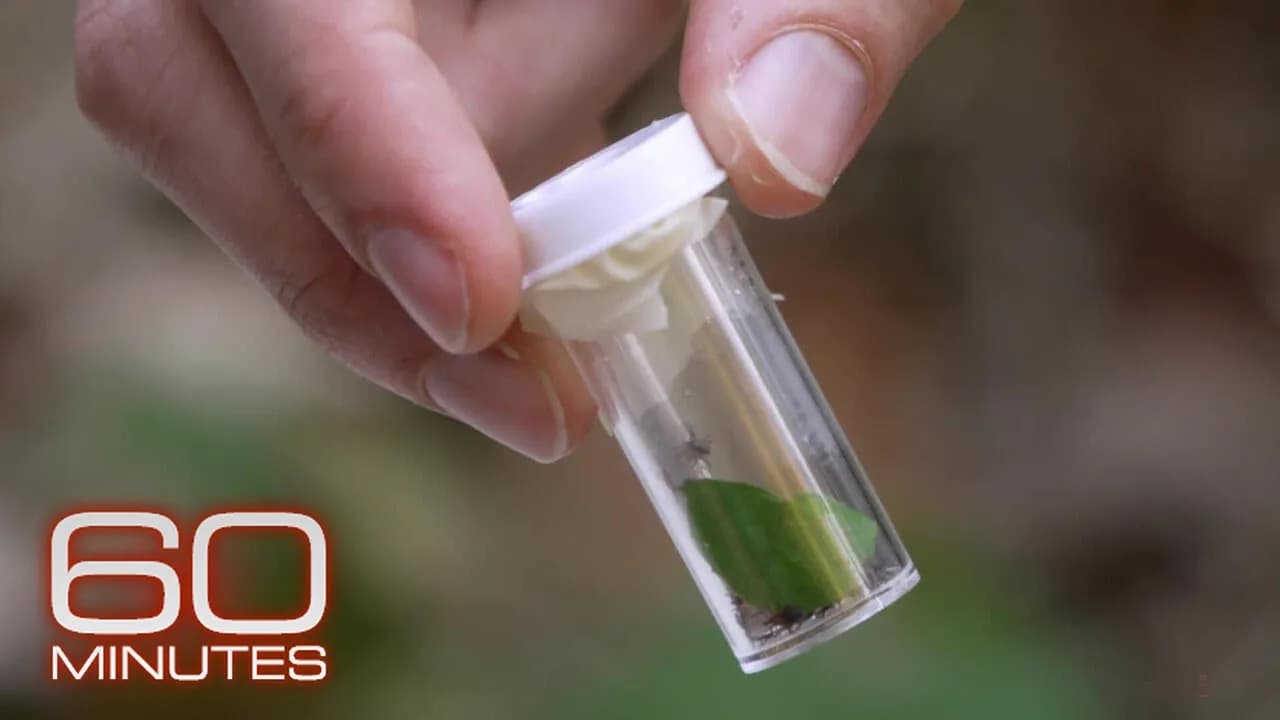
Biologist Charles Darwin began crafting his theory of evolution on a trip to the Galapagos Islands. Nearly two centuries later, scientists on Nantucket have the technology to shape evolution. They are hoping to use genetic engineering to reduce the transmission of Lyme disease, a tick-borne illness. The scientists' target is not deer or ticks, but wild mice, the main carriers of Lyme.
Nantucket is a 14-mile long, three-mile wide oasis 30 miles off the coast of Cape Cod, Massachusetts. Hidden is a scourge that has afflicted 15% of its residents. The natural disaster in the area is not hurricanes, tornadoes, or earthquakes. It is Lyme disease. It is the one plague that might be severe enough that communities might want to engineer a wild organism in order to get rid of it or at least reduce the level of Lyme.
MIT associate professor Kevin Esvelt, a pioneer in genetic engineering, and Sam Telford, an epidemiologist at Tufts University who has been studying ticks on Nantucket for the last 41 years, are collaborating on the project. These tiny vectors of Lyme disease are not hard to find. There is a 50% chance or more that a tick is carrying Lyme disease, but it has to be attached for more than 24 hours to infect you.
The scientists are interested in wild white-footed mice. White-footed mice are the main host of Lyme bacteria. When an uninfected tick bites an infected mouse, the bacteria transfer to the tick. When that infected tick bites an uninfected mouse, the cycle continues. Deer do not get infected, but they help spread the disease because ticks embed on them to feed, then reproduce with a single female tick laying as many as 2,000 eggs.
Esvelt and Telford's big idea is to change the genetic makeup of the mice so they are immune to Lyme. That way, the ticks that bite them will not get infected. You do not have to kill the mouse in order to interrupt the cycle. The dream is that new technologies can ensure wild creatures can live in peace, playing their normal ecological role, but without causing disease that makes people suffer.
Dr. Timothy Lepore, 80 years old, has been the island's emergency room head, sole surgeon, and medical examiner over the past 40 years. Today he runs the only private practice on Nantucket where he treats dozens of patients with Lyme disease each year. Lyme disease can be treated with antibiotics, but if left untreated, the infection can spread to the heart, joints, and nervous system.
Shauna Asp, 33 years old, was diagnosed with Lyme when she was 10 years old. A few years later, the left side of her face stopped moving. A residual effect from the disease is still noticeable today. Lyme disease alters people's behavior and activities.
The problem on Nantucket can be traced back to 1926 when locals voted to import two female deer to the island to give a lone buck company. As the deer population grew, so did the ticks. By the 1950s, half the land on the island was put into conservation. The untamed brush and wild grasslands create an ideal ecosystem for Lyme's host to thrive.
A trip at age 11 to the Galapagos Islands sparked Esvelt's lifelong obsession with evolution. In 2013, he was the first to propose that CRISPR, a revolutionary technology that enables scientists to edit DNA, could be used to change a species' genetics in perpetuity. This idea led to the project they call mice against ticks.
For the last 10 years, Esvelt and researcher Joanna Buchthal have been studying whether they could add a gene for an antibody that prevents Lyme infection to a mouse embryo. The injection mix contains both the antibody gene and CRISPR which acts like molecular scissors. After CRISPR finds and cuts the targeted area of DNA, the cell inserts the gene into the mouse's genetic code. When this mouse is born, it will be immune to Lyme disease and so will its children.
This is a heritable immunization. The immunity is passed on generationally and every mouse that gets the antibody gene is actually immune.
The plan is to release thousands of engineered mice on Nantucket over time starting during the winter months when the native mouse population is low. Esvelt needs community buy-in. He chose Nantucket not only for its high rate of Lyme, but also for its tight-knit, well-educated community with the tradition of town hall democracy.
At the October 23rd select board meeting, the scientists presented their latest findings, stating they have produced the first heritably Lyme-immune laboratory mice capable of breaking the disease transmission cycle. Some residents expressed concerns about mice being the foundation of the food chain and tinkering with the food chain.
Some people are really gung-ho about this. Some people have deep reservations. What Esvelt found heartening about Nantucket is that pretty much everyone agrees that this is how we should go about developing these kinds of technologies. It should not just be scientists in their laboratories getting a clever idea and then it is there.
Dr. Timothy Lepore says he is supportive of the proposal but as an avid falconer, he wants more testing to be done to ensure there will not be unintended consequences to the island's ecosystem. When asked if a change in the field mouse could lead to a change in the hawk, Lepore said that is the question. He does not think so, but that has to be shown.
When asked if he worries about fooling around with mother nature, Lepore said absolutely. But on the other hand, he is not terribly fond of mother nature if she is going to give his kids disease. All of technology is saying to mother nature that we are not always happy with the way things work naturally and so we are going to change it.
If federal and state regulators agree, the team plans to first release the engineered mice in a small field trial on a private island so they can better understand the ecological impacts before any potential experiments on Nantucket. The home run for Esvelt would be a field trial that works, something that allows them to dramatically reduce the fraction of ticks that are infected that does not have anything go wrong with the ecosystem. Then the community has a good discussion and then they decide.
It is a fairly safe bet that most kids taking piano lessons do not like them. Payam Kascade, the 32-year-old son of Iranian immigrants, has come up with a new method of teaching that has students loving their piano lessons. His students are sweeping national competitions. He has won over a legendary tech innovator and an Oscar-winning composer.
Piano is not supposed to be fun. It is supposed to be strict. It is supposed to be stressful.
Piano instruction at traditional schools emphasizes strict discipline and stress. Payam challenges this by creating an environment where students enjoy learning rather than simply enduring it. His students don't just learn piano—they love piano, which becomes central to their success.
In a converted home in the Seattle suburb of Bothell, Washington, Payam and his team of young teachers—all former students—conduct lessons. Students pay between $75 and $100 per lesson, ranging from preschool beginners to high school talents.
In traditional piano education, only 1-2% of students reach diploma level, which takes approximately 12 years. At Payam's school, 96% of students achieve diploma level in about four years.
Payam acknowledges the traditional view that discipline, hard work, and rigor are essential for mastery. He agrees that phenomenal skill requires time and energy, but argues that enjoyment makes students unaware they're investing that effort. The key principle is that students love music first.
The Payam method begins without sheet music. Students learn using ABCs and 123s, with numbers written directly on piano keys. A song taught to three-year-olds involves simple number sequences like 1-2-3, then 1-2-5. This builds coordination using familiar tools—numbers and letters—to learn the language of music.
The analogy compares this to learning Chinese: presenting a Chinese book immediately overwhelms, but teaching through familiar ABCs and 123s allows students to map concepts before transitioning to Chinese characters.
Students progress through 18 levels of the curriculum. Level 2 material transitions to Level 13 material in approximately one and a half to two years. Throughout this progression, students learn songs they genuinely enjoy. The word "play" in music is emphasized as an invitation to be playful.
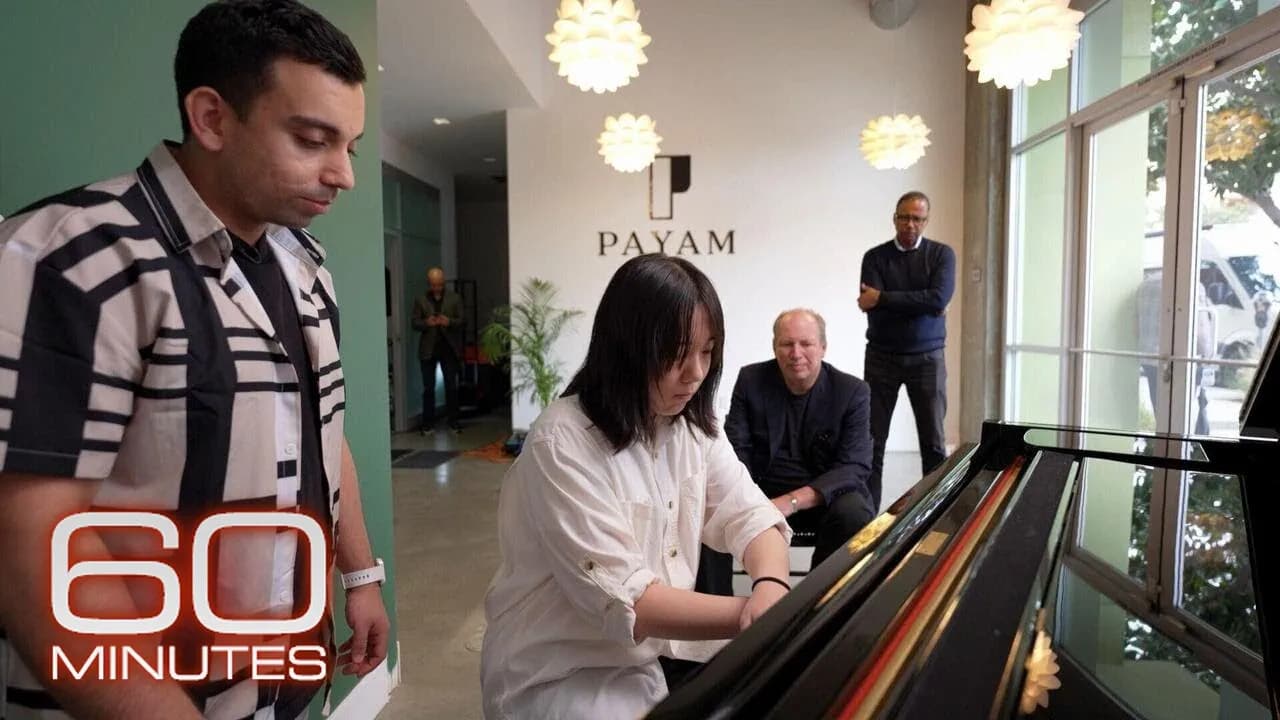
Hans Zimmer, composer of scores for more than 150 films with 12 Oscar nominations and 2 wins including for The Lion King, had an unconventional education—he was asked to leave eight schools. He connected with Payam's method because it embodies the playfulness and unconventionality he wished he'd experienced. Most of Payam's students don't aspire to be concert pianists, yet they develop a love for their lessons.
A distinguishing feature is that students compose original songs at very young ages. Delara, age 12, had already written her third composition. Payam wrote his first original song at age 9 as a gift for his newborn sister.
At age 11, Payam entered an original composition in the National PTA's arts competition and won. His students now participate in the same PTA Reflections Program competition. In 2024, 41 students from the school competed among 300,000 nationwide entrants. Results included 13 of 15 district winners, all 5 Washington State first-place winners, and 4 of the 14 national medals awarded.
Even when learning existing compositions, students are encouraged to experiment with tempo, style, and mood rather than following rigid interpretations. The goal is to change how the musical world approaches teaching.
Hadi Partovi met Payam when his then-12-year-old son Darius enrolled. Partovi is co-founder and CEO of Code.org, a nonprofit whose free platform has taught computer coding basics to hundreds of millions of students. He identified parallels: Code.org teaches coding with blocks and drag-and-drop rather than ones and zeros or angle brackets; similarly, Payam Music teaches using ABCs and 123s before introducing traditional notation.
Partovi became CEO of Payam Music with the goal of national expansion. Plans include opening Payam schools across the country. Funding has come from investors including Hans Zimmer.
Zimmer invested because he remembers his own piano lessons as horrible. He saw Payam's method as giving children happiness, love of music, and self-love. He visited the Santa Monica, California location and heard students including Darius Partovi, now 19, perform their compositions.
The strategy prioritizes convincing parents by letting them observe their children fall in love with music, rather than immediately persuading the music establishment. Parents report transformative experiences: one called it the best decision made; another noted learning can be fun; another observed increased confidence in her daughter.
Charad Salastani's daughter is nine. Sasha Ti Saniel's daughter Anya is 15. Julia Ying's son Jonathan attended through college. Parents describe the experience as life-changing, noting that students want to work hard because the approach is contagious.
A 60 Minutes correspondent, 50 years after their last piano lesson, successfully completed Level 2 of the curriculum during a lesson. The segment concludes with encouragement for skeptics to try the method once.
Keep 60 Minutes in your library
Save the videos and channels worth coming back to, and find them again in one place.