Boosting Testosterone & Understanding Your Testosterone Levels (Aging, Muscle Growth & Nutrition)
In a Nutshell
Total testosterone doesn't decline with age alone — obesity, metabolic dysfunction, and severe calorie deficits are the real drivers. Lifestyle fixes (weight loss, sleep, stress management) produce far larger gains than any supplement or training tweak. Within normal ranges, testosterone levels don't predict muscle growth or training response; only extreme lows or exogenous doses meaningfully change outcomes.
These notes were generated by AI and may contain inaccuracies.
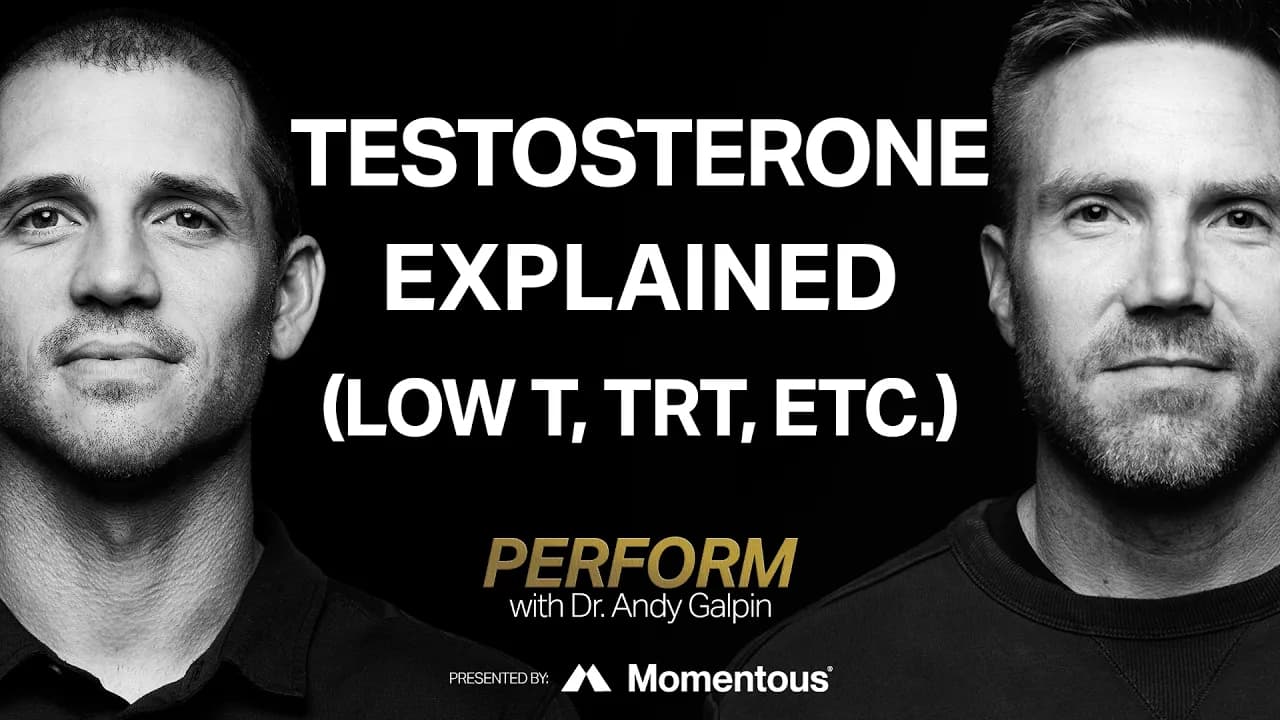
This episode continues and expands on a previous discussion with Dr. Ben House about testosterone and performance. The two episodes are independent, though they share common topics. The goal is to expand the scope of the previous conversation with greater depth and accuracy.
Dr. Andy Galpin learned extensively from Ben and through months of preparation reviewing the topic.
Dr. Ben House presented data indicating there is no decrease in testosterone with aging itself. Any drop appears primarily due to obesity or metabolic disorders. When those factors are controlled, the engine behind testosterone decline with age appears to disappear.
Total testosterone levels in men remain constant throughout their lives. Total testosterone levels within the normal range (300-1000 or 1100 nanograms/deciliter) are not predictive of response to strength training.
Bioavailable testosterone can be restricted by lifestyle factors. Once restrictions are removed, levels tend to rebound naturally. Weight loss is the most prominent factor. Psychological stress and sleep are likely the two other most influential factors.
Comparison to dietary supplements is invalid. The amount of improvement from fixing lifestyle factors is significantly larger than what supplements can recover.
You don't have to be perfect. Removing the very bad situation yields enormous increases in testosterone levels.
The discussion covers both overeating (excess calories leading to increased body fat) and undereating (insufficient calories). Research and public discussion often focus on obesity, but the opposite situation is seen frequently in high-burn individuals, athletes, and those trying to lose body fat.
Clinically low testosterone is generally considered less than 300 nanograms/deciliter. The approximate normal range is 300 to 1000 nanograms/deciliter. Approximately 25-30% of adult men are clinically classified as having low testosterone.
When data is analyzed more extensively, it is heavily influenced by clinically obese individuals. Approximately 40% of obese people have clinically low testosterone. The rate is less than 10% for non-obese individuals.
Current data indicates causality runs from obesity causing low testosterone, not the opposite. This distinction matters because it changes treatment recommendations.
Many studies use BMI (height divided by total weight) or waist-to-hip ratio. These simple measures can predict risk of low testosterone at the population level, reinforcing that obesity is the real driver.
Focusing on tangible outcomes: how many people who don't feel well actually have low testosterone? When combining low testosterone with clinical symptoms of deficiency, the figure drops from 25% of men to less than 5%.
Low testosterone is serious, exhausting, and harmful. It is treatable. The episode emphasizes this is not against testosterone treatment or medical choices. People should not feel fear, anxiety, or stigma about their bodies.
There is not an epidemic of low testosterone as media portrays. There is a large segment of people at high risk, primarily due to obesity rates increasing over decades. Just because you are older and thin does not mean your testosterone will collapse.
Less than 5% of people fit the description of clinically low testosterone due to age alone, and in some cases less than 1%.
If you are obese or overweight and restrict calories through body fat loss, testosterone rises substantially. This is supported by evidence from bariatric surgery, GLP-1 drugs, and calorie restriction.
This differs from being at normal weight or very thin and doing the same. Approximately 15-25% of elite athletes have clinical or near-clinical low testosterone, consistent with the general population rate, but this comes mostly from calorie restriction.
RED-S (Relative Energy Deficiency in Sport) is often associated with women. In men, it may be called exercise-induced hypogonadism, where excessive exercise, insufficient calories, or both cause testosterone decline.
Research on women indicates approximately 30 calories per kilogram of fat-free mass daily is considered normal intake. Some studies reduced this to 15 calories per kilogram or less than 10.
Research originally came from endurance athletes due to high training volumes. Military research involves people carrying weights for days or weeks, burning enormous calories even when trying to compensate through eating.
GLP-1 drugs now provide similar research because many people experience calorie deficits from their use.
Research on men is not as clear. Personal opinion suggests men can tolerate slightly less than 30 calories per kilogram of fat-free mass, possibly 25 or 20, for longer periods than women without endocrine hormone collapse. More research is needed.
The overall relationship between calories ingested and testosterone forms an upside-down U. At one extreme (obesity), entering a calorie deficit generally leads to increased total testosterone.
Once leaner (around 20% body fat for men), moderate calorie deficit may maintain levels. Beyond that, calorie deficit can reduce testosterone, worsening when body fat drops below approximately 5%.
Limited studies exist at very low body fat percentages (5%, 8%, 12%). Most natural range studies focus on 15-25% body fat.
Case studies from bodybuilding and physique competitors show dramatic testosterone drops, sometimes reaching near-castration levels. Starting ranges of 400-600 nanograms/deciliter can drop to 50 with severe calorie restriction.
Case studies exist of individuals at 14-15% body fat with testosterone dropping below 200 or even below 100.
Scientific research provides general concepts about what is most likely to occur in most people, not specific individual recommendations.
Testosterone levels likely won't decrease significantly until becoming very thin, but significant drops can occur even without being very thin. Clients following extremely restrictive diets (1000 calories daily for months) at 170-200+ pounds showed testosterone levels below 50 without medications or hormones, at body fat percentages of 15-18%.
Hundreds of individuals have been observed with testosterone levels of 400, 600, or 800 ng/dL while maintaining body fat percentages below 8%. Some achieved these levels naturally, while others maintained them through active diets that kept testosterone steady. Case studies show that total testosterone can drop between 20% to 80% during energy deficits, approaching levels comparable to castration. Individuals moving from 700 or 800 ng/dL naturally down to below 100 ng/dL exclusively from strict long-term dieting have been documented. Recovery occurs consistently once individuals exit the energy crisis situation.
Four studies have been identified showing people who started at low testosterone rates. When comparing these studies, participants reached what is called the "nadir" - the lowest point. Maximum levels could reach 900 ng/dL while lowest points dropped to 200 ng/dL, but levels returned to 900 ng/dL or higher once nutrition, recovery, or normal eating resumed.
No sufficient evidence currently indicates that even the harshest diets will permanently destroy testosterone forever. While this possibility exists, it is not inevitable. Recovery occurs based on personal experience with continuous feeding for weeks or months, not gluttonous eating, but rather raising calories to maintenance level or slightly higher by 10, 15, or 20%. The system appears robust and flexible. What appears is not a collapse or stopping of the system, but rather a severe reaction where the brain sends signals recognizing this is not the right time for reproduction or maximizing muscle growth.
The final summary regarding energy deficit and total testosterone includes moderate and slow inability, equivalent to 200 to 500 calories daily deficit on average. Even if truly thin, available evidence does not indicate this will reduce testosterone significantly. Individuals can remain in energy deficit for extended periods without harsh conditions and testosterone will likely remain stable, though they may experience low energy, fatigue, or declined performance.
Research data differs from how some people who read or transport research may misrepresent it, either deliberately or unintentionally. Some studies indicate this will break standard testosterone levels. Two groups of studies exist: first, case studies of people following extreme diets who are already very thin with daily steps reaching 10, 15, or 20 thousand steps while making great effort. The second group involves military studies with severe energy deficit cases at very low levels, eating less than 10 calories per kilogram of fat-free mass, reducing calories to half or quarter, often combined with multiple stressors including psychological stress from performance, participation, learning in military environments, extremely restricted sleep, and caloric expenditure often double, triple, or four times the natural rate.
In these exceptional and unique situations, theoretically it's very difficult to state that reducing calorie intake will decrease testosterone. The body is essentially saying to stop, needing to stay alive, directing all energy toward the brain and vital organs while reducing or stopping reproduction and muscle building functions. This resembles how one feels after exercise - being weaker immediately after training because of fatigue. Testosterone becomes somewhat "tired" through energy pathway transformation and shutdown, not adrenal gland exhaustion.
Studies show that when refeeding or recovery occurs, testosterone levels return to normal within days or weeks. Short exposure range is important and deserves attention, unlike the belief that effects will last for life. No studies expand these periods to weeks, months, or years, though persistence in such patterns may eventually lead to permanently lower testosterone, but extensive research does not support this conclusion.
Five criteria define metabolic health classification: blood pressure less than 120/80 mmHg, fasting glucose less than 100 mg/dL or HbA1c less than 5.5%, triglycerides less than 150 mg/dL, HDL cholesterol greater than 40 mg/dL, and waist-to-hip ratio less than 0.5. The best result is five out of five, while the worst is zero out of five. Accessing one or two criteria makes life significantly better.
Obesity defined by waist-to-hip ratio doubles or triples the risk of clinical testosterone decrease. When triglycerides and HDL are combined as blood lipids, and fasting glucose and HbA1c are combined as fat organization and glucose metabolism, obesity as a third category doubles or potentially triples the risk of clinical testosterone decrease. More specifically, obesity increases risk two to two and a half times for levels below 300 ng/dL total testosterone.
Each risk factor increases the likelihood of clinical testosterone depression by approximately 71%, regardless of which factor is chosen. Those classified as obese alone face seven and a half times the risk of testosterone deficiency compared to normal weight individuals. A person achieving five out of five criteria has less than 1% risk of clinical testosterone deficiency. A 70-year-old meeting all five criteria perfectly will have average testosterone levels 70 to 100 points higher than a person in their forties with only one molecular sign.
The difference between achieving five out of five versus zero out of five criteria is approximately 200 ng/dL, sometimes reaching 250 ng/dL or more depending on the precise data group examined. Sex hormone binding globulin and free testosterone move in opposite directions, with fairly constant elevation in sex hormone binding globulin with advancing age at approximately eight nanomoles per liter per decade, even after correction for body composition and metabolic health changes.
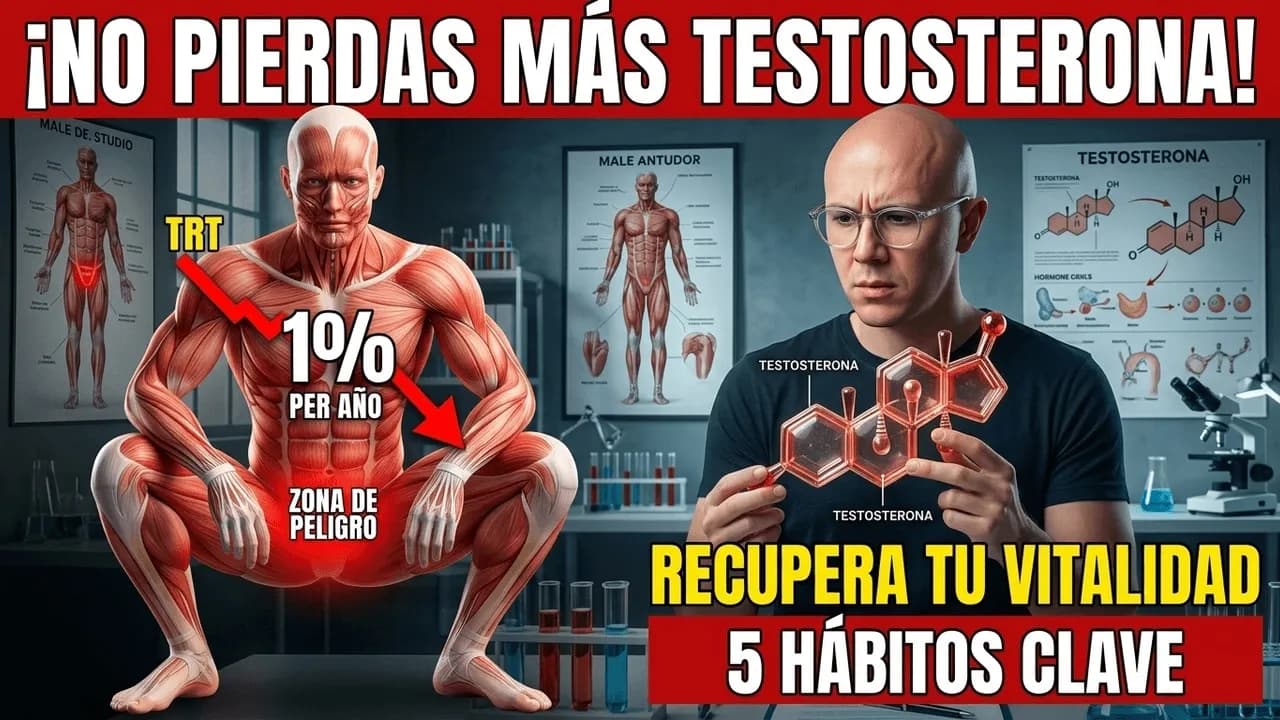
Studies indicate testosterone levels decrease approximately 1% annually after age 40, or 10-12% per decade. However, these data generally do not account for body composition. When factors are controlled in this analysis, testosterone does not decrease with age alone, but rather the decrease cancels exactly or the opposite occurs completely. Data indicates an increase of approximately 8 ng/dL per decade of life. This suggests testosterone not only does not decrease but actually increases with aging as long as metabolic dysfunction or obesity is not added to the equation.
Zero out of five criteria carries approximately 20 times higher risk of testosterone decrease compared to five out of five criteria. Four out of five criteria maintains risk level below 5%, providing 95% chance of good testosterone levels. Three out of five criteria begins raising risks slightly but remains within controllable range at approximately 20% possibility of clinical testosterone deficiency. One out of five or zero out of five criteria causes testosterone deficiency risk to accelerate or rise significantly outside usual ranges.
Obesity and metabolic health represent the largest modifiable factor with greatest impact. Diabetes was accounted for in criteria analysis. Weight-loss medications can cause 20-40 point changes for some people. Marriage and having children typically reduce testosterone by 10, 15, or 20 points. High blood pressure, smoking, and moderate alcohol consumption each contribute 10-30 point reductions. When multiple factors accumulate to 10, 20, or 30 point decreases across three, four, or five factors, total drops of 150-200 points occur.
New guidelines from the Agency for Healthcare Research and Quality represent progress in the field. These guidelines recommend beginning with baseline total testosterone examination for everyone over thirty years old. This varies significantly from most national endocrine societies that discourage this practice. Early examination is supported for body composition and bone health in women, with guidelines calling for waiting until middle age or later considered ridiculous.
Personal preferences favor examination when done appropriately. Two main points against early examination exist. Without it, people suffering from clinical decreases in testosterone at age thirty are highly likely to be found. This is based on reviewed data, especially for those not suffering from obesity. Excluding someone from obesity and placing them in the twenty-fifth percentile of their age makes it unlikely they suffer from low testosterone.
Moving to discussion about excessive tests and who bears responsibility for costs, in addition to false positive results. The following step is guidelines that deal with this appropriately. One should really avoid starting compensatory therapy with hormones, testosterone, or any drug or peptide related to testosterone production based on only one blood test. Misleading results can occur for a million reasons.
Military studies placed people under immense psychological pressure, subjected them to sleep restraint, and low calories. This leads to reduction in testosterone levels within just a few days, with declines at a rate of 50%, sometimes 75%. The convincing and clever aspect of new guidelines is the call to perform examination early, whether at age thirty or available upon request. Guidelines now allow people to request testing directly, which was not allowed in the past.
Diagnosis of low testosterone requires at least two morning tests while fasting. Two important points to note: tests should be in the morning and fasting. If someone is only seeking treatment with testosterone, they can manipulate results, but for those wanting what's best for health, tests must be done early in the morning while fasting. Multiple tests are required due to previously discussed factors. Guidelines explicitly state not to perform any tests within 30 days of strenuous physical activity, sleep deprivation, or acute illness.
This represents a hedge against overdoing misdiagnosis. It may not be realistic to find a 30-day window without illness, sleep deprivation, or extreme training. The most accurate scientific approach requires at least 7 days without extreme training. Not prescribing testosterone for everyone, and decisions about low testosterone should never be based on one blood analysis.
Before assuming low testosterone, questions should be asked about the last training session, last illness, and sleep patterns. Evidence shows these factors can decrease testosterone significantly. If two tests meet standards, next step involves sex hormone binding globulin, free testosterone, and symptoms. If recommending any type of testosterone treatment, hematocrit monitoring is required.
Hematocrit is a blood measurement costing a few dollars found in almost every blood test. It represents the percentage of red blood cells in blood and determines blood viscosity or density. When beginning testosterone treatment, red blood cell count is very likely to rise. This can get out of control quickly, making blood thick and extremely sticky, potentially causing heart disease, heart failure, or deaths. When hematocrit percentage exceeds 52 to 54%, danger exists.
No decisions should be made based on one blood analysis or multiple tests if environmental changes or extreme lifestyle occurred in the past 30 days. If starting treatment, hematocrit and hemoglobin monitoring is required. Guidelines recommend complete hormonal system diagnostic assessment including luteinizing hormone, FSH, prolactin, TSH, T4, ferritin, and complete blood count (CBC). Before resorting to hormones, full hormonal system assessment should be conducted, possibly including pituitary gland imaging.
Before starting hormonal treatment, consider if interested in having children. Fertility and reproduction are very likely to be affected, though not impossible to fix or retrieve. Anatomical process changes in testicles should also be considered. Informed consent about these risks is essential.
Guidelines call for continuous and frequent testing to ensure total testosterone survival within the 300 to 600 nanograms per deciliter range. Many who start testosterone therapy deliberately raise levels to 1000, wanting to live at 800, 1000, or 1200 levels. Guidelines recommend reducing dosage if testosterone levels exceed 600.
Using testosterone treatments for returning to normal 300-600 range or slightly higher is appropriate, but using it to charge oneself to feel like "Superman" is not a medical necessity. People are free to make any decision they wish.
Episode sponsored by Element Company, an electrolyte drink containing ideal ratio of sodium, potassium, and magnesium without sugar. Hydration is crucial for physical or mental performance. Studies show even 1% dehydration can lead to decreased physical and mental performance. Electrolytes are essential for proper hydration, especially when sweating a lot. Element's 1000mg sodium, 200mg potassium, and 60mg magnesium mix is unique and scientifically supported. Available at drinklmnt.com/perform for free sample pack with purchase.
Total testosterone will not decrease much due to aging itself. If it happens, it's likely result of weight gain, decreased physical activity, stress, sleep issues, or metabolic health changes. Short-term changes in energy consumption and thermal expenditures are normal adaptive responses that return once recovery, sleep, and eating resume. Blood drawn during energy depletion states doesn't indicate true hypogonadism.
Discussions needed about different diagnostic thresholds depending on age. Total testosterone is good, but sex hormone binding globulin and free testosterone change with age progression. Reference ranges for sex hormone binding globulin appear very low. Physically fit people regularly show high or very near high levels in laboratories. Guidelines should change with age progression.
Testosterone replacement therapy can change a person's life and may enable lifestyle changes. New guidelines differ from older ones by allowing people to start hormone therapy without waiting for lifestyle changes. Both should happen simultaneously rather than withholding treatments until someone loses 50 pounds.
Evidence for hormone replacement shows improved sexual function including sexual desire and erection issues when clinically suffering from total testosterone decrease. Body composition changes can help increase muscle mass and fat loss. Some benefits may exist for bone density and mental health indicators. Evidence doesn't appear strong for energy, vitality, and perception improvements.
Low energy and fatigue as indicators of low testosterone may not be fair. These symptoms may exist with testosterone decrease but don't guarantee low testosterone, as many other reasons explain fatigue without relation to testosterone. Data shows testosterone use doesn't necessarily increase energy or vitality.
Discussion currently centers on total testosterone, but daily rhythm needs forward movement. This discovery may be more important than total testosterone. Testosterone rhythm throughout the day shows peak levels at night, then rapid decrease. Changes of 150 to 250 points occur, with significant decrease felt upon waking, then acceleration back during night. Standardization procedures ensuring morning testing at exact same time are insufficient if wake times differ.
If someone normally wakes at 10 AM but only available appointment is 7 AM, next blood draw at 10 AM may differ by 100 points or more without real physiological change. This represents daily variation at different points of the day. Previous research doesn't account for time of day or fasting status, leading to zero actual benefit data.
Magnitude of daily testosterone changes may relate to symptoms. Natural 200-point swing between daily high and low may decrease to 100, 50, or less with age. This change, not just total quantity, may have greater impact on perception and world experience. Evidence indicates this change occurs with age, possibly explaining performance and function changes in older adults while total testosterone remains unchanged.
Testosterone terminology includes total testosterone and free testosterone. Between 97-99% of testosterone will be in bound state, with 1-2% completely free and unbound. Free testosterone can easily switch to cells, particularly muscle cells, entering and activating androgen receptors. Bound testosterone is not inactive or unavailable.
Bioavailability represents free testosterone plus testosterone loosely bound to albumin. Test results often measure sex hormone binding globulin, albumin, and total testosterone, allowing calculation of free testosterone or bioavailability. Bioavailability likely ranges between 35-45% due to loose albumin binding.
Sex hormone binding globulin reference ranges between 15-55 nanomoles per liter based on company and laboratory. Some organizations recommend raising upper limit to 75 for those over fifty. Average person at age fifty will be at approximately 45 level, age sixty at 50, continuing to rise five points approximately every decade. This occurs with metabolic health decline.
Sex hormone binding globulin rises with age five points each decade. When moving from five out of five metabolic standards to three, two, one, or zero, levels drop from 45 to 40 or lower. This appears to be a common occurrence regardless of absolute normality.
SHBG holds testosterone, preventing its use. Higher SHBG is considered bad because it decreases with metabolic health deterioration rather than improving. SHBG typically rises with age but decreases with poor metabolic health. This creates a mathematical problem where a 60-year-old with poor metabolic health experiences the opposing effects of age-related increase and health-related decrease, ending up in the middle of the reference range despite the opposite being true physiologically.
This is why laboratory numbers require contextual consideration. The change in SHBG over a lifetime plus how it interacts with metabolic health status represents an exciting, complex, and somewhat confusing area to understand. This is why total testosterone levels that appear naturally may remain misleading.
There is a simple bias acknowledgment: interest in human performance leads to inclination toward factors like greater muscle growth or strength outcomes. The discussion has focused on testosterone regarding body composition, muscle mass, strength, and age. Everything stated may have different answers if attention shifted toward improving mental health, sexual desire, or endurance performance aspects instead of strength or muscle mass.
The relationship between testosterone and muscle health includes how it affects muscle growth and strength, and how this should change training and nutrition recommendations. Two methods of thinking about exercise-induced testosterone increases exist: acute versus chronic elevation. Research shows actual muscle growth results after 8, 10, or 20 weeks. The relationship between testosterone and muscle growth is minimal. Total testosterone quantity does not provide almost any prediction of how much muscles will grow and won't predict who responds better or worse.
Multiple types of resistance exercises cause huge testosterone jumps after exercise, but these are increases within limits - 25 or 50 nanograms per deciliter, perhaps a little more. If testosterone level is 600 and receives an increase for 15 or 20 minutes from 600 to 650, the change throughout the day was likely 200 or more. This is not sufficient to cause any impact. The time period of elevation remains high within limits of a few minutes, and the jump size is very small to the point that it doesn't make a real difference.
There is no strong evidence supporting training program or nutrition decisions based on which will give short, sharp testosterone increases. If total testosterone is less than 300, ability to build muscles will be limited but not completely cancelled. Muscle building and strength gains remain possible even with clinical hypogonadism, though this ability weakens. Within the natural range of 300 to 1000, this doesn't appear predictive for training responses. A person with level 400 might build equal or larger muscles than someone with level 900 on the same training program.
All studies were conducted on younger individuals between 18 and 30 years old. Whether this applies at age 60 or 55 remains unknown. The information indicates it doesn't matter at all. Exogenous testosterone changes the equation and depends heavily on dosage. It can increase muscle hypertrophy or growth caused by resistance training to a large extent.
Few studies reduced testosterone levels medically. The numbers are difficult to define as important. If testosterone is lowered to one-tenth of natural levels, from 500 to 50, muscles won't grow the same size and fat loss won't occur. Studies indicate slight differences: after 8 to 10 weeks of strength training, half a kilogram of net muscle may be gained versus one kilogram or possibly two kilograms. The difference isn't huge in muscle growth terms.
If told that one kilogram of pure muscle will be gained after two months versus two kilograms, the decision becomes personal. Some may say it's not worth the risk or money. Others may see it as doubling growth, making it worthwhile. Accuracy must be maintained. The information can be provided with assessment, but whether it's worth the effort or exaggerated represents a role for scientific communication officials and educators.
If levels exceed physiological ranges and exogenous testosterone surpasses natural boundaries, the effect is real but not always as influential as might be thought. Clear evidence shows muscles will grow apart from weightlifting. The nature is sensitive and very responsive to exogenous testosterone. Some studies showed results like adding one or two kilograms of muscle after 8 to 10 or 12 weeks, plus possibly one kilogram of additional fat loss.
Testosterone is undoubtedly important. The typical impact weighs around a few pounds or one or two kilograms of muscle and fat, not 30, 40, or 60 pounds or 15 kilograms. Over years and decades, different results will be witnessed, but for weeks to months, this represents the impact size to expect.
Total testosterone is likely the largest driver of muscle growth amount, except for the two extreme cases of low or high levels. Free testosterone does not appear to be the reason. Sex hormone-binding globulin does not appear to be the factor. Many studies examined consistent internal fluctuations in IGF-1, inflammatory markers, and insulin. Nothing in circulating hormones appears to predict growth response within natural ranges.
Testosterone must interact with receptors on the cell wall. It must connect with the androgen receptor, move the signal through signaling proteins to access the cell nucleus containing DNA, which tells cells to multiply and develop, participating in muscle protein synthesis. The effective method for testosterone to function involves connection to that receptor and signaling cell growth.
If total hormone quantities don't determine growth extent, the receptor might be the reason. More receptors might mean faster growth, more sensitive receptors might mean faster growth, or better movement from cell wall to nucleus might mean faster growth. However, this doesn't appear to be the solution. Measurements currently conducted in laboratories did not explain why some people acquire more muscle mass than others in exactly the same situation with the same training program, nutrition, sleep, and other factors.
There is strong evidence supporting anabolic resistance, meaning protein synthesis quantity often diminishes with age in response to the same protein or amino acid quantity. 25 grams of protein at age thirty produces a leap in muscle protein synthesis, but the same quantity after 50 years produces a smaller jump. With aging comes greater resistance to anabolic stimuli. This appears worse due to obesity, insulin resistance, and inflammation.
The Recommended Dietary Allowance (RDA) was set at 0.8 grams of protein per kilogram of body weight. This was never determined as a quantity for muscle growth or dietary adherence improvement. Its purpose was simply to indicate that reducing below this increases risk of negative health outcomes from insufficient protein.
New federal guidelines in the United States increased this to 1.2 to 1.6 grams of protein per kilogram of body weight. The 1.2 to 1.6 range was largely built on body composition research. If trying to maintain greatest lean body mass and reduce body fat, more protein in the 1.2 to 1.6 grams per kilogram range appears effective.
Benefits become very marginal when exceeding 1.6 grams of protein per kilogram for muscle growth response to strength training. The evidence is fairly strong at this stage. Some see exceeding 1.6 grams as useless or completely unnecessary. If concerned about body composition, especially with aging, 1.2 to 1.6 grams per kilogram represents the number to reach, as real muscle building resistance is most likely but these numbers might help overcome that problem.
The preferred number is around 2.2 grams per kilogram of body weight, equivalent to 1 gram per pound. Increasing the quantity slightly helps people feel full, eat more food, and avoid other things. These represent practical questions rather than physiological ones. The argument prefers people closer to 2.2 because of other benefits that come with it, not because it accelerates greater muscle growth by a lot.
The debate between 1.6 versus 2.2 is not a serious matter. Better positioning exists with 1.6 compared to 1.2 in most cases. Reaching the higher range is better if concerned about muscle building resistance or aging. If accessing those levels is disliked, expensive, or difficult, staying in the minimum range won't lose muscle gains or put health at risk.
If worried about muscle growth with aging progression after excluding testosterone, resistance exercises should be acknowledged as the largest catalyst for muscle growth compared to protein. Protein represents just an added touch as a building block with very slight effect. Strength training or resistance represents a tremendous catalyst for muscle growth, doing 90% to 95% of the work while protein intake contributes the last 5% only.
The essence lies in focusing on essential matters rather than secondary ones. Testosterone should not be worried about as long as it remains within the normal range. High-quality strength training exercises should be done with consumption of enough protein at minimum 1.2 grams per kilogram of body weight. Anything beyond that comes down to personal preferences or other reasons.
The ability to acquire power does not change significantly with aging. Strength can be increased approximately equally across different ages, but this does not apply to muscle size growth. The side is affected with aging. The hardest part is increasing muscle size at age seventy compared to age thirty.
Regarding protein in relation to strength training, no need to change a lot. An article with comprehensive reference and analysis issued in the past month deals with matters like density and proves its effectiveness. High density and low density are both effective when you are young and effective when you are advanced in age for muscle growth and bone formation.
It is difficult to become powerful when using lightweight, but this is true when you are a young man and that is also true when you are advanced in age. Therefore, we don't actually see a clear difference based on age. This is the point to emphasize.
Your strength training program doesn't actually need to differ as you progress in age. There is no need to provide specific training programs for middle-aged or elderly individuals. The thing is the same. It is simply exactly the same thing. Choosing exercises, order, density, size, and range of motion has no fundamental difference between men and women, between those in their thirties and those in their eighties.
There is always a fundamental difference between one person and another. History of injuries, preferences, number of times exercise, level of stress, and body composition must all be taken into consideration.
There is no strong evidence requiring independent recommendations due to aging. What should be taken into consideration is that the matter will take a little longer. Recovery may be slower. If you want to use that to say we are less sharp, moving a little more slowly, and progressing more slowly, that makes sense.
These matters are not limited to a certain age. This is just good training. This is about listening and talking to customers. This is how things are measured. This is just a proper training session. Guidelines for forces are perfectly balanced and will become just as strong whether you are untrained or a good coach.
Age and sex do not change the amount of muscle growth. Whether you practice other types of physical activity or other factors, they change it more than age or gender.
Key measurements include total testosterone, free testosterone, and sex hormone binding globulin. The vital indicators have been reviewed with lots of numbers, so there must be a good understanding of how to interpret those results.
The majority of high-quality research around how to raise and increase testosterone focuses on removing restrictions effectively. Avoid those things that discourage and harm testosterone. Your body will reach a somewhat normal level.
When it comes to hormones and the endocrine system, you must work with your doctor, the qualified and accredited person who cares and thinks about these things, not just a person who receives a phone call or email then describes pharmaceutical.
If the program was receiving positive feedback and you want assistance to ensure this information remains free and available to anyone in the world, subscribe to the program on YouTube and Spotify. On Apple and Spotify, leave a rating up to five stars. Please see the sponsors as the program will not exist without them and their exceptional products and services.
Share today's episode with a friend you believe will enjoy it. If you have any questions or suggestions about the content, place them in the comments section on YouTube. Instagram and X accounts are used exclusively for scientific communication.
A concise email newsletter contains all episodes with the most important practical results. There are leaflets on improving fitness, physical ability, aerodynamics, building muscle and strength, and much more. To subscribe to the newsletter, visit performpodcast.com and click on "newsletter." It's completely free and email addresses are not shared with anyone.
If you had a body, you are an athlete. - Bill Bowerman
Keep Andy Galpin in your library
Save the videos and channels worth coming back to, and find them again in one place.