Bringing Continual Learning to Every Company: Trajectory’s Ronak Malde
In a Nutshell
Trajectory builds the infrastructure layer that lets any company continuously retrain models from real production traces instead of relying on centralized labs. The core insight is that current post-training algorithms and interfaces are too complex, so Trajectory simplifies the loop—capturing agent workflows, letting users define “good” outcomes on a small sample, then automatically improving the model and redeploying it. Their goal is to move AI adoption from the current 1 % of firms to near-universal by turning every company’s accumulated experience into ongoing model gains.
These notes were generated by AI and may contain inaccuracies.
Much of Trajectory's product philosophy comes from Apple. In the early 21st century, people had computers connected to the internet and phones for making calls. Apple combined these capabilities into mobile devices. Ronak Malde believes that putting training, assessment, and deployment in one place and making it very simple for everyone allows closing the loop and raising the model again to collect new data.
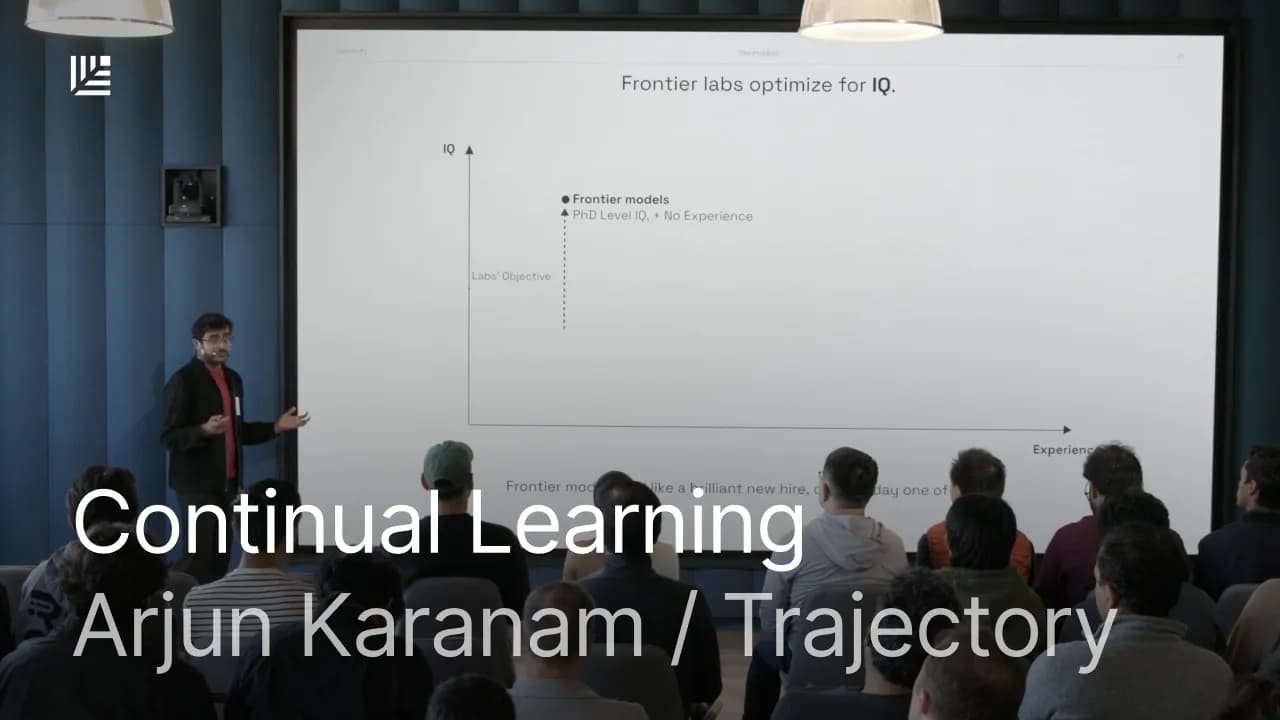
Ronak Malde joins to discuss what Trajectory is building, how he sees the research world, and where he thinks the future is headed. He spends considerable time thinking about continuous learning. The field is currently in a state of pseudo-continuous learning, and the goal is to understand what real continuous learning looks like and how to recognize when it arrives.
When thinking about lifelong learning, the human mind serves as the model to aspire toward. Humans are true lifelong learners who learn incrementally, constantly update themselves, and repeat the process. The current world with agents and artificial intelligence represents pseudo-continuous learning.
Growing up, Malde's family took many road trips using AAA maps that were shaded for routes. Changing routes required contacting AAA or visiting a physical location. This represents the current state where intelligent agents and planning algorithms can only be consulted at limited offline locations. Updating routes requires comprehensive batch updates of entire systems.
Trajectory's primary goal is to democratize access to continuous learning, even for training models and customizing them to user needs. Malde describes this as moving from "AAA" to "MapQuest" - while still not entirely online, it gives everyone the ability to map these algorithms without going through centralized services. The final stage of continuous learning resembles "Google Maps," updating with every drive and route taken, learning fastest routes and traffic patterns.
Rich Sutton and David Silver pointed out that continuous learning isn't possible with current architectures. When examining transformers and large language models, much of their expansion involved stacking attention blocks and transformers. However, recent research like DeepSeekV 4.1 flash shows architectural changes including fast and slow memory within weights and skip connections moving between layers.
These architectural changes are already occurring within base models and will be essential components. Continuous learning involves taking advantage of architectural research and connecting it to real-world applications. The true value of AI advances lies in how people actually use models in practice. Companies have ideas of what good performance looks like, but translating these into actual model improvements remains the hardest challenge.
The missing layer is the connection between reality of data and intelligence, which until recently was limited to laboratories requiring huge research teams. Over the past two years, specialized companies have entered this field building substantial research teams. Malde previously worked at Windsurf training the Sweet One model, while Cursor developed Cursor Composer, both requiring hundreds of millions in research, development, and computing costs with large research teams and 6-9 months to train sophisticated models.
This represented a consulting model based on direct support and guidance. Malde believes good products emerge when every company attempts the same processes repeatedly, wrapped in interfaces that provide controls for quality translation while hiding complexity. The founders' realization came from training models in production environments at Windsurf, where Michael worked on Gemini robots at DeepMind and Arjun worked on Vision Pro at Apple, all encountering the same challenge of using real-world feedback to improve models.
While working in big research labs, the founders realized continuous learning would be the next learning model. The focus at DeepMind was training one huge model then distributing it globally, which works as a business model but fails when customizing single models for individual customers. Harvey exemplifies this challenge, requiring enormous infrastructure for large labs to build for single customers.
Harvey relied on leading closed-source models while building interfaces for law firms globally. They accumulated tremendous knowledge, data, and domain details over 30+ years but couldn't leverage this data with leading models. Using Trajectory, they trained a model six times cheaper with accuracy improving from 4% in open-source models to 18%. These models cost six times less than leading models, allowing more token usage for tasks.
The name Trajectory relates to lifelong learning concepts. While the world focuses on tokens as units of work, human interaction doesn't count words spoken. The unit of work should be tasks or courses of action. In reinforcement learning, this relates to execution processes. With continuous learning, reinforcement training packages function as execution engines and coaches, where workflows become economically valuable tasks.
Trajectory aims to limit required components to knowing what good performance looks like. Currently, companies need multiple components: tracking all production workflows including agent calls, sub-agents, product activities, and user feedback. Many native AI companies have transformed to record comprehensive timelines. Products like LangChain, BrainTrust, and Raindrop help companies track this infrastructure.
After obtaining traces, companies need infrastructure to replay them for evaluations and training. This requires investing time to make traces replayable given production tracking data. Trajectory makes this process easier by allowing traces to be brought in with environment concepts, enabling complete trace restarts through Dockerfiles or system requirements.
The third component involves actual algorithm modification, including entire training packages, loss functions, and reward functions to convert tasks into model improvements. This represents the main component Trajectory wants to simplify. Currently, the platform depends on bringing traces, rewards, and environment concepts, with manual work required for environment creation and production matching.
GRPO represents the main post-training algorithm, requiring comparison of the same task across eight or sixteen repetitions called groups. Humans don't need to reboot identical environments repeatedly. The goal involves modifying GRPO to achieve single group size instead of requiring sets of 16. Progress has been made allowing 10,000 paths from different tasks to learn from single behaviors, eliminating environment infrastructure needs.
For rewards, the current assumption requires categorizing each of 10,000 paths for verifiable bonuses. The approach involves intelligently selecting 100 representative paths from 10,000, having customers specify what good performance looks like for these 100 tracks, then training a comprehensive assessor to apply learnings across the broader set.
The ideal solution involves monitoring interfaces where users specify five things agents excel at and five areas needing improvement, then select and press train. The launched Trajectory platform provides straightforward systems for taking agent paths and deciding what looks good through one-click training interfaces.
The magical aspect involves integrating training, assessment, and deployment in one place with simplicity, closing the loop to bring models back into production for gathering new leads. The target audience includes companies with existing agent systems seeking to optimize the most valuable component - the model itself. Current customers include AI-driven companies like Harvey, Rogo, and Nvidia.
Future development extends beyond models to harness optimization. Models provide efficiency through exposure to tasks hundreds or thousands of times, enabling faster, cheaper, more reliable execution. Harnesses provide new capabilities impossible before. Large companies adopting AI haven't optimized work packages for sub-agents or fully exploited advanced model potential.
Rogo adopts an interesting agent model representing the future direction. Current agent usage is synchronous - directing agents to complete tasks and return results. Rogo wants concise, straightforward financial agents that work independently in backgrounds and return efficiently. Trajectory enables training models that are more token-efficient, cheaper, faster, while scaling capabilities in areas Rogo prioritizes.
Current focus involves helping companies translate good performance concepts into model improvements. Reaching human-level learning efficiency requires innate curiosity about the world, currently missing from self-learning autonomous agents. Models perform tasks without accumulating experience or learning about the real world. Humans build intuition through repeated interactions, developing mental models through exploration.
In reinforcement learning, the Markov decision process characterizes the world as state-action pairs. Large language models excel at predicting from state zero to state one, but lack intermediate transition functions. Humans recognize when they don't understand transition functions and actively seek to discover them, representing where curiosity emerges.
Research heads toward iterative self-improvement and continuous learning, both involving agents learning from experience. Iterative self-improvement places models in black boxes to become optimal AI researchers improving autonomously, raising questions about compatibility with human interests. Continuous learning takes a different approach, learning from experience through actual human interaction to improve on defined tasks.
The key difference in building AI systems is the need to allow models and build algorithms in a way that always keeps humans in control. The goal is to avoid a world where agents get out of control, and the way to achieve this is to stay on the compatibility path.
The exciting work happens where cutting-edge research meets product development. The approach involves modifying underlying reinforcement learning algorithms to learn from the real world, while integrating that into a beautiful and functional interface for people to train these models.
Research Team Composition
The research team includes people who have contributed to projects like Gemini 3 and Gemini Robotics, as well as others who have worked on GPT-4 at OpenAI and built the Muse infrastructure at MSL.
Product Team Composition
On the product side, team members have built scalable infrastructure at Stripe for payment software development kits, and include the youngest design engineer at Netflix.
Team Structure Innovation
The traditional approach separates research (complex, nested code in a corner of the company) from product (well-built and organized). The transformation converts training code to a production-ready level using microservices, Kubernetes for scaling, and auto-scaling every part of the training system and execution engine.
Design engineers run training processes and deeply understand the research experience, creating a unique work environment.
Sophisticated programming agents handle much of the execution phase. Time is now spent drawing on whiteboards and discussing system design, while agents take over the task of executing the code.
Product developers must think about how to take real-world effects and experiences and start shaping and improving the product autonomously. The Trajectory model and framework will both be autonomously improving.
Framework as Core Product
Once products become more AI-driven, the framework will become the core of the product for many companies.
With the right to improve business structure and product autonomously comes the right to improve and develop the entire company autonomously. Product developers become more like gardeners, putting stakes in the ground to define the path for product growth. Products can launch for just a few hundred users and grow independently.
Continuous learning as a model is the learning model of the future. Companies like Google, Amazon, and Facebook were practicing continuous learning through recommendation and advertising systems that learn from real-world preferences through online systems.
Trajectory's Vision
Trajectory aims to create a massive recommendation system where every agent aligns with business and user goals. The first version provides an easy way to train models, with broader ambitions to align agents with business and user objectives.
Trajectory is part of a broader ecosystem requiring multiple companies to succeed. Modal works on test environments and infrastructure two blocks away, and Thinking Machines is also located in San Francisco. The product interface represents where much exciting work can happen.
The world now has abundant intelligence from basic modeling labs and abundant experience from people doing hard work across fields. Continuous learning bridges the gap between these two, honoring acquired experience and making it understandable to intelligence from basic models.
Historical Parallel to Adam Smith's Wealth of Nations
In the 18th century, the world featured integrated career paths called craftsmanship. Adam Smith theorized that abundance needs specialization—people should work on areas where they've acquired expertise rather than constantly switching contexts.
Current AI Development Stage
The AI field is currently in a pre-industrial or hunter-gatherer society stage where everyone does the same work repeatedly, consulting a single expert on technology.
Future Vision of Specialization
The goal is a world of specialization where everyone can customize every part of the model, moving beyond one factory per unit to achieve abundance. Only 1% of companies currently adopt AI due to manual workflows that could be automated through agents in production processes.
Mission
The mission is to take the 1% of companies adopting AI and turn it into 99%, enabling learning from all accumulated experience in the world.
Keep Sequoia Capital in your library
Save the videos and channels worth coming back to, and find them again in one place.