Cancer Proteins Are a New Weapon Against Alzheimer’s
In a Nutshell
A new Cell paper reveals that cancers (lung, colon, prostate) reduce amyloid plaques and improve cognition in Alzheimer's mouse models via secreted proteins, especially **cystatin C**, which binds amyloid, activates brain immune cells for clearance, and reverses memory deficits—though human applications remain uncertain due to blood-brain barrier challenges. Nick, a high-risk neuroscientist, protects his brain with: **LPC-DHA** (superior brain uptake vs. regular fish oil), low-dose **lithium orotate** (5mg daily, inhibits GSK3β and breaks amyloid vicious cycle), and **NMN/NR** (1g daily to boost NAD levels and preserve cognition). This discovery highlights cancer-Alzheimer's inverse links but emphasizes evidence-based prevention over risky shortcuts.
These notes were generated by AI and may contain inaccuracies.
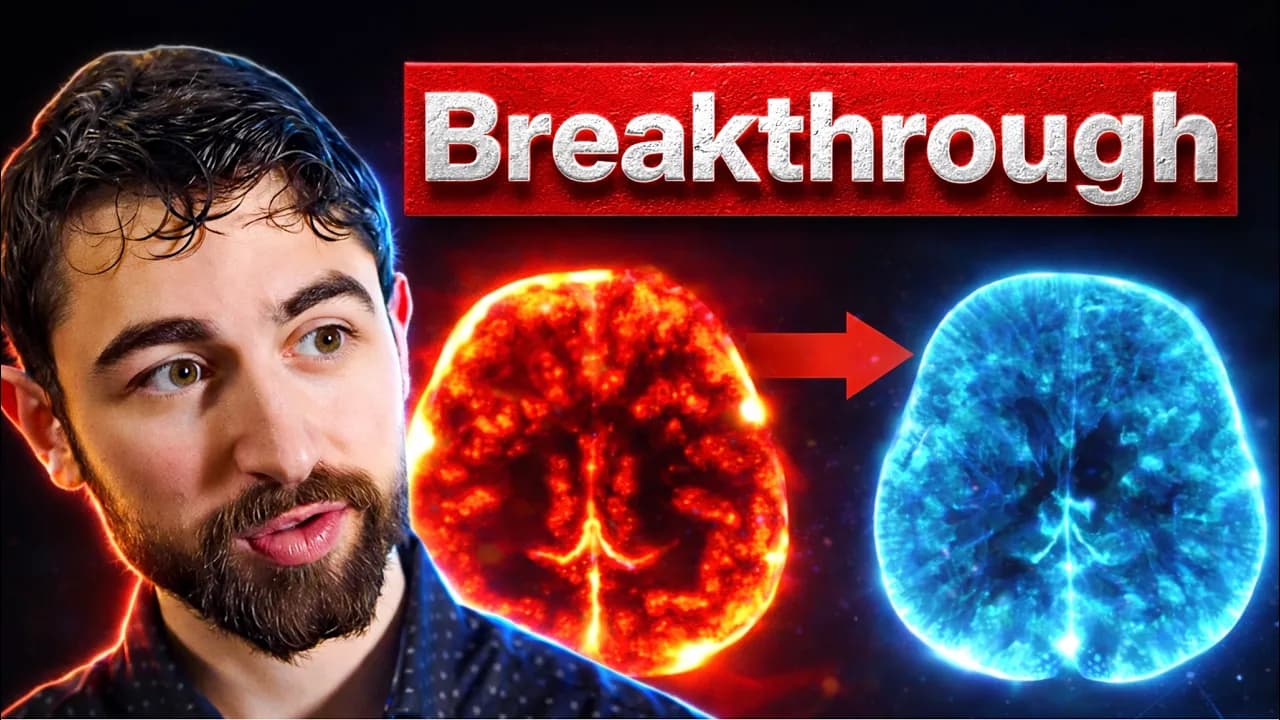
One of the world's top science journals published a biological plot twist: cancer might kill Alzheimer's disease. Nick is an MD/PhD neuroscientist at high risk for Alzheimer's disease, spending time finding ways to protect his brain long-term. This research discovery shows cancer and Alzheimer's colliding in a way that might reveal new treatment paths. The video reviews the data, graphs, what researchers did and found, boiling down to one protein. Then shares evidence-backed actions Nick does to protect his brain, none involving getting cancer.
Part one reviews new data on how cancer-secreted proteins, one in particular, fight Alzheimer's and what it might mean. Part two provides high-yield review of supplements for cognitive longevity and Alzheimer's prevention that Nick uses. More research and deep dives at staycuriousmetabolism.com.
Prior epidemiological studies hinted people with cancer or history of cancer have significantly lower incidence of Alzheimer's disease. Researchers started with animal models to show causal cascade, testing lung, colon, and prostate cancer in mice predisposed to Alzheimer's disease. Implanted cancers, then examined brains focusing on amyloid, a core pathological feature.
In all three cancer groups across multiple brain regions—cortex, thalamus, dentate gyrus (important in memory), basolateral amygdala (important in limbic system and emotion)—mice with cancer had markedly reduced amyloid plaque levels. Primary data shows red and green staining images and bar graphs quantifying levels: red is control Alzheimer's mouse, other colors are Alzheimer's mice with cancer showing much lower amyloid levels.
Researchers isolated cancer-secreted proteins and gave them to Alzheimer's mice without tumors. Same result: reduced amyloid in the brain. It's not the tumor mass; it's something secreted by the cancer affecting the brain.
Cancer-secreted proteins improved cognition and memory using validated tests like Morris water maze and Y maze. In Morris water maze, mice learn location of escape platform in milky water pool (top left quadrant); time spent in correct quadrant measures memory. Animals treated with cancer-secreted proteins performed better.
Together these findings indicate that cancer secreted proteins released from multiple cancer cell types but not the physical burden of the peripheral tumor itself inhibits amyloid pathology and can rescue cognition in a pre-clinical mouse model of Alzheimer's disease.
Researchers pinpointed cystatin C as the key player responsible for anti-amyloid effect. Cystatin C is elevated in human patients across a wide range of cancers. Human cystatin C directly binds to amyloid and promotes its degradation.
Cystatin C secreted by cancer cells is essential for the degradation of pre-existing amyloid plaques in the brain.
Purified human cystatin C injected into Alzheimer's mice once daily for 30 days. Cystatin C localized with immune cells in the brain around amyloid aggregates, activating immune cells to break down and clear plaques. Cystatin C helps brain's immune cells power up and clear toxic amyloid. Treatment reversed learning and memory deficits.
Findings are breaking new basic science, an important piece of the evolving Alzheimer's puzzle, but clinical utility limited. Open questions: Can human cystatin C or analogs cross blood-brain barrier for effective treatments? How early to intervene in humans? Potential off-target or unforeseen side effects?
Brain relies on omega-3s, especially long-chain DHA (40% of fatty acids in brain's gray matter). Dietary sources like sardines and salmon sufficient for many. For high genetic risk like Nick, LPC-DHA has privileged access to brain via transporter, more effective at raising brain DHA levels (orange in graphs) vs. conventional fish oil (red, concentrates in fat tissue).
Nick uses Accentrate Omega Max (patented highly concentrated LPC-DHA). Not cheap, but worthwhile for high-risk individuals. Discount code: stay curious for 20% off.
Higher trace lithium in drinking water associated with lower Alzheimer's risk. Lithium inhibits GSK3 beta, involved in amyloid plaques, phospho-tau neurofibrillary tangles, brain insulin resistance. Lithium levels reduced in cortices of Alzheimer's patients; sequestered by amyloid plaques, creating vicious cycle: lower lithium → more GSK3 beta → more pathology → more sequestration.
Harvard study: lithium deficiency causes Alzheimer's pathology in animals; low-dose lithium orotate reverses it. Nick supplements 5 mg lithium orotate daily (Pure Encapsulations).
NAD critical energy-carrying molecule central to glycolysis, beta oxidation, oxidative phosphorylation, Krebs cycle, TCA cycle. Alzheimer's characterized by NAD deficiency; high NAD preserves cognition despite pathology. Boost NAD via aerobic/resistance training, ketogenic diets, fasting. Supplements: nicotinamide mononucleotide (NMN) or nicotinamide riboside (NR); 1 gram daily doubles NAD levels in weeks (human RCTs).
Science hands dramatic plot twists where cancer and Alzheimer's collide. Study won't change treatment tomorrow but shifts mindset for breakthroughs. Challenge: stay rigorous, skeptical, and curious.
Keep Nick Norwitz in your library
Save the videos and channels worth coming back to, and find them again in one place.