Choke Point; Laser Focus; Growing Up Behind Walls | 60 Minutes Full Episodes
In a Nutshell
In a fictional US-Iran war scenario, Iran's control of the Strait of Hormuz—choking 20% of global oil via asymmetric drone attacks—strands 700 ships, spikes US gas prices 65 cents/gallon, and prompts laser weapons like AeroVironment's $5-per-shot Locust system as a cheap counter to $4M Patriot missiles. Amid economic fallout and failed reopenings, the segment contrasts this with Have Faith Haiti, Mitch Albom's fortified Port-au-Prince orphanage sheltering 56 at-risk kids behind 30-ft walls, providing education that sends graduates to US colleges to rebuild their gang-ravaged nation. Key takeaways: Hormuz remains a "mother of all chokepoints" vulnerable to low-tech threats; lasers offer scalable defense; the orphanage proves love and schooling unlock potential in chaos.
These notes were generated by AI and may contain inaccuracies.
This was the scene this past week in the Strait of Hormuz, a narrow stretch of water where Iranian attacks on tankers and cargo ships have choked the flow of oil and threatened to hold the global economy hostage. > "This is the mother of all choke points. We could be looking at the highest gas prices ever paid in this country."
"If we don't open Hormuz to the free flow of traffic. Yes."
They call it asymmetric warfare. Iranian attacks with cheap low-tech drones across the Persian Gulf while the US tries to shoot them down with anti-missile interceptors that cost millions. Could this weapon be the answer? > "The cost per shot goes from $4 million a shot to less than $5 a shot."
It's rare you hear about something good happening in Haiti. Tonight, we take you to a small oasis where children may be growing up behind walls, but hope is very much alive. > "Do you get greeted like that every time you come?" > "Pretty much. Yeah. It's an orphanage called Have Faith Haiti. It's run by best-selling author Mitch Albom and his wife Janine."
"If you give them something beautiful and calm, they'll aspire to those things. And that's what I think you see with our kids."
I'm Leslie Stahl. I'm Scott Pelley. I'm Bill Whitaker. I'm Anderson Cooper. I'm Sharyn Alfonsi. I'm John Wertheim. I'm Cecilia Vega. Those stories. And in our last minute, Oscar winner Jamie Lee Curtis reflects on America's next act tonight on 60 Minutes.
As the war enters its third week, US military officials say 6,000 Iranian military targets have been struck, including ballistic missile sites and air defense systems, and that Iran's navy has been rendered "combat ineffective." Yet, Iran continues to maintain its stranglehold over a tiny elbow of water called the Strait of Hormuz. It is the only route connecting oil-rich countries in the Persian Gulf to the rest of the world, a crucial 21-mile-wide waterway for a fifth of the world's oil. Normally 130 commercial ships pass through it every day. But on February 28th, when Israeli and American jets began dropping bombs on Iran and Iran retaliated, those ships ground to a halt, spiking American gas prices. It is an unprecedented closure of one of the world's most vital choke points.
An estimated 20,000 crew members are stranded and under attack. This was the scene this past Wednesday in the Strait: a Thai cargo ship was struck by a projectile from Iran, setting the ship on fire and trapping members of the crew. It is one of the few ships that has attempted to cross since the start of the war. Most others have been at a standstill in the waters surrounding the strait with the constant sound of drones and scenes like this all around.
"At what point did you look at the situation out there and say it's too dangerous. These ships should not sail through this strait. That was very early and very quickly Iran already said that they would attack any vessel that is passing through the strait of Hormuz and this was the moment when we called off."
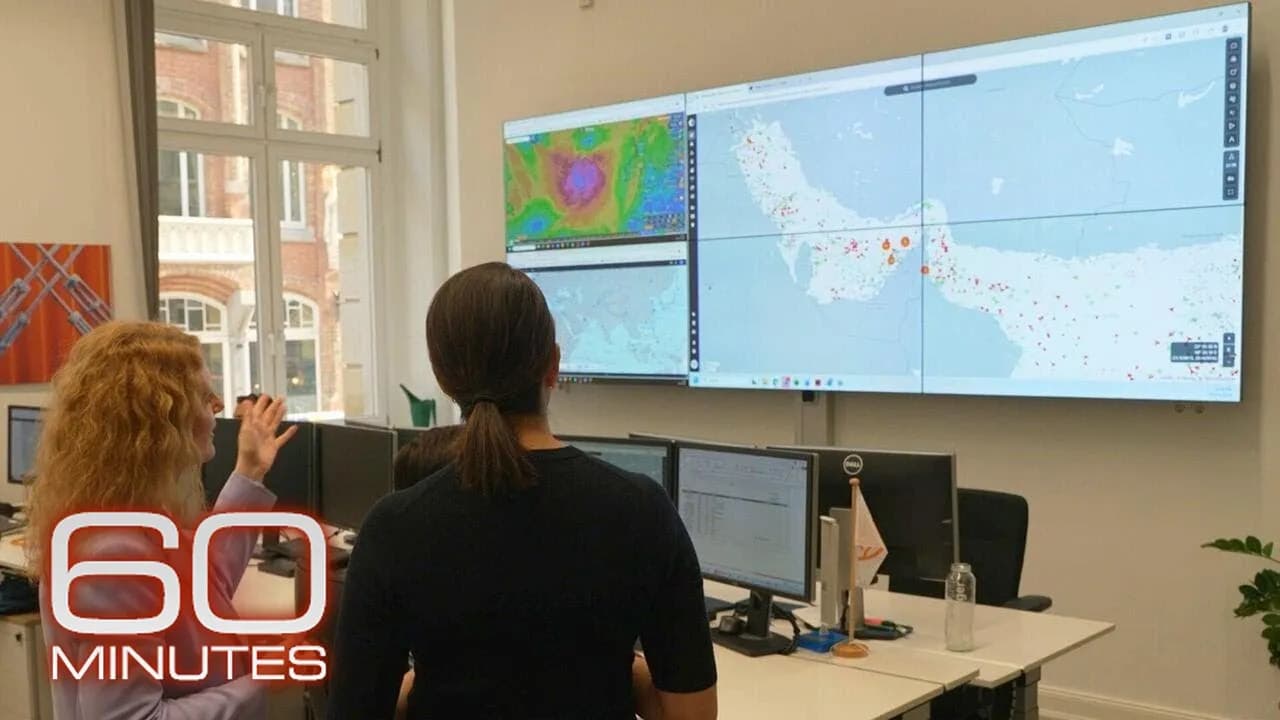
Captain Zilka Lee Kuster oversees a 300-vessel fleet for the German shipping giant Hapag-Lloyd from her operation center in Hamburg, Germany.
"So hundreds if not thousands of ships sitting hovering outside the strait of Hormuz right now." > "Yes. And they're all waiting basically to go inside to go around the corner. It's at a complete standstill. This is a standstill."
Six of her cargo ships carrying furniture, electronics, clothing—anything you might have in your home—were headed toward the strait as the war broke out. This is the message they heard from Iran's Revolutionary Guard, broadcast over their ship radios:
"Attention all ships. Attention all ships. From now on, all navigating through the strait of Hormuz is forbidden."
"So you heard this message from Iran and took that seriously?" > "Yes."
Captain Kuster ordered her crew not to proceed. Today, 150 men sit trapped as the war rages around them.
"What were they seeing out there? Drones flying by. Of course, they also saw explosions close to the port. A lot of smoke." > "They saw explosions close to the port." > "Yes." > "That must have been terrifying for them." > "It was."
And they are not alone. Roughly 700 ships are currently sitting in the Persian Gulf, including 400 oil tankers holding 200 million barrels of oil. That's enough to fuel Japan for 2 months.
This is Captain Lee Kuster's view of the war. Now day and night, she and her team keep watch. Those orange dots are their ships. The men on board have been ordered to stay below deck as much as possible.
"How often are you able to have communications with the crews out there? Sometimes the communication is difficult because the satellite phone is interfered as well. But we are in constant communication with our crew."
Her biggest fear: what's happened to many other ships like these two oil tankers off the coast of Iraq struck by Iranian explosives and set ablaze in the Persian Gulf. One was American-owned. Crews had to be rescued by boat. The next day, scorched vessels were seen drifting in the water. Since the war started, there have been 16 confirmed attacks on ships in and around the Persian Gulf. Iran has claimed responsibility for several of them. At least eight crew members have been killed.
Matt Smith monitors ship activity in the strait as an oil market analyst for Kepler, which tracks global trade and shipping. He made this time-lapse showing how quickly ship traffic moved around the bend of the strait in the days before the war.
"So on a normal day, you see about 100 or so ships that passed through there. When the bombing started with Iran, we saw it drop to about 70. On the Sunday, we saw it drop into the teens. And then since then, it's just one or two tankers that are passing through there every day."
All those red and green arrows represent oil tankers that haven't moved for the past 2 weeks.
"Fair to say this is a very expensive parking lot." > "It is a very, very expensive parking lot. That's right."
The few ships that have moved are mostly from one country, Iran.
"And you can see that Hilda is loaded with Iranian crude." > "Hilda is an Iranian vessel." > "Yes, an Iranian tanker. Iranian crude 2 million barrels and with all of that Iranian stuff it is typically heading to China." > "That oil is going to China. Yeah."
This past week, Smith and his team made a surprising discovery that Iran has exported daily 100,000 more barrels of oil than it did before the war. Most of it going to China. Smith says nine Iranian oil tankers have traveled through the Strait of Hormuz by turning off transponders that reveal locations. Thursday on Iran state TV the first public statement from the country's new supreme leader was read saying: > "the leverage of blocking the strait of Hormuz must continue."
Chokepoint a fair description.
"Chokepoint understates it. This is the mother of all choke points. Imagine your heart has one artery taking that lifeblood to the rest of your body and that is what the strait of Hormuz is."
Bob McNair was an energy adviser to President George W. Bush during the Iraq war who now advises clients on oil and gas markets. Last year he made a prediction.
"You saw this coming." > "Absolutely. My team and I wrote a big report and we're not surprised that if unmolested Iran would be able to make Hormuz unsafe for that lifeblood to flow. We're not surprised at all."
"Would you have advised President Bush to go through with these strikes?" > "Yes. I believe that what President Trump is doing in terms of defanging the Iranian regime is principled, courageous, and correct. totally support the goal. If I were advising him on how to achieve the goal, I would emphasize the need to manage the oil and gas market implications. And that means making sure from day one we are attacking Iran's ability to do what it has done for some 12 days now and may apparently do for an entire month." > "Did they do that?" > "I don't know." > "Do you have concerns based on what you've seen so far? Yes."
In the United States, gas prices have increased by more than 65 cents per gallon since the war began. The fastest weekly spike in 20 years.
"The all-time high for the most consumers have ever paid for gasoline was in the summer of 2022 after Russia invaded Ukraine. It was a $5 per gallon average. If we don't open up Hormuz soon, I can see us making new records. We could be looking at the highest gas prices ever paid in this country if we don't open Hormuz to the free flow of traffic. Yes,"
It's not just gas prices. The cost of jet and diesel fuel has risen 25% and as a result, higher plane tickets and grocery prices are expected to follow.
"The gasoline we pay for at the pump, the price of that gasoline is set in a global oil market. A supply disruption anywhere leads to a price spike for consumers everywhere, including here." > "We're seeing this trickle down effect." > "We are. So when that mom in Des Moines goes to the store to buy food for her family, that food was grown with and transported by oil. And as those producers and growers of food react to and absorb these price increases, they'll be passed along to the consumer, to that mom in the store. So what's happening at the Strait of Hormuz today affects the entire supply chain." > "It does."
"The Straits are in great shape. We've knocked out all of their boats. They have some missiles, but not very many. I think we're in very good shape. We're in very good shape."
Despite President Trump's assurances this past Wednesday, the reality is most ships remain too wary to cross. In recent days, US Central Command took out 30 so-called mine layers, boats believed to be used by Iran to deploy mines in the shipping lanes of the strait. The president said the US would help cover the cost of risk insurance as a way to reassure nervous ship owners and suggested the US Navy could offer escorts for protection. Though it is unclear when that will happen as the Navy is currently busy fighting the war. Captain Lee Kuster is still not letting her ships move through the strait.
"Would more insurance help? You cannot ensure the life of a seafarer. So more insurance would not necessarily help. We rather have the escorts." > "Has a US Navy escort been offered? No."
To move more oil onto the global market, this past week, the Trump administration announced it will temporarily lift sanctions on Russian oil that had been meant to punish Moscow after its invasion of Ukraine. 32 countries, including the US, also plan to release 400 million barrels of oil from the strategic reserves, the world's emergency supply. A process expected to take at least three months.
"I've worked in the White House during an energy crisis. There are no policy solutions to a prolonged closure of the strait of Hormuz." > "You're saying there's not much a White House, a president can do to stop this bleeding." > "You open up the toolkit and the tools in there, the options range from marginal through symbolic to deeply unwise. Escorts are a sideshow. Strategic stock releases are a sideshow. Gas tax holiday. Gas tax holiday. Sideshow. You got to restore the flow of the strait of Hormuz."
"Even if the White House, President Trump declared an end of this war today, tomorrow. Is there any guarantee that Iran would open up the strait and it's back to business as usual?" > "No guarantee. It's not like there's a big gate that swings open in front of the Hormuz and Iran locks the gate. So all Iran has to do is demonstrate every day, every other day that it has the means and the ability to attack ships in the strait and that will be enough."
And those attacks continue, including on this ship Thursday.
Remember the orange dots Captain Lee Kuster was monitoring in the operation center back in Hamburg? Two days after our interview, one of her six cargo ships stuck in the Persian Gulf was struck off a port near Dubai. The ship caught fire. No crew members were injured.
"What needs to happen in order for you to get on the radio to your crews and say go, it's safe. We would need really an end of this escalation so that there are no drones, no missiles, no whatsoever flying and that there's a clear message from everyone that they will stop."
Yesterday, President Trump called on other countries, including China, to send ships to help secure the Strait of Hormuz, saying: > "This should have always been a team effort."
This morning, Iran's foreign minister said its military decides which countries are allowed to pass through the strait.
They call it asymmetric warfare: highly sophisticated interceptor missiles, Patriots, THAADs, against Iran's low-tech drones made of materials you can largely get at your corner hobby store. While attacks by Iranian drones were down this past week, the amount of damage they have done has come as a jolt. An Iranian drone attack caused the first American casualties of the war when it killed six soldiers in Kuwait. Iranian drones are a drain on the US weapon stockpiles and a threat to the Strait of Hormuz.
We have found that in the race for a counter-weapon, there are contenders that look like science fiction: lasers that focus on zapping drones out of the sky. This is Iranian propaganda footage of its arsenal of drones that have been menacing the Gulf States, blasting apartment buildings, airports, oil refineries. These Shahed drones are getting faster, stronger, they can move in swarms, and there are tons of them. Perhaps their greatest advantage, how cheap they are, often made of flimsy plastics. One costs as low as $20,000. To shoot them down, the US is using anti-missile interceptors that cost millions. A possible solution, lasers.
"It changes the economics on how we can actually defeat and defend against these targets that are now being deployed and produced by tens of thousands."
Wahed Nawabi is CEO of American defense contractor AeroVironment (AV) that makes lasers that he says solve the money disparity.
"So let me give you an example, a real example. A Patriot missile battery cost about a billion dollars to procure one system. Each missile cost about $4 million a shot." > "Compare that to a laser." > "And the cost per shot goes from $4 million a shot to less than $5 a shot. In most cases, about $3 a shot."
That's shocking. The price difference of firing a missile or a laser is like buying a mansion versus a cup of coffee.
We visited AV in Albuquerque where their laser system called Locust is built. The top part that looks like Wall-E is the beam director. The deadly ray blasts out of one of the eyes. The base contains batteries as the power source and a cooling system. Each unit costs roughly $8 million and can be stationary or installed in the back of a truck.
"Has it ever been deployed in battle?" > "Absolutely. Yes. Multiple battles in different theaters around the world, including against Shaheds." > "Are you telling us that it has been deployed in the Middle East?" > "Yes."
He said he's not allowed to tell us exactly where, but it is not being used in the current war.
That drones have become so pervasive in the war brings up the question, why didn't the US have a cost-effective solution ready?
"They went into this war prepared for certain threats like missiles. They did not go into this war prepared for other threats like drones hitting soft targets."
Mara Karlin worked at the Pentagon in both Democratic and Republican administrations. Her last job was assistant secretary of defense for strategy, plans, and capabilities.
"Is Iran doing anything that surprises you?" > "Not really. If anyone were to war game this out, you knew there were a couple things the Iranian regime would do. They would always look at how to use cheap, tough to counter capabilities like drones in as many spots as possible."
"Is there anything within our arsenal to confront the drones?" > "So, I can't tell you that there is one magic solution that will do it. And frankly, that's kind of the history of warfare. You find multiple ways to counter different challenges and then your enemy either catches up or they then get a counter to that counter."
While AV is not a household name, it's a leader in developing drones as well as lasers. But their lasers face stiff competition from some of the giants, including Lockheed Martin and Raytheon. Countries are in the hunt as well. Israel has Iron Beam, part of the Iron Dome. Ukraine has a system. And China just revealed its lasers in a large military parade.
"But you're going to start tracking us."
John Gity, who's in charge of the Locust program, showed us how it works. First, Locust's radars find the enemy drone up to 7 miles away as it moves toward the target. Then an operator, in this case me, locks in on the drone by clicking an ordinary Xbox controller.
"I'm going to have you tap that bumper one more time."
From that point on, the laser tracks the drone as it approaches using AI.
"I don't have to touch anything. It's going to follow the drone wherever it goes." > "Yes. Exactly. Yep. And that's the beauty of a laser weapon system, that ability to track and take that overhead burden off of the operator."
Now, as it gets two to three miles from the system, the final step, destruction.
"Tell us about the kill. So imagine if you will, you're taking a beam of light or a flashlight and pushing that out several miles away and that creates enough heat to melt through the plastics or what the material is that these drones are made of."
For a closer look, he had a drone placed in a hangar. The door was bolted and we observed on monitors outside.
"John showed me what an operator would do. All right, Leslie. What I'm going to ask you to do right now is go ahead and pull the trigger."
Watch closely because the invisible beam travels at the speed of light. Here's the replay. The beam went right through the drone.
"And you can see there instantaneously flames. Look at the flames coming out of there." > "That is out of the sky. It is no longer a threat."
This is what the drone looked like afterward. And so let's go ahead and fire again. We were able to see the beam through cameras sensitive to infrared light.
"Look at that. Isn't that cool? And so what you're seeing there is effectively clear light that's traveling across the sky and hitting the target that you intend." > "So the benefit of a laser system is you can just keep on lasing at that target until it goes down."
"Can this shoot down a 100 drones at the same time? because you're only taking 1 second or less to kill some of these drones depending on the range to quickly go through and complete your mission right now today. Is it strong enough to shoot down the Shahed drones that Iran is sending in?" > "So, we've had a lot of great success with those types of drones and our new Locust system is directly intended to get after that Shahed fight."
As drone technology keeps evolving, lasers have to keep up.
Laser technology overall is still relatively young and experimental. Ongoing military tests have raised concerns about performance, accuracy, how heavy the battery is, how much energy is required, and how effective the beam is in certain weather conditions. I'm told that there's a lot of trouble with these systems if it rains, if it's humid, if it's sandy like in the desert, if there's fog, if there's dust.
"Now, when you're talking about does the system operate in rain? Well, traditionally drones aren't flying in rain." > "What about sand and fog and dust? You know, I won't get into our deployments, but I can tell you that our systems have been actively deployed and placed at their battle stations and never had to come inside during any weather events."
We asked Mara Karlin, the former Pentagon official, how laser technology should fit in the US arsenal.
"That would be an element and has clearly been an effort that has gotten some investment, though surely not enough. But even for the lasers, you've got to be able to figure out where the target is coming from. So, do you have sufficient intelligence along those lines? Are you able to make the physics work in terms of what you're actually aiming towards?" > "So, you don't think lasers are a magic bullet." > "So, at this moment in time, they are very valuable. When we are sitting here 6 months from now, I don't know that will be the case."
But as the war enters its third week, there's an alignment of moments with laser weapons maturing exactly when less powerful, less expensive military hardware is needed.
"Is the US military right now procuring Locust?" > "Yes, Leslie. Just this fall, the United States Army requested from us to deliver about a hundred million dollars worth of Locust laser directed energy systems."
Turns out the lasers have been in use since last month, not in the war in Iran, but in the war on drugs at home. We have learned that the army is routinely shooting down drones operated by cartels along the Mexican border. Drug smugglers are sending the drugs in by drone,
"not just one direction. It's a lot easier to fly cash via drone than to dig a tunnel and then transport it underground."
"So, it's the army that is conducting these operations using Locust on the border area." > "I believe the United States Army is working in cooperation with Customs and Border Patrol."
But after Locust was used near West Texas, the Federal Aviation Administration (FAA) shut down the airspace near the border twice, causing flight cancellations and cargo diversions.
"Do you know why the FAA shut down the airspace over El Paso?" > "Because there was some concerns that these systems can interfere and hurt commercial airplanes. Can they?" > "Which is not true." > "It's not true." > "It is not true." > "Well, how do you know it's not true?" > "The FAA just this past weekend conducted a series of tests to ensure and demonstrate that the type of system that we've developed cannot and will not defeat or harm a commercial airliner."
"So if you aim this beam at a Delta flight, it won't burn through it and disable it and crash it." > "The system is designed to not make mistakes like that."
In order for the lasers to be sold to the Gulf States, the Pentagon and the State Department would have to approve the sale because of the national security aspect of the technology. And then there's another issue.
"Let's say Bahrain wants 500 of these to protect their hotels and all the other targets. Could you send them 500 tomorrow?" > "Not tomorrow. Remember, there's a chicken and egg thing in here. So far, we've only been authorized and allowed to provide this to the US military. So, I cannot go at risk and build a billion dollars worth of the stuff when I don't have a contract in place that allows me to have a security or guarantee that somebody's going to buy it."
The reality is that even if the government gave the go-ahead for a sale to the Gulf States tomorrow, it would take months for AV to scale up its laser production.
It's rare you hear about something good happening in Haiti. 16 years after the devastating earthquake which killed some 200,000 people and left more than a million homeless, the government has all but collapsed and gangs battle for control of the capital Port-au-Prince. But tonight, we want to take you to a small oasis in that besieged city where children may be growing up behind walls, but hope is very much alive. It's an orphanage called Have Faith Haiti that's run by best-selling author Mitch Albom and his wife Janine. Since the earthquake, they've been taking in the most at-risk kids: abandoned infants, toddlers with disabilities, children begging in the streets. It hasn't been easy, but with love, faith, and a focus on education, the results have been extraordinary.
It's too dangerous for international flights to land in Haiti's capital. So, every month, Mitch Albom flies the 2 hours from Florida to the northern city of Cap-Haitien. That's where we met him and boarded a helicopter to reach Port-au-Prince. From the air, much of Haiti is a maze of dry riverbeds and rugged mountains stripped of trees. Then appears Port-au-Prince, a dense sprawl of chaotic streets and dilapidated buildings. Once on the ground, heavily armed guards drive Albom to the orphanage in a convoy of bulletproof vehicles.
"It's kind of crazy just what it takes for you to get in and out of here. And you do this every month." > "Yeah. Back before the gangs were an issue, we had two security guards. Now we have 24. Wow."
From the outside, it looks like a prison. The concrete walls are 30 ft tall with barbed wire and guard towers. To enter, you have to pass through a series of locked gates. But once inside, it feels like another world.
"MR. MR. MR. MITCH, they're chanting."
Mr. Mitch is greeted enthusiastically: "MR. MITCH. MR. MITCH. OH MY GOODNESS. HELLO. SO NICE to see you guys." He gets greeted like that pretty much every time he comes. There are 56 children living here and more than 50 teachers and staff.
Kids range from infants and toddlers cared for by nannies to teenagers in dorms. Most haven't left this 7-acre compound in more than four years. They play, do chores, go to church, and attend school 8 hours a day. They're taught in both French and English and prepared for college.
All children deserve to feel like they have a future and the future is possible. And there are a lot of children right on the other side of that gate and their bellies are swollen and they not eating and that's not fair. And if my wife and I can do anything to change that, even if it's a drop in the bucket, that'll be our drop.
You're not doing analysis of a 2- or 3-year-old and seeing what their cognition is and what they're capable of. You are just picking kids in the most difficult circumstances. Love, food, prayer works miracles. We don't give aptitude tests to get in here. Most kids that come aren't even speaking yet, but if you put them in the right environment and surround them with other kids who are aspiring to do certain things, they'll grow.
Not all kids are orphans. Many were brought by a desperate parent or family member who couldn't afford to feed them. Mitch Albom has to choose who gets in.
We try to set the conditions because otherwise it's hundreds and hundreds of children. So we say only if there's one parent, not two, only if there's no home, no actual structure home, or if there's a case of a sickness or something like that.
Interviews include stories like: "I don't have any food to give my baby. The parents died. I don't know who this child is. We found this child under a tree. He was six weeks old and he was starving."
Those stories, those interviews, they broke me in half, but they also cemented me to Haiti and cemented me to this operation, which I will do for the rest of my life.
Mitch Albom is the author of 19 books, including Tuesdays with Morrie and his most recent bestseller Twice. He first came to Haiti in 2010 after the earthquake. That's when Albom, who's Jewish, began fixing up a Christian orphanage run by an elderly pastor.
The pastor basically said, "I don't have any money to run this place, and I'm 84 years old." And I kind of blurted out, "Well, I could probably run it. How hard could it be?" And he said, "Here you go."
Betany was brought here around that time, year and a half old. Her father died in the earthquake and her mother was desperate. Lorins was malnourished when he came at three. Gino was left by her father at 5 and now wants to be a lawyer.
I felt abandoned. I could say I was a little bit scared because there were a lot of new faces and just a lot of people staring and smiling. Smiling felt weird. It was my first time seeing an American Mr. Mitch. He's so white.
Honestly, not really because I know my mom is human and I don't think it was a really bad choice for her to bring me here because she was looking at my future.
Cuz I feel like why would your own family leave you in a place where you don't know anybody?
That feeling of abandonment is something Yanell, the Haitian director of Have Faith Haiti, knows well. He was left at the old orphanage 36 years ago when he was five.
It was the worst day of my life. Honestly, I did not like it.
Yanell's father had three other children and couldn't afford another.
I thought that they hate me back then because they just kicked me out and they didn't even tell me why. But later on, I would understand why they did that. That's why I forgive him, cuz I think they do it out of love.
When we share and when we give, it reminds us of what God did for us. Amen.
Almost all the kids when they come call Yanell father. They need that connection, so he puts himself there for them. The kids view each other as brothers and sisters.
That's all we got growing up. We have to rely on each other to survive. That's all these kids have is each other.
Keeping the kids safe is one of Yanell's biggest challenges. Outside the walls, 90% of the Port-au-Prince metropolitan area is controlled by armed gangs. Rapes, robberies, and murders are common. The UN estimates more than a million people have been displaced by violence. In just the last 24 hours in this one area, there have been three shootouts between police and gang members.
In case gunmen break in, Yanell conducts surprise emergency drills. Kids grab go bags and rush to a concrete bunker with steel doors, a generator, a month's supply of food and water, and cameras to monitor outside. One drill was unsatisfactory because a baby was left napping in the nursery.
Not good. You can't leave no one behind.
Have Faith Haiti's budget is paid for mostly by Mitch Albom and his wife Janine, along with public and private donors.
We try to give them a childhood which is stolen from so many people. There's not a lot of kids in Haiti who get a childhood.
It's very hard to fundraise for Haiti. People think the money disappears or the government takes it.
These children don't deserve to be ignored because Haiti has a checkered history.
After security and fuel, education is the biggest expense. Classes are small; struggling children get customized lesson plans. No kids on phones, playing video games, or with personal computers, cell phones, or television. Their attention span is remarkably long relative to American kids.
16 kids have graduated high school from Have Faith Haiti in the last 8 years, all getting scholarships to American colleges and universities, but they agree to return after studies and work at the orphanage for two years for free to give back.
They're not going to America to take jobs. They're not going to America to do anything but appreciate it and then come back and make their country a better place. I hope our kids can stabilize this country and that's part of what we're trying to raise them to do.
In December, at Mitch Albom's home outside Detroit, Haitian college students stayed on winter breaks. Interviewed: Whidley, Bianca, JJ, and Ju.
For me, it's like opportunities. Like there's lots of opportunities here. Just being able to see the ins and out of how an actual government works. It was like a relief. A relief from all the violence.
All are determined to help turn Haiti around.
Education is one of the things I would really want to take back and I will take back in Haiti because you need a better education to lead the government and to get a good job eventually. I'd like to become an ambassador for my country someday. The end goal is to be a senator. My country one day.
It doesn't scare you off to get involved in politics. I mean there is a little bit of fear honestly. Our last president got assassinated. We have to take that into account.
To me, Haiti isn't just my country. It's like my home where I was raised and I have a deep connection to Haiti. So, yeah, that's my future is with Haiti.
Haiti's future is uncertain. In September, the United Nations with US backing authorized 5,500 multinational troops to combat gangs, but so far fewer than 1,000 deployed. The US slashed financial obligations by more than 50%. This spring, another six students graduate and will volunteer for a year before applying for US scholarships, though visas are uncertain.
Is there a difference between you and kids outside these walls who are working in the streets in terms of their potential? No, because it could have been vice versa and we could have been in the streets and they could have been here. So I think everybody has potential. They just have to be given the chance and the opportunity to explore that.
Every child has that potential inside no matter what circumstance they come from. If you give them something beautiful and calm and hopeful, they'll aspire to those things. And that's what I think you see with our kids.
Anderson Cooper's personal connection to Haiti: "Somebody I knew so well, my math teacher assassinated. That was shocking."
At 60MinutesOvertime.com.
Keep 60 Minutes in your library
Save the videos and channels worth coming back to, and find them again in one place.