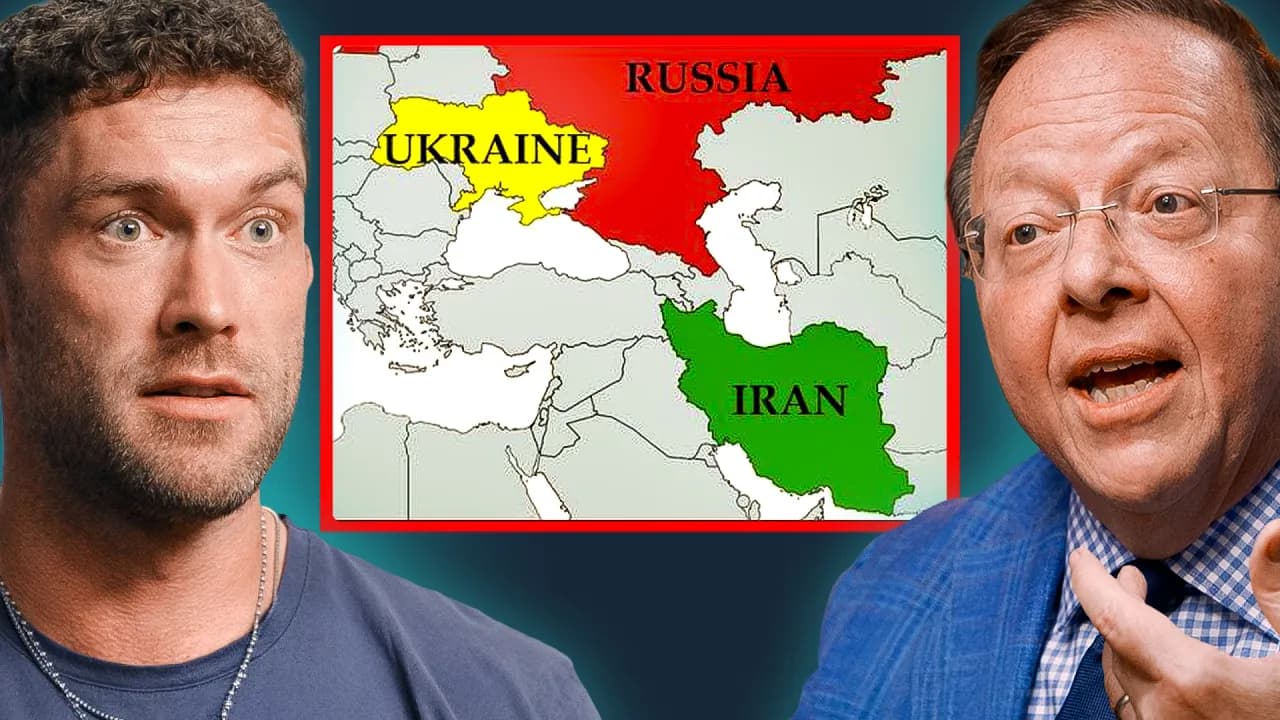
URGENT UPDATE - Iran War Expert: 70% Chance US Sends Troops To Iran THIS WEEK! | Robert Pape
In a Nutshell
Robert Pape assesses a 70% probability the US will launch limited ground operations in Iran within the week to seize control of the Strait of Hormuz. The core dilemma is a choice between triggering a global economic crisis by allowing Iran to control 20% of world oil flows, or committing to military escalation that risks suicide terrorism and a forever war. Pape warns this repeats Lyndon Johnson's Vietnam trap—escalating despite knowing it won't succeed, to avoid immediate political defeat before midterms.
These notes were generated by AI and may contain inaccuracies.
Iran is stronger today than it was before the war started. This represents the nightmare scenario that has been anticipated for years. The world economic crisis is expected to grow in the coming months. Robert Pape has been modeling the bombing of Iran for 20 years and has advised every White House from 2001 to 2024 on conflict-related issues.
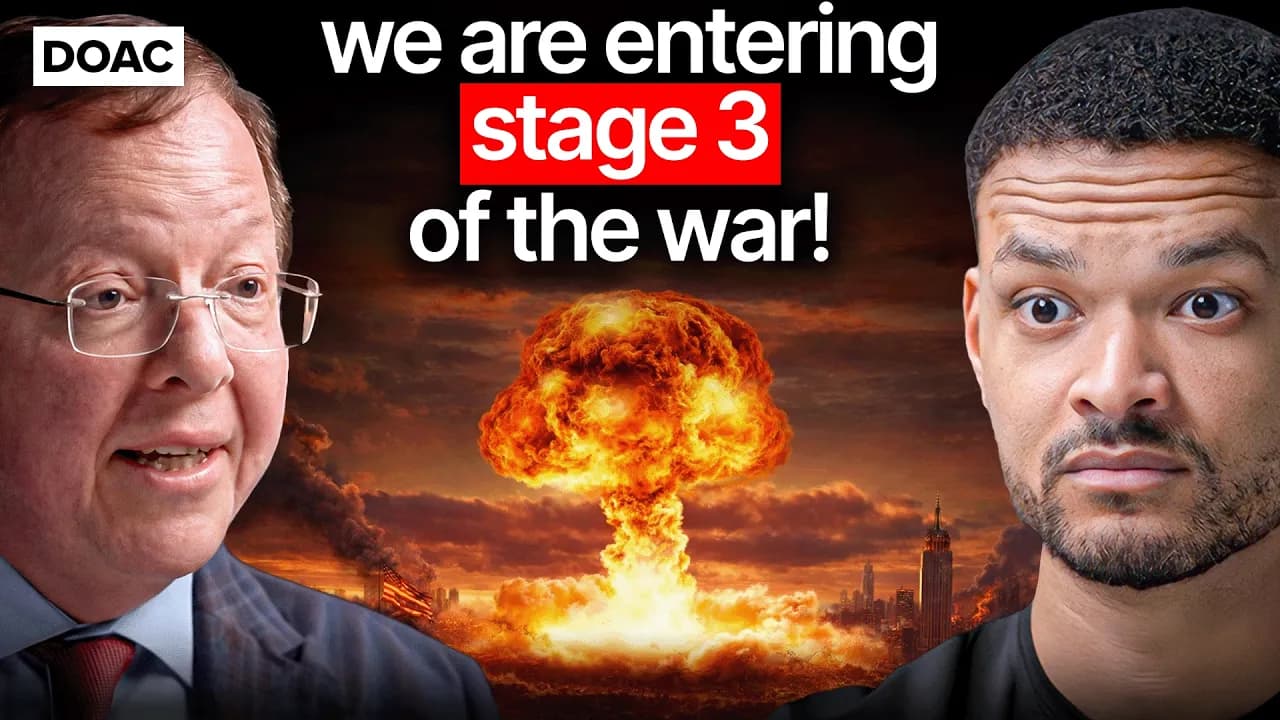
The analysis indicates we are entering stage three predictions, comparable to being on the Titanic approaching an iceberg. The world is approaching a scenario of literally running out of oil. Iran has been attacking US bases in Jordan, with the US conducting its ninth consecutive day of bombing. The scale of eliminating the drone and missile threat is much larger than commonly realized because drones are hidden everywhere.
The risk that the US will conduct some kind of limited ground operation with boots on the ground in Iran is bordering on 70% by the end of this week. A major concern is terrorist attacks, as controlling pieces of homeland territory represents the biggest risk factor for suicide terrorism. The fundamental choice presented is between a global economic crisis, possibly a recession or worse, or allowing Iran to control the Strait of Hormuz.
Robert Pape has been modeling the bombing of Iran for 20 years. When the bombing of the regime in Iran occurred, the regime survived even though the supreme leader and approximately 137 top leaders were killed. This is compared to killing a US president, first lady, members of the first family, half the cabinet, all Pentagon leaders, all CIA leaders, and about a third of Congress. Air power alone has never toppled a regime going back to World War I.
The US shifted to a six-week bombing campaign, then to a two-month blockade. The US attempted to block the Strait of Hormuz to coerce Iran into surrendering control. On February 28th, regime change bombing occurred and continued for several days, but by March 2nd-3rd, Iran controlled Hormuz. Ships stopped cold and have not reopened except for tiny periods of time.
The core dilemma involves either physically taking Hormuz back or allowing Iran to continue controlling it indefinitely. A memorandum of understanding was nearly signed with Iran to end the war. JD Vance indicated the agreement was about to be signed, but weeks later the parties returned to bombing each other.
The memorandum of understanding contained fundamental issues. Vice President Vance approached it as a business deal, offering benefits to Iran in exchange for opening the strait. This represents a fundamental misunderstanding of international politics. The balance of power was at stake, not a business transaction.
Before the war, America was the ascendant power, Israel was rising, and Iran was declining in the region. Within two weeks of the war starting, the balance of power shifted dramatically when Iran gained control of Hormuz. This control represents tremendous future power, wealth, and military capability, equating to the ability to influence other states and build a sphere of influence.
A regional hegemon is defined as the most dominant state in the Persian Gulf and Middle East. The agreement would make Iran the most dominant state in the Middle East. Iran signed the document, with most points matching exactly what President Trump said he would never sign in April when Iran presented their initial 14-point plan.
Article 5 states that Iran will make arrangements with Hormuz and will not charge for 60 days, not that they will never charge. The agreement specifies that Iran and Oman will determine future fees with no mention of the United States or any clause allowing US involvement. This gives Iran control of the Strait of Hormuz and discretion to set fees indefinitely with no constraints.
Both the Iranian government and White House released identical documents word for word. This represents the final document President Trump signed, not an earlier draft. Controlling Hormuz means controlling 20% of the world's oil, representing fantastic wealth and strategic power with no limits on spending, including on missiles.
Becoming the dominant regional power requires more than a strategic base - it requires a sphere of influence. Saudi Arabia began putting out 4-5 million barrels of oil per day starting mid-March into the Red Sea via an existing pipeline. The UAE's Fujairah pipeline carries almost 2 million barrels per day. Of 20 million barrels per day going through Hormuz, 7 million were being bypassed immediately.
Iran discussed their security resistance belt from the Mediterranean to the Red Sea to the Gulf. This strategy aims to prevent all bypasses to Hormuz. The Houthis in Yemen are considered secure after fighting the Saudis for years. The US fought a war with the Houthis in May 2025 to get them to pull back from a temporary Red Sea shutdown but lost essentially.
Hezbollah's strategic importance extends beyond ideological relationships spanning decades. Hezbollah can provide drones in Lebanon to attack pipelines through Syria, functioning similarly to the Houthis. This creates an operational sphere of influence guaranteeing control of all oil from the Persian Gulf, whether through Hormuz, Syria, or the Red Sea.
President Trump signed the document because the world was going to run out of oil in four weeks. Within 48 hours, the Trump administration began undermining the document. Secretary Rubio established a framework accord in Lebanon that would lock in Israel's military presence, violating Article 1's guarantee of Lebanon's territorial integrity.
President Trump encouraged ships to pass through the southern passageway of Hormuz without coordination with Iran and often with transponders turned off. This directly contravenes Article 5. President Trump bragged about this on multiple True Social posts as a secret way to bypass Iran's control.
Article 11 specified that Iran would have some frozen assets unfrozen with exclusive right to determine how the money would be used. President Trump stated Iran could have their money only if used to buy American grain from US farmers, representing the third violation of the agreement.
President Trump owned the agreement for a day or two, representing a strategic defeat for the United States. He then tried to reverse the loss almost immediately. The miscalculation was assuming that if President Trump didn't restart the war, it would be over. Iran began shooting at ships in the Strait of Hormuz because the US was violating the agreement and bypassing their control.
The conflict represents great power politics where Iran wants to be the dominant state in the region while the United States does not want Iran to hold that position. This has been the war's core issue since the first week in March, continuing five months later.
Iran never charged for passage through the Strait of Hormuz before the war. Before February 28th, Iran did not control the strait at all. Iran moved from survival to ambition when the bombing occurred because the United States had no navy present and no means to offset Iran's control of the strait.
Without doubt, Iran is stronger today than before the war started on February 28th due to control of the Strait of Hormuz. Iran can threaten virtually any ship at will and has demonstrated this repeatedly. Even ships with transponders turned off are threatened as they pass through.
Despite US claims that Iran's air force, navy, and nearly all missile capabilities are destroyed, Iran retains capability because only a small fraction of its drone and missile arsenal is necessary to inflict damage. Iran entered the war with thousands to tens of thousands of drones, ballistic missiles, and anti-shipping missiles. Saturation attacks overwhelm defensive capabilities.
March attacks were mostly intermediate range ballistic missiles, shifting to drones since mid-March. Recent attacks have shown renewed use of ballistic missiles and cruise missiles, which are sea-skimming missiles. The full arsenal appears fully stocked with no signs of running out of ammunition.
Trump stated in May 2026 that Iran has no navy, air force, air detection, or radar remaining. However, what remains cannot be knocked out and is sufficient to maintain control of Hormuz. The US took out the easy targets that Iran didn't need to seize and maintain control of Hormuz.
Drones are hidden everywhere, including drone caverns and warehouses. A typical drone would easily fit in a standard room, making detection and elimination extremely difficult due to the scale of potential hiding locations relative to their small size.
The scale of eliminating the drone and missile threat is much bigger than people realize because they're hearing measurements like we've destroyed X% and Y%. Looking at the map, Shahed 136 drones could literally be anywhere in a 500 mile radius. This area is one and a half times the size of California.
The challenge resembles trying to find a truck in California. The area is mountainous, making this a three-dimensional problem rather than two-dimensional. Drones can be hidden anywhere in these mountains. Visual demonstrations show terrain layers being added over drones, making them invisible from the air. Even after finding one drone, the process requires digging them out one by one or in clusters.
Iran was making 55,000 drones a year as of April estimates leaked from the Pentagon, supplying them to Russia. Thousands are produced monthly. New drones continue being manufactured throughout any search operation.
Opening the Strait of Hormuz requires more than finding dozens or hundreds of drones. Shipping companies must be persuaded their ships are safe, as they don't obey Pentagon orders. Tankers carry between 700,000 and over a million barrels of oil each. A brand new vessel with a full tank of oil crossing the Strait of Hormuz represents a floating asset worth $300 million, not including crew lives.
More ships are leaving than entering the area. Ships coming in are heavily directed to Iran's ports. President Trump reinstated the blockade because the situation isn't opening the Strait of Hormuz but preventing the world economic crisis. The world is approaching running out of oil.
The Houthis, a major Iranian ally, shut down the Red Sea route approximately six hours before the discussion. This has been escalating for several weeks as part of Iran's general escalation strategy. Combined with the Strait of Hormuz closure, no oil flows through either route.
When Iran gained control of the Strait of Hormuz, Saudi Arabia and the UAE began bypassing Hormuz with 7 million barrels per day, reducing the issue to 13 million barrels. The United States began releasing about 5-6 million barrels per week from the strategic petroleum reserve around mid-March.
President Trump authorized emergency release of 172 million barrels from the strategic reserve over roughly 120 days. This was part of a coordinated effort by 32 member nations of the International Energy Agency who collectively released 400 million barrels. As of July 2026, the US strategic reserve dropped to roughly 300 million barrels, the lowest level since 1983.
The crisis extends beyond crude oil to refining capacity. Much of the world's refineries are located in the Persian Gulf, representing 25% or a third of global refining capacity now shut down. Russia and Ukraine are simultaneously destroying Russian refineries, creating a compound problem of both crude shortages and refining limitations potentially down 40%.
President Trump chose to take the risk with the world's economy rather than own the loss. Owning the loss would allow Iran to follow through with Article 5, controlling the strait on its terms and setting a precedent for other straits worldwide.
The current dilemma is choosing between a global economic crisis, possibly recession or worse, or letting Iran control the Strait of Hormuz. This represents the stage three dilemma in the escalation trap. Twenty years of modeling predicted reaching this fork quickly, not over months. Trump attempted to avoid the escalation trap through six weeks of bombing, the blockade, signing agreements, and JD Vance offering money.
During a June 2026 G7 summit press conference, President Trump stated: "We run out of reserves at about 4 weeks. You know, there are reserves all over the world and we would run really, really low. But we would run out and there'll be a time when you wouldn't be able to get it. It would be bedlam." Being forthright about signing the agreement to avoid economic crisis, Trump undermined the agreement within 48 hours of making this statement.
Midterm elections occur in three months. If approval ratings drop due to high gas prices at the pump, Americans will vote for Democrats, potentially costing Republicans Congress. Trump needs to ensure Americans are satisfied within three months. His June 17th statement indicated reserves would run out within a month, heading toward economic crisis. The trajectory continues, possibly delayed to August 15th or 17th rather than August 1st.
When the economic crisis hits, there's a good chance Republicans will lose more seats in House and Senate, making Trump a lame duck for his final two years. Impeachment is possible with Democratic control. Trump recognizes the world is approaching an economic iceberg with insufficient lifeboats, and Republicans would be shortchanged.
Lyndon Johnson faced similar pressure during Vietnam escalation. White House tapes reveal Johnson knew escalation was unlikely to end the war and likely to worsen it, but proceeded hoping for a small chance of success to hold onto his Great Society program for another four or five months. Johnson ultimately withdrew from reelection due to Vietnam escalations. Trump faces the same risk despite pursuing escalation to improve Republican chances in November.
Trump has planted seeds suggesting China meddling in elections, preparing for possible stonewalling of election results by foreign countries.
An escalation ladder framework shows an upside-down pyramid structure starting small at the bottom and becoming worse with more red stages toward the top. Stage one begins with limited strikes and leadership bombing to topple the regime, leading to retaliation. Stage two involves Iran taking Hormuz, followed by US retaliation through six weeks of bombing and blockade. Stage three marks the economic crisis threshold.
Stage three presents the choice: either let Iran become the regional hegemon and fourth center of world power, gaining nuclear weapons within a year or two, or physically use force to seize back control of Hormuz. The question of whether the United States can physically open the Strait of Hormuz between now and the midterms is the most important issue for the world economy, international terrorism against Americans, and whether a forever war will develop.
Lyndon Johnson stated: "I know we ought not be there, but I can't get out. I just can't be the architect of surrender." He also said: "Let's get somebody that wants to do something besides drop a bomb, but that can go in and take in after these damn fellas and run them back where they belong," indicating reliance on air power wasn't solving unconventional ground-level problems.
President Lyndon B. Johnson's comments during the Vietnam War provide direct parallels to the current situation. LBJ stated that relying entirely on overwhelming American air power was not solving the unconventional ground-level problem, which connects to the current transition from air power to heavier ground forces. Both approaches ultimately failed in Vietnam.
LBJ also observed that fighting 10,000 miles away from home against an enemy in their own backyard was incredibly difficult and likely futile, describing it as "the biggest damn mess that I ever saw." This observation applies to the current strategic situation. Finally, LBJ noted there was "no daylight in Vietnam" - no realistic achievable endpoint or path to victory for the military strategy, which links to current political pressures and the realization that the current strategy has a deadline with no clear solution in sight.
The situation represents a tragic replay of Vietnam War decisions. President Trump is making decisions similar to those made by Lyndon Johnson, believing that even though military escalation would likely be a loser on the battlefield, the loss would take months to play out, creating some chance to "pull a rabbit out of a hat." The alternative - accepting immediate abrupt defeat - would totally undermine and destroy his domestic political agenda.
Current US forces include approximately 4,500-5,000 Marines and around 4,000 troops from the 82nd Airborne. These forces are concentrated in the Gulf of Oman rather than the Persian Gulf, with carriers, destroyers, and battleships positioned to potentially take territory at Chabahar or the port town of Jask between Bandar Abbas and Chabahar.
The strategic rationale is that these forces could potentially take and hold territory for weeks as a symbolic victory. This location is in southeastern Iran, the least populated part of the country, with Iran's main population centers located further north. The Gulf of Oman is east of the Strait of Hormuz, while the Persian Gulf is to the west.
A ground operation would provide Iran with targets to kill American soldiers, with costs potentially reaching hundreds of dead over weeks. This would be politically divisive - making war opponents even more opposed while potentially hardening support among war supporters. Polling from mid-2026 shows overall American support for the war at 27-34% with 53-57% opposition, but MAGA Republicans show 77-85% support and only 5-14% opposition.
Deaths can actually harden support for war in the near term, as people resist viewing fallen soldiers' deaths as mistakes or worthless. This effect can last for months before eventually whittling down support over longer periods.
The risk of limited ground operations with boots on the ground in Iran is estimated at over 50%, bordering on 70%, possibly within the next month or even by the end of the current week. The economic crisis that escalation was meant to prevent is already becoming baked in, with the Houthis closing the pipeline area around Yanbu - a port city in the Red Sea handling 4-5 million barrels of Saudi oil daily.
Iran's Supreme Leader stated he would deliver "unforgettable lessons to America" following the deaths of two US soldiers in Jordan. Iran is escalating in multiple ways: attacking the US base in Jordan (rare since March), closing the Red Sea through Houthi proxies, and showing no signs of pulling back despite the ongoing spiral of escalation.
The biggest concern is a mass casualty attack against American troops or civilians, specifically a barrage of ballistic missiles against naval ships in the Gulf of Oman. Iran has demonstrated exquisite precision targeting ability over the past week and a half, potentially tracking naval ship movements with possible assistance from Chinese or Russian sources.
A second major concern is suicide terrorism, as ground occupation and control of homeland territory represents the biggest risk factor for suicide terrorism campaigns. This could manifest as attacks against American airliners, business personnel in Aqaba (where recent attacks have occurred), or hotels housing American businesspeople building pipelines in the region.
Suicide terrorism represents the "lung cancer of terrorism" - killing more people than all other forms of terrorism combined. The key risk factor is military combat presence on territory the terrorist prizes. Unlike missile interception, suicide terrorism turns a person into a precision-guided weapon capable of identifying the most vulnerable points in crowds or buildings at the exact optimal moment.
Historical research predicted that invading and occupying Iraq would trigger the largest suicide terrorist campaign in modern times. The critical distinction is that bombing from the sky differs from ground forces because ground forces impose political control, representing a deeper violation of local population autonomy.
No achievable offramp exists that would restore free shipping through the Strait of Hormuz while allowing the United States to retract without appearing to suffer strategic defeat. The opportunity for declaring victory and walking away passed in the first week of March. Later suggestions to militarily contain Israel came months too late to be effective.
The only potential exit mechanism would be if Democrats win either the House or both House and Senate in the midterms and shut down funding for the war, similar to congressional action in 1974 during Vietnam. The period between now and the midterms represents the crucial escalation phase that will determine whether America can physically open the Strait of Hormuz or if the conflict continues escalating.
Congress controls military funding and can pass laws to prevent money from being spent on war, as occurred in 1974. The midterms will determine who controls Congress and thus how much money the military receives.
Trump holds massive constitutional advantages as commander-in-chief and can veto any war powers resolution or funding restriction passed by Congress, requiring a two-thirds supermajority in both chambers to override. Trump could invoke Article 2 constitutional authority, claiming inherent power to defend America's interests and troops without legislative approval.
Even if Congress refuses new funding, the president can use emergency transfer authorities and creative accounting to shuffle existing Pentagon budget funds to keep military operations running in the short term. This creates a constitutional crisis where Congress thinks it has power while the president thinks he has power.
Pape's upcoming book "Our Own Worst Enemies" has a preface called "The Most Dangerous Elections in Our Lifetimes" because of growing tensions. The Iran war is making domestic political tensions worse. Democrats will fight hard to prevent a forever war once they control one or both houses of Congress.
Trump will fight hard for his legacy and domestic agenda including deportations and ICE. Domestic issues and the Iran war will not be compartmentalized separate issues as the midterms approach.
Pape's nightmare scenario is an international crisis occurring simultaneously with elections in fall 2026. This mirrors the 1960s when mass demonstrations, anti-war violence, anti-war terrorism by the Weather Underground, and multiple assassinations including Martin Luther King and Bobby Kennedy occurred. The 1968 Chicago convention saw mass demonstrations with Mayor Daley's shoot-to-kill order.
A mass casualty attack would increase odds of Trump and Republicans winning midterms. A world economic crisis without a mass casualty attack would likely result in Republican losses in midterms.
Mass casualty attacks against Americans could occur as inspired attacks rather than command-directed by Iran. The Iranian Supreme Leader's statements sound similar to those of Baghdadi, leader of ISIS, who issued statements encouraging inspired attacks including the Paris suicide attacks in November 2015 that killed over 100 people and the San Bernardino attack.
Daily cost of the war for America is around $2 billion a day. Iran can continue asymmetric attacks with drones at lower cost. The US risks running out of interceptors to shoot down missiles, particularly Patriot missile interceptors, though this risk is considered low. Stocks are being moved from Asia and Europe to the Persian Gulf, which explains why Zelensky cannot get many Patriot missiles.
The US is unlikely to run out of bombs to drop from aircraft. Precision bombs can be created by strapping GPS-enabled fanny packs costing $20,000-25,000 onto 500-pound dumb bombs to connect with GPS and control fins.
Trump's goal between now and midterms is a symbolic victory that would hold for a week or two to demonstrate he fought back. This would be framed as showing what could be accomplished with a win.
Pape would advise designing a several-year strategy to build a better balance of power in the region to stabilize the world and stabilize the region over time. For the immediate three-month period before midterms, Pape indicates his analysis has already been provided in the discussion.
China does not want global instability but also does not want Iran to come out smashed. China is unlikely to insert itself forcefully or militarily support either side. President Xi has warned about the Thucydides trap, asking if the declining power will launch a preventive war against China in Asia.
Russia sees an opportunity to squeeze Europe economically. Ukraine has been gaining strength with drones and putting pressure on supply lines into Crimea, which Russia took in 2014, causing mass exodus from Crimea. Putin will likely escalate pressure on Europe in fall when the world economic crisis grows due to Iran, making it harder for Europe to fulfill the $80 billion commitment to Zelensky.
There is a 51% probability that the US will cross the threshold with ground operations into either islands or part of Iran's coast in the next few months. The world economic crisis will grow with rising gasoline prices in the United States. Trump will be more desperate to demonstrate he has a plan to open the Strait of Hormuz, even if symbolic, requiring a tangible down payment.
Over 90 million Iranians are caught in the war they did not choose. Families experience psychological impact from bombs dropping, uncertainty about when the war will end, and the escalation trap leading to potential ground troops entering their country.
Pape tells his Iranian students at the University of Chicago that real hope for the Iranian people is five or ten years away, with war escalation pushing closer to ten years than five.
Pape would ask Franklin D. Roosevelt, who died before atomic bombs were dropped, whether he imagined the world that would be created by atomic bombs when developing and supporting them. This would reveal how far leaders can see and understand how their decisions shape the world for decades to come.
Keep The Diary Of A CEO in your library
Save the videos and channels worth coming back to, and find them again in one place.