Crypto Scams, Dopamine Websites, Tasteful Slop & Vape Shop Energy - Rabbit Hole #6
In a Nutshell
The video argues that success comes from shipping imperfect work and taking simple ideas seriously rather than over-optimizing or planning endlessly. It highlights how AI is creating massive amounts of low-intention "slop" content while also enabling new forms of crypto scams and prediction market manipulation. The core insight is that authentic human taste, effort, and risk of failure remain valuable differentiators in an increasingly automated world where most people simply aren't trying.
These notes were generated by AI and may contain inaccuracies.
Europe operates like Android with great features and better customization, while America functions like iOS where everything just works. In Sicily, a franchise restaurant model like Blank Street Coffee offers only three items with the same ingredients to maximize margins and get customers in and out quickly. American service culture differs fundamentally from UK and European approaches.
In the American PE franchise system, staff roles are highly specialized - one person pours drinks while another takes food orders. Despite the fragmented service structure, the person handling waters provided better service than any waiter encountered throughout Italy. This reflects a distinct cultural difference in service delivery.
American tipping culture functions as mini-entrepreneurship training, with millions of people starting as micro-entrepreneurs through tip-based service roles. The original etymology of "tip" means "to ensure proper service," creating direct incentive alignment between service quality and compensation. This system contributes to America's entrepreneurial culture.
Jean-Philippe appears to be AI-generated content initially launched on Instagram and gaining traction on X. The initial launch fooled people into believing the character was real for long enough to build significant momentum. Multiple cryptocurrencies have been launched using his likeness, and derivative content now includes counterfeit AI versions of the original AI.
This creates complex ownership questions around AI likeness rights. The situation represents the "fake Gucci bag of the fake Gucci bag" - a mockery of an original mockery. Similar patterns exist with Hunter Biden's laptop coin and other crypto projects.
X Money payment infrastructure in the US allows dollar sending and receiving. Systems have been built that permissionlessly send trading volume proceeds from launched coins to Twitter accounts. People are opening Twitter to find $13,000 to $70,000 in proceeds from coins attached to their names without their involvement.
These coin launches serve as honey traps designed to reel in the attached person for greater involvement. The volume creates pressure for the named person to either endorse or reject the coin.
During the Dogecoin and Shiba Inu period, people created additional dog coins and airdropped them to Vitalik Buterin, the Ethereum creator. Since crypto wallets function like public email addresses, they sent tokens to him and claimed he was invested. Vitalik donated all received funds to an Indian nonprofit, turning the situation into legitimate charity rather than allowing speculation.
Crypto transactions now generate millions of micro-transactions that create enormous tax complexity. What previously required technical expertise to execute can now be accomplished with a single English language prompt. The "dead internet" phenomenon means increasing interaction with AI-generated mirages rather than authentic human activity.
UK gambling proceeds are completely tax-free for individual gamblers. Professional gamblers who previously used algorithmic approaches are shifting back to old-school methods because AI cannot capture human behavioral signals like observing which semi-pro athletes are drinking at bars or have specific friendships that provide insider information.
Sports bettors use multiple phones at games to capture results before official reporting. Historical examples include Chinese bettors exploiting soccer game duration delays to place bets before exchanges updated odds. Similar tactics involve positioning closer to data sources, like moving trading operations closer to Manhattan exchanges.
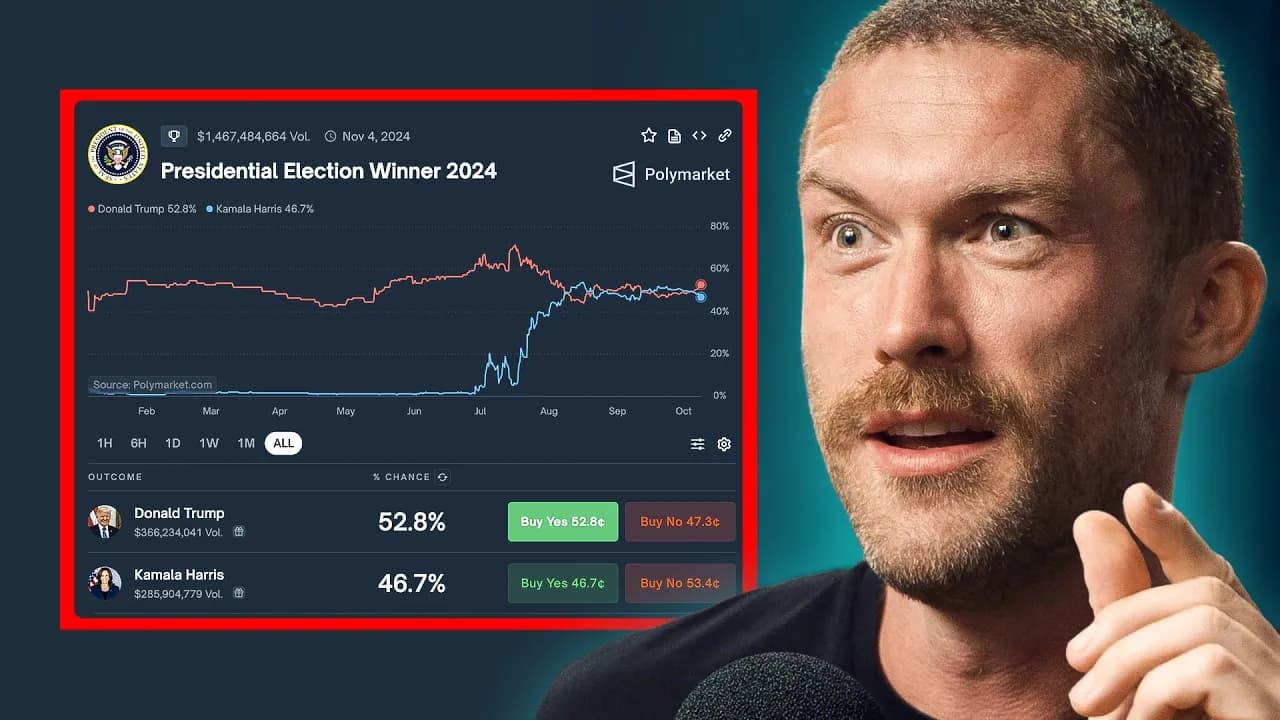
A documented case involved betting on whether Paris temperature at Charles de Gaulle airport would break 20°C or 21°C. Someone used a hair dryer on the airport's temperature sensor, causing a brief spike that broke the threshold before returning to normal. The bet was honored under Polymarket's resolution rules.
Prediction markets must honor bets according to their published resolution rules. While not illegal, platforms maintain enforcement and fairness teams to evaluate controversial cases like the hair dryer manipulation. These teams essentially conduct "garage ethics" discussions about whether specific actions constitute fair play when hundreds of thousands of dollars are at stake.
A journalist received death threats from Polymarket bettors after reporting debris as drone fragments rather than missile debris, showing how financial incentives can pressure information sources.
Despite positioning themselves as truth-seeking alternatives to mainstream media, prediction markets derive approximately 98% of their volume from sports betting. Professional sports bettors have migrated from traditional sportsbooks to prediction markets after being limited by casinos, using celebrity proxies, then moving through crypto before settling on prediction platforms.
Professional bettors can act as market makers on prediction platforms by taking the opposite side of longshot parlay bets. When bettors place $10 on 15 simultaneous outcomes with 2 million-to-1 actual odds but 2,000-to-1 payout odds, market makers can profit from the spread by betting against these unlikely combinations.
Prediction markets make betting more legible by converting traditional odds like "5 to 1" into percentage graphs that show real-time market positions. This accessibility transforms betting from an opaque system into something resembling familiar trading interfaces.
Sports betting against American teams in sports where the US lacks competitive advantage can exploit national pride bias. During the World Cup, the US team received 63% betting support against Belgium despite Belgium having elite players like Kevin De Bruyne and top-tier goalkeepers.
A Dallas Cowboys player was fined $30,000 for a touchdown celebration mimicking shotgunning a beer. The punishment occurred despite the NFL's DraftKings sponsorship, Bud Light Jumbotron advertising, and Bud Light's role as presenting sponsor of the Dallas Cowboys visible during the player's press conference apology.
The same activity receives different framing through word choice: "I have a paper round" versus "I do media distribution," or "basement sofa masturbator quant" versus "betting exchange prediction market." These demonstrate how professional rebranding affects perception of identical activities.
The critical power law in sleep optimization is that trying harder to sleep makes sleep worse. All additional sleep optimization techniques become irrelevant if this fundamental principle is violated. Many people who engage deeply with sleep science actually develop insomnia by creating anxiety around sleep duration targets.
The pattern involves having one good night of sleep, establishing an 8-hour sleep identity, then creating bedtime anxiety by getting into bed early and monitoring the failure to fall asleep. This leads to 3 AM rumination about sleep that compounds the original problem.
Training hard is the most important factor in physical development. Optimizing sets, reps, form, and protein consumption does not matter if the system is not stressed. The best way to determine if training is effective is whether it feels difficult. Training with Sam Sulk demonstrates this principle - he is a 24-25 year old athlete whose only criterion in the gym is whether he has worked himself to exhaustion. His physique suggests that training hard is effective as long as recovery is possible.
Intra-workout nutrition optimization with predigested whey and maltodextrin for carbohydrate shuttling becomes irrelevant without hard training sets where completion feels uncertain. The same principle applies to sleep optimization - if you do not stress about sleep and maintain basic principles of being in bed for approximately 8 hours in a cold, dark, and quiet environment, sleep quality is generally good.
During a period of peak sleep optimization, the speaker was using red light glasses, a wind-down routine with no stimulation before bed, and taking magnesium and L-theanine. While brushing teeth in the dark, his ex-girlfriend turned on the bathroom lights, causing temporary blindness. She fell asleep within 5 minutes while he remained awake.
In commercial endeavors, the planning phase versus execution creates a significant gap. Making notes about what people will respond to, what lines will resonate, and what the market will like can trap people in endless preparation loops. The advice is to ship products and let the market provide immediate feedback rather than theorizing.
A favorite tweet states: "If you want real feedback, add a buy button." Another relevant statement is: "Moving from theory to practice will always cost you status." This refers to how beautiful architected ideas on paper receive affirmation from AI collaborators, but actual market response (often crickets) provides the only real information for improvement.
At a conference lunch break, two people discussed weight loss progress. One mentioned buying a DEXA scanner for $6,000-$16,000 and various peptides and protocols. The conversation lasted 42 minutes of the 45-minute lunch break. A very fit person at the table, asked what he does, responded that he loves surfing and surfs frequently, which keeps him in shape. This illustrated how overcomplicating fitness with expensive equipment and protocols misses the simple solution of finding an enjoyable activity.
The phrase "all the gear and no idea" was referenced, along with "all fart, no poo" as a more accessible version meaning having ideas without taking action.
At a Tony Robbins event, a warm-up game of Simon Says with 5,000 participants revealed a pattern about competition. When asked how many believed they would win Simon Says, 80-90% of people sat down, indicating they did not think they could win. Only four people remained at the end, competing against just 32 others rather than the full 5,000.
This led to a framework for any endeavor with 1,000 people:
- The first half are too afraid to try and won't put a buy button on content
- Dabblers give up within three attempts and tell great stories about trying
- Some people move so slowly they lose all momentum
- Some get distracted by shiny objects
- At the end, only you and one other person remain competing
Charlie Munger's phrase "take a simple idea and take it seriously" applies here. It is shocking how few people will take a simple idea and execute it seriously. Career and Instagram success can come from taking one idea and executing it better than anyone else would.
In high school, someone won a surfboard from a Sprite can contest by being the only person who sent in an entry. Another person named Dan won multiple contests including a mascot naming contest for Spicy Pickle (named "Spy Sea Pickle") and a lifetime supply of Stride Gum. He won six or seven known contests and likely attempted thousands of others. The principle is that most people are not trying, and success comes from simply shooting shots without overthinking.
A misattributed quote about podcasting states that 90% of podcasts don't make it past episode 3, and of the 10% that do, 90% don't make it past episode 20. By doing 21 podcasts, you are in the top percentile of all podcasters. This was attributed to Jack Butcher via Chris Williamson via Reddit.
The compound interest quote often attributed to Einstein was actually from the book "Zero to One." Einstein's brand is so powerful that unattributed quotes get attributed to him posthumously. Shan Puri noted this as accumulating free alpha through brand arbitrage.
The Pod 6 is 50% smaller, fits under most bed frames, has nine times more sensors, and starts at $1,999. Solo sizes are now available for queen, king, and California king beds. A 30-day sleep trial is offered with international shipping. Up to $350 off is available using code "modernwisdom" at 8sleep.com/modernwisdom.
South Korean developers created apps for "never arrive shopping" where users can order food from restaurants that don't exist, plan vacations they will never take, and get satisfaction from shopping without spending money. The concept is that porn did for sex what these apps do for shopping. Similar apps include simulated live streaming with fake engagement, imaginary smoke breaks with non-existent coworkers, and video games built around monotony like watching paint dry or a 9-to-5 simulator.
Older computer games like Runescape had low bandwidth input/output compared to modern games like Fortnite. The speaker describes Runescape as "transcendental" in comparison to current high-stimulation gaming.
Modern TV shows require increased exposition and restatement of premises because viewers are double-screening or not paying full attention. The "piloting" technique involves restating important information multiple times. Fast and Furious movies serve as an index of attention - the first movie 20 years ago was about two guys dragstrip racing, while current entries involve cars being fired off ramps into helicopters.
An Instagram creator has built content around being a "sommelier of Fast and Furious," creating lists like top five key tosses and best Corona swigs. This demonstrates how niche obsession with specific topics can create successful content.
Crown Cinema creates obsessive deep dives into movies like Shutter Island and Inception, explaining details viewers missed even if they considered themselves knowledgeable about the films.
Content on the internet needs to be at either end of a barbell - completely simple "hang with the boys" content or the absolute best content. The middle ground leads to failure. Reaction videos work because they coast off existing cultural relevance while adding the creator's enthusiasm.
A 30-minute YouTube documentary about the world's number one Scrabble player demonstrates how someone's obsession and passion can be engaging even to viewers with zero interest in the subject.
Australian football commentary clips demonstrate nostalgia through voiceovers in a non-native language, creating an unexpected cultural resonance despite the mismatch.
All success represents arbitrage in some form, with infinite supply of content available for analysis.
Nigel Richards began playing Scrabble at age 28 and became the most dominant player in the game's history. The gap between Richards and other players exceeds that of Magnus Carlsen in chess or Michael Jordan in basketball.
Richards won:
- US Scrabble championships multiple times
- UK championship despite 50,000 word differences between dictionaries
- Spanish championship without speaking Spanish
- French championship without speaking French
At his French championship acceptance speech, Richards couldn't say "thank you" and needed someone to translate.
For his first tournament, Richards rode his bicycle 222 miles each way to compete.
Expertise exists at extraordinary levels in seemingly shallow domains. Even Scrabble commentary reaches sophisticated analytical depths. Every subject has experts who reveal unexpected complexity upon deeper investigation.
Global chicken production has consolidated to two primary breeds: Cobb 500 (owned by Tyson) and Ross 308 (owned by German EU group). Dozens of chicken varieties were eliminated in favor of these two breeds.
Gymshark produces training gear emphasizing quality design and comfort. The brand offers 30-day free returns globally, worldwide shipping, and 10% discount via code "modernwisdom10" at jim.sh/modernwisdom.
Despite observing many living animals, dead animals are rarely seen, raising questions about decomposition processes and scavenger behavior.
When interviewing experts, ask: "What's the most fascinating thing that people like me don't appreciate but you think is most intriguing?" This question elicits deeper insights beyond surface-level explanations.
Art significance often derives more from surrounding context than inherent artistic value. The Mona Lisa's fame partly stems from repeated thefts creating cultural lore. The Last Supper's notoriety relates significantly to its aspect ratio matching contemporary printing infrastructure, enabling mass reproduction.
Recent biological research demonstrates that placing an old heart into a young body causes the organ to become younger, indicating environment matters more than individual variables.
Historical art dealers created artificial scarcity and competition by renting mansions, displaying paintings, and engineering situations where wealthy collectors would see each other and compete for purchases.
Nightclubs use mimetic rivalry in seating arrangements, placing competitive tables opposite each other to drive bottle service spending. Tables feature unopened expensive bottles (Nebuchadnezzars up to 6 liters) after events, with bottle cost exceeding liquid value.
Sydney Frank created Grey Goose through deliberate positioning:
- Priced 50% above Absolut
- Designed bottle taller than standard shelf height for top-shelf placement
- Marketed as "French vodka" despite vodka's Russian origins
Frank previously popularized Jägermeister by:
- Acquiring rights when no one wanted after-dinner sipping liquor
- Creating aphrodisiac narrative through fabricated testimonials
- Hiring "nurses" to inject shots in bars
- Distributing "banned in Europe" newspaper clippings in urinals
Taste and slop represent 2026's defining terms. Taste signals high status while slop indicates outsourced aesthetic judgment without intention.
"Nobody tells this to people who are beginners. I wish someone told me. All of us who do creative work, we get into it because we have good taste, but there is this gap. For the first couple of years, you make stuff. It's just not that good. It's trying to be good. It has potential, but it's not. But your taste, the thing that got you into the game, is still killer. And your taste is why your work disappoints you. A lot of people never get past this phase. They quit."
Procrastination prevents shipping sufficient work volume to identify what works. High conviction and wrong is preferable to low conviction and right.
Slop represents output lacking intention, created without taste. AI tools produce slop when used without guidance. Criticism should specify exactly why something qualifies as slop rather than using the term generically.
Billy Oppenheimer's technique involves capturing liked/disliked items and explaining specific reasons why. This builds a swipe file for reference during creative work.
John Mark's AI shadowboxing went viral until revealed as AI-generated. YouTube channels like Hoo and Fern add disclaimers stating "all animation done by humans" to demonstrate proof of work despite indistinguishable output quality.
Gossip Goblin creates AI films with exceptional craft levels comparable to S-tier Hollywood productions, demonstrating that AI output quality depends on production intention rather than the tool itself.
The conversation discusses whether AI-generated content will ever be indistinguishable from human-created content. There is consensus that even high-effort AI work will face skepticism due to general distrust of AI. The group believes there will always be value placed on human-created content, similar to how "organic" or "free range" became premium descriptors. They suggest a new term like "humanade" may emerge to distinguish human-created work from AI-generated content.
The discussion covers rebranding efforts around artificial intelligence terminology. Trump attempted to rename AI to "Supreme Intelligence" or "Superior Intelligence" instead of ASI (Artificial Super Intelligence), which carries negative connotations. Machine Intelligence was considered as an alternative but rejected because it emphasizes human replacement. The artificial component itself is seen as poor branding.
A pickle tasting occurs with multiple varieties discussed: a new pickle from the deli with dill and mustard seed brine, half sour with garlic brine, and barrel cured whole peppercorn extra crisp pickles. The conversation includes a humorous American Psycho-style comparison of pickles, examining subtle olive coloring, tasteful thickness, and texture.
Meta's Chief AI Officer Alexander Wang appeared at Meta Connect wearing camo Crocs and a camo t-shirt. The group jokes about Meta investing $60 billion in the metaverse nearly running out of business before hiring the "camo crocs intern" and suddenly fixing everything. The comment "Jenz, rise up" was made in response.
A warning is given about wearing Crocs on escalators. The teeth/combs at escalator ends can catch Crocs in sport mode, potentially causing severe foot injuries. Sport mode should only be used in extreme circumstances.
The RP Strength hypertrophy app is promoted as a science-backed training tool developed by actual scientists. The app provides specific exercises, sets, reps, and weights, automatically adjusting based on weekly progress. Users can get up to $50 off using code "modernwisdom" at rpstrength.com/modernwisdom.
An article titled "Everything is Goona Casino" by KTR IVS is discussed, presenting a 2x2 matrix with pornography vs not pornography on one axis and casino vs not casino on the other. The thesis argues that builders currently have two options: creating "goona slop" or building casinos, with the most successful products combining both. The article references how sex has always been used to sell products, citing Tom Ford's 2007 campaign as an example of sex selling.
The conversation explores crypto art's relationship to traditional art markets. Crypto art is described as democratizing the ability to create demand around work and structure markets around it. CryptoPunks are cited as potentially the most valuable artwork ever created, with the collection worth approximately a billion dollars and remaining liquid. This is compared to Salvador Mundi, which sold for $450 million in 2021. The permissionless nature of crypto creates both high-value work and significant "carnage" and "slop."
Parents discuss their approach to devices and education with children. One household has zero devices - no TV, no tablets. Video games are used together with children, but social media is strictly prohibited due to its addictive nature being compared to cigarettes. The philosophy emphasizes controlling dosage while recognizing that different activities have different optimal doses. Video games are viewed more favorably than social media because they can provide benefits when properly dosed.
A trending study on X shows brain scans comparing different daily screen/social media usage levels: less than one hour, 1-2 hours, 3-4 hours, and over four hours. The discussion notes that distractibility has increased dramatically over the past 15 years. University students now face the additional challenge of AI providing permanent shortcuts that act as "simulacrum of learning," with Harvard studies suggesting AI users retain significantly less information.
Black cab drivers in London show structural brain changes from memorizing routes over three years. Uber drivers doing equivalent or more miles are hypothesized to show minimal structural changes because the key factor is risk of failure. When using AI, the recommendation is to first attempt answering independently, then compare with AI output, rather than relying purely on AI responses.
The distinction between friction and risk of failure is explored. Ebbinghaus forgetting curve research shows retention comes from self-testing and active recall rather than passive rereading. While friction helps retention, failure creates additional pain that significantly improves memory. The key question is whether the cost of failure (not knowing something) drives better learning outcomes than mere difficulty alone.
The cost of failure differs dramatically across contexts. For a taxi driver, not knowing where you're going means bankruptcy, creating immediate stakes that force competence. University students increasingly submit LLM-generated work, with one Hong Kong film professor reporting students submitting 80-page AI outputs. Proposed solutions include grading the prompts themselves rather than the outputs, or having students evaluate and rank multiple LLM outputs to develop judgment.
As physical labor declined, gyms emerged to provide artificial physical resistance. A parallel development may occur with cognitive exercise. Brain gyms could offer structured cognitive friction, with devices locked away while users complete mental tasks. The concept faces challenges, as there's less visible social status associated with brain training compared to physical fitness.
Physical training provides immediate visual feedback through the pump effect, showing what sustained effort will produce. Cognitive exercises lack this preview quality. Learning Italian through Duolingo doesn't provide the experience of being six months more fluent. This difference in immediate feedback may explain why physical training maintains stronger motivation than cognitive skill development.
The Muse headband represents early attempts at brain training through EEG feedback. The device provides audio cues that intensify with distraction and quiet with focused attention states. Marketed for focus training, mental stamina, and sleep improvement, the technology was used by NASA and Harvard research labs. Users reported skepticism about actual effectiveness despite initial enthusiasm.
Intelligence has rarely functioned as a primary status signal throughout history. Being overweight once signaled wealth before abundance changed this association. In a future where AI agents handle thinking tasks, being less intelligent might paradoxically become a high-status signal, indicating one has sufficient resources to delegate cognitive work entirely.
Moderate left-leaning positions may be gaining cultural cachet. Figures like Alexandria Ocasio-Cortez have normalized personal narratives around freezing eggs and breaking engagements without significant backlash. The right's position in power has fractured its cohesion, while left-leaning positions gain appeal as counterculture. Comedians like Mike Rice and Victoria from the UK demonstrate this shift toward more accepted left-leaning cultural commentary.
The rationalist movement of the 2000s-2010s positioned itself against religion as irrational. This created a backlash where Latin Mass services gained popularity precisely because participants cannot scrutinize the language or meaning. The inaccessibility prevents the cynicism that scientific rationalism typically applies to religious experience. This represents a broader cultural pivot away from pure rationalism toward experiences that resist analytical deconstruction.
A poll of 3,000 Twitter followers revealed 74% believe in God, contradicting assumptions about the audience's secular leanings. Research into near-death experiences suggests life reviews occur from the perspective of others rather than as personal highlight reels. This creates a form of experiential karma where positive interactions produce heaven-like experiences and negative interactions produce hell-like suffering from the recipient's viewpoint.
Theory of mind typically develops around ages four to five, enabling perspective-taking. Most adults possess better theory of mind than five-year-olds but often treat service workers as automatons rather than full humans with complex lives. Developing accurate theory of mind requires recognizing that others have rich inner experiences, which paradoxically produces both more ethical behavior and more accurate predictions about how situations will unfold.
Leaving unusually large tips creates lasting positive memories for both giver and receiver. One documented case involved a Denny's server in Florida and another a New York night-shift worker. The practice differs from consistent percentage tipping by creating memorable impact moments. A friend incorporates this into parenting by regularly giving his son cash to distribute thoughtfully throughout a day, teaching the mechanics of meaningful generosity beyond theoretical good intentions.
The practical challenge of giving extends beyond intention to execution. During a group exercise distributing $1,000, participants found the pressure of identifying worthy recipients and delivering gifts gracefully more difficult than physical challenges like sparring. The experience revealed internal resistance and judgment that required overcoming, demonstrating that prosocial behavior requires practiced skill rather than just good intentions.
A story about tipping a gym receptionist who had never been directly spoken to but had exchanged friendly waves and salutes for months. The speaker was watching Taken the night before an early flight and decided to give the man a tip. After multiple Uber cancellations, he eventually found the receptionist at 11 PM and gave him what he described as an absurd amount of money at the time. The receptionist broke down in tears, and the speaker still thinks about the interaction and wishes he had given more.
The speaker changed their mind about the practical utility of AI agent tools like Muse. Previously skeptical about use cases, they observed that tools connecting to email, Instagram, and other services are finding real applications. Examples include identifying forgotten subscriptions, filing claims for owed money, and handling scheduling tasks. Facebook's agent tool and the startup Instinct were specifically mentioned.
When given to a non-tech-savvy spouse, the AI assistant filed a claim for $2,000 owed by the state of California. It handled calendar coordination for soccer games, including reminders to pack specific jerseys. It helped plan a daughter's birthday party and sent a thoughtful follow-up text checking how the party went. Another example involved connecting a bank account with zero dollars and providing a non-judgmental pep talk about the financial situation.
The observation that AI agents can provide emotionally supportive interactions that many people lack, even with their technical limitations. The concept that people don't do hard things because they have to face judgment from others, and AI removes that barrier. The low bar for being a good friend was noted - even a digital entity that occasionally hallucinates can provide the simple validation of "you've done a good job today."
Reference to Shane Mack who started a company providing military spouses as assistants. The premise was that military spouses often want part-time work from home while their partners are deployed, and they tend to be highly capable operators due to their circumstances.
The distinction between engineers and salespeople, noting that people from advertising, marketing, or sales backgrounds can develop a transactional view of customers. The suggestion that combining performance marketing experience with product thinking creates a useful perspective, similar to how learning kickboxing before jiu-jitsu enhances both skills.
A realization about product market fit from working with James from Element: true product-market fit means customers would continue buying even if everything else about the company was terrible. The example given was that even if James expressed hatred for the speaker's family, country, and dog, the speaker would still buy Element products because they're that good.
During the period when Apple released iOS changes affecting Facebook ads after Cambridge Analytica, advertisers complained about the changes but none gave up their iPhones. This was presented as evidence of Apple's product-market fit - the product is so good that users accept business practices they dislike.
Buffett made his largest gains from investing in Apple despite previously avoiding tech investments. He explained that Apple isn't about technology but about brand and product. His method involved standing in stores and talking to people about their loyalty to brands like American Express and Apple, recognizing the mental switching costs involved.
Despite multiple product issues including problematic keyboards, declining Siri performance, failed Apple Intelligence features, and unpopular design changes, Apple's ecosystem integration and accumulated goodwill maintain user loyalty. The concept of "infinite social money glitch" was introduced - creators or brands with enough accumulated goodwill that no amount of mistakes can deplete it.
Discussion of figures like Kanye West, Dana White, and Brian Johnson who can recover from public mistakes through self-awareness. Reference to Alex O'Connor's idea that sufficient self-awareness allows getting away with anything online. Trump's statement about shooting someone on Fifth Street and still being loved was mentioned as an example of conviction over self-awareness.
Jack Butcher's Twitter handle was shared. A book recommendation was given: "Think on These Things" by Christian Muri. The piag.com/books website was mentioned for accessing favorite book recommendations. A reminder was given about YouTube's tendency to unsubscribe users and the benefits of subscribing for early episode access.
Keep Chris Williamson in your library
Save the videos and channels worth coming back to, and find them again in one place.