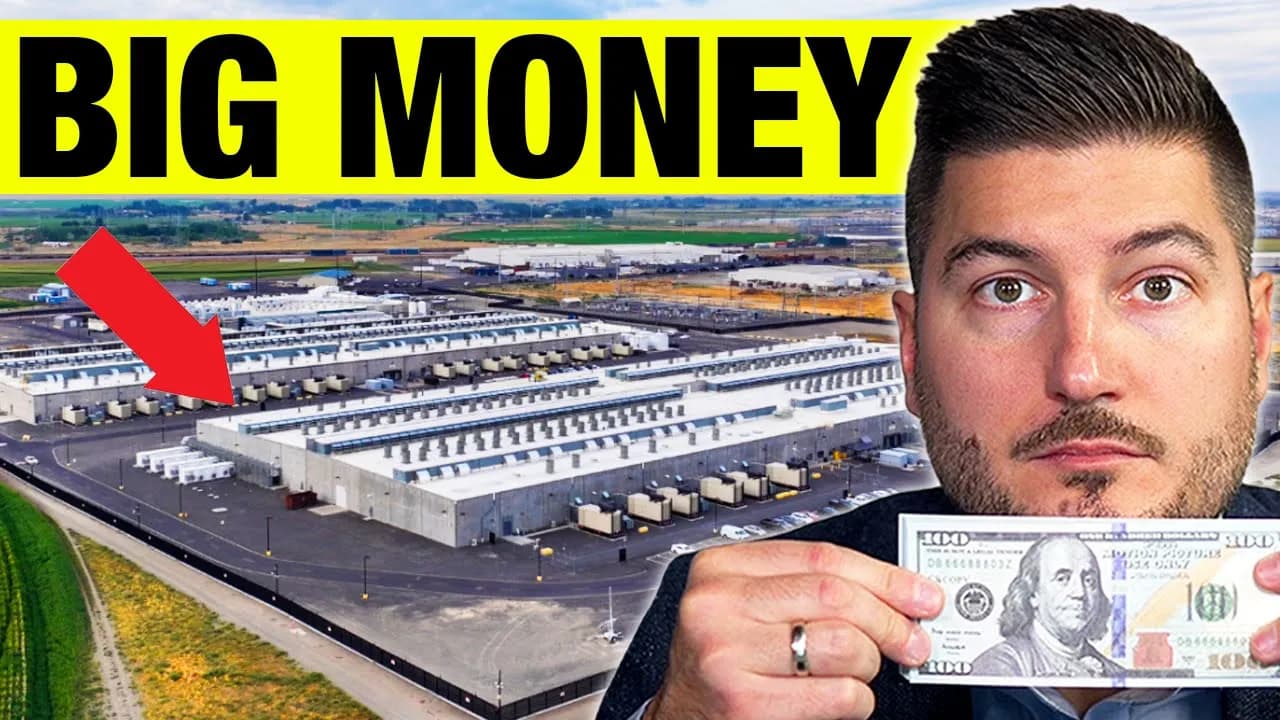
Dan Dreyfus: The Next AI Bottleneck is Copper
In a Nutshell
Dan Dreyfus argues copper is the next critical bottleneck after semiconductors, as AI data centers, EVs, grid modernization, and defense spending will drive demand far beyond current supply growth. Historical copper production over 10,000 years equals just 18 years of future demand at current GDP growth rates, requiring five new tier-one mines annually when fewer than five are scheduled before decade's end. This supply-demand shock coincides with currency debasement and reshoring pressures, positioning copper and critical minerals for a multi-year commodity supercycle with prices potentially doubling.
These notes were generated by AI and may contain inaccuracies.
Dan Dreyfus from Fortius Capital discusses critical minerals and commodities. He explains that human progress will increasingly be measured by electricity consumption. The semiconductor industry is viewed as an industrial infrastructure company rather than purely a technology business. The presentation focuses on the fragile US infrastructure requiring trillions of dollars in investment to achieve technological objectives, reshoring, re-industrialization, national security, and military goals.
From the early 2000s until recent years, the US experienced an economic period where substantial growth, market cap, and value were created with minimal capital investment. Examples include Google with search engines, Meta with social media acquiring WhatsApp for $30 billion with only 12 employees, streaming platforms, food delivery platforms, Apple as a capital-light company creating trillions in market cap, and software as a service businesses. During this same period, critical infrastructure was relocated overseas to China, reinforcing a capital-light mentality.
COVID, the Russia-Ukraine conflict, tariffs, and the Iranian conflict caused inflation to spike repeatedly. The underlying cause was fragile, non-resilient supply chains weakened by decades of offshoring. The US now faces an inflection point requiring reshoring of manufacturing, re-industrialization, and addressing a compute revolution that is significantly more infrastructure-intensive than previous generations.
Multiple capital cycles are occurring simultaneously. The aerospace sector has Boeing and Airbus with a trillion dollars in backlog over the next 10 years, competing with the space economy for the same materials. The electric grid infrastructure is aging significantly. Texas experiences grid failures during cold weather due to lack of interconnection with the broader US grid. In California, a power line over 106 years old caused the Paradise fire killing 300 people.
Current grid infrastructure is insufficient for existing needs and will be overwhelmed by electric vehicle adoption, robo-taxis, and air conditioning demand. AI will create a tsunami of electricity demand. China has built multiples more power generation capacity than the US. Data centers represent a trillion-dollar-per-year capital cycle. Semiconductor fabs are projected at a minimum of $750 billion, likely measured in trillions. Defense spending is increasing across Taiwan, Japan, Europe, and the US. None of these end markets can function without critical minerals.
In April, China announced export cutoffs to the US including samarium, gadolinium, terbium, dysprosium, lutetium, scandium, yttrium, erbium, and silver. The cutoff of samarium-cobalt magnets nearly shut down Ford Motor Company's entire production line within days. McDonnell Douglas faced similar risks. This triggered emergency responses from the Department of Defense and Department of Energy.
The administration is approaching small resource owners in the US and Canada with three documents: an equity investment check to fund mine development, a permit to begin construction immediately, and an offtake agreement with take-or-pay terms and a minimum floor price guaranteeing high internal rates of return while allowing upside participation. This approach is described as unprecedented in 25 years of commodities experience.
Copper is essential for clean energy infrastructure. Solar power requires five times more copper per megawatt than a typical CCGT gas-fired turbine. Wind requires seven times more copper. A 1-gigawatt AI data center requires 50,000 tons of copper. With 15 gigawatts of AI factories planned annually, this translates to 750,000 tons of copper demand from data centers alone. Last year's total global copper supply growth was only 500,000 tons.
Electric vehicles consume five to six times more copper than internal combustion engine vehicles. The Russia-Ukraine conflict consumed more explosives than all of World War II, with artillery shells such as the Copperhead requiring substantial copper quantities that are not recycled from battlefields. Total historical copper mined over 10,000 years since Mohenjo-daro equals 700 million tons. Current annual demand is 30 million tons, with 4 million tons from recycling and 26 million tons from mining.
Maintaining GDP-level growth without accounting for data centers or green energy would require 700 million tons of copper over the next 18 years—equivalent to all copper mined in the previous 10,000 years. This necessitates five world-class tier-one mines coming online annually. Fewer than five such mines are scheduled before the end of the decade. Mine development takes 7 to 12 years. Major Chilean mines exceed 100 years old with declining ore grades.
Commodity cycles typically last 15 years with multiple hundreds of percent upside. The current cycle is only a few years in. Memory, HBM, and NAND are current bottlenecks with vertical price increases. Copper represents the next bottleneck. The supply shock meets demand shock creates a structural deficit.
Since COVID, $40 trillion in government debt has been created, growing at $2.5 trillion annually. Discounted present value of future social liabilities including Medicare, Medicaid, Social Security, and pensions totals $100 trillion, also growing at $2.5 trillion annually. Annual tax receipts are $5.5 trillion. The next recession will trigger significant currency printing. The 1970s saw currency lose 70% of purchasing power through inflation, with commodities and hard assets as the best-performing asset class.
Copper price is projected to easily double. Molybdenum previously rose from $1 per pound to $33 per pound, demonstrating that doubling is achievable. Natural energy demand growth alone, excluding AI, will create shortfalls. The grid has not been modernized or hardened since post-World War II across multiple administrations.
Power prices remain down in real terms over 20 years despite recent increases. Inflation originates from transmission and distribution costs as utilities increase capital bases to earn regulated returns. Craft labor represents the primary bottleneck. The recommendation to young people to avoid trades over the past 10-15 years created this shortage.
Approximately 50% of the audience has installed solar and/or power walls, with another 20% planning installation. For industrial use, the grid remains essential. A 1-gigawatt AI data center requires 5 gigawatts of solar capacity due to 20% capacity factor, consuming 35,000 acres—larger than San Francisco. Craft labor scarcity is identified as the largest bottleneck.
Rare earths exist abundantly but processing technology is the constraint. China controls conversion know-how from extracted materials to usable products. Copper's massive market size makes overnight technological solutions difficult. Silver supply-demand shows 1.2 billion ounces annual consumption against 1 billion ounces supply, creating a 200 million ounce annual deficit. Above-ground silver inventory stands at 600 million ounces, projecting stockout within three years.
Craft labor demand will be nearly limitless. The 2000s offshoring displaced blue-collar workers, contributing to fentanyl issues, wealth gaps, and regional disparities. The same heartland regions now offer entry-level salaries of $150,000 out of high school at locations like Kwantlen University. Tables have reversed with capital flowing to these previously disadvantaged areas.
Natural gas is abundant domestically. Solar faces no raw material bottleneck but silver supply is constrained. Nuclear construction is limited by inability to manufacture containment vessels domestically. Critical minerals shortages affect nuclear plants, silver for solar panels, and space-based data centers. Allocating to copper, silver, and minerals is recommended, along with service providers and labor.
Understanding supply chain pinch points is essential. Investors must assess technological disruption risk and identify innovations that could relieve supply constraints. Ham sandwich analogy illustrates supply chain complexity: 30 million pigs slaughtered monthly outside Chicago. Urban Americans often fail to understand these connections.
Keep All-In Podcast in your library
Save the videos and channels worth coming back to, and find them again in one place.