ELI5: Post-Labor Economics
In a Nutshell
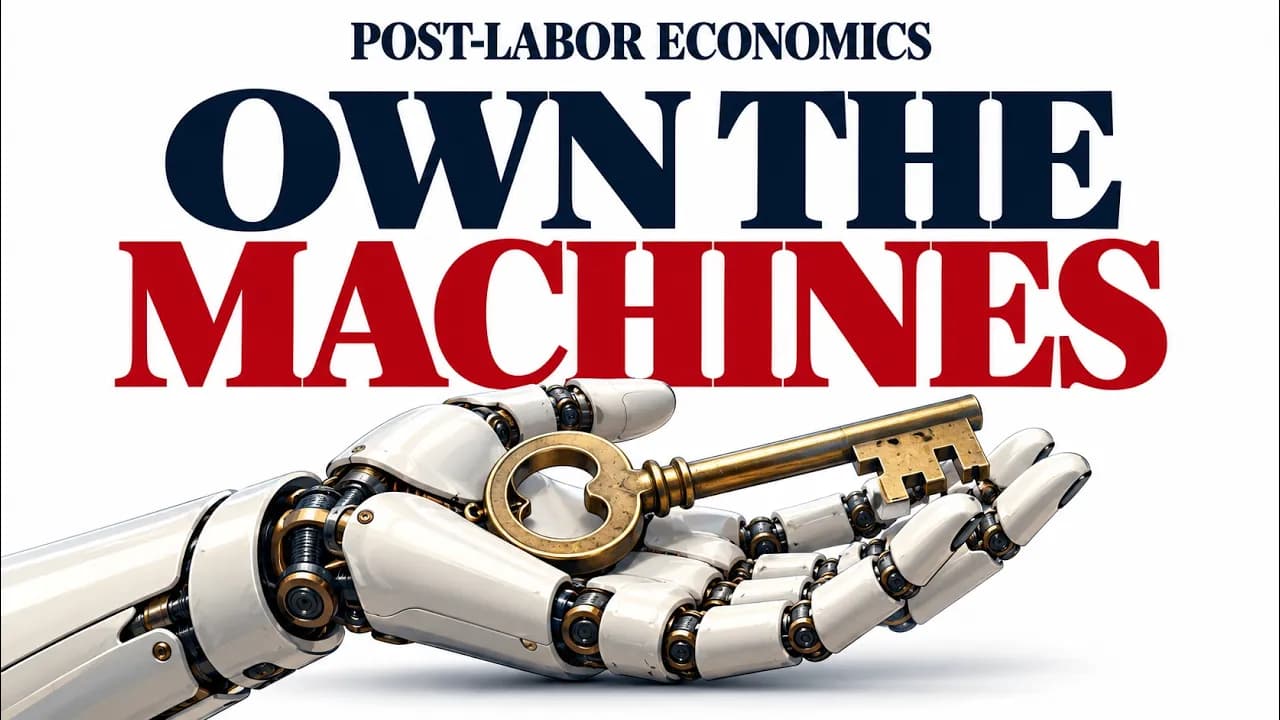
As AI replaces jobs, household purchasing power collapses because wages are the main way money reaches families, but the top 10% already own 87% of stocks while the bottom 50% own just 1%. The solution is to expand ownership so everyone receives income from sovereign wealth funds, employee stock plans, cooperatives, and universal basic income rather than relying on wages. Without replacing lost wages with these ownership streams, consumer demand vanishes and the economy contracts in a self-reinforcing spiral.
These notes were generated by AI and may contain inaccuracies.
A person named "Azzi" on X (formerly Twitter) asked in all capital letters: "If artificial intelligence replaces all jobs, where do companies expect people to earn money to remain consumers?" This question has been the focus of two to three years of work.
There are three methods by which money enters a household. The first is through wages from employment. The second is through government payments such as Social Security or welfare. The third is through property ownership that generates income, such as rental properties or shares that produce dividends.
In 2025, American household income sources broke down as approximately 60% from wages, 20% from government sources, and 20% from property ownership. Wages remain the single largest source for most families.
Jobs have been losing economic power for decades, predating artificial intelligence. Since 1979, U.S. productivity has increased by 94%, while average worker wages have increased by only 33%. In 2026, workers received less than 53 cents for every dollar produced by American companies, the lowest figure since tracking began in 1947.
The core issue is not jobs themselves but household income. For centuries, the primary mechanism for distributing purchasing power has been paid labor. The alternative mechanism is "inventory and cash flow," meaning living off rents and dividends, which is how most wealthy people currently sustain themselves.
The richest 10% of American households own approximately 87% of all stocks held by households, while the bottom 50% of households own only about 1% of shares. The post-work economy refers to the transition as traditional employment diminishes, with the goal of ensuring ordinary families own income-generating assets so money continues flowing into households after jobs disappear.
Sovereign wealth funds represent one mechanism for building universal ownership. Alaska has operated such a system since 1982, with the state's oil fund distributing annual dividends to residents. In 2025, more than 600,000 Alaskans each received checks for $1,000.
Norway operates the world's largest sovereign wealth fund, valued at approximately $1.9 trillion in 2025, equating to roughly $340,000 per person in the country.
Employee Stock Ownership Plans (ESOPs) exist in America, with over 6,600 plans covering approximately 15 million participants. In Britain, Employee Ownership Trusts (EOTs) were established in 2014, and by July 2024, owners had transferred more than 1,700 British companies to their employees through these funds. Cooperatives represent another model, where businesses are owned by workers or customers.
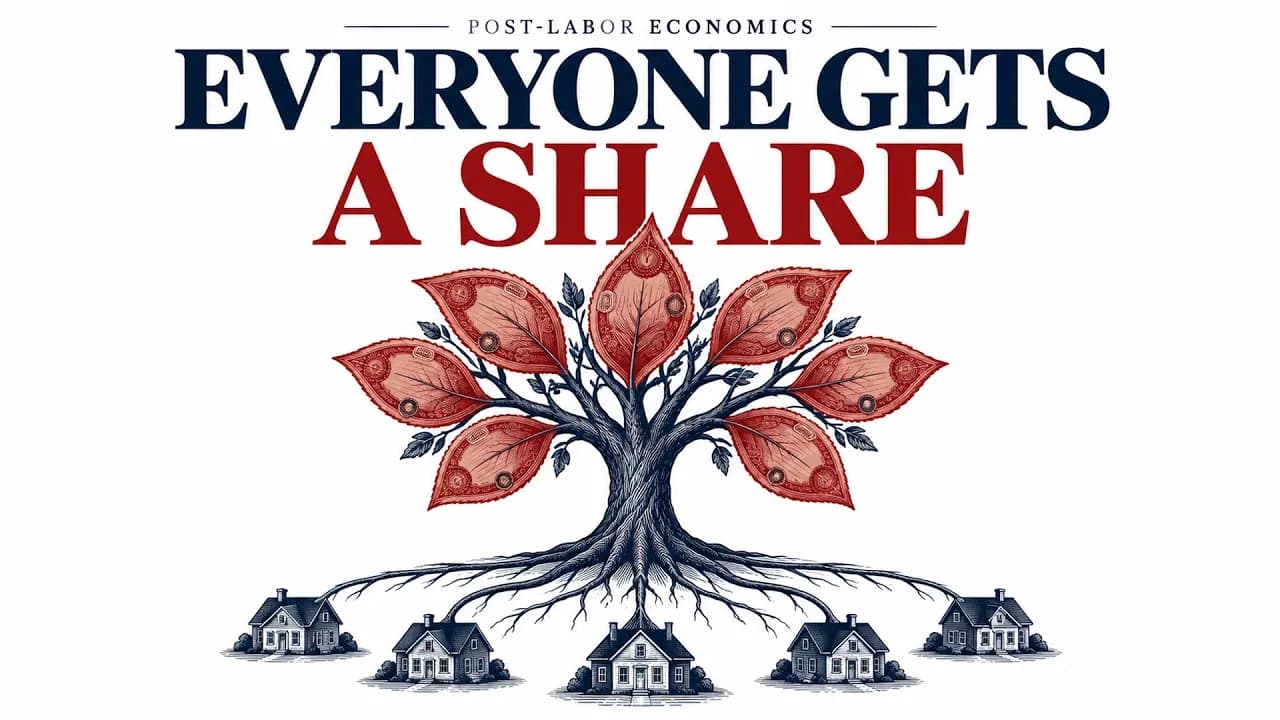
A family in 2045 is projected to receive income from seven distinct sources rather than a single salary: universal basic income provided monthly, quarterly dividends from state and city wealth funds, profit distributions from an employee-owned company, dividends from a cooperative bank, growth from a "baby bond" investment account started at birth, and limited income from part-time elder care work.
No single source constitutes the majority of family income, creating resilience if any individual stream is disrupted.
Without consumer demand, the economy faces what is termed the "contractionary death spiral." Mass production requires substantial purchasing power. If machines replace jobs without replacing wages, there will be no buyers for machine-produced goods. This creates shared interest in solving the post-work economy challenge, including among billionaires, whose choice is between a smaller share of a growing economy versus a larger share of a rapidly shrinking one.
In 2025, the federal government raised approximately $5.2 trillion, with about half from individual income tax and most of the remainder from payroll taxes. In 2022, approximately two-thirds of total income reported on American tax returns came from wages. As jobs and wages disappear, government revenue will also decline, necessitating a rebuilt tax system that captures revenue from companies and individuals benefiting from artificial intelligence, robotics, and automation.
If artificial intelligence and robots can replace all jobs, they can likely produce sufficient food, housing, and other necessities. The challenge becomes one of distribution rather than absolute scarcity.
Money enters households through three channels: work, government, and ownership. As the work channel shrinks, ownership must expand to everyone, not only the wealthy. Existing components include Alaskan dividend checks and worker-owned companies. The task is integrating these interventions into a cohesive system.
Keep David Shapiro in your library
Save the videos and channels worth coming back to, and find them again in one place.