Making Money After AI Nukes All Jobs
In a Nutshell
The core message is that as automation concentrates profits among existing shareholders, societies must build institutions to spread ownership more widely. Four proven models—public wealth funds, worker cooperatives, employee stock plans, and child-bond grants—show that broad-based ownership is both technically feasible and politically achievable. The key takeaway: without deliberate policy, the gains of AI-driven production will remain narrowly held; with it, ownership can become a universal birthright rather than a privilege.
These notes were generated by AI and may contain inaccuracies.
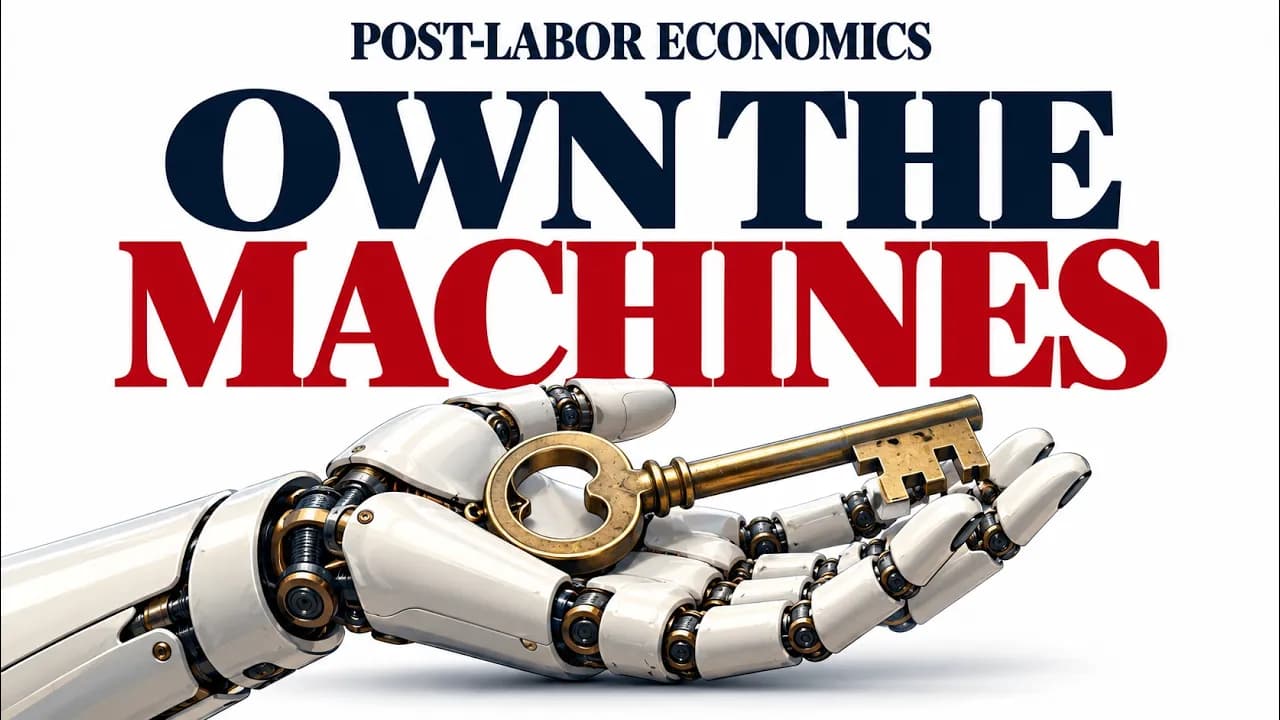
If machines are going to produce more and more of the world's wealth, the most important economic question of this century may be very simple: who owns these machines? Currently, in the United States, the answer is mostly people who already have everything else. The richest 10% of households own nearly 90% of the total shares of companies in the country, while the bottom 50% own only half a percent of those shares. When automation leads to increased profits, these gains flow to shareholders, and shareholders are a limited group.
The reason wages cannot simply be increased instead is that wages only reach the people who are employed, and the rationale for automation is that employers will need fewer of them. Song royalties, building rentals, and dividends from stocks all continue to flow regardless of whether or not someone is employing you. This is the purpose of ownership. This is why the question of who owns the shares is so important. However, ownership should not be concentrated.
Around the world, people have built institutions that work to distribute this property. Here are four of them, and each one has a different answer to the questions: who owns, who decides, and who gets the money.
In 1976, Alaskans voted to amend their state constitution and allocate a portion of the state's oil revenues to a permanent fund. Since 1982, this fund has paid annual dividends to almost every resident, whether man, woman, or child. In 2022, the amount paid reached a record high of $3,284 per person, including a one-time energy relief bonus.
Norway took this idea even further. Its Government Pension Fund Global was established in 1990, funded by oil and gas revenues, and has grown to become the largest sovereign wealth fund in the entire world. Its value today is more than two trillion dollars, which is roughly equivalent to $400,000 for every person in Norway, and it owns about 1.5% of the total shares in companies listed globally. Under the country's fiscal rules, the government may only spend the fund's actual expected return, which is about 3% annually. This leaves the capital intact for future generations.
The strength of this model lies in its inclusiveness because everyone is automatically included in it. Its weakness is distance. Citizens own the fund in principle, but they do not control it on a daily basis, and payments depend on political decisions that are subject to change. However, this model proves something important: public funds can be converted into private income for each citizen without anyone having to apply for it.
In 1956, in the Basque town of Mondragón in northern Spain, five young men founded a small company to manufacture paraffin stoves. The company was owned by the people who worked there. Today, Mondragon is a federation of cooperatives covering manufacturing, retail, finance and education, and employs more than 70,000 workers. In their cooperatives, members elect the leadership, and the wage ratio between the highest and lowest is determined by a vote of the members. That ratio usually ranges around five to one. In contrast, in many large companies, the ratio between the CEO's salary and the average worker's salary is several hundred to one.
The strength of this model lies in democratic control, because the members come with a real voice. However, its weakness is that cooperatives may be difficult to establish in industries that require huge amounts of capital, and members end up tying their income and savings to a single institution.
In the United States, the most common form of employee ownership is an Employee Stock Ownership Plan, or ESOP. The idea came from a lawyer and economist named Lewis Kelso, who believed that workers should earn income from capital in addition to work. In 1956, he designed the first ESOP plan so that employees of a newspaper company in Palo Alto, California, could buy the business from their retiring owners. Congress incorporated ESOP plans into federal law in 1974. Today, there are approximately 6,600 such plans, covering more than 15 million participants, and holding assets exceeding $2 trillion.
Britain has its own traditions in this area. The John Lewis department store chain has been owned as a trust by its employees since 1950, and these employees are called "partners." The power of employee ownership lies in alignment, because the people who perform the work share in the value they create. Its weakness, again, is the concentration of risks. If the company fails, employees may lose both their jobs and their savings.
The newest idea is also the simplest: each child is given a share at birth. In 2023, the state of Connecticut launched the first state-funded child bond program in the United States. The state invests up to $3,200 in a trust fund for each child born on or after July 1, 2023, whose birth costs were covered by the state's Medicaid program. Starting at age eighteen, these children can begin to claim those funds, which will have grown due to compound interest over the years. They can then use it to buy a home in Connecticut, pay for education or vocational training, start a business in the state, or save for retirement.
At an annual rate of return of 6%, $3,200 grows to about $9,100 in 18 years, and about $18,400 in 30 years. This is not a huge fortune, but for a young person starting from scratch, it could be the difference between taking the first step or not taking any step at all. The power of primary gifts lies in the fact that they build wealth for people who do not specifically inherit anything. Its weakness is its range: because the amounts are small, the waiting period is long, and the program only reaches a portion of the population.
None of these models is a complete solution on its own. Public funds reach everyone, but give them little control. Cooperatives give members control, but it is difficult to expand their scope. Rewarding workers with company ownership benefits them, but it increases the concentration of risk on them. Initial donations help young people, but it takes decades to have a tangible impact. However, together they paint a picture of something important: it is an economy in which ownership is a right acquired from birth rather than a privilege. If machines are going to do more work, we'd better own a part of it.
Keep David Shapiro in your library
Save the videos and channels worth coming back to, and find them again in one place.