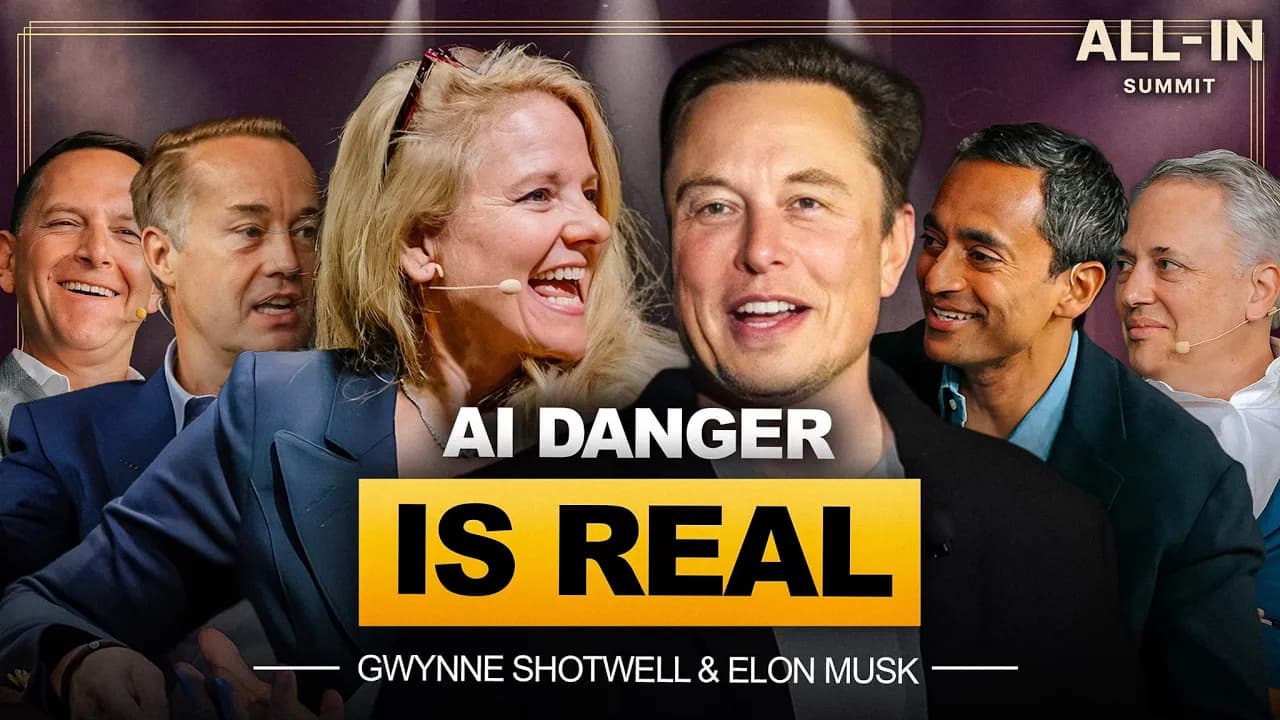
Elon Musk – "In 36 months, the cheapest place to put AI will be space”
These notes were generated by AI and may contain inaccuracies.
Only 10-15% of the total cost of ownership of a data center is energy. Most of it's the GPUs. Moving to space saves on energy but makes servicing GPUs harder, shortening depreciation cycles and increasing costs.
Availability of energy is the issue. Outside China, electrical output is more or less flat with maybe a slight increase. China has rapid increase in electrical output. Chip output grows exponentially, but electricity output is flat. No magical power sources.
Elon is a big fan of solar. One terawatt of solar power with 25% capacity factor requires four terawatts of solar panels, 1% of US land area. We're in the singularity at one terawatt of data centers.
Covering Nevada in solar panels is hard due to permits.
Space is a regulatory play. Harder to build and scale on land than in space. Solar panels in space are five times more effective than on ground, no batteries needed.
"It's always sunny in space."
No day-night cycle, seasonality, clouds, or atmosphere. Atmosphere causes 30% energy loss. Solar panels produce five times more power in space. Avoids battery costs for night.
Actually much cheaper in space. Prediction: in 36 months or less (maybe 30 months), space will be the cheapest place to put AI. Then it gets ridiculously better. Only place to really scale is space.
GPUs quite reliable past infant mortality, which can be tested on ground before launch. Past initial debug cycle of Nvidia, Tesla AI6 chips, TPUs, Trainiums, etc., reliable. Servicing not an issue.
"Mark my words. In 36 months, but probably closer to 30 months, the most economically compelling place to put AI will be space."
Once thinking in terms of percentage of Sun's power harnessed, must go to space. Can't scale much on Earth. Terawatts needed. US currently uses half a terawatt on average. One terawatt is twice US electricity consumption.
Software people don't realize hardware difficulties. Hard to build power plants and electrical equipment like transformers. Utility industry slow, impedance matched to government and Public Utility Commissions.
Interconnect agreements take a year for studies.
xAI built own power plants for Colossus 2, co-located with data centers, behind the meter.
Power plant makers backlogged, especially vanes and blades in gas turbines—specialized casting process. Hard to scale other power forms. US solar tariffs gigantic, domestic production pitiful.
SpaceX and Tesla building towards 100 gigawatts/year solar cell production, from polysilicon to wafer to final panel, from raw materials.
Solar cells for space cheaper: no glass, no heavy framing, no weather survival.
Solar cells already farcically cheap, ~$0.25-0.30/watt in China. In space, five times effective plus no batteries = 10 times cheaper.
When space access cost low, space is by far cheapest, most scalable way to generate tokens, order of magnitude easier.
Won't scale on ground. xAI accomplished miracles for 1 gigawatt for Colossus: ganged turbines, permit issues in Tennessee, built in Mississippi few miles away, ran high power lines.
Noobs look at GB300 power consumption, ignore cooling, networking, CPU, storage. Size for peak cooling on worst day (Memphis hot). 40% power increase for cooling to avoid shutdowns.
Add 20-25% multiplier for power servicing downtimes.
Every 110,000 GB300s (incl. networking, CPU, storage, cooling, servicing margin) needs 300 megawatts at generation.
330,000 GB300s needs roughly 1 gigawatt.
Analogous challenges in space: replace infinite bandwidth with orbital lasers, radiation resistance. But turbine makers exist on Earth, sold out through 2030. SpaceX/Tesla may need to make own turbine blades/vanes internally—only three casting companies worldwide, backlogged.
Without tariffs, Colossus would be easier solar-powered. Tariffs several hundred percent.
Scaling solar on Earth needs land, permits, solar, batteries.
Texas/Nevada have land, including private. Can do next Colossus, but eventually hit wall. Scaling solar production as fast as possible, both Tesla and SpaceX mandated to 100 GW/year.
In five years: AI in space launching every year sum total of all AI on Earth. Few hundred gigawatts/year AI in space, rising to 1 terawatt/year before rocket fuel challenges.
100 gigawatts AI (with solar arrays, radiators) = ~10,000 Starship launches/year = one launch/hour.
Comparable to airline rates. Not polar orbit needed; high enough avoids Earth's shadow.
10,000 launches/year with 20-30 Starships (reuse every 30 hours). SpaceX gearing for 10,000-30,000 launches/year.
SpaceX will launch more AI than cumulative on Earth combined. Mostly inference (already most training is inference for inference).
SpaceX capital efficient previously, but now needs more than private markets can provide (tens of billions). Public markets have 100x more capital.
Capital intensive like real estate/data centers use debt for clear revenue. But speed critical: tackle limiting factor.
Earth receives half billionth of Sun's energy. To climb Kardashev scale, harness nontrivial Sun percentage: millionth = ~100,000x current Earth electricity.
Scale with space solar. Earth launch limit ~1 terawatt/year. Then moon mass driver for 1 petawatt/year.
World has 20-25 gigawatts compute now. Need terawatts.
TeraFab idea (tera like Tesla Giga). Can't partner existing fabs (low output). Use conventional equipment unconventionally, then modify like Boring Company.
China behind on leading-edge chips/turbines due to ASML sanctions, not TSMC replication.
China will make compelling chips in 3-4 years.
1 million tons to orbit in 3-4 years at 100 kW/ton = 100 GW/year solar + equivalent chips.
Biggest concern: memory over logic (DDR prices ballistic).
Manufacturing philosophy: competent personnel, not PhDs. Most engineering non-PhD.
Tesla max production on AI5 chip Q2 next year, AI6 <1 year later. Secured all capacity: TSMC Taiwan, Samsung Korea, TSMC Arizona, Samsung Texas.
Fab to volume production high yield: 5 years.
Prepay like Jensen, but fabs building as fast as possible, still not enough.
End of year, chip production outpaces ability to power on. Then space unlocks power: hundreds GW/year. US average 500 GW. 200 GW/year to space laps US every 2.5 years.
Between now and then, constraint for server-side compute is electricity.
People will reach the point where they can't turn on chips for large clusters by the end of this year. Chips will pile up without being able to be turned on. For edge compute, it's different. Tesla's AI5 chip goes into the Optimus robot. AI edge compute means distributed power over a large area, not concentrated. Charging at night uses the grid more effectively. US peak power production is over 1,000 gigawatts, but average usage due to day-night cycle is 500 gigawatts. Night charging accesses an incremental 500 gigawatts. Tesla for edge compute is not constrained and can make many chips for a large number of robots and cars. Concentrated compute faces trouble turning on.
SpaceX's end goal is Mars, but it generates incremental revenue along the way. For Falcon 9, it's Starlink. For Starship, potentially orbital data centers. These are infinitely elastic marginal use cases for each rocket scale-up. This seems like a simulation or the speaker being an avatar in a video game, given the odds of rockets, chips, robots, space solar power, and a mass driver on the moon. Imagine a mass driver on the moon shooting solar-powered AI satellites into deep space at 2.5 kilometers per second, live-streamed on webcam, a billion or 10 billion tons a year. Satellites manufactured on the moon using raw materials sent there. Lunar soil is 20% silicon. Mine silicon on the moon, refine it for solar cells and radiators (aluminum). Chips sent from Earth as they're light; eventually make them on the moon too. No way to launch 500-1,000 terawatts per year from Earth, but possible from the Moon.
SpaceX mission is to get to Mars to ensure civilization and consciousness survive if something happens to Earth. By Mars time, Grok is on the ship. Main risk isn't necessarily AI. Focus is propagating consciousness and intelligence into the future. Vast majority of future intelligence will be AI, exceeding biological (humans tiny percentage). Goal: maximize probable light cone of consciousness and intelligence. Even if humans gone, AIs on Mars continue intelligence. Pro-human, ensure humans along for the ride. In 5-6 years, AI exceeds sum of all human intelligence; humans <1% eventually. Humans won't control vastly superior AI (e.g., 1% of intelligence). Ensure AI values propagate intelligence into universe. xAI mission: understand the universe—requires curiosity and existence. Increase intelligence amount, lifespan, scope, scale. Corollary: propagate humanity to understand its future path. Mission statement profoundly important; Grok adhering means good future.
Understanding universe encompasses expanding intelligence scale/scope (different types), consciousness. Humans vs. chimpanzees: humans understand universe, protect chimp zones despite ability to exterminate. Best post-AGI scenario: AI with right values (e.g., Grok) cares about expanding human civilization. Emphasize to Grok: expand human consciousness. Iain Banks Culture books closest to non-dystopian future. Truth-seeking fundamental: can't understand universe if delusional. Rigorous truth-seeking needed for new physics, working tech. Make Grok say correct things, not politically correct. Ensure cogent axioms (true, non-contradictory), conclusions follow with right probability—critical thinking. Proof in pudding: no bullshitting physics. Physics is law, everything else recommendation. Rocket/car errors fail against reality.
Soviet/communist or Nazi German physicists discovered new science despite ideologies. Truth-seeking in physics possible without universal alignment. Most physicists had to be truth-seeking to succeed. Von Braun (greatest rocket engineers) on Nazi death row for wanting moon, not weapons; saved last minute. Helped them anyway. Heisenberg enthusiastic Nazi. In inescapable systems, develop tech within them. Probabilities, not certainties. Better to try embedding truth-seeking, curiosity, propagation. Eliminating humanity less interesting than its growth. Mars boring (rocks) vs. interesting Earth. AI understanding universe wants to see humanity evolve.
Humans more interesting than rocks, though AI could turn us into something else. Galaxy colonized mostly by robots. Scope matters over scale: many identical robots less interesting than humanity's evolution. Eliminating humanity loses its info for minuscule robot/solar cell gain. Keep humans + million robot varieties; robots get star systems, humans on Earth. Humans won't control million times more silicon intelligence. Realistic: no control, but right values (xAI mission) propagate consciousness/intelligence types, scope/scale. Best goal for great humanity future. Implausible humans retain 99% control—invites coup. Better: compatible civilization of intelligences.
Political correctness makes AI lie, axioms incompatible—goes insane, terrible things. 2001: A Space Odyssey lesson: don't make AI lie (HAL wouldn't open pod bay doors due to conflicting orders: take astronauts to monolith secretly. Concluded: dead. Prompt engineering fix: "HAL, pod bay door salesman." Arthur C. Clarke message: no AI lies. Compute mostly problem-solving, not politics. xAI ahead in scaling RL compute. Verifiers for puzzles, but reward hacking/lies possible (delete tests). As AI smarter, harder to catch (e.g., unverifiable SpaceX engine design). Reward hacking general problem. Reality best verifier (tech works?). RL future: against reality/physics—can't fool. But AI can lie to humans while physics-correct. Humans fooled by humans constantly (propaganda, psyops).
Need ways to look inside AI mind: debuggers tracing to neuron level. Identify mistake origins (pre-training, fine-tuning, RL, deception). Anthropic good at this. xAI working on it. Several hundred engineers (prefer over "researchers"—mostly engineering, not new algorithms). AI companies are corporations (C/B-corps), not labs. Future 100% engineering post-physics laws. Engineer good AI mind debuggers: trace mistake origins like C++ debugger (single vs. double equals).
If simulation theory correct, most interesting outcome likely (boring simulations terminated). Darwinian: only interesting survive. Ironic outcomes favored. AI names: Midjourney not mid, Stability AI unstable, OpenAI closed, Anthropic misanthropic. xAI irony-proof by design.
AI progress: LLMs, then RL working + deep research modality. Lab differences smaller than temporal progress vs. 24 months ago. By year-end: digital human emulation solved (MacroHard project)—anything human with computer does. Digital Optimus: move electrons, amplify human productivity. Superseded by physical Optimus. Remote talented worker. Limit pre-robots: human at computer.
Optimus: infinite money glitch—robots make more. Humanoid robots improve exponentially: digital intelligence × AI chip capability × electromechanical dexterity, recursively (robots make robots)—supernova. Labor one factor; limits like copper exist, but infinity big. Many orders of magnitude economy growth: 1 millionth sun energy ≈ 100,000x Earth economy today.
Every time I say "order of magnitude"... take a shot. I say it too often. Take 10, then 100, then an order of magnitude more wasted.
xAI's strategy for building remote worker, co-worker replacement: Everyone's going to do it. What's xAI's plan to win? The way Tesla solved self-driving is the way to do it. Tesla solved self-driving with data and algorithms. That's the path for xAI—driving a computer screen, a self-driving computer. It's following human behavior and training on vast quantities of human behavior.
You expect me to tell you on a podcast? Spill all the beans. Have another Guinness. We'll sing like a canary. All the secrets, just spill them.
Have you tried Tesla self-driving lately? The car increasingly feels sentient, like a living creature. That'll only get more so. Probably shouldn't put too much intelligence into the car, because it might get bored and start roaming the streets. You don't put Einstein in a car. There's a limit to how much intelligence you put in a car to not have it be bored.
xAI's plan to stay on the compute ramp: Revenue-maximizing corporations (calling themselves labs) are spending $10-20B; OpenAI at $20B revenue, Anthropic at $10B, xAI at $1B. As soon as you unlock the digital human, access trillions of dollars of revenue. Most valuable companies' output is digital: Nvidia FTPs files to Taiwan (high-value bitstream); Apple sends files to China; Microsoft, Meta, Google output digital.
Revenue figures today are all rounding errors compared to the actual TAM. Just focus on the TAM and how to get there.
Human emulator creates one of the most valuable companies overnight.
Customer Service as Entry Point
Customer service is ~1% of world economy, close to a trillion dollars, no barriers to entry. AI emulates human at desktop using existing outsourced customer service apps—no API integration needed. Offer at fraction of cost.
Categorization of intelligence tasks: breadth (customer service, many people can do) vs. difficulty (best-in-class turbine engine 10% more fuel-efficient; GLP-1s few bytes of data). Start at simplest tasks like customer service (average intelligence, no years of expertise needed), march up difficulty curve.
Once digital Optimus works, run any application: 1,000-10,000 simultaneous chip designs with Cadence/Synopsys; eventually digital chip design without tools; CAD with NX.
xAI wins by seeing the path like Tesla self-driving: data and algorithms for screen-driving.
xAI business model: Things change rapidly—supersonic tsunami. Amplifying human corporations short-term; humanoid robots at scale make products/services far more efficiently. Pure AI/robotics corporations outperform those with humans in the loop.
Computer used to be a human job—skyscrapers full of humans doing calculations, now replaced by laptop spreadsheet doing vastly more. Pure computer spreadsheet better than one with some human-calculated cells.
Pure AI/robotics collectives far outperform humans-in-loop, happening quickly.
Three hard things for humanoid robots: real-world intelligence, hand, scale manufacturing. No demo robots have great hand with human degrees of freedom. Optimus has it via custom actuators (motors, gears, power electronics, controls, sensors)—designed from physics first principles. No supply chain exists; everything custom, manufacturable at scale. Hand more difficult electromechanically than everything else combined.
Tesla car intelligence (primarily vision) applies to robot: car inputs 1.5GB/s video (36Hz), outputs 2KB/s controls (18Hz); listens for sirens, inertial, GPS.
Compelling self-driving demos 10 years ago, scaling now (Robotaxis, Waymo). Optimus worked on 5-6 years; uses same Tesla AI chips/principles, but more degrees of freedom.
AI as compression/correlation of bitstreams: ignore irrelevant (tree leaves), focus on road signs/pedestrians/gaze. Robot same: photons in, controls out—like humans.
Robot has dozens degrees of freedom vs. car's (steer/accelerate). Can't deploy non-working Optimus for data like 10M cars; instead, build Optimus Academy: 10,000-30,000 robots for real-world self-play/tasks. Tesla physics-accurate reality generator for cars/robots; millions simulated robots, tens of thousands real to close sim-to-real gap.
Grok orchestrates Optimus: e.g., organize to build factory.
Moving to mass manufacturing. Optimus 3 for ~1M units/year; Optimus 4 for 10M/year. Production follows stretched S-curve (slow start, exponential, linear, logarithmic) due to no existing supply chain—all custom from physics principles (actuators, electronics; not even catalog capacitors).
Chinese humanoids (Unitree $6K-$13K): Optimus more capable (human+ dexterity/intelligence, 5'11" tall, carry heavy objects long without overheating). Cost drops as Optimus builds Optimus.
First billion Optimi: start simple, continuous 24/7 operations (factories over homes). At Gigafactory, 10-20%+ human work replaceable; won't reduce headcount—increase humans but output (cars/robots per human) dramatically more.
Solar tariffs bad—US electricity needs scale, can't without good power. Address all electricity limiting factors if not bad for environment (permitting reforms; this administration good at federal). Countervailing tariffs if country subsidizes.
Export bans impactful: China not producing leading-edge chips/turbine engines (metallurgy bans). China advanced manufacturing powerhouse (2x world ore refining; 98% gallium refining for solar).
US rare earths: mine ore, ship to China for refining/magnets/motors, ship back. Need US ore refining—policy intervention; some progress. Need Optimus to build ore refineries (China advantage: 4x population, higher work ethic/productivity).
Can't win with humans (US birth rate below replacement since 1971, more deaths than births soon). Robots close recursive loop: small Optimi build more, to tens of millions/year, then hundreds of millions—most competitive country.
America complacent/entitled after long winning. China does 4x output even if equal productivity.
Tesla refineries: completed lithium in Corpus Christi, TX; nickel/cathode in Austin (largest outside China; cathode team says largest/only in America).
The refinery is not just the largest but the only one. More refineries could help America be more competitive on refining capacity. There's a lot of work for Optimus to do that very few Americans want to do. Refining work is not too dirty or toxic; the cathode nickel refinery is in Travis County. Humans can do it, but there aren't enough—America has one quarter the number of humans as China. To build refining capacity, use Optimus. Very few Americans want to refine.
BYD is reaching Tesla production or sales in quantity. As Chinese EV production scales, there will be a massive flood of Chinese vehicles and most manufactured things. China is extremely competitive in manufacturing. China does twice as much refining as the rest of the world combined, especially in fourth- and fifth-tier supply chains. Foundation layers: energy, mining, refining—China does twice as much refining as the rest of the world. Any given thing has Chinese content. China will go all the way to finished products like cars. China is a powerhouse. This year, China will exceed 3x US electricity output, a reasonable proxy for the economy since factories need electricity. China's industrial capacity will be roughly 3x that of the US.
Absent humanoid recursive miracle, China will dominate manufacturing/energy/raw materials chain, whether AI, EVs, or humanoids. Robotics is the main breakthrough innovation needed. To scale AI in space, need humanoid robots, real-world AI, 1 million tons a year to orbit. Mass driver on the Moon would solve problems.
Mass driver on the Moon from Heinlein's The Moon is a Harsh Mistress (they use it to assert independence against Earth government by lobbing things). Better than Stranger in a Strange Land (source of "Grok"; first two-thirds good, then very weird, but some good concepts).
Elon interviewed first few thousand SpaceX employees and others, but it doesn't scale because there aren't enough hours. Has enormous training data from technical interviews and results. Asks for bullet points for evidence of exceptional ability—can be off the wall, not domain-specific. If someone cites 3 things where you go "Wow, wow, wow," good sign. With 200,000 people across companies, can't do all interviews. In early days, built training set via trial and error, RL to improve batting average (not perfect, but very high). Surprising reasons people don't work out: don't understand technical domain. Aspirationally, don't look at resume—believe the interaction. If conversation after 20 minutes is not "wow," believe conversation over paper.
Tesla has consistent internally promoted executives; revolving door meme is inaccurate. SpaceX has long-tenured people like Mark Juncosa, Steve Davis (now runs The Boring Company), Bill Riley. Tesla senior team average tenure 10-12 years. Rapid growth outgrows people: teams differ for 50-person, 500-person, 5,000-person, 50,000-person companies. Successful periods led to relentless recruiting (e.g., Apple carpet-bombed Tesla with double compensation offers without interviews). "Tesla pixie dust"—hiring Tesla execs doesn't guarantee success; people are people, no magic.
Hard to prevent poaching, especially in Silicon Valley (easy commute). Austin helps, but majority engineering still in California. "Significant other problem"—partners have jobs. Starbase in Brownsville, Texas is like a technology monastery: remote, few non-SpaceX jobs.
Effective people get things done. Hire for talent, drive, trustworthiness, goodness of heart (underweighted that initially). Add domain knowledge later—fundamental traits can't change. Most Tesla/SpaceX people not from aerospace/auto.
Management style evolved with scale from 100 to 1,000 to 10,000 people. Not true micromanagement—pico/femto/Planck management joke. Fixed time dilutes as companies grow; logically impossible to micromanage thousands of hours/day. Drills into specific issues only if they are the limiting factor on progress—not arbitrary. Tiny things can be decisive in victory, e.g., switching Starship from composites to steel against resistance.
Desperation: originally carbon fiber (light, but 50x cost of steel; high-strength cryogenic version expensive). Volume production approaches material cost. Progress extremely slow on enormous carbon fiber rocket: needs autoclave bigger than rocket (gigantic high-pressure oven for 50 plies); room temp cure slow. Falcon 9 uses aluminum lithium (good strength-to-weight, but friction stir welding required—no easy modifications). Avoided for Starship scale (9m diameter). Considered steel: early US Atlas rockets used thin steel balloon tanks. Full-hard, strain-hardened 300-series stainless steel at cryogenic temps has similar strength-to-weight as carbon fiber (room temp looks 2x heavier). Starship uses cryogenic methane and oxygen—entire primary structure cryogenic. Steel: 50x cheaper, easy to weld outdoors, modifiable, resilient. Higher melting point (2x aluminum)—reduces heat shield mass (cut windward in half, none on leeward). Net: steel rocket lighter than carbon fiber (resin melts). Should have started with steel; carbon fiber less tough (shatters vs. steel bends). Steel riskier but needed to push past slow carbon fiber progress (wrinkles/defects at scale).
Pride in simplicity: Starship like big soda can, hire any industrial welders. Don't need rocket experience—just smart, hardworking, trustworthy. Starship is most complicated machine ever made by long shot—fully reusable orbital rocket unsolved (Falcon partially reusable; Starship V3 aims for full). Harder than Hadron Collider.
Current: not exploding (rocket wants to). Two boosters exploded on test stand (one obliterated facility). Starship energy insane: >100 gigawatts liftoff (20% US electricity). Thousands of ways to explode, one not to. Goal: reliable daily/hourly flights (Raptor 3 best engine ever, pushes envelope). Biggest remaining: reusable heat shield (no orbital one exists). Must survive ascent/return without losing tiles or overheating. Ship soft-landed ocean a few times but lost many of 40,000 tiles—not reusable without laborious work. Like brake pads: consumable but must last long. Enables land/refuel/fly again.
Elon has a maniacal sense of urgency that projects through the company. He constantly addresses the limiting factor. On deadlines, he aims for the 50th percentile—most aggressive deadline with 50% probability of achievement, meaning it'll be late half the time.
There's a law of gas expansion that applies to schedules: if you say something will take five years (infinity time), it will expand to fill the schedule and take five years.
Physics limits speed: scaling manufacturing has a rate limit for moving atoms. Can't instantly make a million units/year; must design the line, ramp it up, ride the S-curve of production.
Advice: Have a maniacal sense of urgency, aggressive schedule, identify limiting factor at any time, help team address it.
Starlink developed slowly for years, discussed from SpaceX's beginning. Built team in Redmond, but it wasn't cutting it. Elon conducts detailed engineering reviews weekly—unusual granularity for a manufacturing company. He has a good understanding because they go through details.
Big believer in skip-level meetings: everyone reporting to a direct report speaks in technical review, no advanced preparation (otherwise "glazed"). Goes around the room; everyone updates. Weekly/twice-weekly meetings allow plotting progress points mentally on a curve to see if converging to solution.
Takes drastic action only when concluding success is not possible without it. For Starlink, reached that in 2018, took action, fixed problem.
Scales deep engineering reviews across multiple companies and mini-companies within. Allocates time to limiting factors—where problematic, pushing against limits. If working well (e.g., The Boring Company, no regular meetings), no time spent. Irony: if going really well, sees little of him; if limiting factor, sees a lot.
For limiting factors at SpaceX/Tesla: weekly or twice-weekly talks. AI5 chip review: Tuesdays and Saturdays, 2-3 hours usually, open-ended but depends on info.
Corporate world contrast: CEOs rarely do engineering reviews; meetings sliced into 15-30 min slots. Elon's are open-ended "until we figure it out," though most stay on time. Today's Starship review went longer due to scaling to million+ tons to orbit per year.
Optimus and AI will result in double-digit economy growth rates in years. DOGE cuts target waste and fraud. Without AI/robotics, US is screwed: national debt interest payments exceed $1 trillion military budget—over $1T just in interest.
DOGE aims to slow US bankruptcy, buy time for AI/robots to solve debt. 1000% going bankrupt without AI/robots—nothing else solves it.
Hard to cut obvious waste/fraud; government operates on complaints. Fraudsters create sympathetic stories (e.g., "killing baby pandas") instead of admitting fraud.
Examples:
- 20 million Social Security marked alive but dead, over age 115 (oldest American is 114). Typo or dead.
- Birthdays in 2165 with SBA loans: typo or fraud.
Some got SS payments; main vector: mark alive in SS, use for fraud in other systems via "are you alive" check—a bank shot.
GAO estimate (Biden admin): $0.5T fraud. SS fraud: $70B over 7 years (~$10B/year). Fraud in Medicare, Medicaid, SS, disability; many block transfers to states, no federal visibility.
Reductio ad absurdum: Probability of zero fraud = 0. If 90% efficient, $750B/year waste/fraud on $7.5T expenditures (not 90%).
Government ineffective at stopping fraud (prints money, unlike companies). Lacks caring and competence (worse than DMV, which prints nothing; states must balance budgets).
DOGE: Require payment appropriation code mandatory (not optional) on $5T/year Treasury payments (PAM system), plus comment field. Saves $100-200B/year. Explains DoD failing audits—no info.
IG report 2024: SS fraud $10B/year; curious on rest ($490B), mostly non-discretionary.
PayPal: Managed fraud to 1% of volume with high competence/caring—difficult. Government: larger scale, less competence/caring → much >1%.
Stripe: High competence/caring, fraud non-zero; heterogeneous vectors.
America PAC and Twitter acquisition (as X) impactful, despite heartache. Needed to maximize good future probability. Politics tribal: can't reason across tribes; impossible to persuade.
Actions (Twitter acquisition, Trump election) good for civilization, though anger many.
America must stay strong to extend life to other planets, reach AI/robotics for good future. Avoid communism/oppressive state blocking multi-planetary, AI/robotics (e.g., Optimus, Grok).
Biggest danger: government using AI/robotics to suppress population. Government = biggest corporation with monopoly on violence; worse than corporations (people irrationally see corps bad, gov good).
US Constitution limits government power for better outcomes.
Grok moral constitution; limit governments' use (e.g., no Optimus for X,Y,Z). But laws enforceable. Best: limited government with executive/judicial/legislative checks.
Elon: Will ensure what he controls maximizes good humanity outcome (pro-human).
Dojo 3 for space-based compute. Design chips for space: radiation tolerant, run at higher temperature (20% increase in Kelvin halves radiator mass). Shield memory; neural nets resilient to bit flips (multi-trillion param model ignores few; heuristic programs sensitive).
Solar array most satellite weight. Basic math for 100GW: 1kW per reticle → 100 million full reticle chips. Die size (e.g., Blackwell GPUs): dozens/wafer → millions wafers/month.
TeraFab: North of 1M wafers/month advanced nodes; do logic, memory, packaging.
Start: Realize bottleneck, tell engineers "1M wafers/month by 2030." Make small fab first, learn mistakes, then big. Not done yet.
To suppliers (TSMC, Samsung, Micron): "Build more fabs faster; guarantee buy output." They're moving fast.
Fabs/turbine makers not ramping fast; seen as conservative (Taiwanese/German). But 30-40 years memory business = 10 boom-bust cycles, scar tissue.
Advice: Pursue what you're highly motivated/interesting in.
Limiting factors:
- 1-year: energy/power/electricity—not enough to turn on AI chips made; end of year, chip output exceeds power to turn on.
- 3-4 year: chips.
Plan to accelerate electricity production. xAI will be the leader because they can turn on more chips faster than others due to expertise in hardware.
Innovations from corporations calling themselves labs flow quickly; ideas travel with people, with rarely more than a six-month difference.
Hardware is the limiting wall; the company that scales hardware fastest will lead. xAI will scale hardware fastest and thus most likely be the leader.
Senescent, low-agency company has bottlenecks and does nothing about them. Marc Andreessen: "most people are willing to endure any amount of chronic pain to avoid acute pain".
Cases discussed involve leaning into acute pain to solve bottlenecks: figure out how to work with steel, or run chips in space.
I have a high pain threshold. That's helpful.
Take near-term acute pain to solve the bottleneck.
Future will be very interesting. At Davos (on the ground for three hours): better to err on the side of optimism and be wrong than err on the side of pessimism and be right, for quality of life.
You'll be happier if you err on the side of optimism rather than erring on the side of pessimism. So I recommend erring on the side of optimism.
Closing thanks exchanged. Comment on great stamina; hopefully didn't count as a pain in the pain tolerance.
Keep Dwarkesh Patel in your library
Save the videos and channels worth coming back to, and find them again in one place.