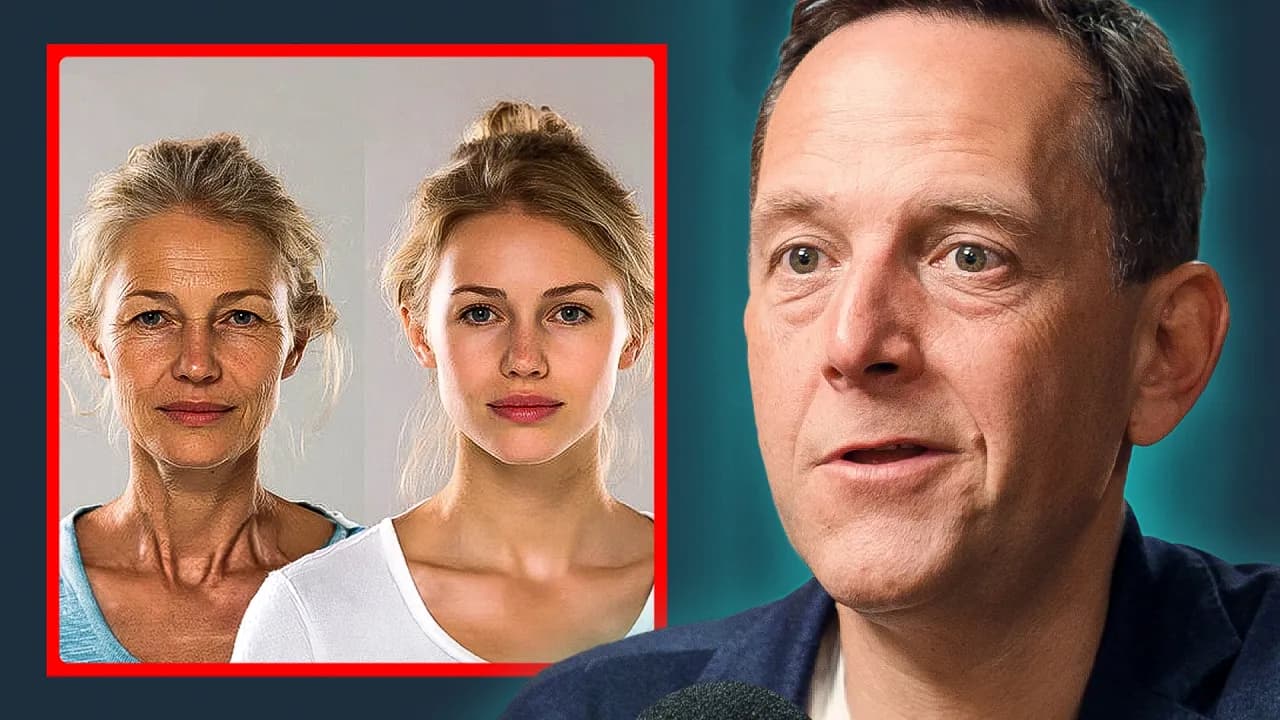
Everything You Know is About to Collapse - David Friedberg
In a Nutshell
David Friedberg counters pervasive pessimism about AI, climate, and existential threats by highlighting humanity's history of overcoming scarcity through innovations like Haber-Bosch fertilizer, diffusing AI (from centralized to edge devices enabling small businesses and robotics), fusion energy nearing 1¢/kWh, lunar mass drivers for cheap Mars materials, and Yamanaka factors for age reversal (extending lifespans 2-3x via epigenetic resets, with clinical trials underway). These exponential advances promise abundance—free energy, infinite robot labor, personalized manufacturing, and longevity escape velocity—unlocking agency for joyful pursuits over drudgery. Western fears stem from broken promises (e.g., college-to-job pipeline) and luxury beliefs rejecting tech like GMOs/nuclear, fueling socialism's cost explosions (healthcare/education up 200%+ due to government intervention); embrace diffusion and markets to avoid self-sabotage amid global competition.
These notes were generated by AI and may contain inaccuracies.
Humans are programmed to worry about existential threats due to survival instincts, from predators to biblical floods, plagues, starvation. In the late 19th century, population outstripped food supply because fertilizer came from guano fields off the South American coast—giant islands covered in poop shipped back to Europe by clipper ships. Islands were diminishing, leading to fears of starvation. Then the Haber-Bosch process invented: nitrogen from atmosphere compressed to make fertilizer. Population skyrocketed.
Every generation faces existential threats: climate change, COVID, now AI. AI is mind-numbing, hard to understand, like plagues or food shortages, leading to existential fears. But facts show people living longer, healthier, better lives across populations. Metrics: everyone has a home, car—things taken for granted today but struggled for 100 years ago.
Extraordinary compounding in technology: digitization of physical world, AI tools for predictions and engineering futures. Long history of data tools to understand world, e.g., make molecule for cancer, build moon machine. Exponential curve transforming humanity's trajectory.
Risk of too much change too fast breaking social order—that's current phase. Questions: how much social/economic dislocation? People want to brake changes, rethink expectations.
West: victim of own success, climbed high, more to lose. China embraces tech: more to gain than lose. West history: FDR, post-WWII resource aggregation won war, then promised extraordinary via government delivery for ~100 years.
Promises: everyone gets home (American dream), college then job. Not always right from free market view. Expectations unmet: college degree no matter cost leads to good job, home—not true anymore. Makes West fearful of changes.
East/China: GDP per capita from $3,000 to $30,000 quickly (10x income rise). People move farms to villages to cities—cities are future. Embracing future vs West's fear.
Concern: AI centralizes power to five trillionaire class, massive work displacement unlike horses to autos or manual labor to JCBs.
All tech shifts diffuse: start central, then spread. Internet: not instant Etsy/Shopify. Took generations: high-speed internet everywhere. First internet businesses did well. Early fears: Cisco dominates with switches. Now Nvidia/Google, but tech commoditizes, diffuses.
Recent: run models on desktop at home, no cloud dependency (Google/hosted). Download open-source models, run on Mac. Auto research viral: Andrej Karpathy ran agents on home computer, 30 talking, improved LLM better than old ChatGPT in weekend.
AI to edge: embedded devices, desktops, iPhones—ubiquitous. Data centers not key for benefits.
CAR-T therapy example: T-cells out, programmed to kill cancer protein/cells, back in. First: millions $, few companies billions profit. Now diffusing: near 100% success blood cancers, cost to $50k/20k/5k eventually—ends class of diseases.
Tech starts aggregated value, diffuses. Models disrupted weekly. Startups reduce token cost 1,000x via better architecture, distributed small models, new chips, energy balancing. Enables small data centers, no $100B monopoly.
History predicts diffusion unlocks value for every human.
AI replaces labor? E.g., accountants. But auto/horse analogy: worried about horse breeding/care/tables, but created mechanics, highways, motels, gas stations, coffee houses, new towns.
Unlocks industries steps away.
Physical AI/robotics: everyone gets robot in garage as 24/7 employee. E.g., custom bicycle shop: tweak online, robot builds, orders parts/machinery, packages/ships. Stand up Shopify/Etsy, no bike-making knowledge needed. Diffusion enables small businesses for all.
E.g., 20-30 years ago: unbelievable everyone has Etsy store, knit/sell for $50k/year. Now possible.
Arm farms India: young engineers strap GoPros, fold laundry/pack boxes to teach humanoid robots chores. Paid for normal tasks; robot learns. Like Tesla FSD: best drivers train model.
Hack: fold incorrectly to mess robots. Transitory training phase.
Anthropic report: jobs popped first by AI (no robotics yet).
Governments can't stop: e.g., NY law bans AI medical/legal advice. But open-source local models unstoppable—software self-replicates.
Challenge: which t-shirt folders buy 5 robots for own business? Agency key: ownership vs waiting.
Social systems programmed us: education/college/work/economy/taxes/government tell "do this, get that." Limited freedom.
Counter: TikTok/Instagram/Shopify/Etsy—millions Americans make tens of thousands/year posting bikini photos, podcasting, custom cat blankets ($300k/year). 15 years ago unbelievable. Everyone has unique capacity if given space.
Concern: AI reliance diminishes agency? Enables but reduces capacity?
95% don't get enough fiber—not carelessness, hard via food. Fiber: gut health foundation for nutrient absorption, energy stability, recovery.
Fiber Plus: 3-in-1 digestion, gut barrier, blood sugar. Cinnamon flavor. 30-day money-back. Up to 35% off first subscription: livmomentous.com/modernwisdom, code modernwisdom.
Expand humans beyond Earth: Mars colony pushed by Elon/others. Mars not habitable, needs lots material.
Math: reduce energy cost 100x+ by making Mars materials on moon, ship from moon to Mars. Moon no atmosphere—one big energy drag off Earth.
Escaping the moon requires much less energy than Earth due to its 1/16th gravity and lack of atmosphere dragging rockets back. Moon dust and rock contain raw materials like aluminum, silicon, carbon, and at the poles, hydrogen and oxygen from ice. Melt polar ice, electrolyze into hydrogen and oxygen, combine with carbon for chemical reactions to produce any Earth-like substance, metal, or material. Build large factories on the moon using solar power—abundant sunlight, no atmosphere or clouds for continuous energy, supplemented by battery storage.
Transport materials off the moon using a mass driver (electric rail gun, like a maglev train track), not propulsion. A 9 km track accelerates one ton of material to escape velocity at the right orientation to clear craters/mountains, targeting Mars. Requires a couple megawatt hours of power; material travels 9 km in 4.5 seconds, reaching 20,000 km/h. Add ~200 kg propulsion to slow down on approach. Use moon rock as a heat shield (15 cm thick) for re-entry into Earth or Mars atmosphere—it vaporizes, delivering ~700 kg payload. Run every hour with 500m x 500m solar panels, batteries, capacitors. Rail requires 9 tons of material to build.
AI enables physical self-replication: deploy robots with starter equipment to make more robots for mining, factories, rails, propulsion. Valuable materials on moon for shipment to Earth. Moon will become a massive economy, like the East India Company—underestimated until it starts, low-cost due to AI/robotics avoiding trillions in human commitment.
Space could be the next industrial revolution, but Earth opportunities abound, especially energy costs to 1 cent/kWh. Current US off-grid: 15-40 cents/kWh; best nuclear: 5 cents/kWh (runtime 5-10 cents, sold at 15 cents). At 1/100th cost, economies explode. Robots run on cheap electricity enable swarms (e.g., 100 robots build a 10,000 sq ft mansion for near-zero energy cost). House 3D printing launching at SXSW (gen 1); imagine gen 6 with zero energy—build custom homes like Hogwarts or personal Lake David.
Fusion powers the universe (sun): massive density from gravity creates heat, forming plasma (fourth state of matter; fifth is Einstein-Bose condensate). Protons fuse: hydrogen (1 proton) → helium (2) → lithium, etc., up periodic table. Fusion < iron releases energy; > iron requires input. Due to strong/weak nuclear forces tradeoff—more protons repel. Sun constantly fuses protons, releasing energy as light.
Earth fusion: spin protons in 100 million°C plasma using tokamaks (donut-shaped) or stellarators (complex shapes). Magnetic fields squeeze protons despite repulsion; protons generate counter-fields disrupting equilibrium. AI trains magnetic field control, achieving stable plasma for 30 minutes (China; progressed from 17 seconds in 2.5-3 years). ~70 startups. Process: water → protons fuse → extract electricity. Clean—no meltdown, radiation, nuclear waste.
Needs rebranding; avoid "nuclear" (confused with fission: splitting uranium, radioactive). Suggestions: electromagnetic energy, strong power, protonics.
Swimming pool of ocean water powers Earth's electricity for a year. Nearing industrial scale; progressing up production curve.
30-minute runs not yet net positive (require input); next phase captures neutron energy heating walls for steam turbines. Alternatives: direct electricity conversion (beyond spinning magnets/coils for electron flow).
Timeline ad: Mitoure (urethylene A) promotes mitophagy for mitochondrial renewal, muscle strength in 30s+ (human trials); 30-day guarantee, 20% off at timeline.com/modernwisdom (code: modernwisdom).
Moon/asteroid mining: Outer Space Treaty unclear on ownership/resources. Adds abundance to economy (not zero-sum like poker chips). True growth from productivity (e.g., mining gold adds value). Earth was closed system; importing iron/abundance lowers prices, increases access (e.g., more iron available).
Abundance game: energy cheaper, AI makes more stuff. Farm work: 80% Americans at 1900 turn → <1% now; 100-hour weeks → automated AC tractors (farmers on TikTok). Food abundance dropped malnourished (<1,200 cal/day) from billions to 600 million (rose post-COVID). Global malnutrition now mostly obesity (> starvation).
Moon ownership: astropolitics emerging. Geostationary orbits tied to nations; moon frontier—claim with flag/lasers, no Earth enforcement. Seven Eves (Neal Stephenson): new space law needed (e.g., multi-national crime). Ad Astra moon pirates. Abundance may end wars (scarcity drives conflict; e.g., less oil wars, crypto bull runs = harmony).
Work reduction: 100 → 60 → 40 → 30 hours/week (France law; US Democrats push 4-day/30-hour). Prosperity metric: less labor for good life, more family/personal time.
Are we being given freedom to do more things rather than being caged into doing the things we don't want to do?
Yamanaka Factors Explanation
Every cell in our body has the same DNA, copied through mitosis from the womb onward. What differentiates an eye cell from skin, brain, tongue, or foot cells are genes that are on or off, controlled by molecular switches called epigenetic markers. These sit on DNA, blocking or allowing genes to produce RNA copies turned into unique proteins—molecular machines that make cells function differently.
Cell complexity: Imagine a cell as Manhattan-sized with 500-story buildings and 10 billion people (proteins) constantly working, building, breaking, and interacting nonstop for 80 years.
Aging Mechanism
Aging occurs due to DNA breaks from radiation, sunlight, poor diet, alcohol. Cells repair DNA with repair proteins, but repairs can misplace epigenetic markers, turning wrong genes on/off. This causes cells to malfunction: eye cells fail leading to blindness, heart cells disrupt electrical cascades, skin cells wrinkle. Aging is a disease rooted in epigenetic errors, potentially the root of all disease.
In 2006, Shinya Yamanaka discovered four Yamanaka factors (proteins) that reset epigenetic markers, turning any cell into a stem cell (Nobel Prize). In 2016, research showed small amounts of these factors reset markers to a youthful state without full stem cell reversion: old retinal cells become young retinal cells, etc.
Results and Companies
- In mice: Extended lifespan to 250+ years equivalent.
- In monkeys: Wrinkles disappeared.
- In eyes: Reversed blindness by targeting retinal cells.
David Sinclair has a company in clinical trials. Altos Labs raised ~$10 billion to pursue this. Cocktails of Yamanaka factors or other molecules can be drunk, injected, or pill-form to reset epigenetics systemically or locally (e.g., for blindness, glaucoma, rheumatoid arthritis, heart issues).
Future: Continuous release of factors inside body to maintain youth, allowing indefinite lifespan. Systemic in mice (200+ years equivalent). Redosing works in animals. Optimizations pending: molecules, delivery, dosing.
Economic impact: Every year extended human lifespan adds tens of trillions to GDP, plus healthier, energetic people reversing cancer, diabetes via epigenome fixes.
Compounding with free energy, AI automation, infinite labor for abundance, freedom to pursue joyful work (yoga instructor, podcaster, wedding photographer) over drudgery (trading floor, factory).
Eight Sleep Pod 5: Smart mattress cover cools/heats each side up to 20°C, temperature-regulating duvet/pillowcase. Tracks abnormal heartbeats, breathing, HRV changes. Built-in white noise speaker, autopilot learns patterns, detects snoring and lifts head. Clinically proven +1 hour quality sleep/night. 30-day trial, international shipping. $350 off at eightsleep.com/modernwisdom with code modernwisdom.
Age reversal in clinical trials now (cocktails work in human cells in vitro). Expect proliferation in 10-20 years. Peter Diamandis' longevity escape velocity: Survive until tech extends life by >1 year per year lived, leading to indefinite lifespan. Best strategy: Maintain health now (not time to neglect it). Past lifespans (60-80 years) had little upside; now differences could be 80 vs. 120+.
Exercise fixes epigenome by releasing molecules; fasting helps. Peptides show effects (non-prescriptive).
Societal Impacts
Careers, retirement, family change with 120+ lifespans. Daughter's genie wish: Family lives forever. Tech gives more time for potential, reduces trade-offs in social systems.
UBI experiments failed. UBI creates wanting more, disincentivizes agency/passivity. Inflation: Increases money supply, raises prices of UBI-purchased goods.
Optimistic: Digital platforms (Twitch, Patreon) enable monetizing interests (massage therapists, yoga/Pilates instructors, dog walkers). Uncharted path ahead.
Superintelligence: AI exceeding human capacity, not yet general.
Humans adapt to AI anticipating thoughts/actions. We already alter nature (buildings, eating berries). Harness superintelligence via human-machine interfaces:
- Neuralink (wires in brain).
- Max Hodak (ex-Neuralink CEO, Science Corp): Solar-powered paper-thin retinal device (outpatient), restores vision in clinical trials. Powers when eye open, triggers neurons.
Future interfaces: Non-invasive (e.g., above ear, transmission), not brain-penetrating. Enables thinking to fly helicopter, solve physics problems instantly via silicon superintelligence.
Controversial path: Transgenic humans. IVF embryo DNA sequencing (e.g., Heritability app/investment: DS test + modeling parents' genomes for accuracy on 10-15 embryos). Dashboard: Immune function, IQ, externalizing behavior. Philosophically consistent: Selecting against negatives implies selecting for positives (eyes, height, intelligence). Already happens via eyeballing embryos/pre-natal screening; DNA sequencing more accurate (like robot umpires vs. human).
Some people draw lines at blind or death interventions, but controversially in China, they're using gene editing for enhancement. They take an existing human trait or allele, tweaking DNA to change brown eyes to blue eyes or increase intelligence—without introducing foreign genes, just ensuring traits the embryo could have randomly gotten.
He Jiankui in 2019 edited embryos with CRISPR-Cas9 to make them resistant to HIV, using a known HIV-resistant allele. Initially reported as twins, court documents later confirmed triplets—three gene-edited babies.
Enhancement edits ensure embryos get beneficial traits they could naturally have. Questions arise: Should we stack multiple traits? Make every embryo superhuman? Create specialized kids for sports, music, podcasting—or combine into one superhero?
Philosophical debates exist on crossing into enhancements if disease prevention is accepted—it's a spectrum.
Transgenic editing introduces genes humans wouldn't naturally have, regardless of parental combinations, e.g., infrared vision, creating X-Men-like abilities. Historically impossible, now feasible. This will be tested soon amid discussions on humans keeping up with superintelligence, enhancing performance, connection, control, or survival traits like for Mars.
Scott Solomon, evolutionary biologist, discussed Mars survival: radiation, bone density loss leading to C-section births, narrower hips, bigger baby heads—reversing evolution. Underground living protects from radiation but affects melanin, vitamin D under artificial light, and psychological profiles.
Transgenics are used in plants; term "trans" or "GMO person" carries stigma (speaker worked at Monsanto).
Human cells involve 80 years of 10 billion proteins interacting in a Manhattan-sized, 500-story space per second. Regulatory networks of proteins are beyond current modeling.
Cells can be frozen and rebooted because cold stops protein kinetic energy—random bouncing enabling function. This chaotic molecular ensembles suggest the universe as simulation.
Matter is mostly empty space yet solids don't pass through; all quantum, capable of tunneling.
Quantum entanglement: Entangled particles change states instantaneously across the universe. Possibly all particles of a type are entangled, meaning any change affects all others—pansychism-like connectivity. Universe progression as quantum state change manifesting space-time and entropy; space-time as feature of particle relationships, like a universal clock.
Speaker supports CRISPR for health or enhancement, giving traits not randomly inherited—no philosophical issue. Therapeutic adult treatments already do this, e.g., follistatin for strength via plasmids or mRNA (Brian Johnson got it in Prospera).
Advanced: Sets of genes making someone 100x smarter via injection. Speaker would take it for self.
Key framing: Parents choosing for kids. Aligns with embryo selection (e.g., Johnny from Herasite). IVF normalizes picking from 15 embryos—no issue philosophically.
Lines: Pick (selection) ok; choose possible genes ok; change genes—morally unconvinced; create new (transgenic)—further.
Overton window shifts: Adult gene therapies for lifespan extension (plasmids self-regulating cells to live forever) normalize, then extend to embryos decades later.
Embryo selection against negative traits (Huntington's) already accepted, e.g., Ashkenazi community. Positive traits will follow as competitive race to the top.
Behavioral genetics: 50% of traits (psychological profile) genetically inherited on average; physical more. Parenting books replaceable by one behavioral genetics book—kids' raw materials from genetics.
Wrinkles: Parental buyer's remorse—blaming self/kid for negatives; convergence on few optimal traits.
Spencer Greenberg study: IQ moderately negatively correlated with life satisfaction—offsets benefits like lower jail/addiction/homelessness, higher marriage/degrees.
Parents pick happier lower-IQ kid over dashboard equal otherwise.
In superintelligence world (Mars travel, quantum shifts), +200 IQ boost needed—not competing with each other, but finding place with pervasive AI tools. Humans as rocket boosters for AI, not bootloaders; everyone gets a rocket for propulsion.
Function offers 160+ advanced lab tests (hormones, heart, metabolic, inflammation, thyroid, nutrients, liver/kidney, 50+ cancer signals) vs. typical 20. Clinician-reviewed, flagged abnormals, personalized protocols, dashboard tracking. $365/year ($340 with $25 off via functionhealth.com/modernwisdom, code modernwisdom).
Speaker's toothpick company embeds flavors/supplements (15mg Cognizin, 15mg caffeine) into wood. Also pouches like Zyn but with Cognizin/cytocoline (better than nicotine), crushing: raised $60M, in HEB, Vitamin Shoppe, GNC, Sainsbury's, Morrisons, Daily UK, launching Australia, RTD smarter energy drinks.
Lifestyle maxi: Build what you want if gap exists (like podcast: less comedy than Joe Rogan, more substance than Tim Ferriss).
Best businesses: Design market gap you'd use.
David Friedberg's day job: Runs company on meiosis in plants.
Cells make new cells through mitosis, copying all DNA. DNA is packaged into chromosomes, with two sets side by side in each cell. These sets copy every time a new body cell is made, except for sperm and eggs.
For sperm and eggs, only one set of chromosomes is copied. The two sets fuse at random places during meiosis, creating a random half from each chromosome. Every sperm and every egg is genetically unique due to this fusion.
And then a sperm and an egg come together and you end up back with two and that's the new offspring. And every offspring looks a little bit different because every sperm is different and every egg is different. That's why kids all look different even though they come from the same two parents.
Offspring get a random half of genes from mother and random half from father. Meiosis drives evolution through this random selection.
Farming challenge: most crops can't use seed because of genetic variation from meiosis. Farmers want uniform genetics so corn grows at the same time for harvest, tomatoes are uniform size and color for marketing.
Seed industry ~100 years ago: inbreed plants for 7 generations. Plants have male and female parts, self-pollinate. After 7 generations, both chromosomes identical (homozygous), same alleles. Every sperm and egg identical regardless of fusion point.
Inbred plants crossed, producing identical hybrid seeds for corn, tomato, cotton, canola, sorghum. Farmers buy seed annually. Allows yearly yield improvement by crossing diverse backgrounds for complementary genes.
Plants like tools in a tool belt: more diverse genes for constant growth (roots toward water, branches toward sun, more leaves). Unlike animals that stop growing after fixed form.
Turning off meiosis: both chromosomes go into sperm and egg, offspring has four chromosomes (polyploidy). Many plants naturally polyploid: modern wheat hexaploid (6), strawberry octoploid (8), potato tetraploid (4). These can't make seed, so propagated by chopping and replanting.
Enabling seed saves farmers expense of chopping/replanting, allows better selections for genetic diversity, disease resilience, drought resistance, climate adaptation, higher yield, more food per acre.
US farms Russet Burbank potato for 150 years. New tech brings better potatoes yearly: healthier, nutritious, climate-adapted, more profitable. Farmer uses 10g seed (palm-sized) vs. 5,000 lbs chopped potatoes (e.g., Matt Gaertner's method), cuts expenses, increases profit and food production.
Business turns off meiosis, develops tech for efficient breeding, faster yield gains, climate adaptation.
Can you make it so that you need less fertilizer?
Yeah, absolutely. Nitrogen utilization key phenotype. Some crops like soybeans/legumes fix nitrogen from air, no fertilizer needed, refertilizes soil. Tech integrates this into other crops.
~1/3 of people talked to have left California. Informal survey of tech leaders: 87% plan to leave. Emerging tech CEOs looking to relocate (e.g., Southern CA company moving to Nevada).
California in sinkhole: politicians promise more to get elected, never less. Can't meet existing promises.
Highest tax rate funded nonsense: bullet train ($30B, 6 CEOs fired/one arrested), homeless program ($220M spent, 6 helped), rural broadband (cost could buy Starlink for every American).
Public pensions: past 12-15 years guarantees state can't afford ($600B-$1T shortfall). Unfunded healthcare promises to union workers. Massive liabilities causing exodus.
Billionaire tax: 5% on net worth >$1B, pushed by SEIU union. Allows legislature to change threshold/amount later (e.g., 1% yearly on billionaires, or expand to millionaires).
Original US income tax: 1% on high incomes (e.g., over $3,000/year), temporary wartime tax. Progressed: added 7% top rate, WWII top rate 94% (1944-45). Post-WWII New Deal expanded government.
Once government solves problems, escalates, never shrinks. 51% voting to take from 49%.
Wealth tax taxes post-tax assets/private property (e.g., iron ore, podcast studio, lamp). Requires annual asset lists (cars, art, home value). Erodes private property rights, US foundation.
Precedent leads to expansion: 5% billionaires → 2% millionaires → 3% on $100k net worth. National push (Bernie Sanders, Ro Khanna, AOC, Elizabeth Warren). Issue for 2026-2028.
US founded escaping tyrannical governments taking property. Pay 53% income tax gladly for services, but leave private property alone.
Future abundance: free energy, longevity, robots, less work, happiness. Yet risk self-sabotage.
Choice: optimistic abundance path or pessimistic control/dystopia. AI most unfavorable in US polls (worse than Trump).
Counterbalance: China/other countries will take abundance path if US doesn't. Possible foreign influence via NGO funding.
Incentives: virtue signaling for 'little person' drove social movements, regrets now. Opinions > deeds: say good, do bad.
What I care about is doing good, not the appearance of it. There are many people out there who are doing bad whilst appearing good.
Leaders with 3 homes pull up ladder, in middle ground: wealthy but below tax.
People in the middle ground—wealthy enough to be wealthy but not wealthy enough to avoid taxes—point fingers at billionaires above them. In Africa, farmers embrace GMO seed because it doubles their income and transforms their lives. Technologies like nuclear energy have dropped energy costs and proliferated in India, becoming game-changers. In the West, shunning these technologies represents luxury beliefs—we can afford to reject them because we're already well-off. Germany exemplifies this: they shunned nuclear, leading to high energy costs. Bernie Sanders owns three homes yet tells average people with one apartment to pursue paths that history shows ruin societies. Socialism is the worst idea humans have come up with, repeatedly tried despite failures like Argentina's recent escape from its consequences.
People flock to figures like Mamdani in New York because they feel left behind. Society promised college would lead to good careers and homeownership, but that was a lie. Federal education grants and loans enabled access without market checks. Any accredited university—from Trump University, Phoenix University, UCLA, Harvard, or MIT—could charge $60,000 tuition for any degree, even basket weaving or computer science. Government loans funded it all, fueling tuition hikes from $10,000 to $60,000 annually because no one said no. Students didn't calculate affording $240,000 in debt. Federal student loans cannot be defaulted on conventionally. Congress passed this, spending trillions underwriting loans without underwriting: any college, degree, student, or price. Privatizing would impose checks for bad students, shitty degrees, poor schools, or high costs.
Result: everyone got degrees, but the job market isn't there. High rents and lack of home building stem from government regulation and funding. As government grew, everything got more expensive. A chart shows government intervention vs. price changes in goods/services: items with heavy government involvement (top, red)—like college education, healthcare via Medicare/Medicaid—skyrocketed. Government dollars flow in, allowing sellers to charge more from an endless money-printing pool, leading to tax hikes. Below (private markets): cars, clothing, TVs, internet, software costs fell or stabilized—no government funding or distortion.
Friedberg showed this chart to Bernie Sanders last year. In that interview, prices rose 74% since 2000 overall, but varied: consumer goods like toys/TVs dropped over 50% (TVs nearly 100% cheaper); new cars not much more expensive. Healthcare/education skyrocketed 200%; housing too. Less legislation allows free markets to lower prices.
What does a family need? Basic needs: healthcare. America spends three times more per person on healthcare than the UK.
Friedberg sat with Sanders (in office nearly twice as long as Friedberg has been alive) strategically, not letting go without pushback. Sanders excels at empathy for desperate people—63% live paycheck-to-paycheck or with less than $500 savings, one catastrophe from debt. But more government hurts more than helps long-term, driving up prices. In 2012-2013, California tax hikes raised $100 billion (Friedberg paid a chunk); 80% ($80 billion) went to public retirement benefits, not schools/healthcare. Public employee voter blocs capture benefits without solving problems. Democracy inherently eats itself over time.
Textbooks, internet, YouTube show socialism fails worldwide: government-run grocery stores, universal healthcare without accountability or skin in the game get messed up. Friedberg wants universal healthcare in principle but sees inevitable failure. People ignore evidence, wearing blinders. During LA protests, a man said:
I'm here for socialism. We need socialism in America. Socialism's never worked anywhere—That's bad socialism. I want good socialism, done the right way in America.
Every socialist movement starts with inept government driving costs up, making people demand socialism. It's sexy—promising free vending machines, like the middle school president candidate.
Food stamp (SNAP) program: spending increased 60x from 1969 to 2022, now $100 billion/year (1.4% of federal budget), doubled since 2010. 60-70% of recipients are clinically obese; ~$20 billion (1/5th) spent on soda, benefiting Coca-Cola. Started in Great Depression as emergency aid (bread, milk, eggs) for starving people.
Total government workers (federal/state/local) + contractors + those on retirement/welfare checks = nearly half the US population working for or supported by government. Recipients won't vote to cut checks. This tipping point elects socialists; 2026-2028 could be big, with AOC as president. Tech/AI is the current boogeyman (like Japanese/Russians/climate change); Sanders pounds table to stop data centers.
More government won't fix problems caused by too much government, amid exponential tech/abundance curves. Schism between real-world progress and negative perceptions. Post-WWII mid-century optimism: moon landings, electric trams, microwaves. Disney's Tomorrowland (1955 YouTube: Disney History Institute) showed incredible future—Rocket to the Moon ride, House of Tomorrow with microwaves cooking in 30 seconds.
1970s shift to fear: Star Tours (faulty robot navigator crashes into asteroid); Space Mountain (veering rocket); Captain EO (Michael Jackson destroys robots that took over Earth). Pessimism burdens social/government systems. Change aperture to optimism: food/energy costs down, robots build stuff, more family time, cheaper housing. Fighting progress is crazy—Germany shunned nuclear, spiked energy costs, bought Russian natural gas, emitted more carbon.
Hopeful people vote less fear-based. Hope sounds dismissive of pain; empathy requires an enemy ("them"). Since 2012, voting shifted from for your party to against the other. Flip-flops: attack Iran/Maduro (anti-Trump if he does it); vaccines (Trump's vs. Sanders's). Shift to tribal "anything you do, I oppose" regardless of merit.
Keep Chris Williamson in your library
Save the videos and channels worth coming back to, and find them again in one place.