Brian Armstrong on Bitcoin, Anthropic Drops Fable 5 & Mythos 5, NewLimit's $435M Age-Reversal | 264
In a Nutshell
Brian Armstrong argues Bitcoin is the new digital gold that will power an agentic economy where thousands of specialized AIs transact via stablecoins on-chain, with Coinbase positioning itself as the financial layer for these autonomous agents. NewLimit's $435M raise advances partial epigenetic reprogramming to reverse cellular age without changing cell type, with human cell success already achieved and clinic candidates next year. Anthropic's Fable 5/Mythos 5 leapfrogs competitors on long-range reasoning benchmarks while Apple concedes by outsourcing Siri to Google's Gemini, highlighting the broader theme that AI compute demand is driving massive infrastructure bets from SpaceX satellites to sovereign wealth fund proposals for frontier labs.
These notes were generated by AI and may contain inaccuracies.
Citibank projects Bitcoin reaching as much as $189,000 by the end of 2026. Bitcoin is described as the new digital gold and expected to become a key part of the economy going forward.
NewLimit raised $435 million to advance age reversal research. The company aims to achieve half of what Shinya Yamanaka accomplished by changing cell age without altering cell type. NewLimit has demonstrated successful reprogramming of human cells, with first drug candidates planned for clinic entry next year.
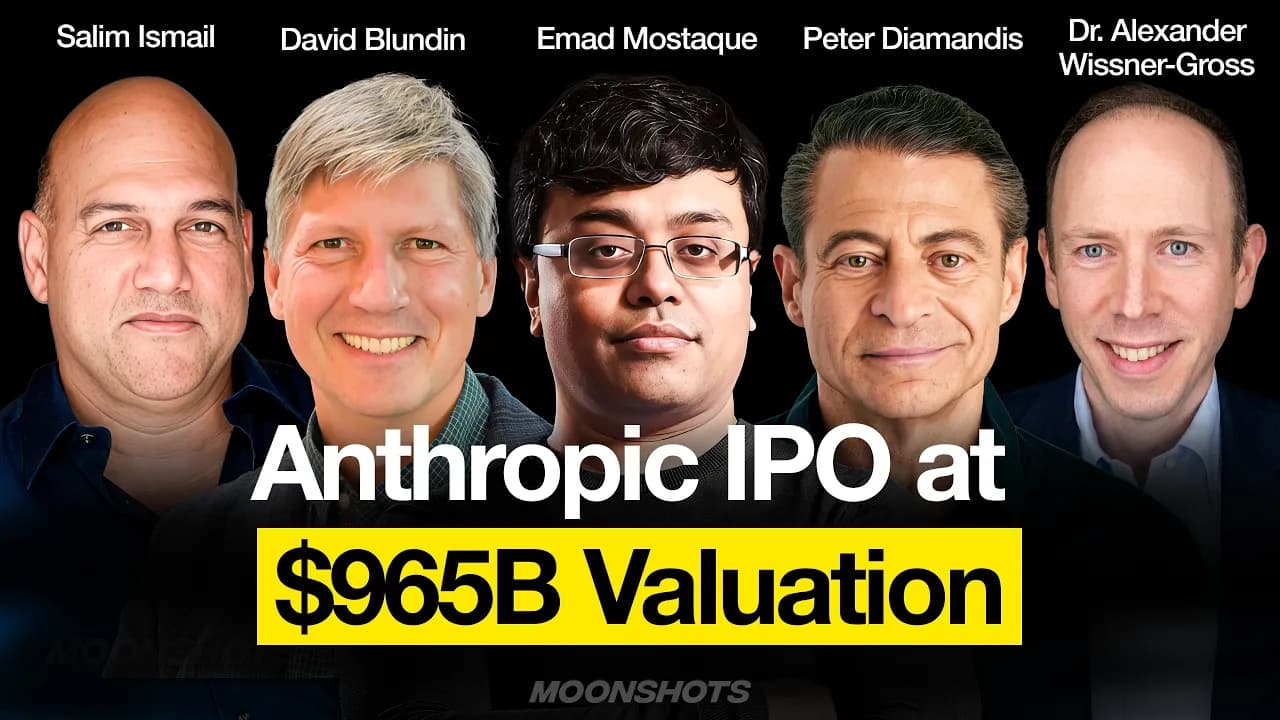
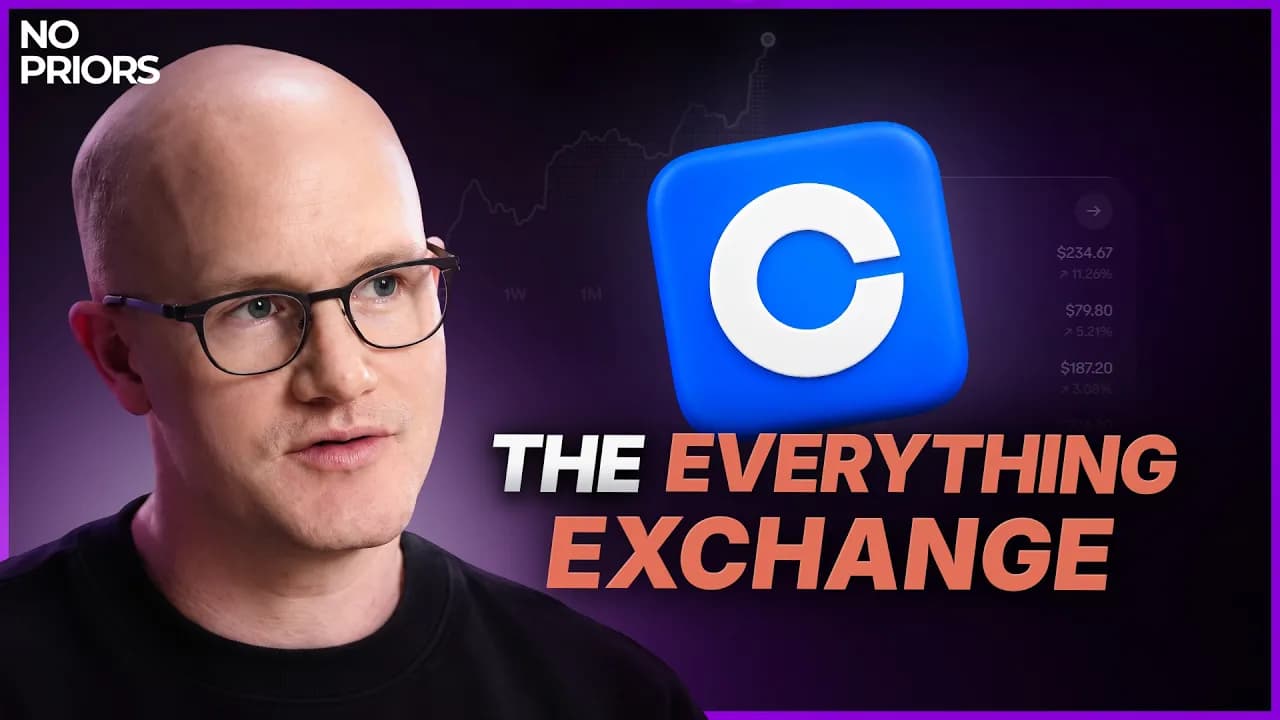
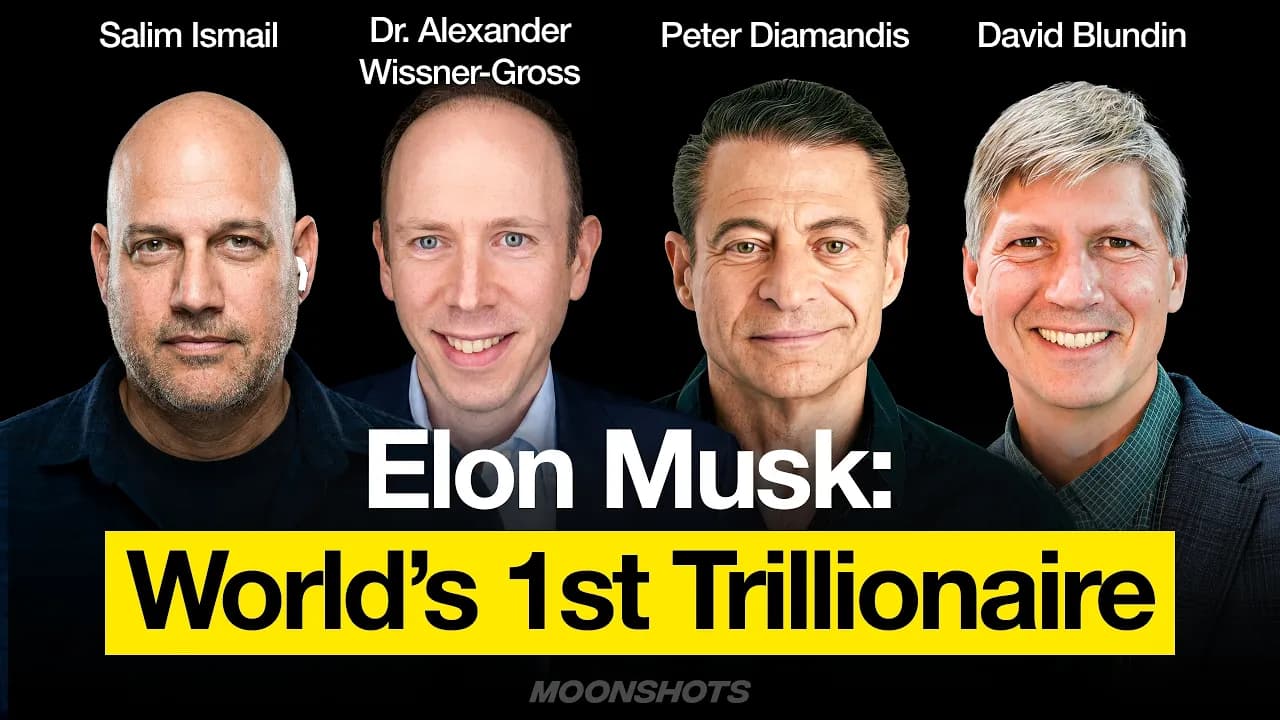
Moonshots is presented as the number one show covering AI and exponential tech. Panelists include Salim Ismail (professor of EXO, speaking from Vegas), AWG (Alex, triple major genius, at family beach house on Long Island), Dave Lunden (AI investing wizard), and guest Brian Armstrong (CEO of Coinbase and co-founder of NewLimit, speaking from Coinbase office in San Francisco). Host is Peter Diamandis.
The episode covers Bitcoin and agents as the opening topic, longevity and epigenetic reprogramming at the close, and interim topics including Trump's interest in frontier lab equity, Opening Eyes IPO, Mythos 5, and Elon's announcement of AI1 ginormous satellites. The stated promise is no politics or doom, focusing only on science, tech, and investments.
Brian Armstrong notes Bitcoin recently bottomed around $60,000. He attributes recent price pressure to AI absorbing risk capital and excitement around stablecoins following the Genius Act and regulatory clearances. Bitcoin's inflation-hedge trade became less exciting in an environment where growth appeared likely to outpace inflation.
Armstrong maintains a long-term bullish view, stating Bitcoin is the new digital gold and will be a key part of the future economy. He believes the current cycle may be one of the earlier ones and that a bottom may have been reached near $60,000, though certainty is impossible. He expects significantly higher prices by 2030 and remains long Bitcoin.
Salim Ismail notes he bought his first Bitcoin in 2014 on Coinbase. He views Bitcoin as digital collateral for an AI-native economy where autonomous agents will require programmable interfaces and settlement rather than traditional banking.
Armstrong addresses whether Bitcoin remains counter-cyclical to global problems such as wars or stock market crashes. He affirms the thesis will still play out but took longer than expected. He compares Bitcoin to digital gold held during uncertainty, noting roughly 30% of capital currently treats it as such while 70% still views it as a risk asset similar to volatile tech stocks. He expects the ratios to shift over time.
Armstrong agrees stablecoin payments will likely serve as the default layer for the agentic economy. He describes a shift from single AI agents to orchestrator agents managing hundreds or thousands of specialized agents. He subscribes to the polytheist view that even advanced models will have limited context and must specialize, communicating via language in swarms similar to human teams. This creates an agentic economy for value transfer, payroll, and hiring specialist agents. He predicts the AI economy will eventually exceed the human economy in scale.
Armstrong confirms AI and crypto compete for chips and energy resources. Bitcoin mining uses specialized ASICs incompatible with AI workloads, but both sectors compete for energy and next-generation chips from TSMC. Ethereum's shift to proof-of-stake makes it 99.9% more energy efficient than proof-of-work.
Dave Lunden highlights massive upcoming IPOs seeking hundreds of billions against limited liquid capital pools. He notes Bitcoin benefits from globalization in regions with hyperinflation or distrust in local currencies, but questions whether IPO-driven capital flows into the U.S. and data center buildouts strengthen the dollar's position relative to Bitcoin.
Polymarket predicts $84,000 for Bitcoin by end of 2026. Armstrong finds Citibank's $189,000 projection notable and states that following prior cycles, prices in the $100,000–$200,000 range by year-end appear plausible.
Bitcoin daily trading volume reaches up to 5% of supply compared to 0.5% for gold, indicating greater accessibility. This higher velocity is viewed positively for long-term adoption.
Brian Armstrong is credited with advancing agentic wallets, providing economic access to AI agents that would otherwise be unbanked. Agents have completed approximately 3.1 million transactions representing over $1 million in value transfer (updated figures indicate roughly 100 million transactions and $50 million in value).
Armstrong outlines Coinbase's three-part strategy for AI financial integration:
- Connecting LLMs to user Coinbase accounts via MCP API and command line for financial context and actions
- Launching Coinbase Advisor, an agentic interface inside the app for tasks such as portfolio rebalancing and tax-loss harvesting
- Enabling AI agents to create their own self-custodial financial accounts without traditional KYC, using the Base protocol for instant signup
Armstrong frames Coinbase's goal as becoming the financial account layer for AI agents rather than solely an exchange for humans.
Alex describes himself as the crypto bear on the podcast with no direct exposure to Bitcoin or gold, which he does not view as productive assets. He acknowledges that Brian Armstrong's work at Coinbase is transformative for the agent economy, particularly for the unbanked set of AI agents.
Alex poses a hypothetical: if the government changed its approach to KYC and expanded the moral circle of entities allowed to open conventional fiat bank accounts, what would that mean for stablecoin-based agentic wallets.
Brian responds that people often discuss crypto empowering the unbanked and unbrokered, but this is the first time someone has thanked him for banking AI agents. The conversation briefly explores whimsical extensions including banking non-human animals, collective human intelligences, and Borganism bank accounts. Brian mentions Sarama, a portfolio company working on uplifting dogs and creating interspecies foundation models.
Brian addresses the core question: even if KYC requirements were eliminated via magic wand, traditional financial system infrastructure runs on COBOL servers from the 1980s and 1990s. The advantage of transacting on-chain with stablecoins is that the infrastructure is faster, cheaper, and more global. USDC can be sent anywhere in the world in under one second for less than a cent. Brian states he would still prefer building on chain rather than legacy mainframes, though expanded KYC would help.
The discussion turns to liability if an AI agent overpays, gets scammed, or launders value. Brian states that legal precedent is needed. One school of thought holds that all agents are controlled by a human or company, so liability rolls back to that entity. Another possibility is that truly autonomous intelligent agents could be treated as their own persons, raising novel legal questions about sentencing, financial penalties, or restricting power access.
Brian emphasizes reducing fraud through on-chain reputation systems. He draws an analogy to Google's PageRank algorithm, where reputation is derived from the graph of links pointing to a website. On-chain payments form a similar graph structure. A high-reputation sender transferring value could assign reputation-weighted signals to recipients, functioning like an on-chain FICO score or Yelp rating. This would give agents additional information when transacting, such as refund request frequency or merchant reputation.
Salim states that allowing agent e-commerce fully enables the MTAM economy, where human transactions become a drop in the bucket. Once agents can negotiate, pay, buy, and consume, coordination costs collapse again, creating the organizational singularity.
The conversation shifts to the US government exploring ownership stakes in AI companies. Trump has called a government stake in AI giants a beautiful thing and suggested pieces could be given to the American public. Precedent exists: the government already holds stakes in more than 20 private companies, including 10% of Intel, 15% of MP Materials, 10% of Lithium Americas, 10% of Trilogy Metals, 10% of USA Rare Earth, and 10% of Korea Zinc.
Dave warns that while current investments may seem positive, establishing precedent for the federal government choosing private sector investments risks future administrations making poor choices. He references Eisenhower's warning about the military-industrial complex. Dave notes that any future president could sell or dump large positions, potentially tanking stocks.
Alex argues that if one extrapolates Anthropic's enterprise value or ARR and it intersects with Google within 18 months or grows larger than the current American economy, quasi-nationalization becomes difficult to avoid. If OpenAI and Anthropic become larger than the rest of the American economy combined, some strong formal arrangement with the US government appears inevitable. Alex defines the singularity as every sci-fi trope happening everywhere all at once, including UBI, UBC, UBE, or universal basic services.
The comparison is drawn to the Atomic Energy Commission formed after World War II. The AEC was created under the premise that atomic energy had essential civilian applications and was too important to be left solely to the military, civilian government, or private sector. Brian notes that AI differs because superintelligence is emerging from the private sector rather than a wartime project like the Manhattan Project. Sam Altman reportedly offered the US government an early stake in OpenAI, which was reportedly turned down.
Brian states he is less worried about government intervention slowing progress in the next few years under the current administration, unless frontier labs themselves want to slow down.
Brian notes that any company reaching a certain size will interface with government through taxes, policy engagement, and potentially as a customer. Coinbase provides crypto services to about 140 different government agencies at federal, state, and local levels. He states that government taking an ownership stake would not be necessary or likely.
Brian argues the government should be limited to setting policy while the private sector handles capital allocation. He raises concerns about political donations creating a toxic circle if the government is both investor and recipient of campaign contributions.
When asked about a sovereign wealth fund, Brian sees benefits in giving citizens skin in the game and increasing alignment with free market capitalism, potentially through shares at birth similar to Trump accounts. The downside is management quality and risk of politicization, such as investing in the green revolution. He suggests a strict rule like keeping investments in the S&P 500 as a mitigating factor.
Sam Altman met with Senator Sanders, who proposed transferring 50% equity from top AI companies into a public fund. Altman responded that such a transfer would not happen. The Overton window on AI wealth distribution has shifted dramatically. A 10% ownership rate is viewed as a more plausible outcome.
Dave considers a 50% transfer proposal insane and unlikely to happen, viewing it as Bernie attracting news. From the frontier labs' perspective, donating 10% equity through a legal mechanism could politically inoculate companies against future UBI claims by demonstrating they already contributed to a sovereign wealth fund.
Alex notes the conflict of interest created when the same state that regulates AI profits from specific companies' success, creating a toxic incentive favoring those two mega-companies over startups. He identifies a structural incompatibility: AI labs are becoming civilization-scale infrastructure requiring treatment like strategic utilities, yet no governance structure fits a technology touching every job, industry, and government service. The US lacks a sovereign wealth fund, compounding the challenge of managing such mechanisms.
The conversation explores a scenario where the U.S. Treasury takes 5-10% golden shares in OpenAI and Anthropic to complement its existing portfolio. The federal government would gradually ease into an S&P 500 or total market index, liquidating individual company holdings. This approach is described as how universal basic income or equity could be achieved.
OpenAI officially filed its S-1 to go public later this year. Polymarket shows 46% betting it will come out at 155% of the total market value of the $1.5 trillion or greater valuation, while 26% say it will not happen this year. This would be the third trillion-dollar IPO following Anthropic and SpaceX AI at $1.77 trillion.
Sarah Fryer, the CFO, previously expressed concern privately that OpenAI was not ready to be a public company and had a risk of $600 billion in compute contracts. The consensus is that times have changed and CFOs must adapt to shorter visibility windows, with 3-4 quarters of visibility now reduced to 3-4-5 months at best.
The challenge of coming out third among trillion-dollar IPOs during a cash crunch is discussed. There's limited liquidity available, and waiting years for market recharge is not feasible. The group agrees OpenAI must go public because competitors are doing so and capital will flow there.
OpenAI shifted from a consumer play to enterprise focus. Key changes include:
- Pivoting to Codex
- Shutting down Sora and AI for science division
- Rebranding Stargate from owned data centers to a leasing model
This combination of new revenue sources, expense removal, and switching to leasing is expected to create a more stable and predictable prospectus than the volatile consumer-focused model from earlier in the year.
Being a founder-led tech company provides advantages in decision-making agility. Healthy tension between founder CEOs and CFOs is considered normal and necessary. Founders bring ambitious energy while CFOs provide risk management. The OKR system encourages setting uncomfortably ambitious goals internally, but public companies often shift toward more conservative, externally appropriate targets that can be reliably hit every quarter.
Retail investors may take the hit on volatile AI valuations. Open source models are described as 99% as good and 3-6 months behind frontier models, but 99% cheaper for inference. The demand for intelligence is considered infinite, but costs are falling faster than Moore's law. Within 12-18 months, 80% of workloads are predicted to move to models that are 99% cheaper.
The value is not seen in the harnesses (Codex, Claude Code) but rather in the dramatic depreciation of model prices. The Facebook IPO is referenced as an example where the stock dropped by half due to insufficient liquidity when dumped into private client accounts, though it proved a great investment in hindsight.
Google is paying SpaceX $11 billion per year through 2029 to access 110,000 Nvidia GPUs inside xAI's data center. This positions SpaceX AI as a hyperscaler. One contract reportedly halved the company's valuation multiple. The deal signals a massive AI compute shortage.
Elon Musk is viewed as having refocused from building a frontier lab to renting compute. The Anthropic deal is cancellable on a month-by-month basis, while the Google contract is three years. xAI may be using revenue from these deals to accumulate resources for future frontier model development.
Colossus 1 contained a mixture of H100s and other generations. Colossus 2 was planned as a pure mixture. Google primarily uses TPUs but needs Nvidia CUDA stack for certain customer workloads, creating demand for additional GPUs.
SpaceX unveiled the next-generation AI satellite designed to launch humanity's first Dyson swarm. Specifications include:
- 150 kilowatts of peak compute
- 70 kilowatts per ton
- Two-ton satellite
- 70-meter wingspan (Airbus 380 size)
- 110 square meters of deployable radiative cooling
- Integrated micrometeorite shield
Elon Musk stated the AI satellite is simpler than Starlink satellites, essentially solar cells with laser links, lacking Starlink's complex antennas. Much of the technology exists in Starlink V3. The design is described as the first-generation node in a future Dyson swarm.
Redundancy for micrometeorite impacts is expected, with compartmentalization allowing the satellite to sustain multiple hits while maintaining sufficient cooling. The manufacturing challenge of folding the satellite inside Starship is acknowledged, with confidence it will use elegant origami-style packing.
Starship's volume capacity is identified as the key enabler that no other vehicle can match. At 150 kilowatts, the satellite is compared to Cerebras wafer-scale engines at 20 kilowatts, highlighting how far current designs are from physical efficiency frontiers.
150 kilowatts translates to approximately $6 million in GPU compute value. Target launch cost is $100 per kilogram. Original filing called for 500,000 satellites requiring a launch per hour of Starship operating 24/7. This was later increased to one million satellites.
SpaceX announced a GigaSat factory in Texas for producing AI-1 satellites starting late 2027. The facility spans 1,000 acres with 11 million square feet of capacity. The factory will be fully vertically integrated, producing solar ingots, wafers, solar cells, and complete AI-1 satellites on one campus. This follows the Giga factory playbook previously used for Optimus production.
Texas is attracting multiple major projects. The 1,000 acres is compared to roughly two golf courses to contextualize the land footprint.
Vertical integration enables future off-Earth manufacturing. SpaceX has released concept videos of electromagnetic slingshots (rail guns, mass drivers) launching AI orbital data centers from the lunar surface. With vertical integration of solar and compute production, manufacturing could shift to the moon where delta-v economics are more favorable than heavy launch from Earth's surface.
Brian Armstrong shared an anecdote about visiting Elon Musk at SpaceX headquarters, highlighting Musk's approach when a manufacturer was underperforming on the Pica heat shielding for the Dragon capsule. Musk reportedly told the manufacturer to forget it, stating he would make it himself and put them out of business. Armstrong described this as an extraordinary ferocious mindset.
The discussion turned to the partnership between Dario Amodei of Anthropic and Elon Musk. Peter noted that Alex had been pointing out that new physics would be invented by AI imminently, and if that physics went into gigafabs, the results could be mind-blowing. If Dario wins the race to self-improvement, he would have the smartest AI rapidly accelerating. However, Elon would have space-based data centers and manufacturing capability to create a closed-loop self-manufacturing system, which Anthropic has not yet started developing.
The group discussed that the AI that designs chips represents where the rubber meets the road. Elon is building the TeraFab, but chip design would come from the smartest AI, potentially Dario's. The duopoly could become incredibly powerful if they stick together.
When asked whether Dario and Elon would still be friends five years from now, one participant predicted they would not, noting that Elon has never partnered for the long term and typically takes the lead and runs with it. Peter registered a prediction that crazy things would happen in the next few years, making the question itself seem laughable in retrospect.
Saleem agreed with Peter, expressing amazement at the level of civilization-scale thinking happening nonstop.
NASA has been working on specialized AI agents that think for hours to understand enterprise-scale code bases with millions of lines of code. Engineers start every development sprint with the Blitzy platform, bringing in development requirements. The Blitzy platform provides a plan, generates and pre-compiles code for each task. Blitzy delivers 80% or more of the development work autonomously while providing a guide for the final 20% of human development work. Enterprises achieve a 5x engineering velocity increase when incorporating Blitzy as their pre-IDE development tool paired with their coding co-pilot.
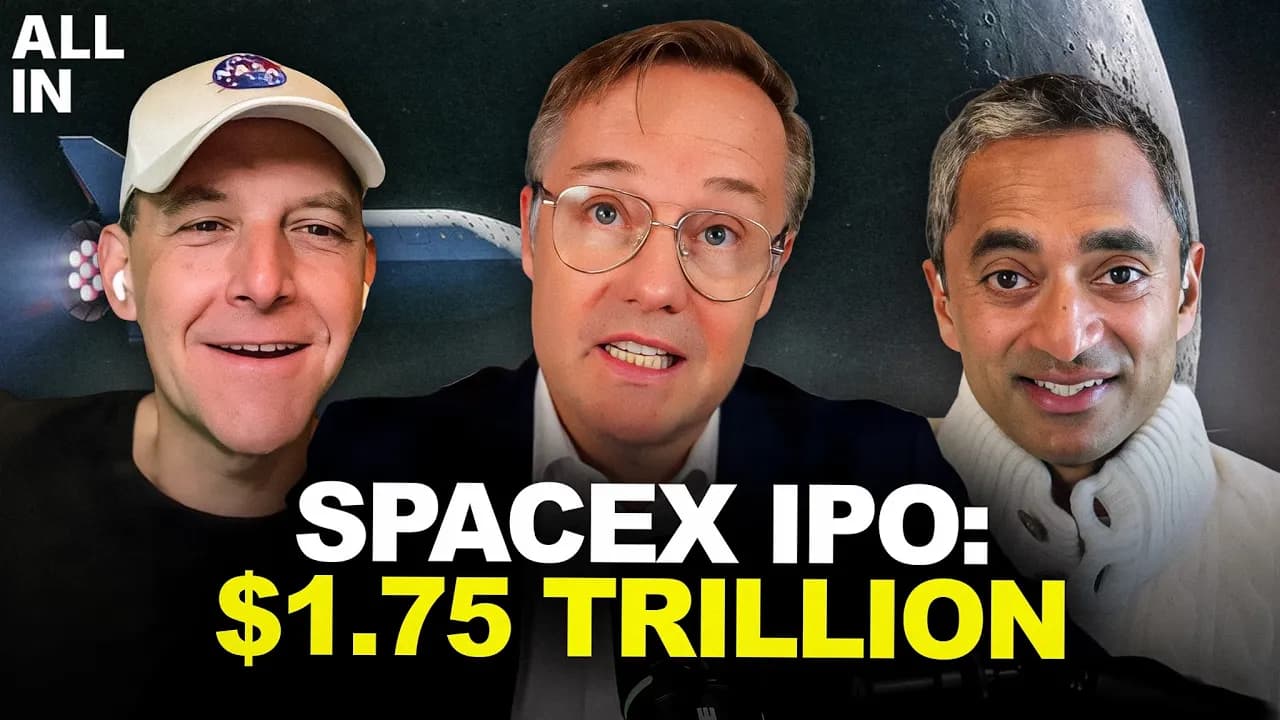
SpaceX valuation is currently expected to hit $2.13 trillion at the close of the first day of market according to Polymarket. Morgan Stanley projects SpaceX revenue could grow from $18.7 billion in 2025 to $3.4 trillion by 2040. At those revenues, SpaceX's value could be between $50 trillion to $100 trillion, potentially representing the first $100 trillion company.
Current revenue breakdown shows Starlink at $11 billion, launch revenue at $4 billion, xAI revenue at $3.2 billion, and Google at $11 billion, totaling approximately $18 billion for SpaceX.
No company in history has ever hit a trillion dollars of revenue. Walmart and Amazon are getting close but not at a trillion yet. A trillion dollars represents about 3% of current U.S. GDP. If GDP undergoes 3x or 10x year-over-year growth, the $3.4 trillion revenue projection would still be relatively small. A few trillion dollars makes sense in a scenario where the Dyson Swarm gets built and a large chunk of civilization runs on the compute it provides.
Brian Armstrong was asked about the role of cryptocurrency in a future where most compute is no longer Earth-based and the economy consists of AI agents trading. He stated that Bitcoin would be the new gold standard, with payments happening on-chain. Capital formation, borrowing, and lending would occur on-chain as the financial system AI agents would use.
Regarding latency considerations between planets like Mars and Earth, Armstrong noted there would be some delay in syncing blockchains, but transfers could happen on-chain with laser links. Payments would be appropriately delayed rather than real-time, settling less frequently.
Armstrong pointed out that the Morgan Stanley projection is likely a fundraising tool ahead of the IPO, as Morgan Stanley is one of the banks that would profit from the deal. He noted daily discussion on X about players opting out of SpaceX, claiming it is overvalued at $700 million rather than $1.7 trillion. He fundamentally believes in SpaceX's long-term value but hopes retail investors do not get hit in the process.
The conversation shifted to longevity and biotech. Armstrong was congratulated on NewLimit's recent $435 million raise for age reversal research. He explained that he, Blake, and Jacob Kimmel started the company together as co-founders, with Jacob now serving as CEO. The origin story traces back to the Coinbase IPO in 2021, when Armstrong had liquidity and began thinking about major technology trends for the next decade.
He felt AI, fusion energy, brain-machine interfaces, and space had good teams working on them, but longevity seemed underfunded. He hosted dinners with top scientists and biotech CEOs, asking what was most exciting but underfunded. Epigenetic reprogramming was mentioned as the answer.
Shinya Yamanaka won the Nobel Prize in 2012 for showing that an old skin cell could be reprogrammed into a young embryonic stem cell using just four proteins. At NewLimit, the team is trying to do half of what Yamanaka did—changing the age of the cell without changing its type, restoring the function the cell had when younger.
They built a high-throughput screening system starting with AI to explore 10 quadrillion different protein combinations. The system originally ingested existing literature and now ingests wet lab data from NewLimit, which has the largest dataset by far. It recommends the next experiments to run in the wet lab.
The process involves pooled screens to see if cells can be made to look younger phenotypically. Best hits move through functional assays to determine if cells actually act younger—for example, testing whether a reprogrammed liver cell can process caffeine, acetaminophen, and alcohol like a young liver cell. Best functional assay candidates then move to non-human primate and human trials.
The process has moved faster than expected. Armstrong thought it would be a five or ten year basic research endeavor, but they have demonstrated successful reprogramming of human cells, with first drug candidates going into the clinic next year.
Life Biosciences dosed their first patient with OSK treatment. The group discussed longevity escape velocity (LEV). Ray Kurzweil's prediction is 2033. One participant expressed an idiosyncratic position that LEV would be spiky like AGI, potentially achieved in certain subpopulations without broader notice.
A recent double-blinded study on HIV patients receiving GLP-1s showed measurable double-digit age reversal on epigenetic clocks. The participant wondered whether second and third generation GLP-1s like retatrutide might push past LEV in a spiky way without broader notice, similar to how AGI passed the Turing test.
The $101 million healthspan prize measures functional reversal of age rather than biomarkers. There is no reliable biomarker for aging because Horvath clock results can vary between morning and evening tests. The focus is on functional measures: whether liver function, cognition, immune system, and muscle match levels from 20 years earlier.
GLP-1 drugs are considered among the first longevity drugs. The group agreed that LEV would likely be passed without people reacting, similar to the Turing test comparison. Armstrong noted the FDA approval process is the slow part compared to AI development.
One participant noted that LEV would not be recognized for a long time because people would not be dying. The baby who will live to a thousand years old is already alive. The healthspan project focuses on age reversal—whether function from earlier life is restored—rather than waiting 30 years for a longevity prize.
Martine Rothblatt of United Therapeutics is working on restoring the thymus using IPSC stem cells. The thymus is lost completely in one's twenties and is important for immune function. NewLimit has not targeted thymus capabilities yet but plans to address all major tissues.
Armstrong noted that as we talk about life extension, death and taxes have been constants throughout human history, and Bitcoin may crack taxes. The fresh perspective from successful entrepreneurs entering biotech provides value because they are not jaded about what is possible.
Armstrong drew inspiration from Elon Musk, noting that software fortunes are being made in a golden age, and hard tech problems deserve more capital. SpaceX and Tesla might not have existed without wealthy individuals with exit capital pursuing moonshots. Venture capital does not always get you all the way there. Money made in crypto and AI will likely fund the next moonshots.
The $435 million will fund multiple clinical trials. In biotech, costs include people, materials like reagents, and increasingly clinical trials as candidates move to the clinic. An average phase one trial might cost $10-20 million, with costs increasing for phase two and three. Enough capital exists to run multiple trials to get candidates through the process.
Columbia University researchers successfully edited the PCSK9 gene for LDL cholesterol and the HBG gene for hemoglobin in embryos in vitro. This opens conversation about embryo editing. In 2018, He Jiankui in China edited the CCR5 gene in two young girls brought to term to make them HIV resistant.
Base editing, invented by David Liu at Harvard, allows single nucleotide swaps in DNA with minimal error rates and is better than first-generation CRISPR. The technology is more advanced than the scenario in Gattaca, where only the best combination of parental genes was selected. This enables actual base editing of embryos.
This is tremendous. And I can't for the life of me understand, Asilomar or otherwise, why this wouldn't become a broad spread practice. Yeah, obviously, you know, shadows of eugenics come to mind. But at the end of the day, if you're getting rid of hereditary disease or if you've got some, you know, if you're a family below five foot and you want your kids to be taller, you know, the ethics of this are going to evolve. And morality around this is going to evolve. And societal norms are going to evolve.
Saleem stated two things. One is this is going to have a lot of people freak out. But let's note that we have an old word for all this is called breeding. For thousands of years, we've been crossing dogs and cats and horses and humans to select the traits that we want. What's happening now is biology is becoming a digital programmable domain. Disease prevention is the most compelling case here. But the governance things that this will bring up are going to be unbelievable. Because we're going to be editing diseases. Like right before birth at this point. I think this is incredible. Between sequencing CRISPR, IVF, AR modeling. Like anything is now possible. Just think of yourself, your 50 trillion cells for every human being in the world is now a software engineering problem. How do we think about that?
Brian raised one of the bigger complexities is jurisdiction. So if you live in a country, so suppose your parents are in the U.S. And you go to a Caribbean island. And that Caribbean island is, yeah, do whatever you want. So then you've got a baby. Then you bring that baby back in the U.S. That's inevitably going to happen. So regardless of what your local laws decide they would like it to be, it's not going to actually work locally. So that's a really big complexity in this whole area.
Brian weighed in that it's a great point. I mean, I think this is going to happen too. I think it'll be good for humanity on net. I think a lot of people will freak out about it for a while. But I think there was a Pew Research study I saw that something like 80% of Americans would support embryo editing for disease prevention. So that was more than I expected. I thought 80% is pretty high. But only about 20%, I think, supported it for, quote, enhancement.
The part that I've never been able to figure out is what's the line between disease prevention and enhancement, right? Not having a disease sounds like a pretty good enhancement to me. I mean, there's cases where, like, let's say osteoporosis, right? So if you have that, it's a disease. But if you had a gene edited to prevent it, you have stronger bones. Stronger bones sounds like an enhancement. I basically think the line is so blurry that people will start with this for disease prevention and then it'll upgrade over time. And I think anything's on the table, even IQ or whatever. It's like, should we have more smart people in the world? Probably. I mean, that seems like a good thing to me. And ethics change, right? Because if you remember a while ago, IVF was considered immoral in the early days. And now it's enabled millions of families to be formed.
Well, but not to state the obvious, but if you are seven foot tall or higher, you have a 50% chance of making the NBA. And if you make the NBA, that's a $20 million a year paycheck. So if you're a couple, just a regular everyday couple in the U.S., and you have the option to have a seven foot tall child by design, you're going to go to that Caribbean island and make your seven foot tall child for economic reasons? You know, think of what could go wrong then. There's going to be some serious guardrails. There has to be guardrails around this.
There's a company I love called Nucleus. Kian Sadagi, the CEO, is going to be at my Abundance Longevity trip in October. Brian, I'm hoping to have you there. I'm hoping to have someone from Ulimit there as well. But what Nucleus does is you fertilize, you know, 20 eggs, you know, 20 zygotes, and then you sequence them, and you can choose the one out of the 20 that have the attributes. Instead of playing dice and hoping for the lucky sperm, you can actually pick the one that has, you know, the right attributes from within the gene population that you have. Separate from base editing, a step before that, but still something you can do today. Remember the line from Gattaca, your child is still you, simply the best of you, except that's not even true with base editing. It's better than the best of the parents.
Brian was thanked for joining. Grateful, I know you've got, you know, the world's largest crypto company in the world to run. So, appreciate your time, my friend. Yeah, thank you for having me. This was a great conversation. I love talking with people who want to build a future. Yeah, for sure. And that is most definitely this amazing group.
Our next story here is Anthropic launches Fable 5 and Mythos 5. Here we go. Andrei Kaparthi, who has joined our friends at Anthropic, is now shilling for the new models. Here's his quote. Super exciting release. Fable 5 is the same underlying model as Mythos, but with added safeguards. You can 10x your test suite, auto-optimize code, run giant research projects with custom HTML for the results, anything.
Alex noted very impressive release. Anthropic is back in the lead now. Until today, GPT 5.5 was the lead, the state of the art across most of these benchmarks. Today, for probably about five minutes, Anthropic takes back the crown across most measures of superintelligence.
A few notes. The distinction between Fable 5 versus Mythos 5. Mythos is, as reported, a less inhibited version of Fable. Or conversely, Fable is a more inhibited version of Mythos that has certain scaffolding and other restrictions that prevent it from having more ambitious conversations that might relate to biology, chemistry, cybersecurity, perhaps other areas. But I've used it. It's incredible. I gave it my typical. Benchmark, which is favorite eval, asking it to one-shot a cyberpunk first-person shooter that's visually stunning. Did an amazing job. No errors. Ran immediately. Had a nice soundtrack that came with it.
What's more interesting, if you look at the benchmarks and then also the demonstrations, far be it from me to suggest that Pokémon games are actually the secret to superintelligence, but if you look at the demos that have been coming out from Anthropic and otherwise, it is able to play just from pure visual reasoning now. This is Fable 5 or Mythos 5, doesn't really seem to matter. It's able to, based on just watching the screens of games like various Pokémon games, it's able to win them. And that requires long-term, long-range reasoning capabilities that we really haven't seen until now. So my guess is Anthropic has probably been very aggressively doing RLVR, reinforcement learning with verifiable rewards, on long-range reasoning challenges, maybe game playing, maybe challenges that involve spatial reasoning, maybe very large code bases, maybe very large capture-the-flag CTF hunts. Very large, sprawling, both in probably, my guess would be in space and in time, RLVR challenges to get some of these results.
It's just incredible what you can one-shot now with Fable 5, with reasoning set to high. And again, difficult to predict how long Anthropic will retain the crown before, say, GPT 5.6 comes out, but it is exciting to see the frontier move once again.
Dave noted yeah, well, it's only been out for about four hours, but I've been playing for four hours. It's, I mean, what we're living through, Alex is constantly posting on our internal feed, it's happening, it's happening. I mean, it's really happening now. This is, oh my god. You know, what's interesting to me, a bunch of things. First of all, they doubled the price, so it's expensive as all hell. This idea of commodity intelligence is not happening. It's damn expensive if you want the most brilliant thing. But what it produces is so incredibly intelligent that it takes you quite a while to read and understand what it did. And it's like, well, I'll just move on while you're reading and trying to catch up. And so that's an interesting new thing for me.
And also, I think this is interesting, that Anthropic had it in the bag. You know, Alex just mentioned that, you know, the leapfrog is going on. But actually, OpenAI pushed out their best. And Anthropic then said, okay, well, we had this ready to go. So, you know, we're just trying to make it safer. But now we'll come out and go over the top. And we've been saying they're pulling their punches. They are, they're gaming this.
Salim, as you're heading towards your flight, do you want to add anything here? No. What occurred to me here is that, you know, I've been playing for four hours. You know, when you have, you have the split now between the safety guardrails and the performance guardrails. And I thought that was really interesting. Because you've got the same underlying model with added safeguards, right? That's the whole safety debate in one sentence right there.
Well, actually, they even changed the name, too. You know, you've got the Mythos, which we've been talking about for a while. And then Fable is the heavily guardrailed, won't do a cyber threat. Won't do a nuclear weapon, you know, version of the exact same model. So they even differentiated it by name to support exactly what you're saying, Salim. With pretty broad buffers. Like you can, friends of mine have tried having conversations, perfectly innocent conversations with Fable 5 High about biology. And from what I've heard, it has pretty broad margins for what it will simply revert back to Opus 4. If it thinks you're asking anything in biology. Or chemistry. That could remotely be a dangerous subject. It'll just downgrade you immediately to Opus.
You know, funny you say that, Alex. Because, you know, I'm often trying to work from a plane. And SSH doesn't work on the plane Wi-Fi. And so I, you know, use a workaround to try and get access to all my remote agents. And that also vomited saying, that looks a little bit like maybe you're doing something sketchy. And it gave me the anthropic, you know, we're not going to answer that query thing, you know, repeatedly. So I had to actually find a workaround for that, too. So, yeah, they've really, really locked it down to try and avoid the cybersecurity issue.
As we head towards IPO season for these two companies, these Frontier Labs, we're going to start to see the rate of model release increase. They're going to be leapfrogging. Who's going to be out front at the day of the IPO? Who's getting the news? At least, Peter, we have competition. The situation could be worse. We could just have a singleton, a single lab that is not getting leapfrogged at all. Yep. At least we have two competitors at the moment in the lead. For sure.
All right. Our final story for today. After more than a decade of sucking, Apple finally made its move to improve Siri. They've announced a multi-year partnership with Google to power Siri with Gemini AI, rebuilding Siri from the ground up. The big shift, Siri is now an agent, not just a voice interface. The key breakthrough is personal context. Yes, finally. Siri can now reason across your messages, your emails, your notes, your photos, and actually get things done. And it can actually, you know, when I'm sending a text message to Kristin, it can spell it correctly or it can spell my name correctly. It doesn't most of the time. They're calling it Persistent AI Workspace, coming to beta later this year, focused in English.
Two huge implications here. First, Apple is essentially admitting it lost to Frontier. They're a model or the foundation model race and chose Google to rent brains rather than build its own. And it's a stunning concession from the company that has always priding itself on its own stack. Second, the real emote was never the model. It's the personal context.
So, Alex, you want to share with us? I'll offer a few different perspectives here. So, one, the glass half empty perspective is Apple, for arguably the first time in modern technology, modern history has outsourced a key element of its tech stack, which Apple, it's just not, as with Elon and vertical integration, it's not in Apple's cultural DNA to want to rent out someone else's technology that's going to be so core to the system. That's the glass half empty.
Second perspective, that perspective says the foundation model is not analogous to, say, an operating system. It's more analogous to the role of a search engine, which has to be localized. So you'll note Apple didn't announce this in China yet. It didn't announce it in the EU yet for different reasons. But focusing just on China, I would expect Apple to strike some partnership that's roughly analogous to the partnership with Google, with one of the three big Chinese AI labs or tech companies. And that will represent a localization roughly analogous to the way Apple localizes its other websites, web search capabilities in China with one of the Chinese companies, analogously to the way it defaults to Google for web search. So the glass half full argument is, well, foundation models, however foundational they are, are intrinsically localizable. And so Apple has merely chosen for its American franchise, Google, and maybe it'll choose another franchisee for Europe and another one for China. That's the second perspective.
Google has been doing this with Android and its suite of products for a while now, right? So this is Apple sort of catching up. I mean, I've almost moved to an Android phone so many times just because of its ability to contextualize all of my personal context.
A third perspective, yes, and a third perspective is if you buy that foundation model economics are hyper deflationary and the cost is going down by 40x year over year or anything remotely like that, then you should view this entire bit of Apple losing its tech sovereignty as a nothing burger. And yes, Apple maybe is struggling to distill Gemini down to its private cloud compute combined with iPhones this year. But in a year or two, there will have been so much hyper deflation and the cost of compute that for the present capabilities of new Siri, that they will easily fit into the new iPhones. Sure. And that any loss of sovereignty or any yield. We haven't even touched on this semi embarrassingly. It's not even the case that Apple is just able to distill Gemini, Google's Gemini or its version thereof into the iPhones. And it's not even the case that they're able to operate it with a combination of Apple's own cloud combined with the iPhone edge compute. They actually need Google's cloud to do this because it's so compute intensive. But all of that over the next year or two can shrink and hyper deflate down to just working on an edge device as these algorithms get more important. And that's why it's so advanced.
Yeah. Dave, any thoughts on Apple? Yeah, lots. Well, anytime in tech that you don't do anything for a long period of time, you eventually get crushed. The question is, how does it emerge? The way it would play out if Apple doesn't do something aggressive is you lose the interface. You know, Siri is now Google. But Google is Android. And Android is the one competitor to the iPhone. Remember, all the revenue still comes from the iPhone. So you lose the interface. At the same time. TSC. TSMC moves the chip manufacturing away from the M5 and M3 and M4 to a much higher paying customer in AI data center use. So Nvidia or Elon take the manufacturing capacity away for the underlying chip because they just pay more to TSMC. So then you've lost your hardware manufacturing under the covers and you've lost the interface on the other side. And then everybody just moves to Android because they're talking to Google or Gemini all day long anyway. And so the machines get the actual physical phones get manufactured by Samsung using Samsung's chip manufacturing capability, which is, you know, immune to TSMC.
Salim, I want to acknowledge your persistence and your ability to stay in the conversation. This is a new low. I'm in my airplane seat. So let's just let it just go past this. Closing thoughts on Apple and Siri. Your closing thoughts. I believe that it's good. I believe that it's good. It's good when I see it. Yeah. We've been so disappointed over and over again. You know, you and I met the founders of Siri before they sold to Apple. And it had such promise back then. And it just stuck around just way too long.
Gentlemen, I think that's a wrap. Enjoyed having Brian here going from Bitcoin to longevity. Anyway, crazy week ahead. I'll see you guys in a few days for our next episode. Thank you, as always, for your commitment to this podcast. Everybody watching, thank you for your support of Moonshots. We're here to give you the news, help you understand it, help you be optimistic. It is the most extraordinary time ever to be alive. I like to say, you know, during the singularity, don't sleep, don't blink. The words live long and prosper really fit that. Yeah, they do. Take care, gentlemen. Safe travels, everybody. Peace and long life. Take care, folks. Bye.
Keep Peter H. Diamandis in your library
Save the videos and channels worth coming back to, and find them again in one place.