Exercise Scientist Reviews Lee Haney’s Genius Training Methods
In a Nutshell
Lee Haney, 8x Mr. Olympia winner, pioneered a scientific training approach emphasizing mind-muscle connection, pre-exhaustion (e.g., leg extensions before squats/leg press), full eccentric control, and full ROM to maximize hypertrophy while minimizing joint injury from excessive loads. He favored a 3-on-1-off push-pull split training muscles ~every 4 days with 10-15 sets per session for optimal stimulus and recovery, avoiding one-body-part-per-day routines. This methodical, restrained system—exemplified by perfect T-bar rows and hybrid powerlifting-bodybuilding adjustments—delivered elite mass with class and longevity.
These notes were generated by AI and may contain inaccuracies.
Dr. Mike from RP Strength, college professor of exercise and sports science, introduces Lee Haney as the greatest bodybuilder of all time, born in 1984, the year of Haney's early reign. Haney won eight Mr. Olympia titles, surpassing Arnold Schwarzenegger's seven. Haney was 5'10"-5'11", 245 lbs on stage with a 28-inch waist. His front double biceps pose exemplifies mass with class.
I use a scientific approach along with my training system. I didn't just grunt it out to see how much weight I could lift. I never did that.
Haney emphasized the mind-muscle link and a training system that avoids destroying the body or injuring joints. He trained methodically, training less than maximum capacity to prevent injury and ensure recovery for consistent great sessions over 16 weeks.
Pre-Exhaustion for Legs
Haney used pre-exhaust: leg extensions, leg press, then squats. Muscles respond to tension, not absolute weight on the bar. This saves hips, knees, and back.
Early hybrid powerlifting-bodybuilding works: heavy compounds first (squats, deadlifts, bench presses, pull-ups, rows), then isolation. As size and strength increase, joint and nervous system limits require adjustment. Pre-exhaust allows high stimulus with lower overall load and injury risk.
Instead of 500 lb squats first, start with 200 lb leg extensions, 400 lb leg press, 400 lb squats. Stimulus to quads is identical per studies and mechanisms, but acute/chronic injury risk is multiples lower avoiding 500 lb loads.
The muscle doesn't know the amount of weight. All it knows is the weight feels heavy and I have to respond by growing.
Full eccentric control, full range of motion essential.
Lee Haney demonstrated perfect T-bar rows: full eccentric control, slowly extend lats at top for stretch, full range. Lean back for better lat contraction if it helps, but avoid jerking. Use belt for lower back protection in T-bar rows.
Hyper Belt from VersaGrips: tall, flexible, stylish, covers entire waistline for intra-abdominal pressure.
For T-bar rows, use 25 lb plates and narrow grip to allow full lat flex at top without bar tapping chest. Bent perpendicular to ground for massive back stretch and contraction. Minimal injury risk, maximum hypertrophy.
Haney had highly developed calves.
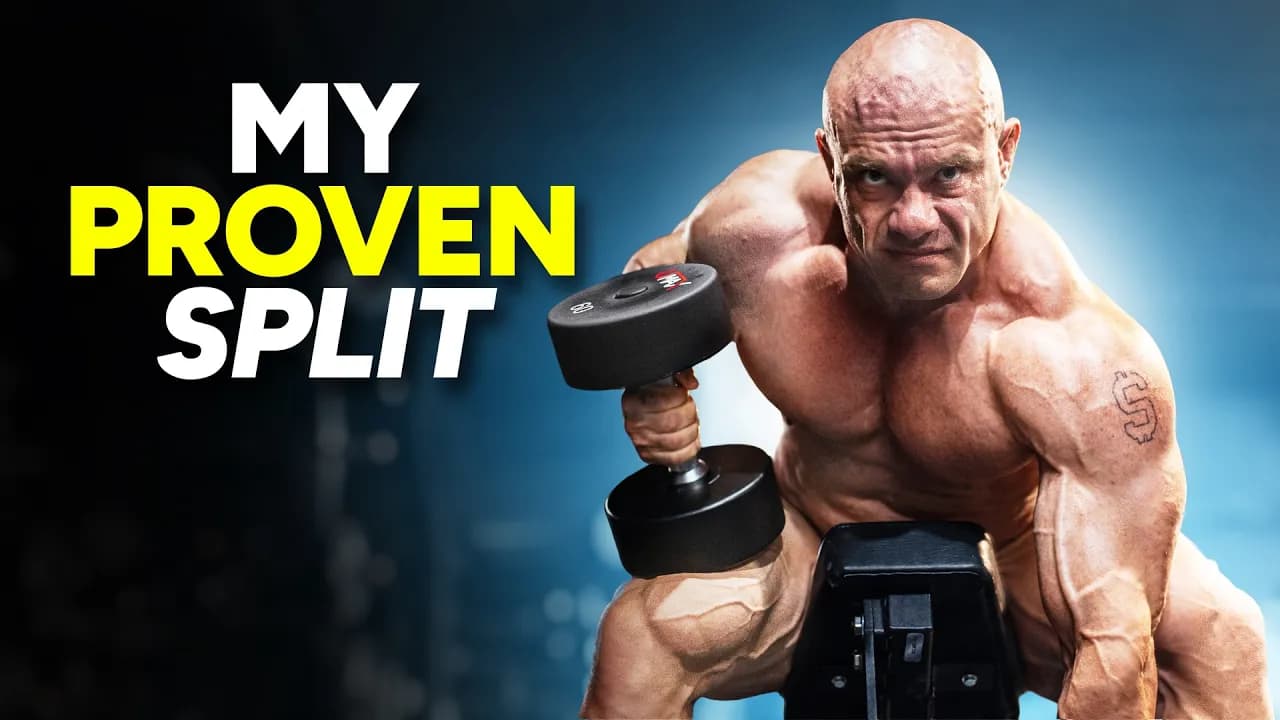
Haney criticized one body part per day (arm day, chest day). Recommended 3 on, 1 off split.
You have enough recovery time and you can use a good bit of weight without tearing your joints apart.
Trains each muscle ~every 4 days (almost twice weekly). Matches 10-15 sets per session max before quality drop-off and ~4-day recovery need. Goldilocks zone: hard stimulus, ample recovery without excess rest.
Push-pull example:
- Day 1: Push chest, pull biceps + calves/abs.
- Day 2: Legs (push quads, pull hams).
- Day 3: Shoulders (push), back (pull) + abs/calves.
Linking push-pull gives tendons/muscles recovery between sets. Exhausted push muscles allow better pull performance. Splits fatigue, maintains psychological drive, hits muscles multiple times in cycle.
RP app has 3 on 1 off programs.
Lee Haney: living legend, ahead of his time in wisdom and restraint. Smart training yielded eight Mr. Olympias.
Keep Renaissance Periodization in your library
Save the videos and channels worth coming back to, and find them again in one place.