Fat Loss Isn't Hard. It's Misunderstood
In a Nutshell
Fat loss fails when people focus on calories instead of food quality, because processed carbs feed harmful gut microbes that drive visceral fat storage and cravings. Two recent studies confirm that specific microbiome bacteria (Dorea longicatena, Bifidobacteria adolescentis) directly cause organ and liver fat, creating a cycle where inflammation and cravings reinforce each other. The solution is to stop "pleasure picking," replace processed foods with microbiome-friendly options, and use MRI to track real fat distribution rather than scale weight.
These notes were generated by AI and may contain inaccuracies.
You've cut your calories, resisted your intense food cravings, and stepped on the scale every morning to see if any of it has worked. However, the dangerous fat, the fat that accumulates around your organs, may remain in place. I am Dr. Sean Amara. I am a physician and clinical researcher. I spent 7 years running a study for the National Science Foundation, in which I scanned thousands of Americans using magnetic resonance imaging. So, I can see what is happening inside people, even today, who are working very hard on this matter. Many of them misidentify the problem. Losing fat is not difficult. It's simply a misunderstanding.
People treat it as a mathematical problem, or blame their willpower, and assume that money and comfort are on their side. There are two studies that have been published this year that are consistent with what I have been seeing in surveys for years. What I see with my wealthiest clients is why I believe this is becoming increasingly difficult. But first, we need to correct three serious misconceptions that are ruining your life, your health, and your appearance.
The first misconception: Fat loss depends on calories consumed and calories burned. Unfortunately, this is a huge misunderstanding. The principle of calories in and out is simply about eating less and moving more. The group that promotes this principle is causing an increase in obesity, liver failure, and diabetes, all of which are on the rise. This simply proves that counting calories is useless. It's not that calories are unimportant, but the quality of calories matters much more.
So, let's take a look at an interesting study in the journal "Radiology" from April 2026. They studied 615 people and found that the more processed foods they consumed, the more fat was observed in their thigh muscles via MRI. But what I know from experience is that when you see muscle fat, and it starts to increase, we also see an increase in visceral fat, heart fat, and organ fat. So, the lesson learned is: if you eat processed foods, you increase your visceral fat. It increases the fat around your heart. Therefore, two people can consume the same number of calories, but they are stored differently in each person. This is all due to their respective microbiomes. So, you need to stop asking yourself how much you weigh, and start asking yourself where my fat goes.
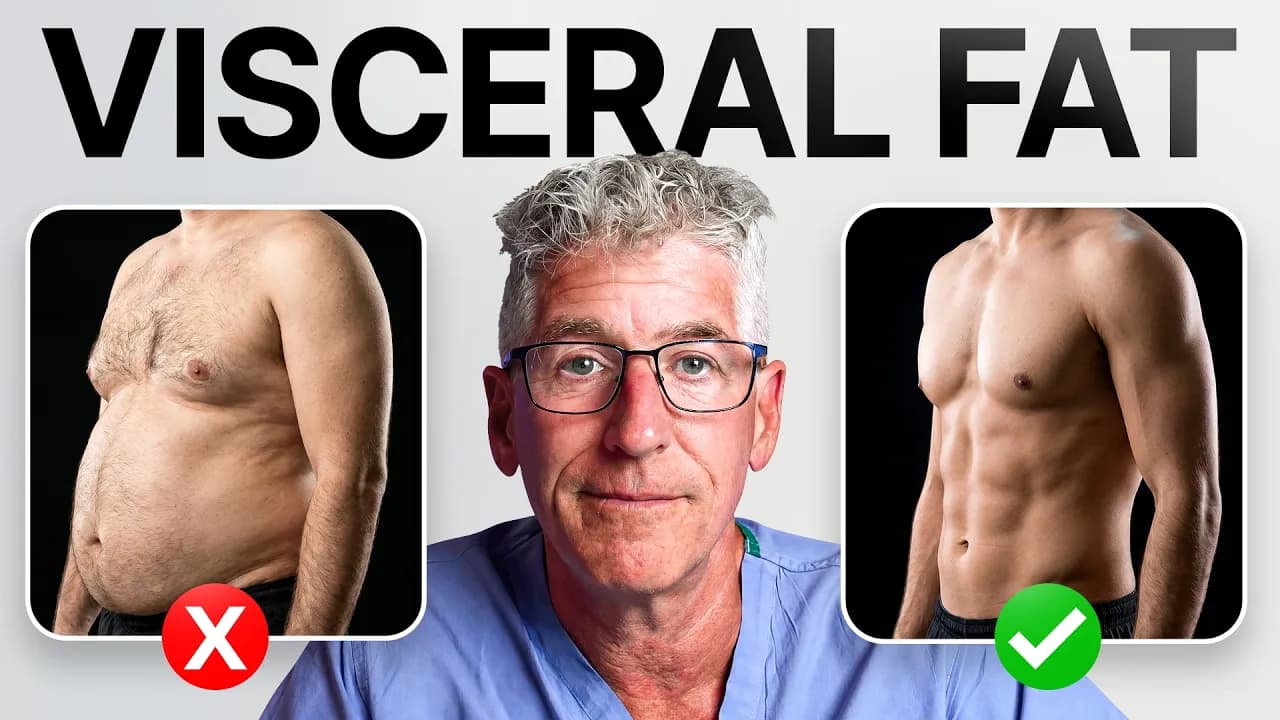
Let's take a look at this picture. Here's a client who's full of visceral fat, and look at all that fat in his thighs. A huge amount of fatty deposits. I have previously described it as human "Wagyu" meat. And look how thin this man's thighs are because he has very little visceral fat. Thus, processed foods play a huge role through the microbiome in determining where fat is distributed in your body. And that's what really matters. Targeting these fat depots: visceral fat, muscle fat, and heart fat. All of this is determined by your microbiome. So, over time, what you eat shapes and determines where that fat goes, and how it turns into disease-causing fat or healthy fat.
So, the second misconception is that losing fat is a willpower problem. It's not a lack of willpower. It is an ecosystem problem resulting from a disruption in the gut microbiome. Your intense cravings are not from you, but rather are microbes resulting from an infection. It comes from the bread you eat, pasta, pizza, ice cream, and chips, all of which are carbohydrates that feed the obesity-causing microbes that demand carbohydrates. So, how does the disease occur? Harmful microbes can infect you; they are everywhere, on handrails, shopping carts, and elevators. It demands carbohydrates and produces fatty polysaccharides and toxins that damage the lining of your intestines. These toxins begin to leak into your bloodstream. It then travels through your circulatory system throughout your body, leading to inflammation. This leads to a metabolic disorder, resulting in visceral fat, rather than superficial subcutaneous fat. However, more inflammation and more leakage occur. And then you get more visceral fat and more diseases. As you can see, it's a vicious cycle that you can only get out of if you fix your microbiome and treat the underlying infection.
Listen to this science. In the journal Nature Experimental and Molecular Medicine, dated September 10, 2026, they recently looked at 1,771 Koreans who underwent CT scans, took their weights, body mass index, and waist circumference, and found that none of that mattered as much as their visceral fat. They found in particular that the measure of visceral fat was associated with two specific types of microbes that were compatible with visceral fat. They are called "Dorea longicatena" and "Bifidobacteria adolescentis". This was a correlation, but they proved causation in a rodent model. They gave these two specific types of bacteria to the mice, and this caused the mice to develop visceral and liver fat, and altered their gene activity towards a pathological state. Stubborn visceral fat eventually comes back to microbes, to your destructive microbiome. Every bite of fast food and carbohydrates that you put into your body leads to bad microbes and more cravings. You are caught in this vicious cycle that never ends.
If you want clarification on the food aspect, I have built a free 5-day framework that guides you through eating, exercising, and sleeping, step by step. It's the first link in the description.
The third misconception is that rest is a reward you deserve. Let me talk to you about the pressure of selection. Selective pressure is that force in nature that makes the most desirable traits pass on and be preserved. But today it is completely missing. We are driven by comfort, calories, and warmth, all of which can be bought without your body having to earn them. And that's the problem. So, I came up with this term which I call "pleasure picking". "Pleasure selection" has replaced "selective pressure". It has completely replaced him. Now we are driven by pleasure, comfort, and calories. The best hunters of old targeted better meat, better animals, and better game, not just more food. They knew that the quality of their lives and their ability to survive depended on it. Therefore, the quality of the meat used to be the reward that determined how you would live and whether you would live at all. Consuming poor game, poor meat, and poor food leads to a poor life, with one potential flaw I want to talk to you about.
You are high-net-worth individuals, and there is a paradox among high-net-worth individuals regarding health. There are the poor, the middle class, and the rich. The poor eat anything, everything they can get their hands on. The wealthy eat delicious and enjoyable foods, such as Godiva chocolate and crème brûlée, and Marie Antoinette's attitude of "let them eat cake". They have discipline at work, they are professionals, but they lack discipline when it comes to fun. They eat extravagant foods and think, they expect, that they can get away with the consequences, but they are wrong. They cannot do that. This is what happens when you have a microbiome that pushes you towards "pleasure picking" based on the pleasure of food. Every treat or dessert you give yourself is a "selection for pleasure". You choose the illness.
Let me give you some final advice. You need to stop the forced endurance and start counting calories. It's a losing strategy. Change what you feed yourself, your ecosystem, and your microbiome. Get the right microbes by feeding them good, healthy food instead of bad carbohydrates. Remember this saying that I share with all my clients. The enemy tastes sweet. Secondly, get a reference MRI scan. Magnetic resonance imaging (MRI) assesses your position in this disease model. Where do you have disease and where do you have healthy tissue? Magnetic resonance imaging (MRI) puts an end to the lie. You are not as healthy as you think. Third, when your eyes fall on food, use your brain. Will this help my singing garden, my rainforest, or my trip to Africa, or is it just a fleeting pleasure that will lead to sickness, misery, and ongoing suffering? This is what you need to know every time you look at food before it passes through your mouth.
If you want to know the first changes I'm going to make, starting with reducing processed foods, watch this video below. It's exactly what I would do if I wanted to lose visceral fat quickly. Before you change your diet, your workouts, or any medications, talk to your doctor. I am a doctor, but I am not your personal doctor.
Keep Sean OMara, MD JD, Health & Performance Optimizing in your library
Save the videos and channels worth coming back to, and find them again in one place.