The Real Cause of Obesity (Not Calories)
These notes were generated by AI and may contain inaccuracies.
Calories don't cause obesity in a biological sense. In a fascinating experiment, lean individuals were fed 10,000 calories per day. Most didn't gain nearly as much weight as expected. Researchers had to keep increasing calories to achieve weight gain. After the experiment stopped, participants immediately lost all the weight. Forced overeating gains are easily lost naturally, unlike chronic obesity where losing 25 lbs is nearly impossible. This data has been available since the 1980s.
Calories in, calories out is simple arithmetic, always true, but not a model of obesity. It's a misunderstanding of the energy balance equation: body fat = calories in - calories out. Reducing calories by 500/day doesn't guarantee 1 lb fat loss/week because metabolic rate drops. Every scientific study of weight loss shows metabolic rate decreases with calorie cuts. There are three variables: calories in, calories out, body fat. Change one, others adjust. Cutting calories often leads to burning fewer calories, not fat loss.
Devil's advocate: even if imprecise, eating more than needed stores as fat. But overfeeding studies show short-term calorie surplus doesn't recapitulate real-world obesity. Analogy: capturing a jump at apex doesn't mean flight; full arc shows gravity pulls back. Calories are the dependent variable, result of hormonal fluctuations, not the independent driver.
Rearranging equation: calories in = body fat + calories out. For every calorie eaten, store as fat or burn it. Overfeeding increases burn to minimize fat gain. In Rudy Leibel's classic study (discussed in The Obesity Code and The Hunger Code), liquid diet overfed participants to gain 10 lbs, requiring more calories than expected. Metabolic rate increased by 500 calories/day during gain. After returning to normal weight, rate normalized. During weight loss, rate dropped again. Eat more, burn more; eat less, burn less—minimizing body fat change.
1993/1996 New England Journal study and 1999 Science study (Slavine) showed 10-fold variation in fat gain from overfeeding due to non-exercise activity thermogenesis. Personal anecdote: ate 6,000 calories/day for 3 weeks, gained no weight—body temperature rose, heart rate increased, sweating constantly, slept with ice packs. Dr. Bray self-experimented: doubled sandwiches, then switched to fattening foods like cookies and ice cream, gained 10-15 lbs, got uncomfortably hot and sweaty. Stopped and lost weight in 3 weeks effortlessly. Leptin rose, appetite suppressed, body returned to set weight.
Calories in/calories out debunked for 40-50 years. Food stimulates hormones: brownies raise insulin, eggs don't, steak raises GLP-1. Satiety hormones (peptide YY, cholecystokinin, GLP-1), vagal receptors activated by steak/eggs lead to fullness. Same calories in Frappuccino: no satiety, hungry soon after. Energy balance holds as arithmetic, not obesity model.
Host frustrated from medical school: system designed to make weight loss/maintenance harder, despite evolutionary ease. Grateful for Dr. Jason Fung, nephrologist pioneering intermittent fasting and carb-restricted diets for type 2 diabetes/obesity. Author of NYT bestsellers The Obesity Code, The Diabetes Code, new The Hunger Code—questions dietary dogma.
Overeating stems from overhunger, not deliberate fat gain. Eat when hungry, stop when full. Reducing calories without addressing hunger increases hunger, leading to failure (e.g., jaw wiring, lap bands in 1960s-70s). People bypassed with smoothies, soft foods. Bariatric surgeries (Roux-en-Y peaked 2010, now declined; lap bands mostly removed) initially worked via restriction but hunger adapted, weight regained over ~5 years. Most regret them.
GLP-1 agonists (e.g., Ozempic) reduce hunger, calories drop naturally, weight maintained better—works with body.
Three types of hunger:
- Homeostatic hunger: physical, hormone-driven (not just empty stomach). Circadian rhythm: hungriest 7:30-8:00 PM (post-lunch), least at 8:00 AM (after 12-hour fast). Morning cortisol, growth hormone, sympathetic tone suppress hunger, release glucose.
- Hedonic hunger: pleasure/reward-driven (dopamine spike). Dessert not eaten from physical hunger but desire. Comfort foods alter neurotransmitters for emotional eating. Ultra-processed foods, food addiction tied here.
Body regulates fat tightly like animals (too fat = predator risk or can't hunt). Body fat thermostat hormone-controlled. Insulin promotes storage. Gravidose stat hypothesis: excess fat burdens agility/survivability. Studies: weighted vests (10% body weight) cause loss of vest-equivalent weight; same in pigeons. Osteocytes signal brain.
The body maintains fat stores in a tight range, which can be disrupted if hunger gets out of control. Hedonic hunger has a physical basis in brain phenomena, hormones, and neurotransmitters like dopamine, the desire and pursuit hormone, distinct from actual pleasure. Pursuit of hyper-palatable foods leads to desensitization, where pleasure at a given level diminishes. Someone adapted to low-carb, low-sugar may get as much or more pleasure from a handful of blueberries as others do from an ice cream sundae.
Anecdote: First year strictly keto (no sweets, not even stevia), mistook yellow frosting from JP's ice cream cake (formerly favorite) for hard-boiled egg yolk; it was abhorrent despite same flavor, showing changed emotional response. Now, wild blueberries taste sweeter and provide more pleasure than ice cream sundaes ever did.
Hedonic hunger involves habituation and pursuit rather than true in-the-moment pleasure.
Agreement: Perceptions change with diet. Little sugar makes small sweets taste very sweet. Example: Used to drink Double Double (Canadian coffee with two creams, two sugars) frequently; recently tried son's and found it overwhelming overload, now drinks coffee without sugar.
Hedonic hunger is driven by pleasure of eating. Processed foods hammer reward pathways to maximize pleasure, encouraging repeat consumption—what food companies want. This can tip into food addiction. Cutting sugars resets this. If problem is hedonic hunger, address it directly, not just insulin, cortisol, or GLP-1s (though overlapping Venn diagram).
No food spiking hedonic hunger fails to also spike insulin. Data shows spiking insulin also spikes dopamine—they go together. Refined carbohydrates reduce satiety signaling, allowing more consumption of stimulating foods. Example: Hamburger is pleasurable but satiety prevents eating 50 due to satiety hormones.
Processed carbohydrates hit hedonic hunger while reducing satiety—worst offenders.
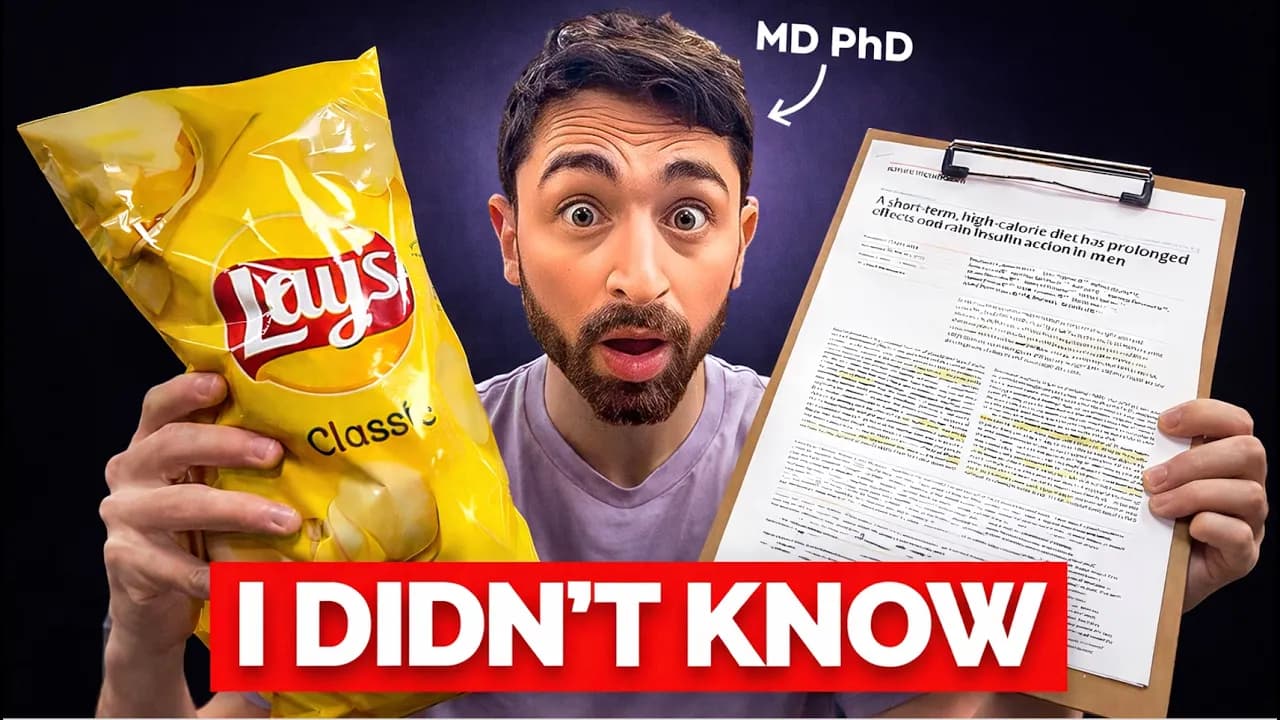
Study reference (Nature Metabolism, ~2023/2026?): "A short-term high calorie diet has prolonged effects on brain insulin action." High-calorie meant Snickers, brownies (hedonic foods). Even after short-term trial ended, increased insulin resistance in the brain persisted.
Overlapping biological cascades link hungers: hardcore biology viewed through human behavior lens.
Conditioned hunger: Create hunger by pairing with neutral stimulus (Pavlov's dog classic). Dogs salivate at food; lab assistant bringing food triggered salivation pre-food (learned association). Paired bell with food repeatedly: dog salivates at bell alone, increasing hunger.
Appetizers work similarly: small food wets appetite. Any neutral stimulus (bell, lab coat) can become conditioned if paired with food.
In US, food paired with everything: sitting in car, TV, movies, desk/computer, reading book, walking street, ads everywhere. Celebrations (birthday) or bad days both paired with food—every human experience conditioned to food, creating hunger overdrive.
Social events pair food (even antiquity feasts/holidays), but other pairings absent elsewhere. Japan: no eating while walking (frowned upon), eating at table only; no eating in car or at desk.
Tips:
- Designate one eating place (e.g., kitchen table), eliminate others.
- Practice fasting regularly: sets expectation of not eating most of the time, breaks habits powerfully.
Study (New England Journal of Medicine): Obesity spreads like virus person-to-person. Best friend obese → 117% increased obesity risk (network effect, social influence).
Japanese in Japan: low obesity risk; same person in America: 6-fold increase in 1.5 generations. Military families moving to high-obesity county: risk increases.
Anecdote: Grew up rarely eating dessert (once/month max, parents didn't believe in it). At camp with daily dessert: shocked, thought "how can you eat cookies every day?"
Environment dictates norms/acceptability. Adults can influence personal environment.
Conditioned hunger most important but under-discussed/overlooked.
Top 3 tips:
- Mindset first: Change perception (e.g., cookies as rewarding treat vs. poison). Use repetition, imagery. Ultra-processed foods: now sees additives (xanthan gum, guar gum, carrageenan) as gross—not deprivation, genuinely unwanted.
- Internal "food propaganda": Repeat mantras like "sugar is poison" (hyperbolic, dose makes poison). Rewires association—aversion over desire. Avoids forbidden fruit effect.
- Control environment: Not always changing physical space, but perception of it.
Example: Severe IBD (bleeding 12x/day)—knew fudge would cause bleeding within hour; now itches aversively despite past hedonic pull.
Exercise mindset: Punishment (burn calories) vs. fun (run, basketball, tennis).
Losing weight is about eating behavior (foods + hedonic/emotional + mindset/conditioning/behavioral psychology), not just diet. Cookie example: If forbidden, crave it; if unwanted, no issue. Christmas cookies untouched—not deprivation.
Ultra-processed foods media attention positive: shifts mindset to avoidance.
Challenge: Reconstruct mindset (mantras), conditions, environment. Studies link obesity to home patterns (cereal on counter, kitchen side door → habitual snacking).
Superpower for not being hungry, losing/maintaining weight.
Follow-up to Obesity Code. Available everywhere. Delves into under-covered hunger topics: types, impacting them. Practical: 3 golden rules, 50 weight loss tips, mindsets, cognitive behavioral therapy lessons (e.g., mantras—highly effective).
Humor noted: analogies about Brad Pitt and charcoal.
Mantra example for fasting.
Mantras are lessons repeated to gain power and motivate action, like Nike's 'just do it'. The key with fasting is getting hungry and reframing it as positive. When fasting, pat tummy, feel body fat, and say 'burn baby burn'. This reminds that hunger means burning fat because body fat releases calories without eating. It reframes hunger positively using cognitive behavioral therapy, making it manageable by focusing on benefits.
After repeating, it becomes second nature; hunger no longer bothers. Mantras change mindsets. In The Hunger Code (third book), discusses conditioned hunger, breaking bad habits, creating healthy habits.
Habits don't require willpower and provide daily benefits, like brushing teeth: no thinking needed, but clean teeth and no cavities every day.
Eating twice a day became habit years ago: eat breakfast, skip lunch. For 24-hour fast, only drop one meal instead of two plus snacks, making it much easier.
Thank you for joining part one. Come back for part two: practical metabolic quiz and new literature. Thanks, Nick.
Keep Nick Norwitz in your library
Save the videos and channels worth coming back to, and find them again in one place.