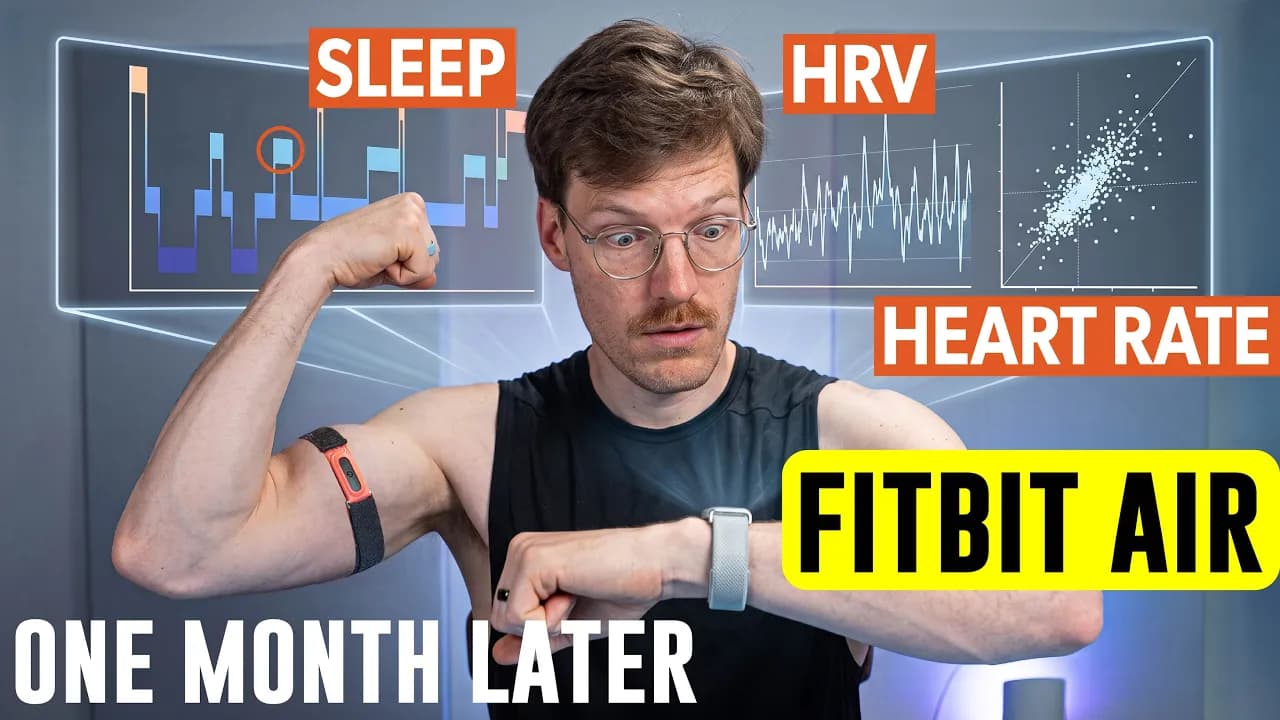
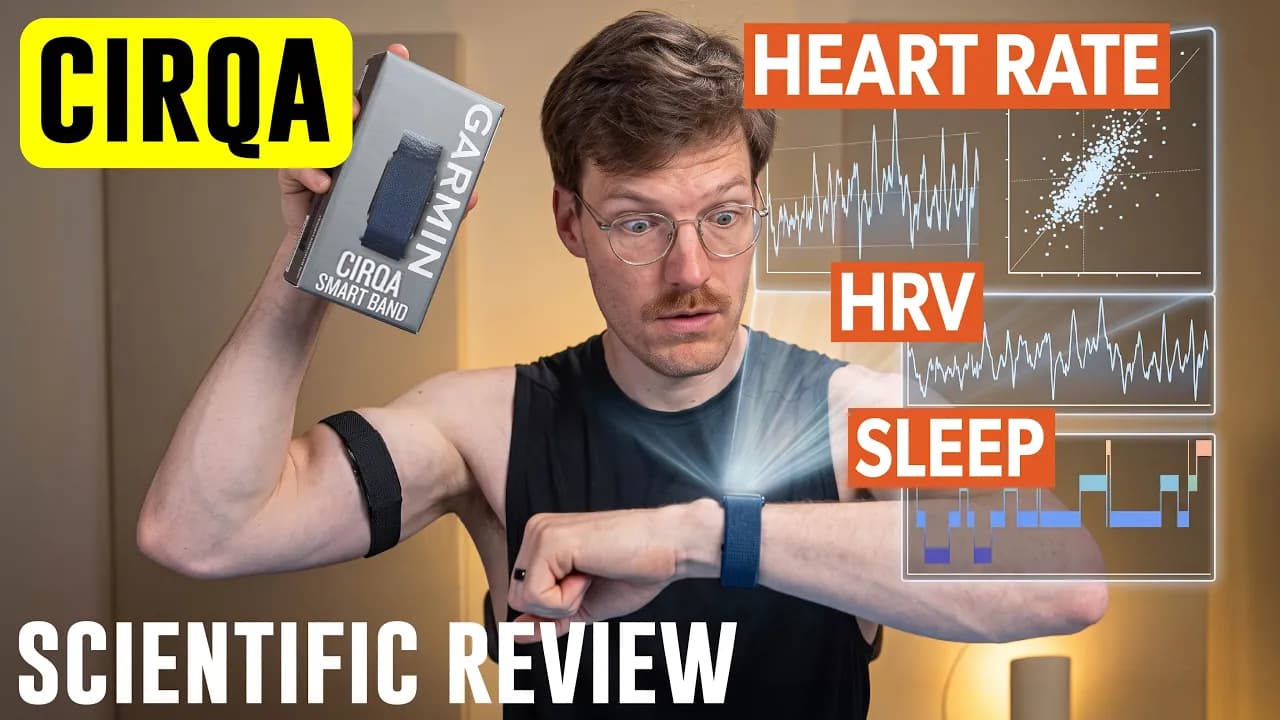
Fitbit Air vs Garmin CIRQA - Direct Scientific Comparison!
In a Nutshell
Fitbit Air ($100) beats Garmin Circa ($200) in both heart rate accuracy and sleep tracking, especially during running (0.99 vs 0.89 wrist correlation) and weightlifting (0.93 vs 0.73 wrist correlation), with superior sleep stage agreement (73% vs 45% REM). Both devices reach near-perfect performance when worn on the biceps, but Fitbit maintains better overall rankings across all activities. Fitbit is the better standalone choice for health tracking, while Garmin suits users already in the Garmin ecosystem.
These notes were generated by AI and may contain inaccuracies.
The Fitbit Air costs $100 while the Garmin Circa costs $200. Testing compared both devices on the wrist and biceps across multiple exercise types including indoor cycling, outdoor running, outdoor biking, and weightlifting. A Polar H10 ECG chest strap served as the reference standard for heart rate measurements. An EEG headband (ZMAX) provided the reference standard for sleep stage measurements.
Both devices achieved a correlation of 0.99 with the reference ECG chest strap when worn on the wrist during indoor cycling. When moved to the biceps, both devices improved to a correlation of 1.00, representing perfect agreement with the reference.
The Garmin Circa on the wrist showed a correlation of 0.89 during outdoor running, with points both below and above the reference line indicating both under- and over-estimation of heart rate. The Fitbit Air on the wrist maintained a correlation of 0.99. On the biceps, the Garmin Circa improved to 0.98 correlation while the Fitbit Air achieved 0.99 correlation.
Both devices achieved a correlation of 0.92 on the wrist during outdoor biking. On the biceps, the Garmin Circa reached 0.96 correlation while the Fitbit Air achieved 0.98 correlation. The Fitbit Air showed more points close to the reference line on the biceps position.
The Garmin Circa on the wrist had a correlation of 0.73 during weightlifting, struggling particularly with detecting heart rate increases during exercise sets. The Fitbit Air on the wrist achieved 0.93 correlation. On the biceps, the Garmin Circa improved to 0.91 correlation while the Fitbit Air reached 0.96 correlation.
The Garmin Circa on the wrist ranked better than 63% of devices for indoor cycling, 54% for outdoor cycling, 27% for running, and 19% for weightlifting. The Fitbit Air on the wrist ranked better than 61% for indoor cycling, 55% for outdoor cycling, 80% for running, and 72% for weightlifting.
The Garmin Circa on the biceps ranked better than 77% of devices for indoor cycling, 75% for outdoor cycling, 63% for running, and 68% for weightlifting. The Fitbit Air on the biceps ranked better than 84% for indoor cycling, 80% for outdoor cycling, 91% for running, and 82% for weightlifting.
The Fitbit Air on the wrist received a score of 97 while on the biceps it scored 99. The Garmin Circa on the wrist scored 93 while on the biceps it scored 98. Both devices are rated as great on the biceps position, with the Fitbit Air on the biceps nearly reaching perfect scoring.
Sleep stage accuracy was measured against the ZMAX EEG headband as the scientific reference standard. The analysis examined agreement percentages for deep sleep, light sleep, and REM sleep stages across multiple nights.
The Garmin Circa on the wrist showed 82% deep sleep agreement, 67% light sleep agreement, and 45% REM sleep agreement. The Fitbit Air on the wrist achieved 85% deep sleep agreement, 80% light sleep agreement, and 73% REM sleep agreement.
The Garmin Circa on the biceps improved to 91% deep sleep agreement, 69% light sleep agreement, and 58% REM sleep agreement. The Fitbit Air on the biceps showed 86% deep sleep agreement, 77% light sleep agreement, and 75% REM sleep agreement, showing minimal difference from its wrist performance.
The Fitbit Air on both wrist and biceps positions ranked among the top performers. The Garmin Circa on the biceps ranked in the high second tier while on the wrist it ranked in the low second tier. First-tier devices include the Pixel Watch 4, Pixel Watch 5, various Apple watches, the Whoop strap, and the Eight Sleep Pod.
The Fitbit Air received a total sleep score of 79 on both wrist and biceps positions, rated as great. The Garmin Circa scored 64 on the wrist (okay rating) and 73 on the biceps (good rating). REM sleep tracking was the weakest metric for both devices.
Both devices showed strong agreement with reference ECG measurements for resting heart rate during sleep, operating in the narrow range of approximately 38-55 BPM. The Garmin Circa maintained consistent performance on both wrist and biceps positions. The Fitbit Air showed a slight tendency to detect higher heart rates in the lower range and lower heart rates in the higher range when worn on the biceps.
Both devices performed well for heart rate variability measurements. The Garmin Circa on the wrist showed slight underestimation in the higher HRV range. The Fitbit Air showed similar patterns. The differences may relate to calculation methodology rather than measurement accuracy.
Biceps band usage is recommended for both devices during exercise. The Fitbit Air outperforms the Garmin Circa for sleep stage tracking. Both devices perform comparably for resting heart rate and heart rate variability. The Fitbit Air is recommended for users prioritizing sleep metrics and health tracking. The Garmin Circa is recommended for users already in the Garmin ecosystem or those engaging in multiple sports with other Garmin devices like cycling computers and power meters.
The Garmin ecosystem supports integration with additional sensors and devices, while the Google Health app has more limited connectivity. The Fitbit Air provides better sleep stage tracking and health-focused app experience. Both devices represent good value at their respective price points, particularly when worn on the biceps.
Both devices offer strong value propositions at their respective price points, with neither requiring a subscription for core functionality. The pricing for either device is reasonable, and both provide solid performance for basic health and sports tracking. The speaker notes that neither subscription service adds significant value beyond the standard tracking features and health insights already available without additional payment.
Creating detailed comparison content requires substantial effort. Viewers can support the channel through standard engagement methods like liking and subscribing. Those interested in purchasing either the Garmin Circa or Fitbit Air can use the provided Amazon affiliate links, which provide no additional cost to buyers while supporting the channel's continued production. General Amazon affiliate links are also available for any other purchases, including everyday items like coffee beans or toilet paper.
Additional affiliate partnerships offer access to other fitness and health devices at optimal discount rates. These include the Whoop strap and the Aura Ring, providing viewers with purchasing options across different tracking platforms.
Surf Shark sponsored this video as a VPN service. Despite VPN sponsorships being common in YouTube content, the speaker provides genuine endorsement based on personal long-term usage spanning multiple years. The service link is available in the video description for those interested in VPN solutions.
Viewers interested in the Garmin Circa and Fitbit Air comparison may also appreciate related content covering the Pixel Watch 5 and the HLE Pod, with links presumably available in the video description or recommended videos section.
Keep The Quantified Scientist in your library
Save the videos and channels worth coming back to, and find them again in one place.