Fitbit Air - One Month Of Scientific Testing!
In a Nutshell
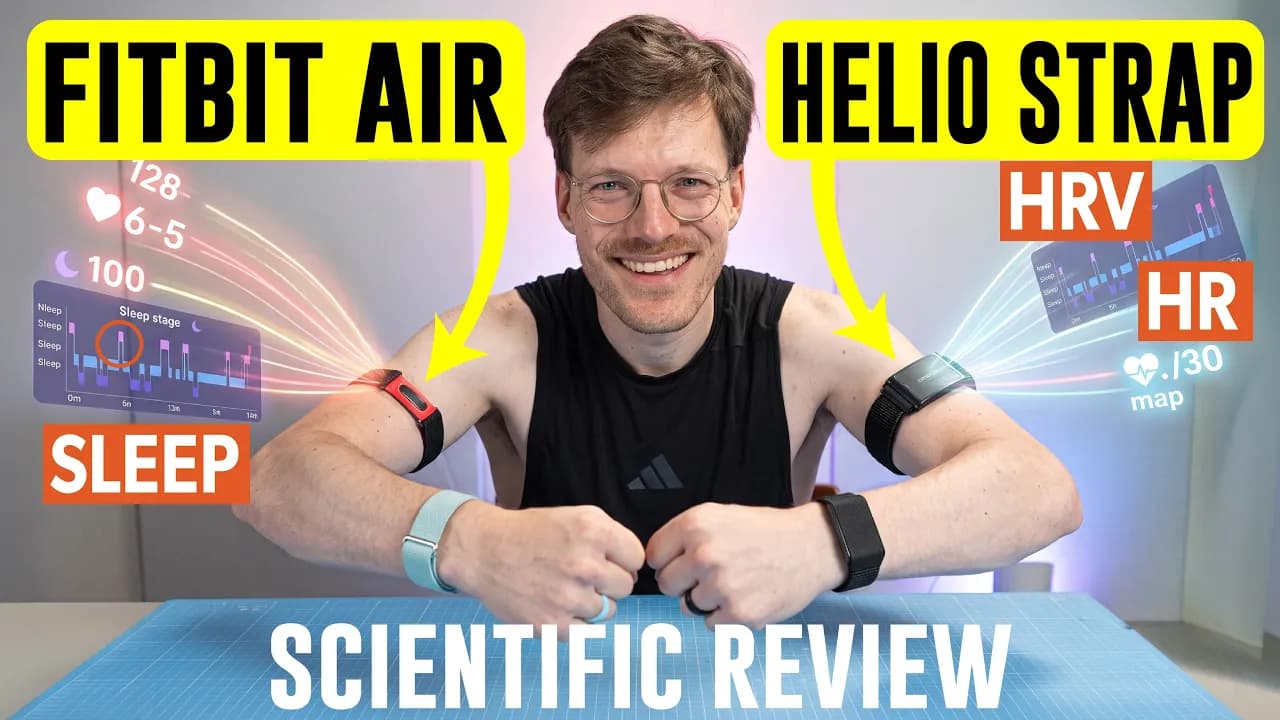
The Fitbit Air delivers excellent heart rate tracking (0.99-1.00 correlation) when worn on the biceps versus good wrist performance (0.92-0.99), excelling particularly during outdoor cycling and weightlifting where wrist readings often miss peaks. It ranks among the top devices for sleep stage tracking with 73-85% agreement across stages and earns "great" to "perfect" overall scores. At $99, it's positioned as the cheapest option for high-quality raw data and sleep tracking, with third-party biceps bands expected soon on Amazon.
These notes were generated by AI and may contain inaccuracies.
The Fitbit Air has been flying off the shelves the last few months and there's good reason for this. It's a really good tracker at a very affordable price. Data has been collected over the last month using this device, both on the wrist and on the biceps. The analysis focuses on data and data science to evaluate device performance by comparing it to reference devices.
Indoor cycling was tested as one of the easiest exercises for heart rate tracking devices. The Polar H10 ECG chest strap served as the reference device, using ECG electrical signals of the heart for accurate measurement. When worn on the wrist, the Fitbit Air showed a correlation value of 0.99 with the reference device. When worn on the biceps, the correlation value reached 1.00, which is perfect correlation that cannot be higher than one. Individual spinning sessions showed the Fitbit Air on the wrist performing quite well with only minor moments of deviation, while the biceps position delivered basically perfect tracking.
A biceps band was created for optimal performance, as commercial versions are expected to become available on Amazon within a few months. One available biceps band was spotted on AliExpress, though quality remains uncertain.
For running, the Fitbit Air performed quite well on the wrist with a correlation of 0.99. On the biceps, performance was even better with points closer to the reference line, though the correlation remained at least rounded 0.99. Individual running sessions showed similar overall patterns, though some small details like full heart rate dips were occasionally missed on the wrist but detected on the biceps. The improvement from wrist to biceps was smaller compared to other exercises.
Outdoor cycling tends to be harder for devices to track due to tension on arms when holding handlebars. When worn on the wrist, the correlation dropped to 0.92. On the biceps, the correlation improved significantly to 0.98. Individual sessions showed minor deviations on the wrist, while the biceps position delivered much better performance. This exercise showed major advantages for the biceps position.
Weightlifting is quite hard for devices to track due to maximum tension on the wrist, especially during chest exercises like bench pressing. When the reference device detected high heart rates between 120-150 bpm, the Fitbit Air on the wrist tended to detect too low heart rates. On the biceps, performance improved significantly with a correlation of 0.95 compared to 0.93 on the wrist. Individual weightlifting sessions showed that wrist position missed peaks in heart rate, while biceps position correctly detected all peaks.
Initial hiking tests showed poor results, but additional testing yielded improved outcomes. On the wrist, correlation remained quite low at 0.88. On the biceps, results were almost perfect, showing quite a difference between the two positions.
The Fitbit Air on the wrist was compared against all previously tested devices across four main exercises. For indoor cycling, it achieved the 64th percentile with a correlation of 0.99. For outdoor cycling, it ranked at the 57th percentile with a correlation of 0.92. For running, it performed well at the 80th percentile with a correlation of 0.99. For weightlifting, it achieved the 71st percentile with a correlation of 0.93.
When worn on the biceps, the Fitbit Air performed exceptionally well. For indoor cycling, it achieved the 94th percentile with a correlation of 1.00. For outdoor cycling, it reached the 83rd percentile with a correlation of 0.98. For running, it achieved the 94th percentile with a correlation of 1.00. For weightlifting, it reached the 83rd percentile with a correlation of 0.95.
The overall scoring system calculates average correlation over cardio exercises including indoor cycling, outdoor cycling, and running. When worn on the wrist, the Fitbit Air received a score of 97, classified as "great" for heart rate tracking. When worn on the biceps, the score improved to 99, classified as "perfect" heart rate tracking, representing some of the best performance observed for any device.
Nighttime heart rate measurements showed really nice correlation, especially given the narrow range between 40-70 bpm. On the wrist, the correlation value was 0.89 with R squared of 0.8. On the biceps, correlation was mostly similar but potentially slightly worse, with the best-fitting line showing a slightly different slope than actual values. Individual night plots from June 15th showed both wrist and biceps positions following reference values really well.
Heart rate variability measurements showed super nice correlation with only two outlying points that weren't filtered for data quality. Both wrist and biceps positions showed very similar correlation patterns. Individual night analysis from June 15th showed Elite HRV and Fitbit Air following along really well, with the Fitbit Air potentially detecting slightly lower HRV on average but maintaining very similar overall patterns.
Sleep stages were measured using the ZMax EEG device as a silver standard reference. On the wrist, deep sleep agreement was about 85%, light sleep agreement about 80%, and REM sleep agreement about 73%. On the biceps, deep sleep agreement was about 82%, light sleep agreement 75%, and REM sleep agreement about 76%. These small deviations are not considered significant, with both positions showing super good tracking performance.
Individual night analysis showed deep sleep marked in purple matching very well with Fitbit Air measurements, with possible minor algorithm instability rather than position-based differences. REM sleep detection showed the Fitbit Air detecting the two main REM segments correctly, though missing a very short initial segment on the wrist while detecting it on the biceps.
The Fitbit Air ranks amongst the best devices for sleep stage tracking, very close to Pixel Watch 4 performance with the new algorithm. Five brands currently have the best sleep stage tracking: Whoop, Apple Watch, Oura Ring, Eight Sleep Pod, and any Google device including Fitbit and Pixel Watches. The Fitbit Air represents the cheapest way to get good sleep stage tracking at the moment.
The Amazfit Helios strap appears to have slightly improved sleep stage tracking but not yet at Fitbit Air levels. The overall sleep score for wrist position was 79 and biceps position was 78, both classified as "great."
Google has been listening to reviewers and user comments to optimize the app. The latest update 5.02 or 5.03 allows for more customization. The text parts are still relatively big but getting smaller. The app has everything needed including long run data and health metrics showing what's in range versus out of range. Weekly cardio load is available but may not be the main focus for users with daily workout routines.
The AI or premium part is not needed and wouldn't be paid for currently. The free version contains all necessary data, which is much better than some competition. At 99 euros or 99 dollars, this represents a real bargain. Older Fitbit models like the Inspire 3 or Charge 6 with the same sensor appear to perform in a similar range, making them even better deals. During Black Friday, the Inspire 3 was available for under 50 dollars.
A large group of people wanting a decent app with great raw data performance will likely choose the Fitbit Air. The biceps band from third-party manufacturers is expected to become available soon.
The biceps band is expected to become available soon from third-party manufacturers on Amazon, representing the cheapest option for users. Google has released specifications for the Fitbit Air, which has made it easier for third-party manufacturers to create biceps bands.
For most people, the Fitbit Air is a relatively easy device to recommend. Performance on the wrist is decent, while performance on the biceps is great. At night, good performance can be expected for both locations, at least if the data on the speaker's body translates to other people as well.
If you decide to get yourself a Fitbit Air, you might also want to consider getting a new coffee mug, a Whoop strap, or an Amazfit Helios strap. The speaker also mentions their favorite sleep improvement device, the AC pod, especially during hot days. Other items on Amazon like coffee beans or toilet paper can be purchased through affiliate links in the description below to get the best discount possible while supporting the channel.
The speaker recommends subscribing to the channel and suggests that viewers who watched this video will also like the video on the Amazfit Helios strap or the video on the AC pod.
Keep The Quantified Scientist in your library
Save the videos and channels worth coming back to, and find them again in one place.