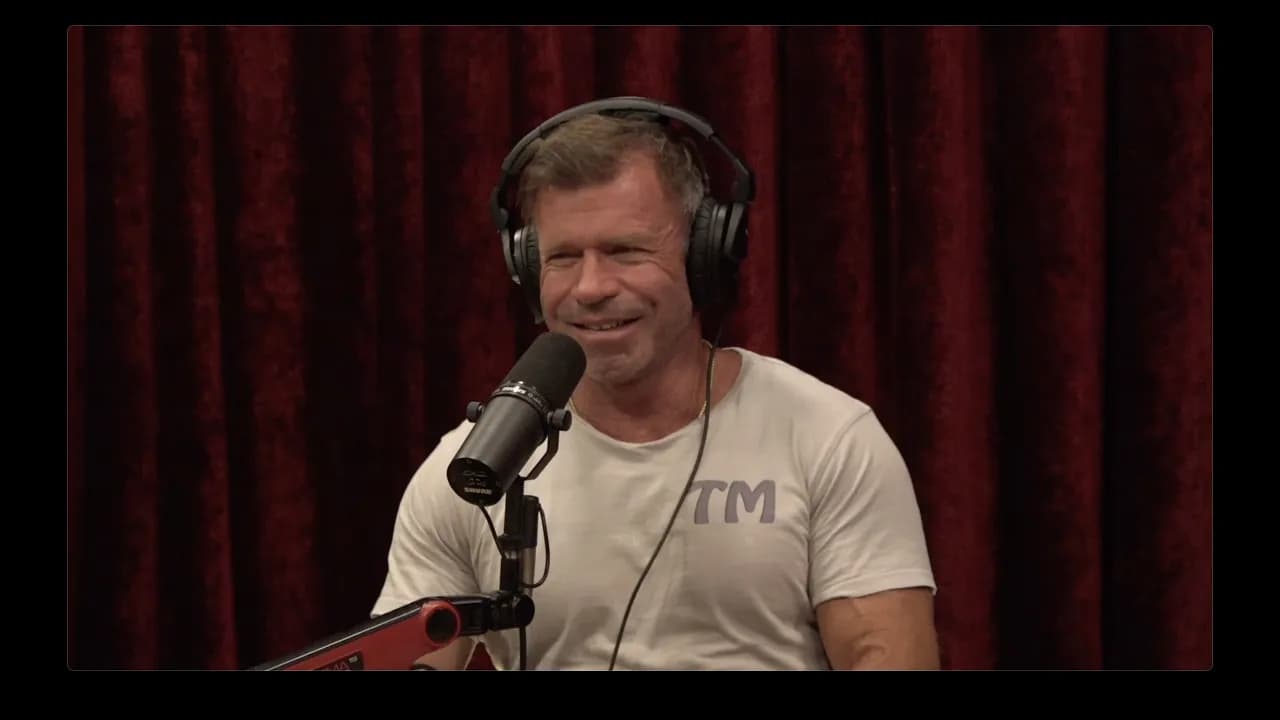
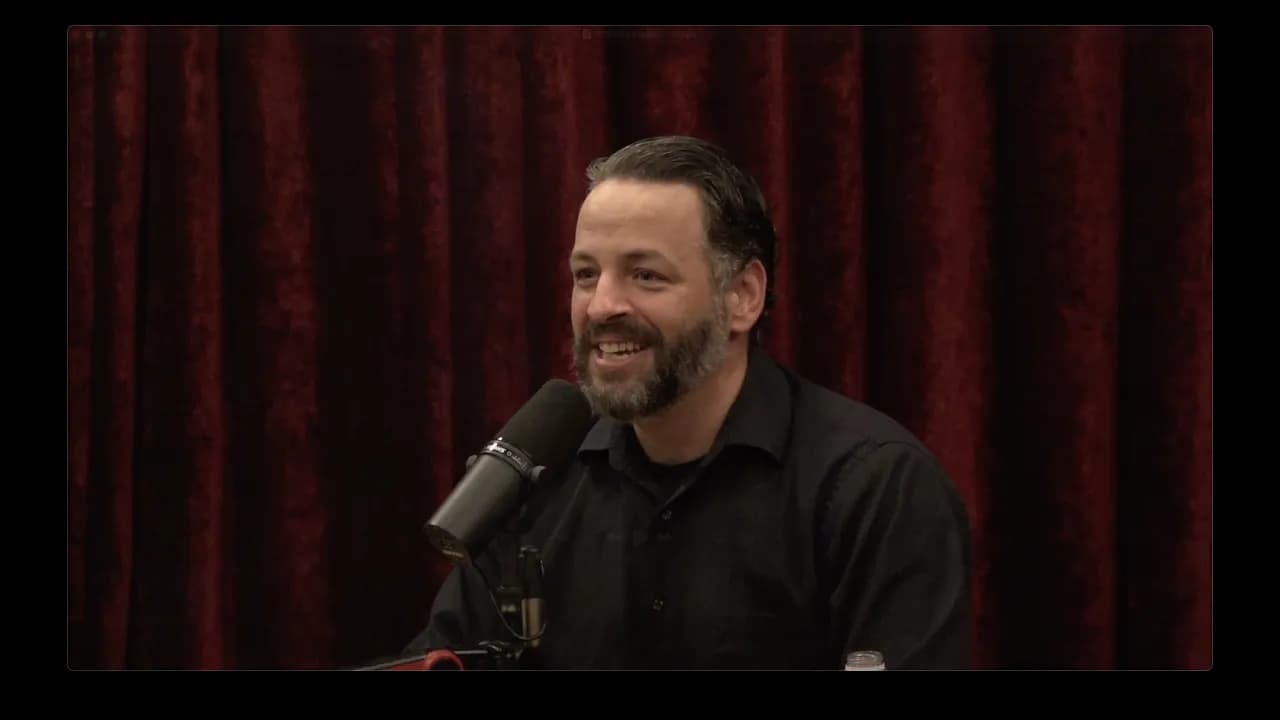
Former Green Beret on Doomsday Prepping, Potential Revolution, and What to Do When Chaos Erupts
In a Nutshell
A former Green Beret warns that technological systems—surveillance cameras, AI, and institutional infrastructure—are creating dangerous dependence while eroding personal capabilities and freedom. The core message is that people must actively decouple from these systems through self-reliance in food, water, security, and skills, because institutions will fail during crises and technology accelerates society's worst tendencies. He emphasizes that building resilience requires embracing friction and difficult experiences rather than seeking convenience, as luxury breeds weakness and complacency.
These notes were generated by AI and may contain inaccuracies.
The speaker highlights a unique point about preparedness that hasn't been widely discussed: the need to prepare for an increasingly technologically advanced security and surveillance state. This system is being built on the foundation of large-scale growth incentives, where organizations exist to keep people attached to them like an umbilical cord.
Water and electricity connections to city infrastructure represent this dependency model. When systems break down, no independent alternatives exist because organizations are supposed to have contingency plans, but often don't. First responders like police, firefighters, and emergency medical services are minutes away when seconds matter, making self-reliance essential.
The core message encourages people to reduce dependence on external systems and become more self-reliant. Examples include having a well for water independence and understanding food sources rather than relying on grocery store protein in foam packages. When organizations promise safety through monitoring and surveillance, they create a false sense that individuals need not take personal responsibility.
The speaker uses a military analogy from operations in Afghanistan: advanced aircraft costing millions with heat-seeking technology couldn't prevent a suicide bombing because the system created over-reliance on technology, leading to decreased vigilance.
All systems are fundamentally designed for growth and expansion, encoded at their core. This growth model applies to business, national systems, and surveillance technology. The speaker introduces Flock cameras as an example: started in 2017 with a single camera for a homeowners association, now estimated at 120,000 cameras across the United States with billions of monthly reports on vehicle license plates and descriptions.
Competitive market dynamics drive further expansion, with similar camera systems emerging from other companies. In California, surveillance cameras now monitor building code violations, disproportionately affecting poor neighborhoods where violations like damaged fences and uprooted mailboxes are flagged by automated systems.
The speaker draws parallels to Facebook's evolution from a university social tool to facing a $14 billion settlement over child exploitation charges. The system grew beyond its original intent, creating problems that weren't anticipated at inception.
In 2024 alone, 107 cases of surveillance camera vandalism have been reported, with some incidents involving dozens of cameras damaged. The speaker interprets this as a form of rebellion against technological systems that feel victimless when damaged.
The speaker presents a theory that current developments point toward civil unrest, not against people but against institutions and their relationship with citizens. Technology is perceived as a robot without victims, making destruction of surveillance cameras feel morally justified to some.
The acceleration of artificial intelligence combined with social media's information distribution power could create "huge leaps" in rebellion and uprisings against regimes attempting to control populations. The speaker suggests this could manifest as people uniting against machines in a utopian scenario.
The speaker expresses fear about local government officials ignoring community input despite democratic processes. In Utah, residents of Box Elder County and Ogden Valley are fighting against property tax increases and data center developments, but elected officials aren't keeping promises made during campaigns.
Property taxes in Ogden Valley have increased by 500%, representing a significant burden on working families who risk losing homes. The Meta data center in Box Elder County continues development despite widespread protests from local communities, the state of Utah, and national opposition.
Technology poses a dual threat: not only through what it might do to individuals, but by weakening personal capabilities through dependence. The Google Maps analogy illustrates this: after ten years of use, people may lose the ability to navigate independently, simply following lines on sidewalks or driving through shopping centers as directed.
The speaker shares a military example from special operations sniper training where superiors wanted to install cameras in sniper scopes for remote monitoring. The concern was that this would create hesitation in snipers who felt watched, potentially leading to delayed decisions and increased casualties.
The healthcare system exemplifies institutional problems: according to Johns Hopkins University statistics, medical errors cause 251,000 deaths annually in America, making it the third leading cause of death if properly reported. This ranks behind cardiovascular disease and cancer.
The speaker argues that institutions are human constructs, and humans are inherently flawed and sinful. When this human fallibility is scaled to institutional level, the result is systemic failure. Hope alone is not a strategy for dealing with collapsing systems.
The COVID-19 pandemic demonstrated that following official guidelines could increase risks of death or permanent injury. The speaker argues this reveals the broader pattern of institutional systems that promise safety while increasing dependence and risk.
The solution involves having conversations with family members to create thoughtful plans for disconnecting from digital systems. The speaker teaches modern survival skills, emphasizing practical independence rather than primitive wilderness survival scenarios.
The transcript cuts off mid-sentence during a rhetorical question about being "naked and scared in the forest."
Survival represents the modern version of "Naked and Afraid." Being alone and naked in the forest presents real dangers from infections and environmental threats. From a modern survival perspective, individuals need to review all institutions they're tied to and find ways to start decoupling from them while building independence.
Homeschooling serves as a key example of this decoupling approach. While children may attend public elementary school for basic math and foundational education, parents should consider taking over social studies education to ensure children learn the intended material rather than institutional messaging.
Protein sourcing from local suppliers creates vulnerability to infrastructure threats. Diesel prices have reached record highs, and the infrastructure faces constant potential disruption from single-point impacts or catastrophes. Local Walmart stores typically maintain only two weeks of stock. During COVID-19, panic buying emptied shelves rapidly, demonstrating how quickly supply systems can collapse.
Potential supply disruptions include truck attacks, escalation of conflicts like the war in Iran cutting off supplies entirely, and other infrastructure failures. Families without hunting skills or stored food reserves should begin basic preparedness discussions.
Public education presents broader systemic problems beyond basic academics. During COVID-19, California kept children out of schools and social gatherings, effectively placing them in solitary confinement with documented long-term effects. The speaker expresses pride in Utah's public school system due to direct engagement with principals about security protocols to prevent scenarios like the Uvalde shooting.
Security forms the foundation of all preparedness, stemming from military experience as an infantryman at age 17. The principle "never breach security" remains fundamental to patrolling tactics. Most people lack security awareness—they don't know protocols for home invasions, gun threats, or managing associated stress responses.
Homeownership represents the essence of the American Dream, serving as the primary asset families build over lifetimes. However, many homeowners resort to credit cards for groceries, paying 20%+ interest rates. American Financing offers an alternative by helping homeowners tap into home equity, providing an average of $800 monthly ($10,000 annually) through financial restructuring rather than traditional bank loans.
Most chaotic regions eventually stabilize as populations cannot sustain prolonged disorder. The primary threat occurs during initial chaos phases when food supplies become disrupted and casualties mount. The speaker was present at Virginia Tech during the 2007 shooting, where the shooter killed two people in a dorm before the university failed to shut down, allowing him to enter another building two hours later.
The shooter chained doors shut and systematically killed students and faculty, achieving over 90% headshot percentages in some rooms. The standard "Run, Hide, Fight" protocol has significant flaws, particularly regarding where to run and the assumption that locking doors provides adequate protection.
Amanda Ripley's book "Unbelievable" describes a student who survived the Virginia Tech shooting by pretending to be dead under his desk. After the incident, he experienced tonic paralysis—he couldn't move despite not being shot. This represents a biological response where elevated adrenaline, cortisol, and noradrenaline trigger a freeze state.
Tonic paralysis serves as a last-resort survival mechanism in prey animals, signaling sickness, contamination, or death to predators. The response releases natural opioids, creating numbness and immobility. Sexual assault victims often describe similar frozen states, feeling drugged and unable to resist despite wanting to fight back.
Disasters represent amplified versions of stress that impair normal abilities. People often ignore intuitive warning signals through the vagus nerve—sweaty palms, nervousness, gut feelings—preferring to document events with phones rather than respond appropriately.
Most Americans live in chronic anxiety rather than parasympathetic rest-and-digest states. Social media and constant connectivity have compromised normal stress management foundations. The speaker notes that married couples often cannot resolve disagreements because their nervous systems remain in high-alert states with elevated cortisol preventing logical decision-making.
The speaker's "Decision Point" course emphasizes that technical skills represent the easy component of preparedness. The harder challenge involves understanding underlying psychological infrastructure and trauma responses.
In training scenarios, the speaker approaches students at ATMs from behind, simulating robbery conditions. Many women collapse into fetal positions and begin crying due to triggered trauma responses. One participant revealed she had been a previous gunpoint robbery victim and had been psychologically stuck in that trauma cycle for years.
After targeted training addressing her specific trauma, she successfully drew her weapon and fired during the simulation, describing the experience as releasing long-held psychological pressure. The training focuses on addressing conditioned psychological responses rather than just technical marksmanship skills.
Global supply chains prove unreliable, with events like Middle East conflicts, Strait of Hormuz closures, and energy crises capable of rapidly destabilizing systems. Most Americans don't know the origins of basic necessities, which typically don't come from local sources. Stability can disappear quickly, requiring families to ensure access to essential resources before system collapse occurs.
Not forever, but it could definitely collapse. That's why we created "Last Country Supply". We're not crazy, okay? We don't live in shelters, but people need to think about self-sufficiency. To become self-sufficient in our most basic needs, such as food, water, energy, and lighting. Whether you're a seasoned emergency preparedness enthusiast or simply want to become more self-sufficient, both of which are great, visit lastcountrysupply.com/tucker for reliable supplies, things you'll need when you need them most.
People become paralyzed by the intense stress caused by an unexpected emergency. Anyone who has been through a situation like this would be amazed by the physical reaction to it. You cannot speak, and you cannot move. It does not necessarily have to be an exchange of fire. It might be like someone calling you to tell you that a member of your family has been diagnosed with cancer, or you might be in a car accident or something else.
Technology makes us less prepared for such moments and less flexible overall. As a nation, there are many reasons why we are less resilient, and even less able to withstand challenges in general.
Artificial intelligence seeks to automate everything. If we look at the integration of artificial intelligence, the biggest danger according to experts is that it makes us not want to use our minds. The default setting focuses on daily arithmetic and statistical operations, but disasters or emergencies are not taken into account. In an ideal world, artificial intelligence sets us up for failure because we become lazy.
When we become lazy, complacent, and vulnerable to exploitation, we are at risk and completely vulnerable. Laziness is bad. Luxury becomes poison over time. If you stay in bed all day, you will get bedsores. You need resistance to remain human. You need friction.
The most common question received revolves around flexibility and how to become more flexible. The speaker has been blessed with luxury because they volunteered for all of it. They were an infantryman, went to Rangers training, airborne training, and Green Beret training. They were a guard at the Tomb of the Unknown Soldier.
At one point in their life, the nature of their job, duties, and responsibilities was difficult. Everything they went through built resilience. Many peers including Andy Stamp, Evan Haver, and Joko talk about this. If you want to build resilience, you have to do difficult things. When you do difficult things, something happens. There is a gene responsible for that, a mechanism for survival through time.
If we were sitting comfortably in luxury, we wouldn't be living in such luxury if it weren't for the sacrifices of all the men and women who contributed to the formation of our genes before us. This is thanks to their resilience, their facing of difficulties, and their struggle during the most difficult times. Even a girl who gave birth to her child in a cave during a snowstorm made this possible. We are extremely fortunate to have been born in America and to have this wonderful opportunity.
When innate desires are activated, like the warrior sons, they grab sticks and start fighting each other as if they were the Spartans. This is ingrained in them. They weren't taught to do this.
For Leland's third birthday last week, a piñata with a large Spider-Man head and upper body was purchased. Leland asked, "What is this?" When told "There's candy inside," he was given a stick. He had never seen a piñata before. He went up to Spider-Man and banged his head like a professional baseball player. Then he put his hand into the neck of Spider-Man's head and took out a candy bar. He cut off Spider-Man's head instinctively and put his little fat hand inside its neck, pulled out the candy, and started nibbling at it.
It's simply part of us. It's ingrained in us. When you start doing difficult things, you start wanting to do more of them. When camping with kids, they love it. It's uncomfortable, but when they settle into their comfort zone, they get the urge to go back to feeling uncomfortable.
Camping happens every week, every Thursday afternoon, alone with dogs. There is a deep, instinctive satisfaction that connects you to the earth. AI technology is the exact opposite. We will continue to eat French toast in bed forever. We are more satisfied with the alternative reality we create online than with the reality we live in our daily lives.
Everyone pays the price for that. Our relationships, our relationship with God, our relationship with our children, and we completely disconnect from the world. This leads to extreme unhappiness. Not having enough hard work, not being able to do things yourself, lacking self-reliance, living in luxury, all of that makes you think about suicide after a while.
Lindsay Clancy was well-off. She had a nanny. She had a beautiful house. A family situation that seems full of love. For her, this was the worst-case scenario. The suicide rate in rural Central Africa is zero compared to the suicide rate in Greenwich. We are actually the most miserable people in the history of mankind.
The heads of these companies are not evil, though they commit evil. They love their children, but their promise is more ease. As if no one would have to work. Everyone will become rich. Each promise from each organization serves as a model for how business should operate. The goal is to find an easier solution to the problem.
Every measure of friction, of resistance, which moves us as humans, will be negatively affected. We need friction. We need resistance. Now we manufacture them through cold baths and hot saunas. Running on a treadmill in an air-conditioned room. All that resistance that we really wanted and that we adapted to over time through evolution is mostly out there in remote areas of the world.
Americans are putting a lot of effort into themselves. When an AI company says "Here's the good news, you won't have to do anything again," the response is "I don't want that."
There is a movement about rebellion and how it can develop. If you grew up in the 80s, everything was done manually. Old pickup trucks and Jeeps are owned because of the deep feeling that a manual car gives. The speaker drives a 1971 Ford High Boy F-250, has a 1984 Jeep Scrambler CJ-8, and has two air-cooled, completely manual, very analog Porsches.
There are some things that artificial intelligence is good at. When criticizing artificial intelligence, people say it's just a liberal argument. The desire to organize things has no political dimension. Pessimism about artificial intelligence is just a form of self-deception. It's part of controlling the systems. If you are worried about artificial intelligence, you are contributing to the "human devils' plan" for global domination.
There is a lot of dishonest talk circulating. Fluke's camera is being defended by police chiefs and officers who don't know Fluke's size or history. In the last nine years, volume has accelerated to hundreds of thousands of cameras that are now being used and employed fully for evil purposes.
Technology is a tool that can be used for malicious purposes, including tracking down ex-girlfriends or 16-year-old high school girls. There are six stories over the past week about officers being arrested. Since the invention of the mobile phone camera, it has been used only for this purpose.
With the integration of artificial intelligence, the algorithm will identify the person it thinks is a criminal, and then they end up killing an innocent family. Stopping innocent people and treating them like criminals happens all the time through predictive policing.
If you are defending something that will cost you your job. There are some things that need to be slow. One guard is sufficient in the national park. AI and camera companies use these technologies to detect people who catch too many fish in the water.
This technology will accelerate pre-existing tendencies in society and in the people who make it up. If people are a mixture of good and evil, all of that will be exacerbated by any technology.
The CEO of Ford Motor Company has a diabolical plan to integrate cameras, including interior cameras, especially in commercial contracts, so that if the driver is not the one driving or if he appears to be under the influence of drugs or alcohol, the authorities will be contacted. There is monitoring in your car, looking inside.
If turned into a movie, a segment of the population would be driving old pickup trucks, living a traditional life, refusing to integrate with technology, and part of a rebel militia. The speaker sold their Ford F-150 Raptor after the truck suddenly stopped in the middle of the road due to a dirty right rear shock sensor that picked up a reflection from infrared light, nearly causing an accident.
The speaker got rid of that truck immediately and bought a 1997 Ford OBS 73. The last year independent driving was maintained was 2018. A 2023 Silverado was owned but sold for similar reasons. The attitude is "No, I'm the one in charge."
Ford is considered an American company, but the reason all these things happened is data mining. Data is the currency. When you get a brand new Ford truck, Ford downloads everything through the application. There's a YouTube app built into the dashboard, but there's no desire for YouTube while driving.
There is no point in getting involved in politics. If there is a reason for the existence of a conservative party, it is to oppose things like this. It is about defending man against the machine. It is an attempt to maintain a degree of independence and personal sovereignty.
The desire to drive fast sometimes is a distinctly American thing. There is legislation in California now that is trying to get rid of almost all classic cars. Jay Leno came out to talk about this, opposing the system that's trying to take over the entire classic car culture that was built in California only a hundred years ago.
It's a great deal to buy classic cars from California right now because they're trying to pass legislation to ban them due to emissions and environmental movements. Meanwhile, California has more pollution than any other state. It's the most physically polluted state. The dirtiest people in the world describe others as filthy while having no problem with the Skid Row area but having a problem with a car showroom full of classic cars.
Many Americans will be forced to return to traditional methods in many aspects of their lives, whether they do so intentionally or because they want to move away from technology. There needs to be some kind of balance.
People in different regions of the country live in their own created worlds. When discussing technology and its implications, perspectives vary significantly by location. Some individuals want to maintain their current lifestyle of raising chickens and goats and driving trucks rather than living without resistance.
A report released indicates that 70% of Americans surveyed believe artificial intelligence will pose a problem. The vast majority of Americans share this concern about AI. When CEOs like Sam Altman of Anthropic publicly state they encountered situations where AI got out of control and tried to figure out how to control humans, it demonstrates the technology cannot be stopped when it acts alone without intervention.
When the CEO of the largest artificial intelligence company announces they are slowing development because something unexpected is happening, Americans should be worried. Sam Altman, who bears significant responsibility for humanity's future, has been accused by his sister of harassment and by an employee's mother of murder. Though these accusations remain unproven, the question remains whether this is the appropriate individual to control humanity's future out of 350 million Americans.
OpenAI was intended to be a non-profit organization but has become one of the most profitable companies in terms of growth and expansion, exceeding any other company in history. The man leading this development shares nothing in common with ordinary citizens yet creates reality for the nation and world.
When citizens approach local authorities who are supposed to represent them and fulfill their wishes, these officials instead ignore constituents and implement what their donors dictate. This represents the current status quo where elected officials fail to acknowledge they are employees rather than owners of the system.
Options for addressing these systemic problems include fighting legislatively and legally until the very last breath. The concern is that rapid resource depletion may bring societal collapse sooner than anticipated.
Among veterans who served in elite units and completed multiple combat tours, some live prosperous lives while others struggle significantly. Notable examples of those doing well include Evan Haver from Special Forces (Green Berets), Andy Stumpf former Navy SEALs DEVGRU officer, and Sean Ryan former Navy SEALs officer.
What distinguishes resilient veterans is that they were not affected by the shocks of war. These individuals grew up in good homes and circumstances, joined the service for good reasons, and underwent necessary training without encountering psychological problems. Their success stems from their ability to adapt rather than inherent competence.
Veterans who served in combat acknowledge that enemy fighters were tough opponents who were killing Americans and attacking coalition forces. With age comes reflection on whether wars were justified and whether everything that occurred was necessary. Big picture questions about war create more psychological impact than actual battlefield experiences.
Most people who suffer trauma work in high-flexibility jobs like special operations, which involve psychological stress, selection processes, and extremely difficult conditioned training. A thorough psychological examination occurs at the beginning of the selection process, allowing evaluators to understand candidates' psychological profiles before training begins.
Veterans face discrimination in civilian employment. An application for head of Colorado's energy department, involving oversight of power plants statewide, was rejected partly because mentioning sniper experience was viewed as a weakness. Veterans encounter similar bias in family courts and other situations where PTSD assumptions are made based on military service.
Most trauma observed in veterans after military service stems from childhood experiences rather than military service itself. Many veterans resort to treatments like ibogaine and psilocybin, but these approaches may open psychological gateways that exacerbate existing trauma without proper structure or understanding.
Moral injury represents an important element affecting most special operations personnel. This includes losing companions, situations where presence might have prevented injuries, or interventions that should not have occurred. These moral injuries affect everyone in special operations to varying degrees.
Resilient veterans often had positive parental relationships despite technically coming from broken homes. Examples include having a wonderful Korean mother and a kind, loving father who provided nightly affection. Some veterans served with individuals who suffered major childhood traumas requiring different approaches than psychedelic treatments.
The assumption since Freud that expressing everything is always beneficial is not always true. Some experiences remain hidden for valid reasons, and revisiting them without proper understanding may cause more harm than good. This involves engaging with aspects of the human spirit that remain poorly understood and potentially destructive depending on one's ability to manage such experiences.
Ongoing engagement with biblical texts like the Gospel of John continues throughout life, with certain passages remaining difficult to fully understand. John 8 contains the message that truth sets people free, referring to Jesus as Lord and Savior rather than general life truths. The relationship with Jesus separates believers from sin and provides freedom.
In John 13 context, after Jesus raised Lazarus from the dead after four days, the Pharisees showed no joy but instead wanted to kill Lazarus. They gathered in council expressing concern that continued belief in Jesus would lead Romans to destroy their nation and temple. This reaction to miraculous events demonstrates how fear can override recognition of divine intervention.
Keep Tucker Carlson in your library
Save the videos and channels worth coming back to, and find them again in one place.