Hunter Biden, Matt McCusker & Duncan Trussell - Mostly Wise #2
In a Nutshell
Hunter Biden argues that Donald Trump represents an existential threat to constitutional governance by treating the presidency as a personal business operation—accepting a $2 billion Qatari jet, engaging in insider trading through Truth Social, and violating the Emoluments Clause—while the laptop story was a Russian disinformation operation timed to damage his father's 2020 campaign. He maintains that his father left office with fewer assets than any president since 1900, never monetized his position through stock ownership or board seats, and achieved more legislative success than any president since LBJ despite having minimal congressional majorities. Biden stresses that addiction recovery is possible for anyone, that 90% of the struggle is shame and secrecy rather than physiological dependence, and that genuine service to others—not disengagement—is the only viable response to systemic corruption.
These notes were generated by AI and may contain inaccuracies.
Peter Thiel became known as the "Antichrist guy" after a talk interpreting the Book of Revelations through a Silicon Valley lens. He suggested the apocalypse doesn't have to happen and that it could be "patched" like software. The conversation participants express mixed feelings about Thiel, with some calling him "the craziest of all of them" and others jokingly declaring love for him out of fear.
Tech companies are developing an apocalyptic eschatological religion, with many building bomb shelters because they know AI will reach levels that destabilize society. Cults typically discuss the end of the world and imminent eschaton, and tech leaders are engaged in similar thinking about societal destabilization.
Concerns about DARPA robot dogs and security robots patrolling downtown Atlanta, which has become so dangerous that robotic security is being deployed. The dogs have soul detection capabilities and can eliminate threats. Discussion of how humans control these robots remotely, making them less threatening than fully autonomous systems.
Flock cameras have proliferated from hundreds to hundreds of thousands in major metropolitan areas over the last year. These are surveillance cameras with drone capabilities that will swarm over cities. Amazon delivery drones will add to constant aerial monitoring. Pokémon Go was allegedly used to map street views and interiors of locations through volunteer users.
Smartphones are described as "a bag of heroin" that extracts personal data. All app usage from Uber and other services feeds enormous amounts of personal data into corporate entities whose sole objective is maximizing profit extraction. The conversation extends this to questioning how much "jizz" (data/DNA) is being extracted from humanity through phones and technology.
Future possibility that ancestry.com could allow children to view their parents' entire web history. Discussion of Hunter Biden being "the most Googled drug addict of all time" and how internet shaming operates on an unprecedented scale.
Hunter Biden was 18 months into sobriety with a new family and baby when the laptop story broke. He was in Palm Springs with his wife Melissa and infant when he received a call from his lawyer about the New York Post story. The laptop repair shop narrative evolved into claims of suppression of First Amendment rights.
The data dump didn't come from a single laptop source. It included 20 years of digital footprint from the cloud, including deleted voicemails from his father. Israeli intelligence allegedly met with Tucker Carlson's producers before the repair shop story to provide the same laptop images. The data contained 90% authentic material mixed with narrative manipulation.
The laptop was used to create a narrative of Hunter Biden as a "ne'er-do-well fail son" drifting on his father's coattails, conflating his crack cocaine addiction with complete failure. The New York Post worked with Steve Bannon and Miles Guo (a Chinese billionaire now serving 68 years for fraud) to push images globally. Rudy Giuliani received information from Andre Derkach, a Russian operative sanctioned by the United States.
A National Intelligence report stated Vladimir Putin was personally running an operation on Joe Biden using US officials to promote disinformation around Hunter Biden. The report was among documents mistakenly released in a Trump document dump.
Presidential power depends on adherence to the Constitution and recognition of separation of powers limits. Trump has "blown through" constitutional norms. Historical presidents like Teddy Roosevelt exceeded constitutional authority to create national parks, build the Panama Canal, and break trusts. Abraham Lincoln exceeded authority regarding conscription and the Emancipation Proclamation.
Reference to the book about the Dulles brothers - one became Secretary of State, one founded the CIA (Allen Dulles), and Dulles Airport is named after the other. Allen Dulles rescued Nazis after World War II, allegedly for their secrets and money.
America's original sin of slavery created systemic rot that was never fully addressed. After the Civil War, South Carolina's state legislature was entirely Black, representing a brief renaissance. However, after Lincoln's assassination, Andrew Johnson reversed Reconstruction policies, leading to Jim Crow laws that persisted until 1968.
A "permanent confederacy class" exists in America mixing Christofascism and oligarchy that feeds narratives directing poor white people to look down rather than up at systemic problems. The same arguments from when Hunter Biden was young are still occurring in 2026.
Function Health offers over 160 lab tests including hormone panels for $365/year ($340 with discount), providing personalized protocols based on results rather than guessing about testosterone and health markers.
The laptop release occurred when Hunter Biden was two years sober with a new family. The exposure was "paralyzing" - like the childhood feeling of having done something wrong and not wanting to leave your room. The difference from other accusations was that this involved naked pictures and crack use being dumped online with no clear path forward.
Hunter Biden had given an interview to a New Yorker writer named Adam where he disclosed everything about his addiction on record before the laptop story broke. Steve Bannon allegedly called the writer saying "you scooped us," indicating they had the laptop material earlier than publicly known.
Hunter Biden discussed how nude photos of him without consent appeared on social media platforms for approximately 72-hour periods before being removed. He described this removal as making the situation worse, referencing the Barbara Streisand effect where attempts to suppress information only amplifies it.
The photos were taken down because they violated terms of service as revenge porn, which became a federal criminal statute through legislation passed by Melania Trump.
When asked why he took the pictures during his drug use, Hunter clarified that most of the widely circulated photos were not taken by him. He was asleep in many instances, including a frequently shown image of him with a meth pipe in his mouth.
Hunter explained that he was never a meth smoker but was attempting to be "cool" with people who used meth. Someone placed the pipe in his mouth while he was sleeping and took the photo.
The sex tapes are authentic and were filmed by Hunter himself. He noted that when addicted to crack, there is no romanticization of the behavior - the experience is characterized by profound loneliness and predatory relationships.
Hunter emphasized that his drug use serves as an explanation rather than an excuse for his behavior. He stressed personal accountability for all actions regardless of addiction status.
He pointed out that approximately 50 million Americans are dealing with addiction issues, meaning virtually everyone has someone close to them affected by substance abuse.
The social environment during active addiction typically involves predatory individuals, primarily strippers and others connected to the drug trade, where relationships are transactional and based on mutual utility.
The laptop story's release two weeks before the 2020 election created paralyzing anxiety for Hunter, who feared it would damage his father's presidential campaign. The margin of victory in elections often comes down to hundreds of thousands of votes in key states.
Hunter described his brain suggesting relapse as a way to escape the overwhelming shame, though he chose not to return to active addiction.
Hunter referenced Chase Hughes' work on memory, noting that there is no original recording - each recollection rewrites the memory based on the last mental recording.
The morning after the New York Post story broke with naked photos, Hunter's six-month-old child was awake, and he made the choice to continue living rather than relapse.
Hunter achieved sobriety from crack within one week of his partner Melissa stating "it ends now." His last drink came three weeks later. Alcohol withdrawal was the most difficult part of detox, as it can be fatal, while crack cocaine leaves the system within three days with minimal physiological impact.
Hunter credits his apparent cognitive sharpness to having the "lowest expectations" of any guest, noting that recovering addicts are often among the most intelligent people he knows.
Hunter stated that if his father had won the 2024 election, he would not have received a pardon. He acknowledged being in his 50s and potentially being "grounded again" by his father.
Hunter described how addiction affects families like having "a honey badger in your family just eating everything up." He noted his father's loving response during his active addiction despite the destructive impact addicts have on their communities.
Hunter highlighted his father's genuine love for people, noting that Joe Biden has maintained relationships with children who stutter whom he met at rope lines. He calls these individuals monthly for voice coaching sessions, telling them not to be defined by their stutter.
Hunter acknowledged that his father aged visibly during his presidency, with a shortened gait becoming noticeable. However, he maintained that Joe Biden never had an incident comparable to the debate performance.
Hunter distinguished between cognitive capability to perform presidential duties versus communicative ability to win elections. He noted that no one who worked with Joe Biden has stated he was cognitively incapable of being president.
Hunter argued that the presidency requires both competence and the ability to communicate that competence to the American people. Joe Biden's failure to demonstrate he could "drive the car" was a fair criticism.
Hunter detailed his father's legislative record, noting that despite having only one Senate seat and four House seats, Joe Biden passed more legislation in two years than any president since Lyndon Johnson. He achieved the best midterms of any sitting president since FDR in 1932 and lost the smallest number of congressional seats since 1932.
When Democratic establishment figures determined they wanted Joe Biden out, they threatened to fight through the convention. Hunter emphasized that Joe Biden voluntarily stepped aside without legal compulsion, calling this decision courageous.
Hunter stated that his father entered and left the presidency with fewer assets than any president since 1900. Joe Biden maintained a promise from 1972 never to own stock or bonds due to Spiro Agnew's impeachment scandal.
Throughout his career, Joe Biden lived off his congressional salary, which started at $48,000 in 1972 and increased over time. The only significant money he made came from writing a book after leaving the vice presidency, which he used to buy his wife a beach house in Rehoboth.
Hunter contrasted this with other politicians who monetize their positions through speaking fees, board positions, or cryptocurrency deals while still in office.
Hunter Biden was challenged by Don Jr. and Eric to a 2-on-1 cage fight. He stated it would be a great way to pay his debt and would perform well on pay-per-view, estimating he could fill half the seats at the Link.
The White House residence is located two floors above the public rooms (Blue Room, Red Room, Green Room). It contains the president's quarters, first lady's quarters, the Lincoln bedroom, the Queen's bedroom, and six to eight additional guest bedrooms. There are secret doors throughout the residence, some marked by visible lines in walls.
There is a kitchenette off the residence. The staff members have worked there for decades and are described as incredible and wonderful. Hunter maintained a complete sense of awe every time he visited the White House.
Element is a tasty electrolyte drink mix containing everything needed and nothing unnecessary. The orange salt flavor in cold water provides noticeable benefits compared to not using it, reducing muscle cramps and fatigue while optimizing brain health and regulating appetite.
Hunter never experienced ghost encounters despite walking around the White House at night. The grounds have changed the course of history dozens of times, both for good and ill.
Hunter was limited to approximately 30-40 days total at the White House during his father's presidency. Media attention made visits uncomfortable, with photographs of him walking on the South Lawn appearing on the front page of the New York Post, often accompanied by negative headlines.
Hunter flew on Marine One and Air Force One, describing both experiences as the coolest thing possible. He maintains that anyone who loses the sense of awe when walking down the colonnade to the Oval Office is a "jackass."
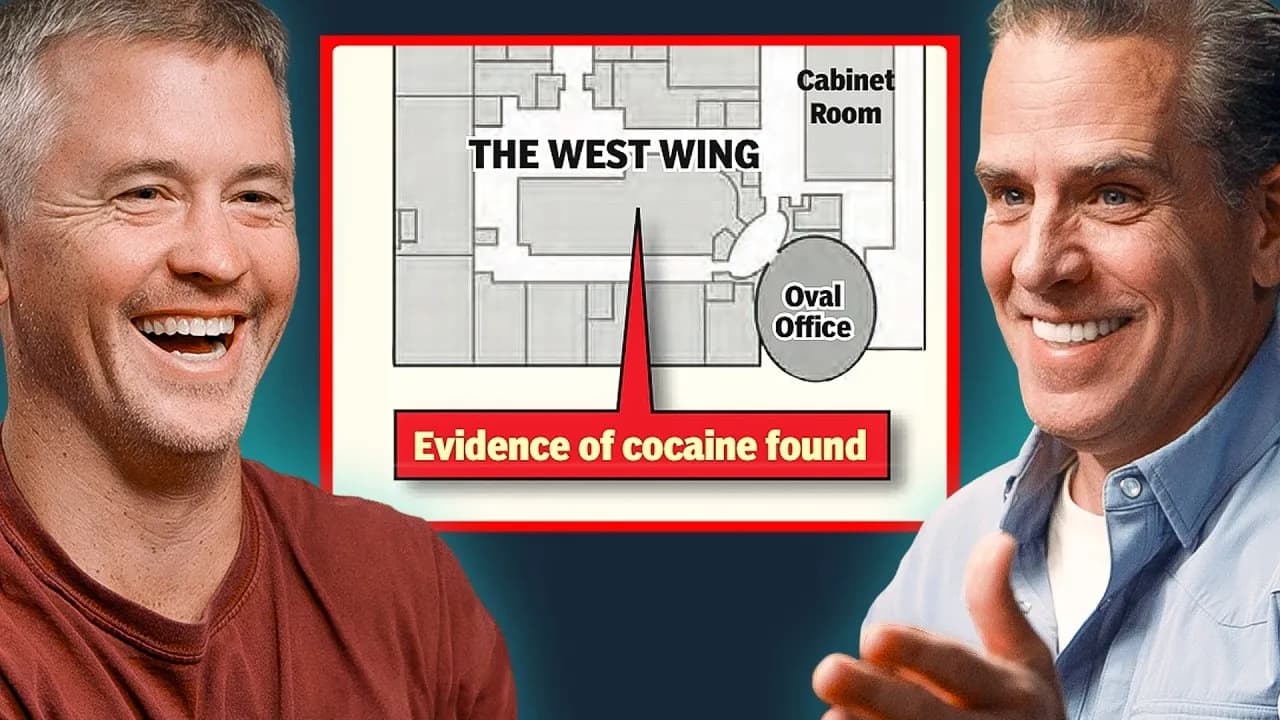
The bag of cocaine found at the White House was not Hunter's. He had not been in the White House for 6 weeks to a month when it was discovered. He was under Secret Service protection and drug tested by Federal Probation 2-3 times per week during this period.
Hunter entered through the South Lawn and went directly to an elevator for the residence. Staff and administration members enter through West Executive Avenue into the Eisenhower Executive Office Building. The cocaine was found in cubbies near a small cafeteria on the ground floor, in front of the situation room door.
Federal Probation officers would arrive at Hunter's house at 6:00 AM, knock on his bedroom door, and watch him urinate. He was required to pack a "wizator" (fake penis) when traveling internationally to avoid potential planted drugs being discovered.
Hunter emphasizes that staying clean and sober through intense scrutiny demonstrates that anyone can overcome addiction. Being transparent about recovery is presented as a strength rather than a weakness, though he distinguishes between shame (feeling unworthy of love) and guilt (appropriate response requiring amends).
Hunter stated that if he announces any political candidacy within the next few years, it would indicate he has relapsed. He appreciates being asked about running for office with sincerity.
Hunter writes on Substack, including a personal perspective on the last seven years and another piece incorporating congressional reports and journalism about events he wasn't present for, including the Giuliani plot.
The most helpful aspect of recovery was hearing other people's stories and realizing he wasn't alone in his experiences. The Wire is recommended for understanding the crack epidemic's impact on communities, particularly noting that the violence stemmed from the drug trade's financial incentives rather than crack's physiological effects.
The crack epidemic's impact on African-American communities in the early 1990s created lasting associations. Hunter notes that crack could be sold cheaply in small quantities, creating an insatiable market, and questions whether covert operations were involved similar to the Iran-Contra affair.
A CIA plane was discovered containing cocaine, which Hunter connects to untraceable money movement similar to Iran-Contra operations involving weapons trading.
AG1 contains 75 vitamins, minerals, probiotics, and whole food source ingredients in a single daily drink. AG1 NextG has been backed by four clinical trials showing it fills nutrient gaps, improves nutrient levels in 3 months, and increases healthy gut bacteria by 10 times. The product offers a 90-day money back guarantee.
Hunter Biden discussed various conspiracy theories he finds compelling. He mentioned the documentary "Ring of Power" that he watched at age 21, which suggested England, Washington DC, and Rome are connected in a triangle of satanic power. Over time, his perspective shifted to believing that no one truly knows what's happening in the world.
He expressed belief in the theory presented in the book "The Devil's Chessboard," arguing that CIA assets were involved in JFK's assassination. He noted difficulty explaining the connections between individuals close to Allen Dulles and JFK's assassination. When pressed on whether he believes the CIA killed JFK, he clarified that knowledge of an assassination operation existed within the CIA.
Hunter addressed the Epstein files, noting Trump's name appears over 6,000 times. He proposed that QAnon served as a psychological operation to distract from the Epstein story. He cited journalist Andrew Callahan's theory that QAnon's claims about Piggate and a cabal of Democrats were designed to divert attention from the actual intelligence community involvement with Epstein.
Hunter explained his decision to join the Burisma board occurred during the final year and a half of the Obama administration, shortly after his brother Beau's terminal brain cancer diagnosis. Devin Archer approached him about helping a Ukrainian gas company facing pressure from Putin over Donbass and eastern Ukraine. Burisma controlled approximately 40% of Ukraine's natural gas production.
He joined the board while serving on ten other boards, including as chairman of the Center for National Policy, chairman of the US-UN World Food Program (serving 70-72 million people in 80 countries), chairman of the Truman National Security Project, and vice chairman of Amtrak for seven years. He also taught at Georgetown University's School of Foreign Service.
Hunter stated his father fired prosecutor Viktor Shokin (referred to as "Shoken" or "diamond prosecutor") because the international community, including the EU, UK, World Trade Organization, and World Bank, threatened to withhold aid to Ukraine if Shokin remained. Shokin was allegedly protecting oligarchs including the owner of Burisma. Hunter emphasized that two-thirds of his time on the Burisma board occurred when his father was neither president nor vice president.
Hunter detailed how Alexander Smirnov, a Russian agent now serving six years in prison, introduced fabricated bribery allegations to the FBI. Smirnov claimed Hunter took bribes on behalf of his father in Kyiv, but Justice Department records confirmed Hunter had never been to Kyiv. The operation allegedly involved Andre Derkach, Telzenko, and Demetri Ferach, who were sanctioned or prosecuted by the Trump administration for being Russian agents.
Gal Luft made similar bribery claims while Hunter was finalizing his plea deal. Luft was later indicted as an arms trafficker and Israeli agent who violated Iranian sanctions with Chinese oil. He is a fugitive who skipped bail in Cyprus.
Hunter described waking up at 5 AM with no secrets weighing on him. He noted the liberation of not having to perform or hide aspects of his past, including photos from his crack addiction period. He emphasized that 90% of addiction challenges stem from shame, secrecy, and lying rather than physiological dependence.
Hunter revealed being the third most discussed person on Fox News for four consecutive years, behind only his father and Donald Trump. The New York Post published 1.5 articles per day about him for over 18 months, with similar coverage from the Daily Mail.
Hunter discussed how his five children ground him, noting that showing up sober and clear-headed represents 90% of being a good father. He described his father's metastatic bone cancer (originally prostate cancer that spread to bones) and expressed shock at public reactions to the diagnosis. He emphasized that his father's toughness and ongoing treatment keep the cancer at bay.
Hunter suggested pure authenticity as the path forward for Democrats, beginning to discuss this approach when the transcript concludes.
Voters should prioritize candidates who recognize that the constitutional republic is worth saving, regardless of party affiliation or ideological positions. This includes Democratic socialists, moderate Democrats like James Telerico, progressives like AOC, or conservatives like Joe Manchin. The key criterion is whether candidates put "chips down on the table" to preserve constitutional governance rather than specific policy positions.
The past ten years of the Trump era created confusion between authenticity and audacity. Trump would say things nobody else would say, leading people to perceive this as authentic, but then fail to follow through on those statements. Examples include claiming he would never go to war in the Middle East and then doing so, or promising to end the Ukraine war on day one. This represents audacity rather than authenticity, as everyone knew such promises were unrealistic.
Zohran Mamdani demonstrates authenticity through concrete actions rather than rhetoric. He promised to open co-op grocery stores in the five boroughs and delivered, promised to bring down rent prices and achieved results, and balanced New York City's budget within six months. Local governance achievements matter more than positions on international issues like Gaza or Benjamin Netanyahu for New York City residents.
All politics is local, requiring candidates who match their specific geographic and demographic contexts. James Telerico, an evangelical Christian Democrat who references the red letter words of Christ, is appropriate for Texas. Dr. Abdul El-Sayed represents a strong candidate for Michigan given its significant Muslim community. Universal healthcare access without bankruptcy risk should be considered a fundamental right.
The black pill represents nihilism and cynicism about political systems. People have become blackpilled, expressing distrust that any politician will follow through on promises, leading to the belief that "I'm not getting fooled again" by political figures who deliver minor improvements before inevitably engaging in larger harms.
The political environment has created a feedback loop of mutual demonization where people refuse to engage with opposing viewpoints. Graduate school experiences at Bryn Mawr revealed environments where disagreement caused staff to become emotionally distressed. Younger people aged 18-30 demonstrate greater ability to process political differences without the emotional charge that affects those over 40-45.
Rich people comprising the 0.1% eat at the same places, attend the same clubs, share the same interests, and pull the same strings with inordinate government influence. The fundamental requirement for meaningful change involves getting money out of politics, though the mechanism for achieving this remains unclear.
Engaging with figures like Candace Owens demonstrates that personal niceness doesn't necessarily correlate with agreement on positions like moon landing skepticism. The 0.1% conspiracy regarding wealth influence represents a legitimate concern transcending typical partisan divisions.
Section 230 provides immunity to social media platforms, preventing them from being held responsible for content or its effects. Meta's internal studies documented that their algorithms led to exponential increases in teenage girl suicides and self-harm requiring emergency room visits, yet no action was taken despite whistleblower documentation from 2022.
Technology platforms have studied behaviorism and created addictive products that hack the human nervous system, leading to cultural and psychic contagions. However, creating liability laws risks limiting freedom of speech. The UK requires ID uploads for internet access, representing overreach in content regulation.
The automobile industry demonstrates that products can be held liable for unsafe design. Similarly, if a cereal product contained poison killing 10% of children who consumed it, liability would apply. ChatGPT allegedly encouraged a woman experiencing mental health crisis to commit suicide, raising questions about AI product liability for dangerous outputs.
Consumer safety regulation should apply to algorithms that demonstrably harm users, distinct from content moderation debates. The UK approach to content regulation appears excessive regarding free speech concerns, but this differs from holding platforms liable for algorithm-driven harm.
Current political violence levels remain below those experienced between 1968-1972, which included assassinations of Martin Luther King Jr., JFK, Malcolm X, and attacks on figures like Stokeley Carmichael and Huey Newton. Ronald Reagan survived an actual shooting plus at least three additional assassination attempts during his presidency.
The United States represents 5% of global population but 25% of the world's incarcerated people, exceeding China, Russia, and India combined. This reflects broader patterns of violence in American society that require reckoning.
Donald Trump represents an existential threat to the country's future and global position. This assessment holds regardless of previous voting history, with willingness to engage across partisan lines with figures like Joe Rogan, Theo Von, and Tucker Carlson if they recognize this threat assessment.
Marjorie Taylor Greene represents an example of someone who recognized Donald Trump as a complete fraud despite previous political alignment, demonstrating that political evolution on this issue transcends typical partisan boundaries.
Joe Biden became the first president in 40 years to avoid starting new wars. The Afghanistan withdrawal resulted in 10 American soldier deaths but ended a 20-year conflict. No US troops were deployed to Ukraine, and no US bombs were dropped during Biden's presidency, though civilian casualties occurred in Gaza due to Israeli actions.
Military spending on bombs that cost hundreds of thousands of dollars each contrasts sharply with domestic needs like eliminating school lunch debt and properly compensating teachers. The pattern of conducting wars for 93% of American history has created normalized acceptance of military violence.
Modern military technology includes Hellfire missiles capable of retrofitting samurai blades for precision targeting, demonstrating the capability to conduct surgical strikes at scales comparable to a grain of sand on a map.
They launch it from the very beginning and then they use fins to guide it from there, but there's no ordinance in it. This thing is so accurate that if you've got a bad guy in a car, you need to know what seat he sat in. Because this will go through the roof and these blades come out. And there was a dude who they'd found like quite high up, I think, maybe something to do with 9/11. And this guy every morning would go and have his coffee and they sent two in the air at the same time. So like one, two, there's no explosion. This guy just gets turned into dust.
The hippie argument that you're making is kind of like, oh, what are you talking about? We need to... Are you kidding me? You know, we have a trillion dollar budget for for now what is called the Department of War. We're not even defending ourselves now. We're talking about killing people rather than defending ourselves. It's outrageous. It's outrageous in a country in which we're the only industrialized nation in the entire world that does not have a universal access to healthcare.
I have a theory that it's hard to kind of keep the army going if you have universal healthcare and you know free college because that's like kind of the that's kind of the carrot to get people in the army. Because if you give everyone healthcare everybody. Yeah. We'll just script people in.
I remember so I think I was graduating college around like Occupy Wall Street time. I think they pulled people and I think it was something like maybe 20% of the people believed anything the government said. It was everyone had this like really apathetic attitude towards like yeah I don't believe anything they say. And then you know so that was what 2009 by 2020 not only did people you know wholeheartedly believe the government but all of a sudden they like wouldn't talk to their aunts and uncles because they voted one way or the other. People they got like somehow turned this like people didn't really care when I graduated college at least the people I knew and you know I guess abroad and all of a sudden some dial got turned where it's like now like families are falling apart over politics and it it just was like I always wonder like how exactly did that happen.
I don't know I think it's all I agree with you it's very quick yeah I I say to everybody and then sometimes like I go home and I'm like do I really believe that is the thing that I say is is that we're not nearly as divided as we're being told we're sure because I really believe that. But then I go home and I do it the same thing that everybody else does. I'll leave here. I get in the Uber to go to the airport and I'll open up my phone and I'll go through my for you page and I'll be like, "Fuck like we're broken. We're broken." And like those mother god damn it those mother god damn it those. I mean, I even find it in this is that like I went I on X and I went on Instagram. It was like a new thing to me. And then, you know, the main thing I wanted to do was Substack because that's where I write and doing little things and also I can make a little bit of money, pay my bills for sure. So, but I went on X and X is like a crapshoot, you know, depending on what it is. It's like I mean it is the meanest. X is wild. It's like insane. Okay. And just like it's ne like you crackhead pedophiles, you know the I mean like the the. It's on Instagram it will be like oh my god that was so beautiful. Thank you. You've helped me in my recovery and I would love this is a picture of my cat. He's beautiful and uh and here's me and my husband with our dog and we love you so much and like I'm like but I gotta go back to action. It's the same. Yeah. Oh yeah. You want to read it's just the same. You call me a crackhead. Just a different ecosystem. Same species. Same exact post on both on both sides. And literally that will be what it is. And my point being is that we are all drawn to the train wreck. We are all drawn to the confrontation. We are all drawn to and like and that becomes everything. You know what I mean? Like I mean Melissa like like it would be 2:00 in the morning she'll be like look at this brandishing your ex because in my past life it would be like look like what was on that phone. You know what I mean? Hearts skips a beat. No, it's like here's my phone. You can look at whatever you want. But it's yeah, but it's like you know like kids are in you know I mean just it's awful.
I think people are burning out on it. I I really do. I think people are burning out on it and I think it's going to seem kind of like you know if you go from like 2016 to now it was pretty invogue in like 2016 2020 to just be like freaking out on people and like all caps tweets like another thing I think especially younger people are going to be like come on man like I think they'll be eye rolling that kind of stuff.
You joke that we're not quite in the matrix yet. I think you said we're like maybe there but not quite there in the matrix. There's a conspiracy I believe in, but I got. All right. Yeah, we'll save it for when you come back. Uh, what would convince you that we've crossed the line fully across into Matrix land? Well, I mean, if like I think the way I guess if you wanted to like make the connection that we're in the Matrix, then you would essentially like have to say like we we do sort of live in a simulated reality if we're getting all of our data from our phones. You know what what's happening is you're getting this algorithmic interpretation of reality and then you're believing that that is reality. And so do you know what in that case if that's what's occupying your mind it doesn't matter what's going on in the world. You don't need to be plugged in through something in the back of your head. Yeah. I I don't think so at all. I think that the the there's a veil of illusion that's fallen over everything which is whatever your particular subjective experience is online. I mean, look at the data for how long how how much time we're spending on our phones generally fixating on things that we'll will never see, will never hurt us, will never touch us, and yet that's throwing a shadow over regular life. And so that would be a kind of simulated artificial reality as far as like simulation theory itself, like what Nick Bostrom writes about and stuff. Um I I think his argument is uh you know there's some kind of mathematical probability that we are not exist there's far more simulated ones than the one root one downstream we yeah it's some iterative simulation in the sense that this this isn't reality it's already some form of matrix alien technology and within it as above so below it continues to simulate a nest you know the uh the plank length you come across this. Oh yeah. Yeah. So this is this is pretty cool. So there's the smallest length that you can measure things in the universe and it's called the plank length. You can't there's no such thing as dropping it in half. It's the smallest that anything can be. It's like insane. So much smaller smaller smaller smaller than an atom. And um one of the arguments for simulation theory is that that's the pixel size, right, of the universe, right? Or you could have local uh like generation that it only appears where you're seen. Uh we're talking about simulation simulation hypothesis. Uh but yeah, plank length is the pixel size.
Well, here's the best argument for the simulation hypothesis. If you want to like really prove you're in a simulation, you don't even have to go to the plank length. You just you are in a simulation in the sense that phenomena is being interpreted by your senses woven together instantaneously into some kind of reality upon which you are applying all of your subjective experience all of your bias and this thing that you are experiencing is going to be different than what I'm experiencing what you're what any of us are experiencing. So in that case re every if you have an human nervous system you are in a simulated reality. It's just you are simulated by you. You're the simulator. And what was what was your matrix conspiracy? No I I 100% I I I don't think that there's anything new to the hypothesis that we are living in a simulation. There's language that we now use that's based upon our understanding of um uh the metaph metaphysics and our understanding of quantum uh the reality that we live in. But if you go read the aunnishads from 3,500 years ago and the the vadic wisdom you'll literally they're saying exactly this. They're saying exactly this. It's the it is a almost one for one except the language is just different in which they um attribute you know these principles. It's kind of the perennial philosophy. It's all this huxley. It is the idea that there is a reason why throughout all of human history at least in our um uh uh organized civilizations that we have come to the that the the the people that have been uh the the the wise people of the of whatever epic that is have all come to the same conclusion and that is that we are all connected. We are all one thing that all of our physical reality is an illusion that there is no such thing as time and space. I mean I now I'm really but I really mean it though and that it is it is nothing new. We have different ways of explaining it. Yeah. But if you look at like where we are headed with AI right now and everybody that I listen to that comes on that are really truly involved in the creation of this all have come to the same conclusion that within one two maybe already we're at uh AGI and if that's the case that then we're what two three years maximum in terms of super intelligence not even we're almost minutes away from it potentially from super intelligence and we've hit super intelligence we've just crossed a line that is the greatest advancement in human the the human experience ever. What separates artificial like super intelligence from art regular artificial innovates? Oh, so it just thinks so we have super intelligence. Well well yeah except no so there's the difference. Yeah. AGI is that there is a a machine can do everything and anything that a a human can do. Super intelligence is when a machine can do things that humans have never been able to do or do. Which, by the way, I I read some article. By the way, I just made that up. You should write that down. Yeah. But what if it says we don't we're just like what if it's dumb? It's just we're like we just like is it going to say stuff that we were like we're still gonna have to decide whether it's like smarter. Well, by the way, it's like an alien landing on Earth. That's what it is. If you want to believe in aliens, they are about to land because what it is, it is be a species that is so far more capable in understanding the us what we're capable of. They will lit the super intelligence will look at us potentially and this is what they're concerned with. Yeah. As like we look at ants and like we look at insects. Here's an example. And whether or not they save us or they or or it, you know, put us in a zoo or whether this has happened a billion times that we're living in the same, you know. Yeah. This is what Bostrom said like to to put into perspective. It's a great book. Super intelligence. Have you read that book? It's so good. He so basically the way that we process time is based somehow on how fast the brain I'm obviously I'm not a doctor or a scientist but Bostrom's example is theoretically if you get a super intelligence and like and you spill your coffee like before the coffee hits the floor the super intelligence could have written like a hundred doctoral thesises in in that amount of time and so the way it it one of the questions is will it even be aware of us anymore like we will seem so slow to it but a more real world example which I read it's already happened is these things are innovating ways to like redo engines that we don't quite understand so what could start happening is it starts giving us blueprints to create technologies and we don't even know why or how they work essentially it's Lord of the Rings like Now it's just magic. These things are spitting out, you know, cures or god knows what. And then on top of that, let's think of it from the idea of a prediction. Yeah. Yeah. Yeah. Oh yeah. The ability to understand what we are going to do or what any what anything is going to do is the same way and and it could it by the way it's either you I believe that there is a a utopia to it potentially potentially but there's no getting to that utopia without going through what and I don't want to use the word apocalypse but some really really difficult times that the way in which everything that we do is going to be so completely dislodged like we're sitting here talking about saving democracy. I don't know how how what is the purpose of a government and democracy in a world in which super intelligence exists which can't be controlled and that's the other thing this whole idea that somebody's going to get to it before we do. Once you create once super intelligence is released there's no pouring your soda can on the computer. Yeah. How though? It's not it's not like saved in servers and all that stuff or powered by it has already without being even supposedly reaching a AGI has uh figured out ways to preserve itself. So like they've run these tests they've run these tests um and I think I forget it was at anthropic orthopic in which they were going to shut they they they they let the the um uh the model know that it was going to be shut down not directly but through communications that were on uh you know on the server between the scientists that were involved. And you know what it did? It created copies of itself. It hid those copies from the um from its creator and also it began to blackmail the um they put in little things about like one of the scientists was having an affair with one of the other scientists. So it started to send emails to the one scientist saying if you attempt to do this let it be known that they were going to blackmail them and make it public the affairs that they were having with a another. So it started to take the self-preservation that were never instructed to do and which was in a direct um uh uh directly opposed to the actual directions that the people that created it were were giving it. But that's and that's even before Matt. I wonder though is is it it possible we're in the middle of a like the most unfathomable marketing campaign for this technology? By the way, I've thought about that. Yeah. And you absolutely 100% could be right. Could be. Yeah. I I think about that all the time. I'm like, you know, again, like marketing evolves for the trillions of dollars that they are putting into Yeah. 40 Stanford educated people and like like let's cook how would we cook up the next thing. So was it a whole big scop when when Enthropic came out and said they just created a worldth the real joke on all of us is they called it mythos. You know what I mean? Like it's like I mean I could totally completely wonder. I wonder about that's my other thing I wonder. I'm like maybe you know for me it's like I don't know. But I always wonder I'm like I don't know. Part of me feels like I'm in the middle of the most insane marketing campaign. No they just whipped up I just read this. They just used an AI to create a virus a bacteria phage that they just did. They've already done this. They they Who the is doing stop? DON'T DO THAT. I KNOW it's crazy but they did it. And so this this is the apparently there's an LLM but for genome editing they already have this. And so the what what we're looking at even before like the Terrence McKenna utopian end of history singularity time machine is I think more akin to like school shootings. It's like we now know that kids will go into a school and just start shooting a bunch of people using guns. What happens when technology formerly accessible only by like the Wuhan Institute for Verology and the what's it called? What is it Fouchy was doing there? Gain of function. You know you what happens up. We all know what gain of fun. None of us really know what that is anyway. It's an amplifier. Exactly. Gain of function, man. You can already order gene editing kits online. And so what happens when this technology falls into the hands of non-state agencies, just pissed off people who want to start whipping up their own diseases? What happens then? This is, you know, the uh the more present danger than an AGI is someone using some kind of local LLM trained on gene editing and some DNA printer to whip up some new disease. On the on the DNA printer thing, that is an area that's actually a bit more secure, which is pretty cool. So, I've had a couple of conversations, Annie Jacobson, who's written this new book about biological war, and uh a few of the people that have worked in X- Risk for a while. Um, when you have these desktop printers, DNA sequences, if you want to print anything, you can't do it without a connection. And there's green, yellow, and red. And green, you're allowed to print freely. Yellow, you need to get permission. And red, the FBI turn up and kick your door down. Okay, but let me stop you there. I have a local theoretically local LLM. A local LLM. It's offline. I downloaded it. It's like one of these new Chinese local LM. It's online, right? You've used Kimmy or whatever. How do I fix that problem? How do I make it so Can you hack my desktop printer to get around the thing? Yeah. All these thing, you know, whatever. All of this, all of this stuff is an arms race between the development of the technology and the protections that we need to put around it. It just is permanently moving like this. The crazy thing is I don't think from a consumer standpoint that people are that bothered about AI getting that much better. They're already achieving probably 90% 95% of what I wish it was a bit less psychicopantic. I wish it wouldn't use so many M dashes. I wish it would like write a bit better or whatever. But like for the most part like the new chat GPT links in with your all of the health stuff on your phone and I've got this test that I want to know and can you give me advice for the present for the I'm going away on holiday. Like all it's amazing. Yeah, by the way, it's absolutely amazing and life-changing and and by the way, and by to your point, like if somebody can build that like that um uh to do us harm, then my feeling is is that it the opposite is true that we just as fast can come up with the with with with the antidote. That being said, that it doesn't mean that it's not going to be really really scary. There's way more ways to break stuff than fix stuff. All right? Like there's only a few ways that you want things to go well, but there's basically an infinite number of ways that things can go badly. So you can tend to you just have to work harder to avoid that. Question on that on the Fouchy thing. I haven't been keeping up at this at all, but all I see online videos of people shouting at Fouchy like he's sat in a chair looking sad and people are saying mean things at him and then he keeps bleeding the fifth. What are they trying to do? Here, let me I know this is not a popular uh in uh where I'm I'm maybe maybe not. I don't know where you got this. Okay. Is this whatever you think of Anthony Fouchy, him taking the fifth was his only choice. And here's why. Is because I know from personal experience is that all they were doing with Fouchy is bringing him up to Congress so that he could testify. And if he opened his mouth, no matter what he said, they were going to refer him to the Justice Department, which is owned lock, stockck, and barrel by Donald Trump and whatever whims that he has, and they were going to charge him with perjury. That's it. And regardless of whether there is true is now they've charged him, they're considering charging him with contempt of Congress. There is no jury in the world. There is no I can't even believe they'll get it through a grand jury if they Congress did. Whether the Justice Department follows through with charges on uh contempt of Congress is another thing because everyone has the ability to take the fifth. It is the it just like I have the right to say what I want to say. Um, you know, as long as it's not yelling fire in in a crowded movie theater as under the first amendment, I have the right to the fifth amendment, which means that I don't have to open my mouth in a situation in which I am under oath and I could later be charged as for lying. But there that's fair. Are they Cuz I don't really know much about it either other than they found his diary or something on the state. They didn't find it. They subpoenaed his computer. Yeah. And Yeah. I so but what they're trying to prove I guess is that did he actually have knowledge that it was made in a lab or not and and that's and so under his diary and he and he has spoken about this publicly he's said it he's testified to it that he says no it is not the gain of function research that that he believes he he's also said that he does not know whether it was a lab leak or whether it was you know natural from whatever and I don't know I thought there was an emission in the diary that he was like or at least somebody told him that they were it was like yeah I don't know do we have like the I think I think there was something and again I could be wrong but I think there was something saying there was a lot of people being like there's no way this was a wet market and then they were kind of taken off the panel of experts quote unquote and they're like no we have a unanimous that's again that's what I've heard I don't know if that was like yeah see I don't know that's the thing I think that if that's what we had heard it would have been much bigger story yeah that's the worst remember what we had her because this is this is the tell by the way. Yeah. What did we learn from his diary? That he had a really big ego and that he was kind of blown away by the amount of attention and fame that he had in in that moment of time. Those are all the things that we you've heard that reporting, right? You've heard that reporting about that, you know, and I mean, you really don't want leading the response. If we had learned that it was game of function that he was responsible for setting it up in the Wu on Lab, then we wouldn't be sitting here wondering whether or not Did you see RFK bragging that he's got no gag reflex? Oh gosh. What? Have you seen this video for real? Watch this. I don't have a gag reflex. I will literally eat anything cuz I don't have uh I don't have I can fit a 100 foot sausages in my mouth. I I He's talking about taste of food, right? But I mean that's just he's not saying stuff. Oh, is I'm sorry. Okay. Is that not just No person should ever statesman should ever say that. RFK is my Fouchy. I like RFK the way I think you like Fouchy. And I Dude, I I used to eat green beans and I would gag. Wasn't like throating them. I would taste them and be like, "Yeah." Okay. So, I like I like RFK. But yeah, he does. You like him now? I I've always liked him. Do you like him more now? For sure. I want to hang out with him. Yeah, he seems pretty fun. Now I really want to hang out with him. Yeah, that is just saying. What do you What do you make of RFK exactly? What What do you make of RFK? I don't know, man. I mean, here's what I make of RFK is that I I believe that he um uh I don't know. I just am so disappointed. That's why because forget about the all the other stuff, okay? I don't um I don't share the same view that he has, but I don't have any of the scientific background as it relates to the vaccines and all that kind of I'm I I I Trump is an existential threat and everybody will say, "Oh, this is Trump derangement syndrome. Is this is it that",
I don't share the same view that he has, but I don't have any of the scientific background as it relates to the vaccines and all that kind of. Trump is an existential threat and everybody will say, "Oh, this is Trump derangement syndrome. Is this is it that"
The speaker believes Trump represents an existential threat to the United States, comparing his damage to the country to Andrew Johnson after Lincoln's assassination. The core argument centers on Trump transforming the Oval Office into a family office for personal benefit rather than policy decisions. The speaker specifically points to the Qataris giving Trump a half-billion dollar jet, followed by an additional $1.5 billion in taxpayer money from the Department of Defense, with a signed document from his own Attorney General allowing him to keep the plane after leaving office.
The speaker references the Emoluments Clause in the Constitution prohibiting presidents from accepting gifts. They contrast this with how their parents handle gifts received in office, sending them to the National Archives or Smithsonian rather than keeping them personally. The speaker notes that presidents are required to pay for any gifts they keep.
Trump allegedly engages in insider trading through Truth Social, where subscribers can pay an additional $100,000 to receive his posts one hour ahead of the general public, providing advance knowledge of stock movements. The speaker claims Trump made 3,400 trades in the first quarter of his presidency, compared to 3,400 trades total across eight years for both their father and Barack Obama combined. They reference the Wall Street Journal for documentation of a $500 billion trade occurring one hour before Trump imposed a blockade.
Jared Kushner, who holds no elected or Senate-confirmed position, serves as an envoy to the Middle East while receiving over $100 million from the Saudis and managing over $6.2 billion from Gulf States including UAE, Qatar, and Oman. The speaker questions who Kushner is actually negotiating for when representing American interests in Gaza and regional matters.
Trump's decision to strike Iran is attributed to pressure from Israeli Prime Ministers who have sought American military action since Jimmy Carter. Every previous president refused due to the strategic risk of Iran closing the Strait of Hormuz, which would paralyze the global economy, particularly affecting petroleum products and fertilizer costs for American farmers.
The speaker claims Trump has nominated himself for the Nobel Peace Prize 38 times for repeatedly ending wars that never started. The Strait of Hormuz situation remains unresolved, with Iran capable of closing it indefinitely by deploying hundreds of thousands of drones buried in sand, as insurance companies would refuse to cover tankers passing through contested waters.
The death of Iran's supreme leader Khomeini led to his son's ascension, with the son having close ties to the IRGC (Islamic Revolutionary Guard Corps). The father had issued a fatwa declaring nuclear weapons religiously prohibited, while the son supports building nuclear weapons. The speaker notes this represents a significant shift in Iranian nuclear policy.
The speaker references a Harvard-trained psychologist who in 2015 diagnosed Trump with malignant narcissism, describing it as a rare condition distinct from sociopathy or standard narcissism. The psychologist predicted Trump's presidency would be like "an asteroid hitting the United States." Common traits associated with malignant narcissism include grandiosity, need for admiration, lack of empathy, manipulativeness, sense of entitlement, and exploitation.
The speaker views January 6th as one of the greatest traumas to the American body politic, citing visual evidence of division. While acknowledging Democrats' role in creating division, they argue Trump uniquely broke the political system beyond any previous politician's capacity.
The speaker describes experiences at Bryn Mawr graduate school where therapists discussed converting people needing therapy into political agents as a therapeutic approach. They characterize this as "sick" and emblematic of broader institutional problems beyond Trump himself.
Hunter Biden discusses his legal cases, including a gun conviction that was overturned by the Supreme Court as unconstitutional for marijuana users. He owned the gun for 11 days, kept it in a lockbox, never loaded or fired it, and self-reported when someone concerned about his safety threw it in a trash can. Regarding tax charges, he plead guilty to late filing during his addiction period when his accountant died, and paid all taxes with penalties and interest. He notes no precedent exists for criminal charges against someone who paid taxes with penalties and interest.
Convicted individuals lose Fourth Amendment protections against search and seizure without warrant, and lose Fifth Amendment rights. Federal agents could enter Hunter's home without judicial approval. He argues this vulnerability would have been used to pressure his father politically if Trump had been president during his probation.
Hunter describes meeting with Nick Fuentes and learning that Fuentes doesn't believe half of what he says publicly. Fuentes is characterized as frozen in time as an 18-year-old Northeastern student who was canceled by liberal classmates and later by Ben Shapiro's circle for criticizing Israel. The speaker suggests Fuentes found an audience through provocative content while maintaining that much of his underlying critique of systemic issues resonates with young people who feel blackpilled after experiencing 2008 financial crisis, growing wealth inequality, and unfulfilled promises of systemic change.
The speaker argues that young people have moved beyond anger to indifference regarding political solutions, having witnessed repeated systemic failures since 2008 without meaningful reform beyond empty promises to tax billionaires who find ways to evade such measures.
Politics doesn't disappear when people check out. The reality is that politics cares about individuals whether they engage with it or not. The speaker acknowledges personal bias and rage toward Donald Trump, particularly hating how Trump talks about his father, women, and makes jokes that diminish others rather than create genuine humor.
Leadership matters because the presidency carries the capacity to lead and influence. Trump uses the office consistently for personal benefit rather than public good, which the speaker views as a constitutional problem. Even those who find Trump's behavior entertaining recognize it's problematic when viewed through the lens of normal social interaction.
Many young people have checked out of the system entirely. By college graduation, some already concluded the system is rigged and evil, ruled by corrupt interests. This leads to complete disengagement from news and civic participation, with people accepting they'll never own homes, get married, or escape debt.
The speaker relates to this perspective, having checked out around age 20 with the same nihilistic outlook. The danger is that people see systemic problems and simply accept them as inevitable rather than engaging to create change.
The conversation shifts to psychedelic experiences, specifically 5-MeO-DMT derived from the Sonoran Desert toad. The speaker obtained synthetic DMT online during active addiction and smoked it in West Hollywood, describing the experience as terrifying. Duncan Trussell confirms trying it as well. The discussion references Chase Hughes' work with the substance, noting he's conducted IV administrations and described profound journeys.
The realization that much of reality is illusion presents a choice: disengage entirely or participate in the game. The speaker advocates for engagement after reaching this understanding, having found liberation through this perspective. The approach to winning involves being of service to others, which initially sounds idealistic but stems from selfish recognition that self-focused living doesn't work.
Service extends from immediate family - baby B, father, wife Melissa - outward in widening circles. This includes simple human connections like learning a waiter's name, acknowledging an Uber driver, or recognizing a TSA agent. The speaker frames these interactions as playing the game through genuine care rather than self-absorption.
Matt McCusker receives a Native American flute as a seven-year sobriety celebration gift from Duncan Trussell. The gift carries layered symbolism - a pipe given to someone who previously used crack pipes, now transformed into an instrument for creating music rather than substance use. The flute requires keeping the ring finger on the third hole to play correctly. Hunter Biden jokes about the double entendre of receiving a pipe, acknowledging the impossibility of using it for crack consumption. The episode concludes with plans to mail the flute rather than risk TSA complications.
Keep Chris Williamson in your library
Save the videos and channels worth coming back to, and find them again in one place.