Freedom vs. Safety: Axon CEO Rick Smith on the Future of Policing
In a Nutshell
Rick Smith, CEO of Axon (formerly Taser), built the company from a garage startup into a $30B public safety technology firm by developing non-lethal weapons, body cameras, and AI-powered policing systems. The interview details how body cameras transformed from a failed product into the company's growth engine, while addressing the core tension between public safety needs and surveillance/privacy concerns. Smith argues that advanced policing technology—drones, robots, and cameras—must be deployed with strong ethical guardrails and civilian oversight, particularly as society transitions through technological disruption.
These notes were generated by AI and may contain inaccuracies.
Being tased is terrifying while happening because the person loses control of their body amid waves of energy. Five seconds under taser current seems very long, allowing time for philosophical realizations about what it must be like for people unable to control their body. When the current stops, the person returns to normal immediately. The experience is not fun but ends completely once the current is off.
The discussion explores whether a substantial content business could emerge from body camera footage, noting the entertainment value alongside social benefits. Live PD was mentioned as a live version of the show Cops, providing real-time policing footage that drew weekend audiences like a live sporting event. The show was cancelled following the George Floyd incident due to production companies' concerns about appearing pro-police.
Axon operated Axon Studios for a period attempting to build a live content business from body cameras but determined the company's corporate DNA was too aligned with pro-police positioning to execute the edgy content approach needed for success in that space. The opportunity remains available for other entities to pursue.
Rick Smith, CEO of Axon, joined for an interview. His business history traces back to the company's founding as Taser in 1993 in a garage in Tucson. The motivation originated during graduate school in Europe when European students expressed fear about American gun violence. One student asked if Smith knew anyone killed by gunfire, prompting him to count five or six acquaintances from his high school football team and family connections who had been shot.
This led to questioning why bullets remained the primary technology in 1993, given their centuries-old origins. The insight was that a device like Captain Kirk's phaser would provide a more civilized alternative, potentially reducing lethal force incidents.
Smith discovered the original taser was invented in the 1970s by a NASA scientist living in Tucson, Arizona. He located the inventor through patent filings and contacted him directly, asking what happened to the technology. The 73-year-old inventor invited the 23-year-old Smith to his house, leading to a partnership building new tasers in the inventor's garage.
Emil Michael, later a leader at Uber and now Under Secretary of War, visited Smith at age 23 and filmed a spoof video mocking the idea of manufacturing electrical weapons, reflecting widespread skepticism about the concept.
The inventor came out of retirement to help Smith develop the technology. The first tasers were built in the garage using parts from Ace Hardware. The initial challenge was obtaining federal government approval that the new taser would not be classified as an illegal weapon, requiring regulatory approval.
The first prototype was built in 30 days. Smith started the company with friends and family funding, including support from his father who had previously founded a successful Silicon Valley company. No venture capital was available as the company was not internet-related during the late 1990s boom.
The original taser was classified as a firearm due to using gunpowder, placing it in Category 2 alongside sawed-off shotguns, making it difficult for civilians to purchase though police could acquire them. The new design used compressed air instead of gunpowder to avoid firearm classification, targeting the consumer market with the theory that individuals like Smith's mother could purchase it for self-defense.
After seven years of struggling in the consumer market, Smith pivoted to the police market in late 1999 after hearing repeatedly that consumers would only trust the product if police adopted it first. The strategy was to prove effectiveness with law enforcement before returning to consumer sales, which Smith predicted would occur within five years.
The company experienced two failed product launches before the 1999 pivot. In 1998, after the second failure, Smith recommended shutting down to his father and the other investor. His father revealed they owed Silicon Valley Bank approximately $2 million, with the father personally liable for $500,000. Rather than shut down, both investors contributed their final $500,000 each, providing the last $1 million the company would receive.
With this funding, the company designed, tooled, manufactured, and launched the police taser, then operated on a shoestring budget until achieving cash flow break-even and an IPO two years later.
The company went public around the end of the dot-com boom in 2001 at approximately $12 million valuation. An investment bank approached after observing a training event, noting the company had real revenue and manufactured physical products rather than being internet-based. The timing aligned with banks needing deals during the market downturn.
The founders owned 100% of the company with no VCs or institutional investors on the cap table. The IPO provided relief by allowing repayment of shareholder notes, ensuring Smith's father would not face financial ruin.
The company faced the challenge of selling a handheld device shooting electrodes that incapacitate targets to police departments unfamiliar with the technology. Early generation tasers lacked sufficient power, as demonstrated when Rodney King was shot with an LAPD taser that failed to work, leading to baton use with catastrophic consequences.
The original taser had a deservedly poor reputation in the late 1990s because it could be fought through by focused, aggressive individuals. The company conducted animal testing to calibrate nerve stimulation levels that would actually paralyze subjects rather than merely cause pain.
Without funds for advertising campaigns, the company hired a former Marine who traveled in a Winnebago with $100 bills. The trainer would enter police departments offering $100 to any officer who could take the device. Officers who accepted the challenge and were hit would fall down, often expressing surprise at the device's power.
Non-lethal weapons had previously been viewed as ineffective since pepper spray could be fought through. The new taser represented the first weapon that could reliably stop aggressive individuals. Police officers frequently reported the device would have prevented shootings or physical confrontations with dangerous subjects.
After seven years of survival struggles, the company went public in 2001 and experienced four years of rapid growth, tripling revenue annually. In 2004, the company was the number one performing stock in the world on a one- and three-year return basis according to the Wall Street Journal, outperforming even Google which went public that year.
In late 2004, an SEC investigation began based on allegations the company had lied about product safety to inflate stock price. The investigation stemmed from a short-selling attack involving significant short positions. Smith's personal assistant was discovered to be a mole for short sellers, sending internal documents to them for distribution to the New York Times.
The stock dropped from $33 to $7 per share in 2005. Police customers stopped purchasing during the federal investigation, unwilling to justify purchases to city councils until the matter concluded. Smith personally delivered boxes of documents to the SEC office in San Francisco, offering to assist completing the investigation to avoid business failure from prolonged proceedings.
The investigation concluded with no findings. The company survived hundreds of lawsuits from shareholders and plaintiffs, including cases where individuals shot by police tasers sued both the police and Axon.
The company's market cap peaked around $2 billion in late 2004 before declining to approximately $100 million. Insurance companies wanted to settle the first cases for around $2 million, but the company refused, believing settlements would trigger overwhelming litigation. Instead, the company negotiated with insurers to pay plaintiffs while the company assumed liability and defended the cases.
This approach succeeded, with the company winning cases and even profiting from the insurance arrangements. The strategy of aggressively defending cases where the company believed it was right, while being reasonable in cases of actual wrongdoing, eventually resulted in zero active litigation cases.
Heidi Roizen, a college friend of Smith's who made money during the late 1990s internet boom, joined Axon's board around 2007-2008. At that time, Axon was struggling with its body camera software business launched around 2010. Smith had never built a software company and was experiencing technical difficulties with the initial team.
Roizen served effectively as part-time CTO for approximately five years, helping recruit the right team and navigate software business development within a weapons company. The company had been building its own data center but experienced a near-catastrophic outage nearly losing all customer data.
Roizen advised against managing proprietary data centers, leading to migration to AWS and subsequently Azure cloud services. Shareholders initially questioned the transformation of a weapons company into a software company, but Roizen helped execute the transition.
Roizen also advocated changing the company name from Taser to Axon, arguing that Taser had become a sledgehammer brand associated specifically with electric weapons while the company's scope had expanded significantly. The taser remains an important but smaller part of the business.
Axon now manages more video daily than YouTube in terms of upload volume, though YouTube has more viewers. Over one million police officers upload two hours of video daily from body cameras, requiring secure management and sharing infrastructure.
The body camera concept emerged during litigation defense when Smith realized the challenge of conveying police officers' experiences to juries. In one Northern California case involving a 40-year-old man with a 20-year methamphetamine problem who died in custody, family members presented high school graduation photos while officers described an individual exhibiting animalistic rage similar to scenes from The Exorcist.
Police officers noted they could not use emotional language in testimony, being required to maintain professional descriptions, while plaintiffs employed colorful, emotional rhetoric. Smith recognized the need to record events so officers could show rather than explain what they encountered.
The body camera concept was novel at the time of development.
The concept was new. Consumer cameras like GoPro existed, but the company was building the first police body camera when an employee quit in the middle of the night and launched the product a week later. The employee had been funding development with his stock options to compete against the company. The company ultimately acquired that company back, and the body camera became the reason the company grew from a couple hundred million to a $30 billion company today.
When the body camera launched, police did not want to wear it. There were seven years of failure where cops expressed concerns about being nitpicked by supervisors. The company believed officers needed to show people what they do when accused of misconduct.
The cloud bet was made because scaling would require putting videos into cloud infrastructure rather than having 18,000 departments run video servers securely. The cloud could be safer than average police department servers, which could be vulnerable to Chinese hackers despite being physically present.
A police union leader stated that no cop wants to wear a body camera until they've worn one for 90 days, after which they will not go on patrol without it. Police arrest criminals who have no compunction about lying. False allegations are incredible in number.
An early ride-along story from Phoenix involved a cop arresting a prostitute who was more than half naked and high on drugs. As he drove her to the station, she threatened to accuse him of rape unless released. The officer informed her the interaction was being recorded on body camera, and her demeanor changed completely. Without the camera, the situation could have become a career-ending he-said-she-said allegation.
The Michael Brown shooting in Ferguson, Missouri, involved a white officer and unarmed black subject who was significantly larger than Officer Wilson. According to Officer Wilson, they were fighting over the gun, which would justify self-defense. The family claimed Brown was surrendering with hands up. The subsequent review largely supported the officer, but it could not be proven without video evidence.
After Ferguson, Michael Brown's family said they wanted body cameras, and the police union wanted them to show what was happening. Today, virtually every major police department wears body cameras, with the vast majority on the company's system.
The company is maniacally mission-driven, choosing problems that make a difference rather than being purely profit-motivated. This leads to different product outcomes.
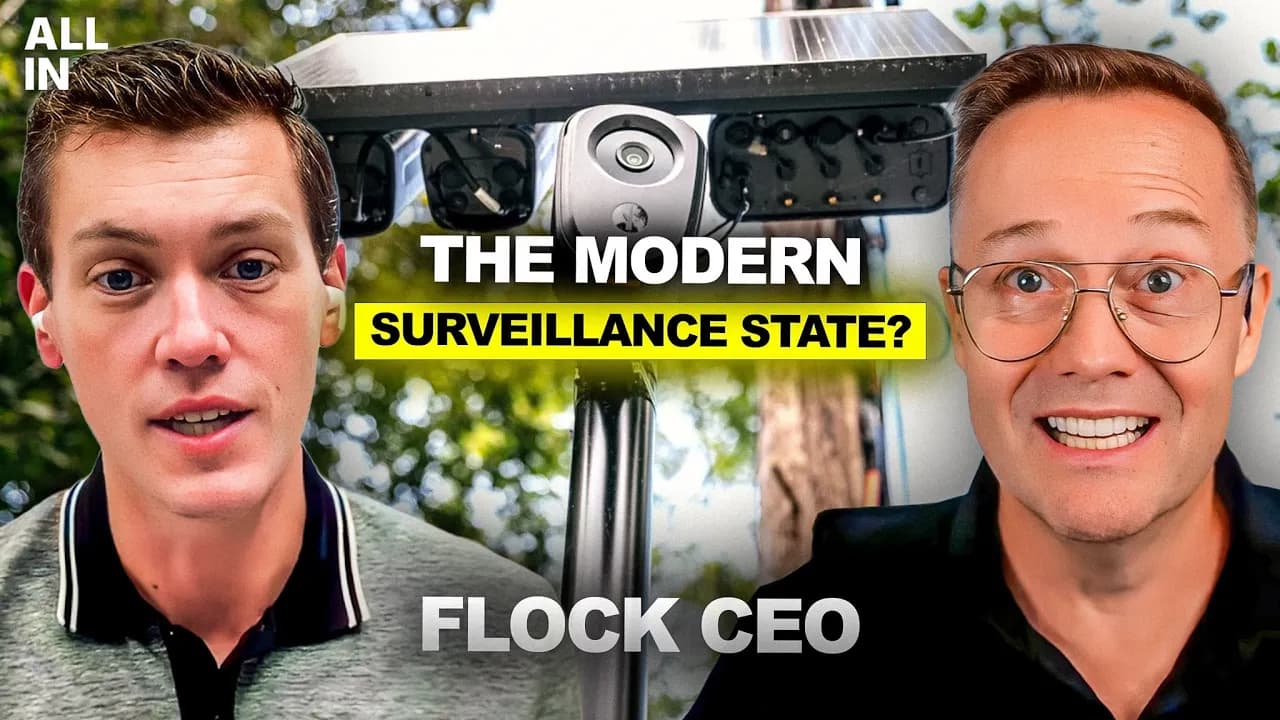
Flock has been installing cameras in cities, with some city councils rejecting them due to concerns about a surveillance state. The broader concern involves AI proliferation and cameras everywhere. The U.S. cannot return to the 1950s when cameras were not everywhere. There are more cameras than people, including cell phone cameras, home cameras, and business cameras.
The issue comes down to data governance: under what circumstances should camera feeds be shared with government, and how should they be used? The company builds license plate reading cameras with security controls. Concerns include officers searching for ex-girlfriends or tracking everyday Americans, which are considered morally offensive.
Ben Jordan, a thoughtful critic, argues against getting rid of the technology but emphasizes the need for good guardrails and safeguards. Federal regulation movement is expected after the election. Senator Holly is introducing guidelines with criminal penalties if police officers misuse technology for personal purposes, and safeguards requiring viable case codes before running searches. Two key systems require collaboration before searches, so an officer searching for an ex would need another officer willing to risk their career.
Ring did a Super Bowl ad that triggered negative sentiment about neighborhood monitoring. Ring has put safeguards in place. The company has a partnership with Ring focused on enabling homeowners to share camera video if a crime occurs, while making it difficult for police to randomly canvas videos. There is privacy work ensuring people know they control their cameras.
The speaker had a car stolen and had to get a technician to download video from a homegrown system, which took days. Ring allows faster sharing with police when needed.
The mission is to protect life, focusing on violence as a problem worth solving. Tasers reduce times police have to shoot and kill. Body cameras reduce risk of excessive force and protect officers from false accusations.
The company partnered with Skyo and became the largest investor in America's leading drone company. Skyo builds robotic autonomous docks where drones can fly from fire stations and reach scenes in seconds. This reduces times police respond to alarm calls, allowing focus on bigger calls. Drones sometimes reach scenes before 911 operators finish entering calls.
Agencies can share mission profiles with the public. Most agencies have policies against flying drones on patrol missions, only deploying them when called for help. Drones have been used to distract or prompt surrenders.
The debate centers on how much safety at what cost. People in poorest neighborhoods with highest crime rates most want these technologies. Concerns often come from wealthy neighborhoods where the issue is more theoretical. People dealing with gun violence cheer when police show up and want more technology for deterrence.
The best deterrence to criminal behavior is not long sentences but high probability of being caught and prosecuted. The challenge is building technology that meets ethical standards and makes the right trade-offs.
Rob Henderson's concept of luxury beliefs applies when people in safe neighborhoods oppose cameras they do not personally need. In June 2022, advisory board members quit after plans were announced to develop a taser-equipped surveillance drone for stopping school shootings. The board had voted against the project due to ethical and privacy concerns.
The project continues. The AI ethics board was set up to get feedback from civil liberties groups concerned about policing, not pro-police people. This led to safeguards in ALPR and other technologies.
The concept involves sending a drone or robot armed with non-lethal force instead of waiting for police with guns to have gunfights. Cops will not take non-lethal weapons against guns, but small drones shift the dynamic. Anytime bullets are introduced, innocent bystanders get killed accidentally.
The incident occurred post-George Floyd when advisers worried about cancellation. Many worked in universities and were accused of being pro-police. Many privately agreed the drone approach was better than sending cops with body armor and assault rifles, but it was politically risky.
The company did not give up. Many companies canceled their ethics boards, but the company reconstituted and rebranded as the equity and ethics advisory council. It now has more black and brown voices from communities most affected by overpolicing concerns, rather than being academically focused.
Rick Smith discussed the future of policing with humanoid robots and drones. Five companies are launching humanoid robots for commercial sale in the next 12 to 18 months at $10,000 to $30,000 price ranges. Smith stated that policing is fundamentally a human job, with any decisions about using force on another person being made by humans. This represents a bright line for Axon. The Taser drone discussed earlier requires human oversight with multi-key approval processes. Before any officer can operate a non-lethal weapon from a drone or robot, real-time approval from an administrator is required. These robotic systems are designed to provide institutional decision-making with multiple parties in real time, leading to fewer mistakes and less concern about abuse.
Axon invested in SkyO and bought almost half the company. Smith explained they wanted to buy as much as possible because they believe millions of drones will be deployed in the US in the next few years. They decided to leave SkyO as an independent company to maintain startup speed and ability to raise and spend capital without public company constraints. However, Axon secured exclusive rights to be the exclusive channel into the markets they care about. Drones and robots will arrive on scene before people have opportunity to get there, enabling better understanding of situations and safer decisions. The goal is to keep everybody as safe as possible.
Addressing concerns about maintaining individual liberties against a state equipped with advanced technology, Smith acknowledged the risk of significant concentration of extraordinary power. He identified as more of a libertarian while being a proponent of government's role in public safety. He noted that the government already has a monopoly on the legal use of force, with officers carrying lethal weapons making life-or-death decisions under adrenaline.
Smith compared current and future police response scenarios. Today, if police receive a tip about a dangerous felon in a house, they may enter with multiple officers in body armor carrying lethal weapons, making instantaneous decisions while adrenaline is surging. Human beings don't make good decisions under fight or flight response. In the future, police would send in a drone or robot with a team of operators rather than a single person in fight-or-flight response. Mistakes would result in non-lethal weapons like tasers or pepper spray. The entire operation would be recorded, unlike many police shootings today which are not recorded.
Smith emphasized that every robotic system deployment should have independent civilian oversight and review. He argued that police need enough technology to keep up with the rest of society rather than showing up in outdated equipment. Laws, regulations, and oversight must evolve to control government power, with good judiciary and balance of power ensuring accountability for abusive actions.
Regarding the DSA political class calling for defunding the police, Smith stated that defunding would be catastrophic. He referenced the 1968 Montreal police strike, known as the night of terror, where criminals heard police were on strike and the city went crazy. Steven Pinker used this example in "Better Angels of Our Nature" to demonstrate the need for functional police forces as the glue holding society together. Decriminalizing shoplifting after George Floyd led to catastrophic consequences, with downtown San Francisco being abandoned. This caused jobs to flee and created economic deserts where business models imploded due to lack of safety.
Smith described non-lethality as a great mission and emphasized that public safety is critical to underwriting all other social contracts. Without good public safety, none of the other social contracts work. He acknowledged uncertainty in the current environment, referencing The Economist's coverage of AI jobs apocalypse followed by reports that AI is making millions of jobs. Technology acceleration is leading to massive uncertainty. Policing may be the glue needed to hold society together during difficult transition periods.
Smith expressed optimism that 10-20 years from now will be a near utopian society, with technology curing many diseases and ills. He referenced Elon Musk's idea of universal high income as potentially fantastic, while acknowledging difficult moments during the transition. Axon's role is to arm police in ways that will be viewed positively in retrospect, putting good controls in place to help make people comfortable that society will get through this transition together.
Keep All-In Podcast in your library
Save the videos and channels worth coming back to, and find them again in one place.