From HOA Management to $4B in Revenue & $6.3B Deal for Amex GBT | Alexander Taubman, Long Lake
In a Nutshell
Long Lake acquired American Express Global Business Travel for $6.3B to deploy frontier AI into a $4B+ revenue business managing travel for half the Fortune 500. The company's core thesis is that AI deployment requires vertical integration—owning the businesses and workflows—to drive real ROI rather than selling software that people won't use. By embedding 70-80% shared AI infrastructure (Nexus platform) across 40 companies in five verticals while treating employees as customers, Long Lake achieves 99% accurate email automation, 6-month to days-long adoption cycles, and 90% better jobs that create retention advantages competitors can't match.
These notes were generated by AI and may contain inaccuracies.
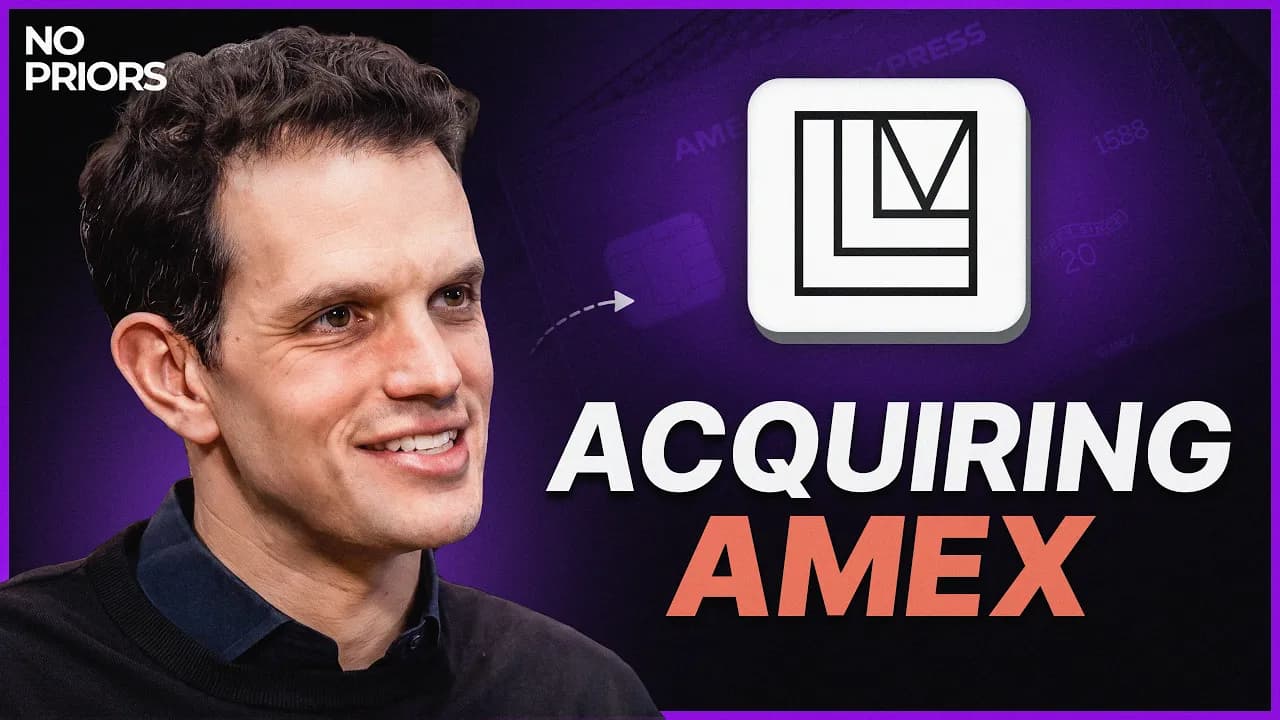
Alexander Taubman announced the acquisition of American Express Global Business Travel for $6.3 billion. The company is a 111-year-old business founded in 1915 by American Express to help evacuate their customers from Europe during World War I. The business manages travel for nearly half of the Fortune 500, a significant percentage of the global 2000, the US government and military, and governments worldwide. The acquisition aligns with Long Lake's mission to deploy AI into the real economy, as travel represents a multi-trillion dollar global sector growing faster than GDP.
Long Lake was formed three years ago with minimal public profile. The company deliberately avoided publicity, following the principle of "talk less, do more." The mission is to bring frontier AI innovations into real businesses and partner with American entrepreneurs in important verticals. Taubman was inspired by low-key, high-value Midwest entrepreneurs who built billion-dollar businesses in unsexy industries like construction and distribution without seeking attention.
Four years ago, AI models were impressive but couldn't perform basic addition. Recent developments show models solving the ten most difficult unknown math problems in history. Despite rapid AI advancement, deployment in the real economy has been slow due to legacy systems, legacy data, workflows, and change management challenges. Long Lake was formed to pioneer the diffusion of frontier intelligence breakthroughs into real businesses at scale.
The question of whether intelligence works has been resolved. Current market concerns center on financing trillions of dollars in AI infrastructure investments. The solution requires demonstrating ability to borrow against future cash flows from real economy applications. Long Lake focuses on deploying frontier innovations in high-ROI use cases, removing toilsome work like data entry and process-oriented tasks, freeing human capacity for customer-facing and growth-focused work.
Long Lake's approach differs from typical private equity models that focus on cost reduction through workforce elimination. The thesis centers on AI abundance and positive-sum outcomes. Historical productivity innovations have benefited the economy, wages, and consumers. Long Lake demonstrates that making people 50% more productive enables handling 50% more clients with better customer service, resulting in faster growth and increased hiring rather than workforce reduction. A salesperson achieving 3x quota increases demand for more salespeople, not fewer.
Long Lake operates across five verticals with 40 companies acquired total. The company started in homeowner association management, managing tens of millions of homes in associations. Additional verticals include HR services, specialty tax, infrastructure services (architecture and engineering), and now travel with the Amex GBT acquisition.
Taubman describes a Buffett-like approach of pre-mapping investment opportunities. Long Lake maintains a prepared mind for opportunities across 15-20 industries that are force-ranked based on evolving market dynamics. The company sees 4,000-5,000 deals annually across sectors, adding one or two new industries per year through a large funnel with tight filtering. The approach emphasizes keeping an open mind across multiple industries to increase chances of finding exceptional businesses with strong teams.
Amex GBT exemplifies Long Lake's target criteria: 90s logo retention, 100%+ dollar retention, 15-year average relationships with top customers, deep embedded partnerships, and mission-critical service delivery. Travel represents a small cost but mission-critical function where reliability matters during crises like wars or weather disruptions. The company had been building a travel thesis for approximately one year prior to the acquisition.
AI will make travel experiences more seamless, personalized, and proactive. Legacy systems in travel create messy data issues across supplier, customer, and distributor systems. Nexus, Long Lake's horizontal AI platform, addresses integration of messy systems. The platform is model-agnostic, using different models for different tasks or combining multiple models for single tasks.
Nexus is Long Lake's horizontal AI platform built across verticals. Approximately 70-80% of infrastructure is shared across industries, including model integration, intelligent model routing, security, and agentic orchestration layers. The remaining 20-30% involves embedding Nexus into specific business workflows and integrating with industry-specific data sources. This customization challenge requires world-class AI engineering teams working directly with field teams.
Long Lake engineers operate across nearly every state, with approximately 70% of the engineering team embedded with field team members across 15-20 states. This approach mirrors Kelly Johnson's Skunk Works methodology of placing engineers directly in operational environments. Engineers work alongside team members to understand pain points and iterate solutions based on real usage.
In HOA management, significant work involves complex email responses requiring research across multiple communities, vendors, pricing, reviews, and scheduling. A single email can take 45 minutes to an hour to craft. Nexus drafts these emails overnight with 99% accuracy, reducing the task to 5-10 minutes of editing. The system has learned individual manager writing styles and applies this capability across all verticals since most businesses handle substantial email volume.
Fifty-five percent of travel agent inbound queries involve email communications for bookings, changes, and cancellations. The email automation capabilities developed for HOA management transfer directly to travel operations. Long Lake has received acquisition interest for Nexus as standalone software but declines to sell it, preferring to maintain focus on outcomes and industry transformation rather than software licensing.
The approach requires being an owner operator. Nexus takes AI breakthroughs happening at the frontier and deploys them into businesses for real outcomes: faster growth, better customer experience, better team member experience, paying team members more due to increased productivity, and ultimately shareholder returns. The vertical integration of owning the platform and deploying it only into owned companies creates significant alignment.
Larry Ellison's perspective is that it's not a software program problem, it's a human problem. There's no point in selling software if the way people work doesn't change. The solution is to own the company and control the workflow.
The Nexus platform does not force anyone to use the tools. If someone has to be forced to use the platform, then the platform is not good enough. The approach treats team members as the customers. With 30,000 team members operating globally across all sectors, the goal is for Nexus to be so magical that when tools are introduced, they go viral inside the company.
Adoption rates have improved dramatically. Previously it took approximately 6 months to activate a cohort, but now with better models, better products, and better deployment playbooks, cohorts activate in days.
For an HOA management example, if someone works there and uses Nexus along with other tools being built, their job becomes 90% better. This also protects retention because another HOA service company would not have these tools, making it undesirable to leave.
The vision is to become a talent magnet and the best place to work in every industry operated in. Building the best tools for people makes them more productive so they can make more money and have better jobs. Team members report that mental friction from the 30% of work involving manual rote tasks like responding to emails and data entry is eliminated.
People want to focus on getting more customers, understanding customers, and interacting more with them. By enabling more of the fun parts and less of the dull parts, team members love their jobs more, make more money, and won't want to leave for competitors that lack these tools.
If the best people in every industry use the best tools, this creates a much better customer experience, leading to faster growth, better customer retention, more money made, and the ability to pay people more. This represents the positive sum vision of AI deployment.
The combination of experience in finance, ability to recruit the best technical AI talent, and execution capability makes Long Lake unique. The team came together through network connections, with Zach and Alex first meeting at Goldman Sachs.
The team at Long Lake level consists of approximately 55-56 people, expected to reach closer to 100 by year end. Approximately 90% are AI engineers, operations, and deployment folks, with 10% focused on acquisitions, M&A, and finance. The team is purpose-built because the vision started with helping change the whole economy.
Approximately 75% of team members come from referrals and in-network referrals. The hiring funnel is extremely tight, hiring 3% of applicants with close to 1,000 applicants seen in one quarter.
Three things must be done at world-class level to deploy this technology: buy great companies well through a great M&A function; build amazing world-class technology that rivals the labs or best applied AI companies; and execute change management operations.
High bar in talent, high bar in acquisitions, and high bar in technology are essential.
Grew up in a family of entrepreneurs. Grandfather started a real estate business after World War II and essentially invented the shopping center. The book "Threshold Resistance" describes his concept of wanting the shopper to be more likely to go into the store. Stores used to be designed with big windows and merchandising requiring customers to go through dark alleys to reach doors in the back.
The idea was to bring the door to the front with no threshold, eliminating even half a step up which reduced foot traffic by 20%. This continuous improvement mindset and making things magical and easy for users directly applies to making Nexus so magical and easy that team members love it, minimizing threshold resistance on AI adoption.
The business was called Long Lake because the family business was built and lived on Long Lake Road for the last 40-50 years in Michigan. Growing up in Michigan meant tremendous respect for the American entrepreneur. There was no finance scene or tech scene, only people building what East Coast might call unsexy businesses that are actually amazing businesses built over 50-75 years.
An architecture business in Minnesota partnered with was built 50% of K-12 schools in Minnesota over the last 70 years. These are iconic American entrepreneurs who bootstrap their way to build huge businesses providing unparalleled service in their markets.
The mission is bringing the best of the intelligence revolution and the best engineers in the world to help iconic American entrepreneurs across industries deploy AI into their businesses to make team members happier, make customers happier, improve bottom line, and grow faster. Deploying technology in the real world and driving real ROI generates cash back into the system to scale the models.
Long Lake acts as distribution for the labs by generating ROI in the real economy on intelligence to reinvest into scaling the models. Technology changes way faster than human nature and human behavior. The bottleneck is changing what people actually do.
There are real hard technical problems. Taking a 100-year-old business's systems and data and problems that are global with each customer having different optimization needs, and scaling that with Nexus and diffusing AI into that whole stack represents genuinely difficult technical work.
Started career at Goldman Sachs in the internal investment unit called Special Situations Group. Fell in love with capital allocation and the idea of putting resources of the economy into the highest and best use. Worked up and down the capital structure from debt to equity, public and private, across all industries.
At age 22-23, managed a couple hundred million of invested capital with guidance from mentor Patrick McCain, which was very formative.
After business school, went to Oak Tree and partnered with Patrick McCain, working directly with Howard Marks and Bruce Karsh. Started Oak Tree's first equity business and got involved in credit businesses.
Favorite case at business school was Danaher, with its long-term compounding model having structural advantage, ability to operate businesses better, better cost of capital, and best people.
While at Oak Tree for almost 10 years, worked with family to build out Tobin Capital, the family investment business using their own money. Partnered with founder-owned companies and completed close to 50 deals, which is where the learning about how to buy companies occurred.
The transcript ends with: "So that's where you learned how to buy"
Alexander Taubman learned how to buy companies through a combination of his experience at Oak Tree and his work with Toddman Capital. Oak Tree focused on larger public companies, while Toddman Capital involved smaller and mid-size businesses. Tomman Capital achieved approximately 70% IRR over a successful run.
Taubman discovered that remarkable businesses exist across all sizes, not just large public companies. He cited a Minnesota business that has built most schools in the state for 70 years as an example of an amazing business. This experience resonated with his Michigan roots, allowing him to partner with entrepreneurs and help grow their companies.
Toddman Capital brought permanent flexible capital with a long-term horizon. They avoided short-term quarterly earnings focus and overleveraging companies like traditional private equity funds. The approach emphasized being long-term growth investors in great American businesses, partnering with great founders.
They provided growth resources, M&A resources, and capital to founders who had built amazing businesses but never done acquisitions. This helped founders consolidate industries and become bigger scale players with industrial logic.
Long Lake combined Taubman's passions for partnering with founders, technology, and capital allocation. Early investors included Rick (an extraordinary investor and one of their biggest partners), Hmont at General Catalyst, Mark, and El Gil. These investors pushed the team's thinking and level of ambition significantly.
Rick described Taubman as unusually receptive to both new ideas and criticism, unlike many headstrong founders. Taubman views feedback as a gift and emphasizes getting better every day, applying this to companies, team, and himself personally.
Long Lake onboarding includes approximately half a dozen of the podcast episodes because Taubman learns more from these episodes than from almost anyone else.
Taubman and Zach go way back from their Goldman days. Zach brought Taubman into technology deals and invested in a Toddman Capital deal involving a go-kart track platform. They partnered with 20 different locally owned go-kart tracks to build one of the largest go-kart track companies in America.
This experience reinforced that great businesses exist that people don't spend much time thinking about. The idea was to bring world-class technology expertise from companies like Ramp and Cognition to main street American businesses and enterprises.
It took approximately nine months from the first conversation about the thesis to incorporating the company. Taubman was still at Oak Tree during this period. They spent significant time meeting early engineers who eventually joined.
Taubman was excited by the palpable excitement among engineers when discussing the idea, indicating they could build an extraordinary team. The company's ambition and vision continue to increase over time.
The vision was always big from the beginning. The Amex GBT deal surprised even close observers who didn't initially think a $6 billion acquisition was possible. The execution has exceeded expectations, with the team getting better over time.
When considering several acquisitions, Rick suggested doing them all rather than choosing between options. Partners make the team more ambitious. The company discussed changing many industries and the economy from the start, which initially sounded lofty.
The team now operates in 15% of the services TAM with tens of thousands of team members, making the vision feel achievable. Early founding partners had to be convinced to leave technology jobs, with some even dropping out of school to join.
The team's rule is that each incremental hire must make them better and raise the average. They've bought close to 40 companies across five industries. They've built processes, a playbook, and the Nexus platform for redeployment.
The ambition level includes the perspective that if Long Lake doesn't buy Amex GBT, then who should? The team plans to continue this work for the next 50 years.
The combined businesses, including Amex GBT, are expected to generate over $4 billion in revenue next year. The revenue base is stable with 100% dollar retention. The strategy focuses on buying established profitable businesses with 20-25%+ EBITDA margins.
The company never needs to raise capital again, generating enough cash flow from existing assets to compound through internal reinvestment for decades.
Tremendous investor support and interest helps inspire bigger thinking and faster movement. Taubman values long-term partnerships over bidding contests, referencing his family's real estate business where partners lasted 50 years and partnership was treated higher than family.
The emphasis is on partners who help execute the mission and increase ambition level, not just provide capital. Hmont at General Catalyst led the first round with $100 million when it was significant capital three or four years ago.
Long Lake doesn't have to be public, but the maximally ambitious path involves going public. Public markets provide deeper and lower cost of capital, representing the biggest stage with deepest capital pools.
Great holding companies like Henry Singleton and John Malone proved that executing over long periods earns currency trading at lower cost of capital, enabling more ambitious actions.
Singleton was a math genius on the Putnam team at MIT and served in the Office of Special Services. He compounded earnings per share over 40% annually for 20-25 years. Buffett called him the best capital allocator and best operator in America.
Singleton's key principle was staying flexible rather than creating detailed strategic plans. His quote emphasizes steering the boat a little bit every day because nobody can predict outside forces. This philosophy supports Long Lake's open approach to different industries.
The team never planned to enter travel when starting the company. They built a thesis on travel through maintaining an open mind. The Amex GBT deal represents one of their most exciting acquisitions, involving an iconic business with gold-plated customer excellence and AI improvement opportunities at a reasonable multiple.
Malone excelled in creative structuring and financing. He was a first principles thinker who asked "why" five times to reach root causes. This root cause thinking is embodied in Long Lake's investment and capital allocation processes.
The focus on understanding why businesses are good is critical for permanent capital deployment over decades. First principles thinking about post-AGI business sustainability is considered the most important capital allocation factor currently.
Stock selection becomes a stock picker's market with significant dispersion between winners and losers over the next 20 years. Post-AGI, the gains to winners will be even more extreme. High-quality services that preserve and expand ecosystem positions can become orders of magnitude more valuable.
Lower quality businesses that are easier to disintermediate and don't provide enduring value-added services will disappear, reducing economic friction.
Long Lake has never sold any businesses and has no plans to sell. The focus is on whether value is being added and whether Long Lake should remain in the business. The goal is to let investments compound over long periods rather than sell after building technology, teams, and market positions.
Taubman plans to continue this work forever. The company has received acquisition offers but hasn't entertained them because they're not sellers. The maximally ambitious approach aligns with Torson's philosophy of not selling for any price when building something mission-driven.
Zach Dell wants to work on this for 50 years to see how far it can be taken, emphasizing it's not about paychecks given his background.
Taubman believes they can build a trillion dollar company through the power of compounding. Long-term thinking and non-sale approach enables tripling business value every 5 years, potentially reaching trillion dollar scale over 20 years.
The challenge involves maintaining execution quality over decades, avoiding mistakes, retaining top technology talent, and delivering world-class customer excellence. The TAM encompasses the whole economy, making the potential staggering if execution continues successfully.
The first time Long Lake got name dropped on a podcast, people were surprised because the company had been relatively stealth despite aggressively buying and executing on deals. The Amex deal caught the attention of one of the 10 best entrepreneurs in the world, who reached out asking what was going on with Long Lake and how to get involved.
Thank you so much. Honored to be here.
Listeners are encouraged to subscribe wherever they're listening, leave a review, and check out the Founders podcast. The host has obsessively read over 400 biographies of history's greatest entrepreneurs for almost a decade, searching for ideas that can be used in work. Most guests on the show first found it through Founders.
Keep David Senra in your library
Save the videos and channels worth coming back to, and find them again in one place.