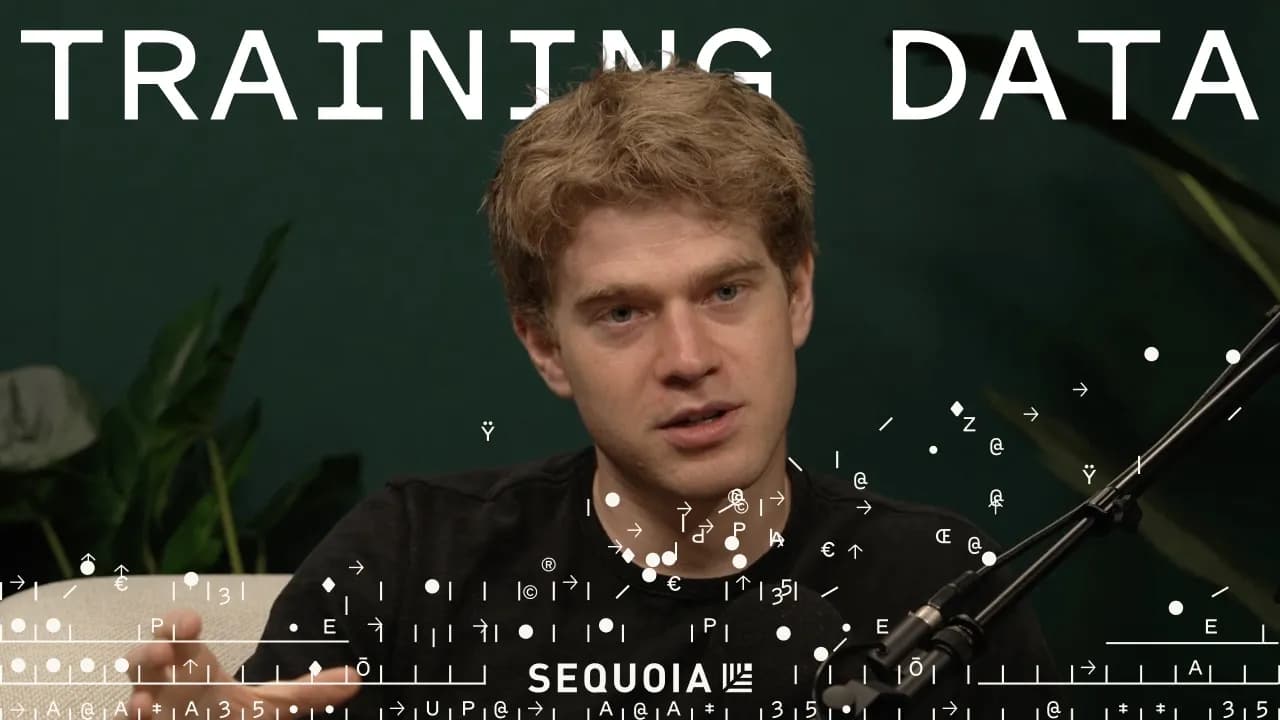
Re-Founding Incumbents for the AI Era with Sequence Holdings Co-Founder and CEO Michael Lee
In a Nutshell
Sequence Holdings is a permanent AI-focused holding company that acquires established companies with strong competitive advantages, then uses proprietary platform technology (Atlas) and engineering talent to restructure their operations for the AI era rather than relying on traditional software or consulting approaches. Their first major deal was the $7.7B acquisition of insurance broker Baldwin, following a successful pilot at BankSouth where they achieved 94% reduction in loan underwriting time and doubled loan volumes. The model succeeds by creating a culture celebrating engineers over investors, maintaining long-term ownership alignment, and focusing on dense, centralized organizations where AI agents can be deployed at scale across 80% reusable workflows.
These notes were generated by AI and may contain inaccuracies.
Every company on earth has a personality it celebrates. In a world where you believe that added value comes from engineering and artificial intelligence, you need to create a culture where the engineer is the celebrated figure. If you think about your usual investment in a fund, you're typically trying to figure out how to get that thing up and running and sell it within 3 years. This is a completely different framework for how we think about technological transformation and what investments you are prepared to make here. Sequence Holdings tries to complete one deal per year. That's all. Their mission is to accomplish only one.
Michael Lee is co-founder and CEO of Sequence Holdings. They have just announced the largest AI-powered private equity deal to date, partnering with the Dell family office to acquire Baldwin for $7.7 billion. Sequence Holdings is a permanent holding company that works with management teams to buy and refinance their companies to become market leaders using artificial intelligence.
The field of mediation is an area where Sequence has spent a lot of time since the business was founded. They met with dozens of insurance brokers, and Baldwin was truly a unique case among all the insurance brokers they met. It has been an honor over the past few months to spend a lot of time with Trevor Baldwin and the management team, and they couldn't be more excited about the journey ahead with the Baldwin team and the Dell family office who supported them in this deal.
When Michael Lee first joined Lone Pine in 2017, one of the first areas he was asked to cover was artificial intelligence. That was around the time AlphaGo came out, and also when the first paper on Transformers was published, when there was a lot of excitement about what could be commercially viable if these architectures were scaled up. At that time, convolutional neural networks (CNNs), generative adversarial networks (GANs), long short-term memory networks (LSTMs) and the like were prevalent.
When the models emerged, or when ChatGPT was released at the end of 2022, it became clear that the world had changed forever. They had finally obtained a structure that they knew was capable of scaling without limits. As an investor, Michael began to think about the effects on the world and felt strongly that artificial intelligence would have a disproportionate impact on the economy.
There are certain parts of the economy that artificial intelligence would not affect at all, such as restaurants and golf courses. There are certain industries where startups were going to win. Take programming as an example. The idea of Sequence buying an external software services company seems like a bad idea; instead, they would give the money to companies like Cognition or Anthropic.
But as a student in the business world, there were always certain industries where established companies had all the advantages, whether it's branding, size, network effects, or regulations. In light of what will be the biggest technological shift of our lifetimes, if you could acquire the right existing company, and inherit the advantages of being that company, could you create a market leader? The essence of that idea is what Sequence was founded upon.
The idea came to Michael in early 2023, and a handful of people tried to convince him to leave Lone Pine to do it at that time. The timing wasn't right for him then. He remembers being on a walk with his wife in 2024, and telling her: "What a rare thing in life to be at the heart of the most important technological change of our time, and to have the core of an idea that I believe in so strongly, with a strong feeling of being able to assemble the team needed to make it happen." That's why Sequence was founded.
Sequence's approach is based on the first principles of understanding the overall change that is taking place in technology, and how it will affect the economy. They think they are living through the equivalent of the next industrial revolution. What they generally see in most organizations, and what they usually see from many of the software companies that produce AI agents today, is a huge trend to give small machines to every human on the human assembly line.
There is nothing wrong with that. This is amazing. It's better than nothing. But when you have machines that can operate around the clock, that can expand as electricity becomes available, and that can accomplish what no individual or group of humans can do, the right answer is to think about: How do you begin to reorganize the organization to meet the opportunities available to you through technology?
Sequence believes there is a real opportunity to partner with amazing companies with great leadership teams, and to connect that with their platform and their engineering team, and to think seriously about how to restructure the organization. How can they make the most of what this technology can do? What can humans do? And to rethink how to compete in these diverse sectors.
When considering what was needed to achieve what Sequence Holdings aspired to, which was how to form partnerships with global institutions, how to utilize advanced engineering, and how to build a platform that they can share across all their portfolio companies, the only natural way to do this was through a holding company.
How do they build a business that can produce market leaders? How do they balance the duration of capital, sustainable investments, and operational commitments required to drive the entire transformation? How do they create a culturally oriented entity that focuses on building market leaders, rather than simply employing capital? Finally, how do they create the right structure through which they can use retained earnings to rethink how they support their existing businesses and new investments?
Regarding ownership, let's say your company is amazing, and we won't specify which one. Let's assume we are a Fortune 500 company and we have unlimited resources. If challenged with the mission to re-establish the company, there are three options.
The first is that you do it yourself. The structural challenge is the impossibility of recruiting and retaining the talent needed to accomplish this re-establishment process. The reason is that every company on earth has a celebrated personality. Take Blackstone as an example. An amazing institution. The celebrated figure in Blackstone is the investor. That is why they are able to gather the greatest investors in the world. In a world where you believe that outstanding returns come from engineering and artificial intelligence, you need to create a culture where the celebrated figure is the engineer.
If you can't acquire the talent to do it yourself, there is this huge, multi-billion dollar industry that has formed and is called the service industry. These are great companies, such as Accenture, McKinsey, and Palantir, that truly celebrate the engineer, and truly celebrate technology change. But the challenge when partnering with a service provider in terms of rethinking and restructuring your business is the problem of incentives. Service companies work to improve three things: access to your wallet, staying in your wallet, and increasing their share of your wallet. It is a path towards gradual change.
To make matters worse, service providers can't actually change the things you really need to keep up with the moment. How has the way people are organized, who works in these organizations, and what incentives have changed?
If you can't do it yourself, and you can't use vendors, you have a third option, which is that you buy the software. The challenge in purchasing software is twofold. What is clear from both of them is that it is a trial version. If it is available to everyone, it is available to everyone. The most subtle aspect that people often overlook is that if you were to start a software company, the thing you would improve is what a reasonably consistent workflow is that exists in many places. Then how do you install them quickly enough but deeply enough so that you can sell a lot of them but they remain stable?
Those will be the genes they will be looking for. But what that means is that you will always sell to a workflow as it is designed today. Humans are also being prepared on this human assembly line today. It's the only way you can sell a product. You can't sell a product about a new human assembly line that doesn't exist today just because that's what you think.
When thinking about why their approach is successful, it's about how you take ownership and, therefore, are aligned with the goals. How do you create an organization like Sequence Holdings that celebrates the engineer and employs the latest engineering technologies? Third, how do you push for a long-term economic model to be aligned with management on how to craft the best possible version of this company based on the technology available today?
Sequence has a team that combines the expertise of Scale and Palantir, and they strive to maintain a very high level of quality. What attracts the team and engineers to work at Sequence is a combination of things. The first one is the opportunity to work in companies that are, in reality, the arteries through which people interact. AI modeling companies are truly amazing. They would not have reached where they are today without Anthropic, OpenAI, xAI and the like. But the reality is that the impact on people's daily lives will depend primarily on the companies that currently serve them.
For Sequence, it is an opportunity to partner with important companies that play a pivotal role in the economy, and to think seriously about how to employ world-class technology to deliver outstanding experiences for their customers. When thinking about the two types of engineers they typically hire, such as field engineers, what attracts them is the opportunity to be directly associated with the value they create. It is seen as a very rewarding experience, and the ability to effect a kind of change that cannot be achieved if you are just a service provider, is very appealing.
On the other hand, when talking to application software engineers, they say: "We are one of the few business models in the world that are completely immune to what models will do." With the models performing better, they celebrate here at Sequence; this gives them more tools to offer to the companies they partner with. There is no real existential threat to the survival or demise of their business.
When Sequence started this business in March of last year, when Michael made his first investment in Sequence, they had a cold start problem. The holding company model is a rather unusual business model. Without money, you can't make a deal. If you don't have a deal, you can't hire engineers. If you can't hire engineers, no one will give you money.
They managed to get a handful of engineers to work with them. But they remained stuck in the cold start problem, where there was nothing really to do. One of the things they discussed at that time was: Should they buy anything to prove to the world that they are capable of buying and changing, or should they wait for the right asset? They have always had a tendency towards large-scale and large institutions. Unfortunately, there aren't many investors in the world who would be willing to give you hundreds of millions of dollars to buy a company just to see if your technology works.
They decided to move forward and take over one of the clients. They contacted a dear friend, Jimmy Reynolds, who is one of the co-founders of Avenir. They explained the matter to him, saying: "This is the problem we faced." Fortunately for them, his family happened to own a bank in Georgia. And so he became their first customer. This began in August of last year. Actually, it was on August 4th, and it was Michael's wedding anniversary. He remembers that he was absent from it. It was an amazing experience.
From August until approximately late November of last year, they operated on a service system and actually began to address the basic workflow at the bank. Fortunately for them, the family asked them at the time if they would like to become permanent partners. And so it became their first investment. They completed the investment in March, and it took some time to negotiate and obtain approval from the Federal Reserve and the Office of the Comptroller of the Currency.
Working as a service provider and then becoming an investor made a huge difference. It involves many aspects. One of them is from an engineering perspective, where you know you'll be here for a long time. Therefore, the level of complexity and depth that you are willing to tolerate compared to being a service provider, knowing that you will eventually leave and leave applications for others to maintain, is clearly different.
The second thing is that there is great enthusiasm among the employees, as they say: "These people are here to support us for a long time." So, how can they present the most ambitious version of this work? Third, they can really adopt a long-term approach to what they want the bank to look like 3, 5 or 10 years from now. And how do they lay the technological foundation to ensure they continue to benefit from the model's performance?
In a strange way, the bank was the perfect test case for what they needed to validate their business model. It was an opportunity to buy a minority stake, with a bold investment, to operate in a real corporate environment. Strangely enough, the bank's regulated nature was an advantage rather than a disadvantage. One of the good things about regulated institutions is that their working methods are clearly defined. The data organization is excellent. There are clear rules about how your business should be conducted. So if you think about it in this context, it works extremely well for agents.
The other really important part about banking, which was a big lesson for them in terms of how they think about investing, is its centralized nature. When Sequence talks about the companies they are looking for, they talk a lot about the "physics of organization." They like dense organizations with centralized operations. So that anything you build on a large base can be consumed.
Take a bank as an example. A bank may have a number of different branches, but all subscription processes are done centrally. Therefore, everything they build at headquarters is distributed to all the branches they deal with. Compare that to a lot of the mergers seen in the market today, which is a great strategy, but involves a lot of complexity. You need to integrate different systems, send engineers to several locations, and standardize operating procedures. You must unify the cultures.
For Sequence, the good thing about the bank is that despite being a large institution with sales exceeding $100 million, the work physics there is extremely intense. Therefore, they were able to make great progress in a short period of time. There is a central nervous system. There is an accounting record. There are some key processes. There are tools you can use economically.
The field of mediation has been an area where Sequence has spent a lot of time since the founding of Sequence. It fits with many of the things they are looking for. What they generally look for as an organization is first the size of the market. What they do here at Sequence does not allow for rapid expansion. Therefore, if they are going to make an investment, they need it to be valuable. They want to work with companies that they believe they can build to a value of more than $100 million. They wouldn't do this 10 times a year. They are not an investment store. They partner with great companies to build leaders.
The second thing they paid close attention to was: Is it a sector where the current competitors enjoy all the advantages? Third, if they consider what the organization is doing and what artificial intelligence is good at today, and look at the points of overlap, can they build something unique? The brokerage industry is suited to all of that in many ways.
It includes premiums exceeding $2 trillion annually that go to insurance companies. Brokers receive a commission from this, and it is an industry that has produced dozens of large, skilled companies over time. In addition, it is simply a fascinating industry that has been very difficult for startups to compete in. This is due to reasons that are less obvious to people than they think.
If you think about the insurance value chain, it consists of three parts. You have the insurance companies, the distribution partners, and then the customer. The insurance company makes money in two ways. You have the underwriting, where they price the risk and hope to pay out less in claims than they receive, and the other part of the business is investing. The insurance industry has almost never made any money from underwriting, and has generated the main part of its profits through investment. Therefore, what motivates this is the accumulation of assets. Therefore, obtaining high-quality underwritten premiums is the basis of the game. This is why the brokerage industry is so strong.
Another interesting feature of the brokerage industry is that your client does not actually pay you. Rather, it is the insurance company that pays. So, if you consider the nature of the work, which is a work that focuses heavily on relationships, the overall retention rates are 90%. And if you consider the fact that the middleman can't really compete on price, it's a very difficult industry for startups. So, if you think about what's ideal for Sequence, it's a huge market and companies that are largely immune to the risks of startups.
But what if they could partner with the right company? This is what the Baldwin opportunity offered: a huge asset with a centralized technology base and an ambitious, world-class leadership team, extremely excited about what is possible today thanks to advanced technology.
If they take a step back, they are thinking of their shared platform capabilities as two broad areas. The first is "Atlas," which is their platform. Then they have their engineers, and they have a working manual on how to collaborate with companies. This is more like art than pure science. They often jokingly say within the company that they have two problems here at Sequence. They have an engineering problem and a human engineering problem, and the human engineering problem is much more difficult than the engineering problem.
If they think about the engineering problem, they think of Atlas. So, what is Atlas today? Atlas is their platform that they built at the bank, which they expect to be rolled out across different sectors over time. Part of this is due to an observation made by a number of their engineers from their previous experiences in companies such as Palantir and others, which is that if you break down a business into its basic units, you will find that 80% of it is very similar, while 20% of it is specific to a particular sector.
So, if you think about what Atlas represents, it is simply their platform that does several things. First, it helps improve deployment speed, enhances agent performance, improves build rates for their engineers, and ultimately, it is a development platform that allows operational company engineers to
Sequence Holdings has built a four-layer development platform that operational company engineers can build upon. The first layer is the data ontology, which defines how organizations and work movement are represented in software form. This enables models to understand and read the business, including how to identify the same customer across different systems and how client characteristics relate to claims or loan policies.
The second layer is the agent-building tool for constructing high-performing agents based on solid facts. The third component is Lattice, the coordination engine that manages workflow using the built agents. The fourth and top layer is Artifacts, the application-building tool that sits atop the entire platform.
The basic infrastructure established at Atlas and the bank is reusable at Baldwin and any future company established by Sequence Holdings.
The work manual aspect is described as more of an art than a science. Engineers from Scale AI and Palantir have already developed this workbook, but Sequence Holdings takes a completely different approach. Following the bank investment, the company learned the importance of being more accurate and sensitive to employee feelings, as AI transformation raises significant organizational concerns.
The key focus at Sequence is making people feel that the offering enhances their role, bringing out the best human qualities at work, making jobs more enjoyable, removing repetitive routine tasks, and creating a sense of organizational success. This work manual continues to develop through learnings at the bank and Baldwin.
Traditional private equity operates within investment fund structures focused on investing capital, finding great assets, pricing them attractively, establishing suitable capital structures, and generating required returns. Sequence Holdings operates differently by finding global organizations run by exceptional people and taking a very long time horizon to build market leaders.
While many private equity firms will make progress on AI through operations, they face constraints including difficulty recruiting world-class engineers, as typical PE firms are designed to celebrate investors rather than engineers. A 25-year-old engineer having opinions on investment profiles would be unusual at traditional firms.
The time horizon difference is significant—traditional funds typically prepare assets for sale within 3 years, creating a completely different framework for technological transformation investments.
Sequence Holdings completes one deal per year with a very focused, deliberate approach. There is no specific schedule for distributing investments, and no group of investors or limited partners pressuring for deal volume. The mission is to complete one deal, even if that means no deals in a given year.
When evaluating management teams, Sequence looks for teams that are distinguished in their field of expertise and have actually driven change through technology adoption. This includes teams that have started centralizing data infrastructure, installing OpenAI or Anthropic across their organizations, and making efforts when returns on AI investment are not yet obvious.
Baldwin serves as an example, with CEO Trevor Baldwin pushing Anthropic completely inside Baldwin and working on a single version of Applied Epic, the Agency Management System that serves as the primary operating system for insurance brokers.
Following the March investment, the bank transformation has achieved significant results. The bank was broken down into three aspects: deposit acquisition, loan origination, and the core middle/back office apparatus for underwriting.
Historically, loan volume grows linearly with middle and back office staff due to complex loan processing. Since March (approximately 6 months), the bank has built a system that handles all consumer loans, reducing average consumer loan underwriting time by 94%. Commercial loan underwriting services have reduced average loan processing time from 30 days to 11 days.
In Q2 compared to Q1, the bank's loan volumes doubled. The bank was able to handle this increased volume without changing underwriting standards, using a smaller underwriting team than before the investment. One person retired and another moved to the front office, demonstrating how the right people can be positioned in roles they enjoy.
Loan officers now spend more time in the field instead of writing credit memos, and credit underwriters work on the most difficult and complex loans rather than routine tasks.
The bank transformation has laid groundwork for launching new products and businesses, equipping loan officers and relationship managers with new tools to sell more products, and delivering superior customer experiences that competitors cannot provide.
The biggest realization after founding a company is the dramatic increase in sympathy for founders. Building something from nothing involves significant challenges in attracting people and capital to join the journey. The experience involves very high peaks and very deep troughs, with days of extreme loneliness, but remains extremely enjoyable and rewarding.
The partnership with Dell's family office emerged from the need to secure capital for going private. Despite ambition and brilliant partners, most individuals lack billions of dollars to back letters of commitment. The Dell family office, including Michael Dell and Dan Pittar (Head of Global Private Equity), worked closely on the Baldwin deal, covering the technology platform and supporting the technology transformation process. They jointly control Baldwin together.
Michael Lee's career path includes Goldman Sachs after university, Apollo for learning deal structuring, capital structures, credit agreements, and private equity fundamentals, followed by Lone Pine where he studied the world's best companies including Nvidia, Microsoft, and Visa.
The five years at Lone Pine provided powerful learning about what constitutes great businesses and the benefits of long-term cumulative returns. Building a private investment business at Lone Pine allowed time at technology frontiers, spending time with founders working on difficult problems and understanding where technology is taking the world.
Michael Lee emphasizes that ideas are cheap while execution is extremely difficult. Truly exceptional people will always find ways to make things work, whether by attracting others who highlight their weaknesses or persisting to convince the right people to support ambitious visions.
The philosophy is to bet on exceptional people working on tough problems in huge markets, even if ideas seem crazy. This human-based business approach applies to both early and late stages, with the belief that high returns from supporting such people largely compensate for remaining risks.
The best investments at Lone Pine and the best companies in markets today all come down to finding exceptional people, with Jensen Huang cited as an example of consistent clarity of thought, stunning execution, and ability to surround himself with the smartest and most loyal people while constantly re-establishing businesses for changing markets.
Keep No Priors: AI, Machine Learning, Tech, & Startups in your library
Save the videos and channels worth coming back to, and find them again in one place.