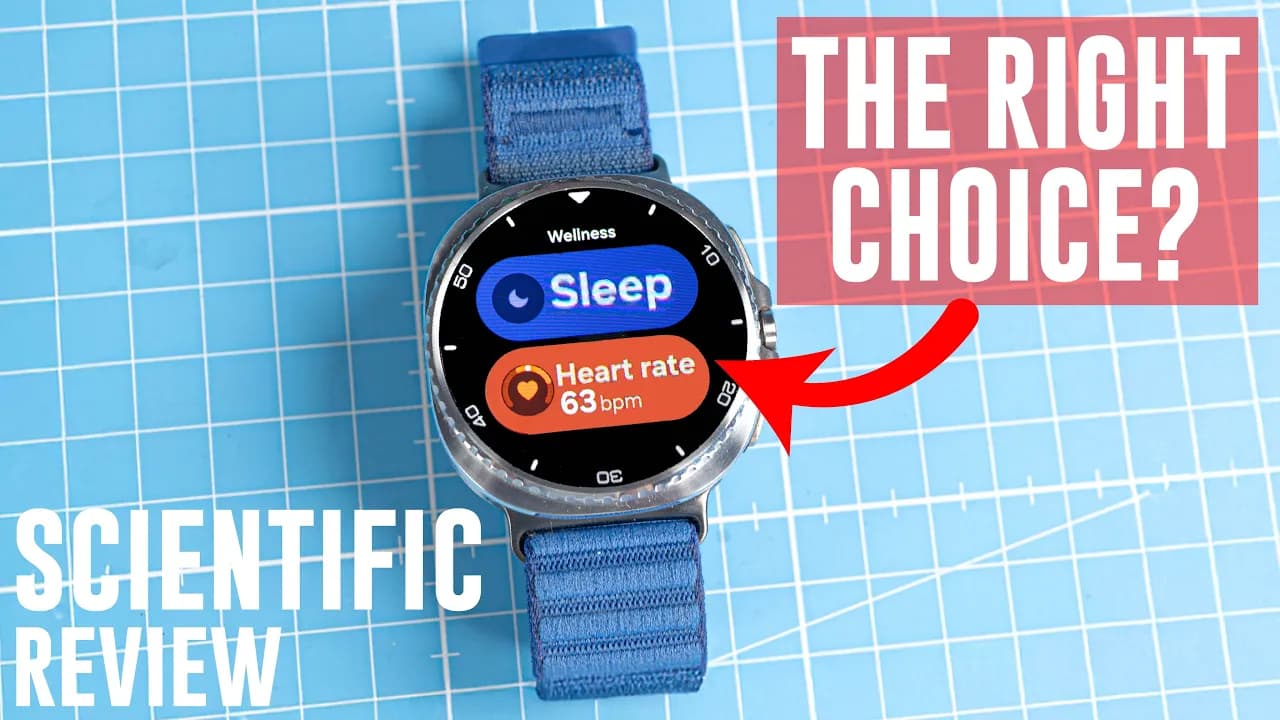
Galaxy Watch 9 & Ultra 2 - Initial Scientific Review!
In a Nutshell
The Galaxy Watch Ultra 2 and Watch 9 delivered strong heart rate tracking with 0.98-0.99 correlations across cycling and running, outperforming 69-88% of competing devices. Sleep stage tracking placed both in second-tier performance, correctly identifying 81-86% of deep sleep but over-detecting REM and light sleep stages. GPS accuracy on the Ultra 2 was notably good, marking the first positive recommendation for recent Galaxy watches in scientific testing.
These notes were generated by AI and may contain inaccuracies.
The Galaxy Watch Ultra 2 and Galaxy Watch 9 were tested for sports and health tracking capabilities, including indoor cycling, running, and outdoor cycling. GPS tracking and sleep stage tracking performance were also evaluated. Both devices performed surprisingly well in initial testing.
For indoor cycling (spinning), the Polar H10 chest strap served as the gold standard reference device. The Galaxy Watch Ultra 2 achieved a correlation of 0.99 with the reference device. Each dot represents a single heart rate measurement, with values clustering close to the blue line indicating strong agreement. The session data showed good overlap between the reference device (blue-green) and the Ultra 2 (red) with only minor deviations.
During running, the correlation was 0.98, which is acceptable. Most data points remained close to the blue line, though some deviation occurred in the higher heart rate range. The Ultra 2 occasionally registered slightly too high or too low, but overall tracking remained quite good. The run session showed occasional brief spikes of a few BPM too high, but nothing problematic.
Based on two short bike rides, outdoor cycling results showed good performance. Most points clustered close to the blue line with a correlation of 0.98. Some points fell slightly below or above the line, but deviations were minimal. The first bike ride showed nice agreement with only minor detail differences, while the second ride missed some full heart rate peaks but still performed well compared to competition.
Performance comparison across devices showed the Ultra 2 performed better than 71% of devices for indoor cycling, better than 88% of devices for outdoor cycling, and better than 69% of devices for running. These correlations of 0.99 (spinning), 0.98 (biking), and 0.98 (running) positioned the Ultra 2 favorably against competitors.
The GPS larger variant of the Galaxy Watch 9 was purchased with personal funds. Samsung does not provide review samples. Channel funding comes from viewer support through likes, subscriptions, and Amazon affiliate links, as running the channel alongside a full-time scientific job involves significant costs including device purchases over $1,000, editor compensation, and camera equipment.
The Galaxy Watch 9 achieved a correlation of 0.99 for spinning, very similar to the Ultra 2. Minor deviations were observed but overall performance was good in initial testing.
Running results were affected by battery life limitations. The watch was charged to over 50% before bed but died mid-run. The battery died approximately halfway through the run, potentially affecting heart rate measurement quality. This result should be disregarded until additional testing with full battery can be conducted. The Ultra 2 demonstrated superior battery life compared to the Watch 9.
Outdoor cycling showed a correlation of 0.96. Individual sessions revealed small deviations similar to the Ultra 2, though slightly larger. The similar sensor sets suggest comparable long-term performance between both devices.
The Watch 9 performed better than 72% of devices for indoor cycling and 76% of devices for outdoor cycling. Running results were excluded from comparison pending additional testing.
Both devices performed better than initially expected. Initial recommendations can be made for heart rate tracking, though more in-depth testing is planned. Samsung appears to be improving Galaxy watch heart rate tracking capabilities.
Sleep stage tracking was evaluated against the ZMAX EEG headband reference, which measures brain waves on the forehead and side of the head. While not a perfect gold standard, it provides sufficient data for initial performance assessment.
Based on two nights of testing, the Ultra 2 showed: deep sleep agreement at 81%, light sleep agreement at 51%, and REM sleep agreement at 76%. The device detected too much deep sleep and too much REM sleep, which explains the lower light sleep agreement. However, 81% of actual deep sleep was correctly identified.
The Watch 9 demonstrated similar performance: deep sleep agreement at 86%, light sleep agreement at 48%, and REM sleep agreement at 69%. Both devices showed consistent patterns of over-detecting deep and REM sleep across four total nights of testing.
Visual comparison of an example night showed that both watches detected most actual deep sleep segments but added extra deep sleep periods. The Watch 9 detected even more additional deep sleep than the Ultra 2. Similar patterns occurred with REM sleep detection, where most actual REM segments were identified but extra REM sleep was also recorded.
Galaxy watches occupy second-tier performance for sleep stage tracking. First-tier devices include Oura Ring 4, Whoop strap, Pixel and Fitbit devices, Apple Watch, and the Eight Sleep Pod. Second-tier includes Galaxy watches, new Amazfit devices, and some newer Garmin models. Third-tier encompasses Polar, older Garmin, and some newer Huawei devices. Fourth-tier includes older Huawei watches, the Y Band, and some Coros devices.
Galaxy watches provide second-tier performance and may be sufficient for many users. The patterns over time could still be informative. For optimal sleep stage tracking at lower cost, the Fitbit Charge is recommended at approximately $100. Higher-end options include Pixel Watch, Apple Watch, Whoop strap, or Eight Sleep Pod, though the latter's primary value lies in temperature control rather than sleep tracking alone.
GPS accuracy was tested by running multiple laps around a circular track in Park Belvedere. The 3D map visualization showed good signal overlap, indicating solid GPS performance. Areas with open views performed better, while proximity to walls caused some signal interference. Despite some deviation near walls, performance remained quite good compared to competitors.
GPS testing was limited to the Ultra 2 due to battery failure on the Watch 9. Future testing will evaluate the Watch 9's GPS performance when battery issues are resolved.
Initial testing showed better-than-expected heart rate tracking performance. Sleep stage tracking demonstrated the same improvement patterns as previous Galaxy watch generations. GPS tracking on the Ultra 2 was surprisingly good. This represents the first positive recommendation for Galaxy watches in recent testing periods. Additional in-depth testing is planned over the coming weeks, though device release schedules may affect timing.
Viewers interested in purchasing Galaxy Watch Ultra 2, Galaxy Watch 9, Whoop strap, Amazfit Helio strap, Garmin devices, Fitbit Charge, Oura Ring, or other Amazon products can support the channel through affiliate links in the description. These purchases support the channel at no additional cost to the buyer.
Keep The Quantified Scientist in your library
Save the videos and channels worth coming back to, and find them again in one place.