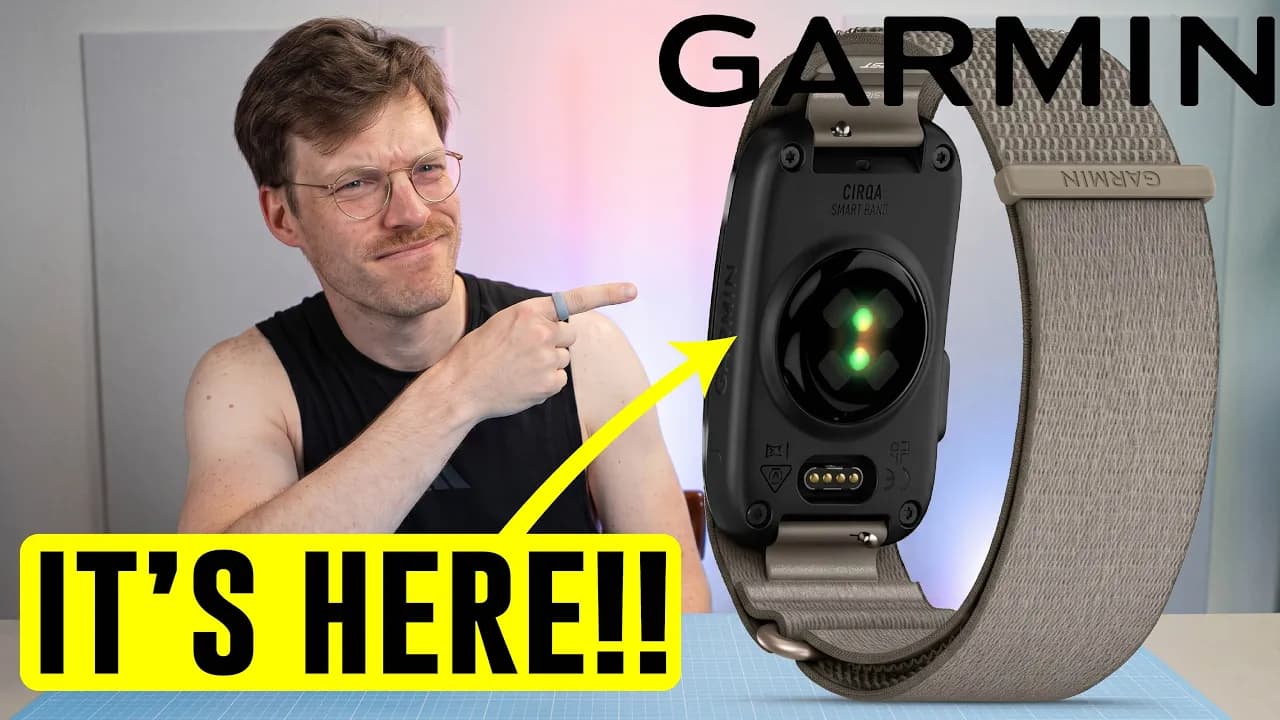
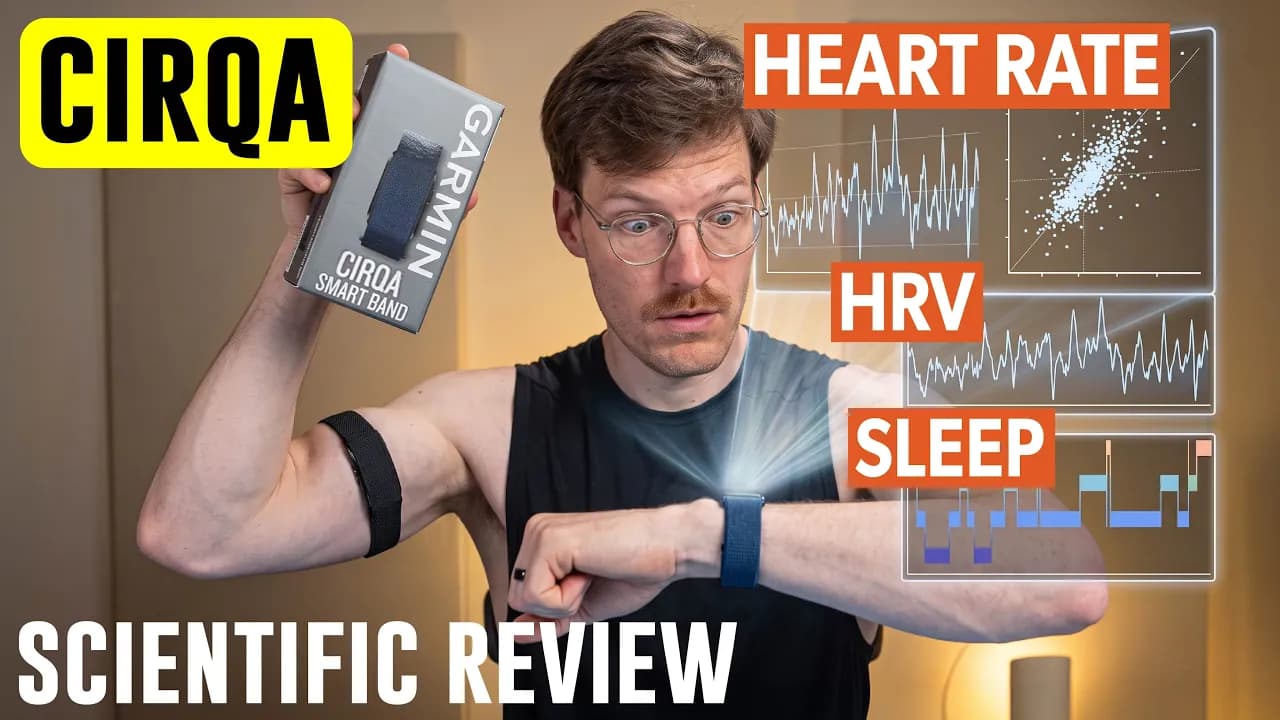
Garmin CIRQA - First Tests!
In a Nutshell
Garmin's new Circa is a screenless optical heart rate band using the Elevate V4 sensor, which can be worn on wrist or biceps and integrates with existing Garmin watches through a primary wearable priority system. Initial tests show the Circa performs well for indoor cycling but has mixed results for running and weightlifting, with some heart rate artifacts and delayed responses compared to a Polar H10 chest strap reference. The device supports heart rate broadcasting, automatic activity detection, and uses the same sleep stage algorithms as Garmin watches, with the option to set it as primary wearable for daily metrics while using a GPS watch for workouts.
These notes were generated by AI and may contain inaccuracies.
Garmin is entering the screenfree wearable market with their new Circa device. Several important questions cannot be answered by simply looking at the device. These include what happens when wearing the Circa alongside another Garmin watch, which device gets priority when recording data with both devices, whether the Circa uses the same sleep stage tracking as Garmin watches, and whether wearing it on the upper arm actually changes the measurements.
The sample should arrive within the next hour or two. The testing plan includes answering all questions about device priority and data handling, then setting up the Circa and immediately putting it through its first real tests. The tester is Rob, a post-doctoral scientist specializing in biological data analysis, with the focus being on data and data analysis.
Testing will include an outdoor run, an indoor cycling session, and weightlifting. Heart rate measurements will be compared against a reference device in ECG chest strap, showing actual results including where it performs well and where it might struggle. This will only be an initial impression of its performance. For real testing, multiple rounds of each type of exercise are planned, along with outdoor cycling. Sleep, heart rate, heart rate variability, and sleep stages will also be examined over the coming week or two for a more complete set of data for the first proper review.
Before the Circa arrives, details that could be just as important as raw measurement accuracy need to be addressed. An extensive list of questions was asked to Garmin about the Circa, including which optical sensor it uses, how its automatic activity detection works, whether its algorithms are adjusted when worn on the wrist versus the biceps, and how the Garmin Connect app handles data when using both the Circa and a Garmin watch.
Garmin sent detailed answers, several of which are really interesting. These questions will be addressed first, then the Circa will be set up and testing will begin once it arrives.
According to Garmin, the Circa comes with the same Elevate V4 sensor found in some of the cheaper Forerunner models. This is the fourth generation of the optical heart rate sensor together with a skin temperature sensor. This is not Garmin's newest optical heart rate generation. However, the generation of a sensor does not automatically tell how accurate the final measurements will be. The cheaper Forerunner models were already really good.
The fit of the device, the placement on the arm, the algorithms, and the type of movement can have a substantial effect. Given that the Circa is quite light, it might actually do relatively well, which is exactly what will be tested during several very different exercises.
Running usually involves fairly repetitive movements, which can cause interference in the signal. Indoor cycling tends to be a lot easier for optical heart rate sensors. Weightlifting is often the most challenging activity because of the wrist movement and tension, and it also has a rapidly changing heart rate.
Compared to other screenless wearables, the Circa has a physical button. Out of the box, that button starts and stops a timed activity. Garmin states you can assign it to any one of more than 80 activity profiles supported by the Circa.
The button also has some secondary functions. Three quick presses can put it into pairing mode, although it should already be in pairing mode when first turned on. If using an alarm, the button can snooze or dismiss it. Heart rate broadcasting can be enabled in Garmin Connect, then pressing and holding the button for two seconds switches between broadcasting on or off. Holding it for longer should also place it into pairing mode. Additional button-related enhancements are planned for future releases.
Heart rate broadcasting works over both ANT+ and Bluetooth. Garmin states it can be used with both Garmin and non-Garmin devices. This could make the Circa useful as an external heart rate monitor, especially when worn on the biceps during an indoor bike ride or with compatible gym equipment.
One interesting detail from Garmin's battery explanation is that simply enabling heart rate broadcasting should only cause a relatively small increase in power consumption. According to Garmin, the amount of time spent recording timed activities has a much bigger impact on battery life than heart rate broadcasting or connected GPS.
The Circa can detect certain activities automatically. Garmin did not provide a fixed list of activities because that feature is continuously changing. In general, higher intensity activities are more likely to be detected because they have much clearer patterns in changes in heart rate and movement. An activity needs to last at least 15 minutes before it can be detected automatically.
Importantly, Garmin states that the classification is personalized. When reviewing, confirming, or correcting detected activities, the system uses history and movement patterns to improve future classification. Similar to how Fitbit does it, Garmin states users should expect adaptation to take a few weeks and require multiple activities of the same type to be completed. This is not something that can be properly judged from one or two workouts and should be interesting to evaluate over a much longer period.
Another key feature of the Circa is that it can be worn on either the wrist or on a biceps band, which Garmin calls an armband. The band does not automatically detect where it is being worn. Instead, the wearing location must be selected in Garmin Connect under the Circa's user profile setting. The wearing location can also be changed for an individual activity.
Garmin states its algorithms are adjusted based on the selected location, including specific adjustments to the sleep stage algorithm when the device is worn on the upper arm. Garmin expects that wrist and upper arm placement should provide comparable heart rate, heart rate variability, and sleep results. This is something that needs to be tested personally.
Most companies are clear that biceps measurements are usually better for heart rate specifically, though at night that might be less of an issue. Most features remain available when wearing it on the upper arm. The two exceptions Garmin mentions are wheelchair pushes and rep counting during workouts.
Garmin states that the sleep stage algorithm is basically the same one currently used by its watches. There are slight differences in how it is tuned for the wrist versus the upper arm, and this could make the upper arm an interesting option for sleep tracking, especially for people who find the device on the wrist uncomfortable at night.
Not only heart rate and heart rate variability need to be compared, but also sleep stages during the night on both the wrist and the biceps. Garmin might have tweaked this quite well already given that their Index sleep monitor is also worn on the biceps, so they should have enough training data to make a good algorithm, though that device uses a newer Garmin sensor.
The Circa also has a smart alarm that creates a 30-minute window and tries to wake at an optimal point between when you say you want to wake up and that 30 minutes. According to Garmin, the SmartWake function doesn't really affect battery life much. It will be interesting to see if this is very reliable and also how strong the vibration is.
One of the biggest questions was how Garmin Connect handles Circa data when also using a Garmin smartwatch. Garmin's answer is that the system relies primarily on classification of the primary wearable setting. If two Garmin devices record the same data at the same time, the device selected as the primary wearable is used to break that tie. Daily health metrics such as sleep, Body Battery, steps, and other overlapping measurements are primarily decided based on what is set as the primary wearable.
Garmin does not actually merge simultaneous measurements - it takes the priority one. However, Garmin states that switching between the Circa and a watch during the day should not create significant gaps because the TrueUps synchronization system keeps data aligned across devices. If only wearing one device, that shouldn't be an issue.
The example Garmin specifically gave is probably the most logical use case: wear the Circa throughout the day and during sleep, then switch to a Forerunner or another Garmin watch for workouts where built-in GPS, a display, and training guidance are needed. Garmin states there's not much additional benefit to wearing both devices at the same time because where data overlap, Garmin Connect will prioritize the primary wearable rather than combining them.
There's an important rule for overlapping activities. If the Circa automatically detects an activity, but an activity is manually recorded from another Garmin device and synchronized for the same period, Garmin Connect will not display the automatically detected Circa activity. This should prevent duplicate workouts from appearing in the app without intending it.
In theory this all sounds reasonably straightforward, but issues have been seen with other wearables. How smoothly this works in real use needs to be tested, especially when moving between the Circa, a Garmin watch, and possibly external devices connected to these watches.
Garmin states there's up to 10 days of battery life, but actual battery life will depend heavily on usage. Garmin indicated that pulse oximetry can reduce total battery life by as much as a couple of days, although the exact effect varies by factors such as movement, perfusion, and skin tone. Garmin's 10-day battery assumption includes approximately 30 minutes of timed activity per day.
Both manually started and automatically detected timed activities have a measurable impact on battery consumption. Connected GPS and heart rate broadcasting do add some power usage, but Garmin states the duration of timed activities is probably the most important factor.
These are the most important details wanted from Garmin, shared before receiving the device. There are some promising ideas here, particularly the option to wear the band on the upper arm, the integration with Garmin Connect while using it also with another watch, and the ability to broadcast heart rate to another sensor, especially if on the biceps that's performing really well. However, specifications and feature descriptions can only tell so much - what really needs to be known is how good the data are.
The Circa should arrive soon. As soon as it does, there will be a quick look at the device, pairing it with Garmin Connect, going through the most important settings, and checking how the wrist and upper arm placement option works if it can be found in the settings. After that, testing will include going outside for a run, then using it on a Zwift bike for an indoor cycling session, and testing while lifting weights. Recorded heart rate measurements of the Circa will be compared against the reference device and results will be shown.
The plan is to wear the Circa in the beginning on the wrist of the non-dominant arm. Garmin didn't share a biceps band yet - that should arrive maybe in a week or so. All first testing will be on the wrist. Most testing of screenless devices long-term is on the biceps just because that provides better heart rate measurements and the device needs to be tested at its peak.
The device arrived and is being unboxed and set up. It's the standard Garmin box for their cheaper devices. The device is on loan from Garmin - there is consideration of buying it, but otherwise it needs to go back after a month or two. Three units were also ordered personally, but delivery takes a long time in Europe.
The device uses standard Garmin ports, so any Garmin charger can be used. When turned on, it should be in pairing mode. There are already wearables in the account, so testing will show how pairing an extra device works if that gives any issues.
Pairing worked flawlessly and the color was correct to the one received. The device is set up and needs to be set as the primary wearable. The tester is not a wheelchair user. The device will be worn on the left wrist for now. Several favorite activities were set up - it can be up to 10 activities. After syncing, any required updates will be checked.
Several hours later, the results are in - very initial results. The indoor cycling session, running session, and weightlifting session will be examined.
For the running session, the reference device (Polar H10) is shown in blue-green and the Garmin Circa worn on the wrist is shown in red. Time is on the horizontal axis and heart rate on the vertical axis. Several intervals were performed and all were more or less correctly detected by the Garmin Circa. Really nothing to complain about here.
There was an issue where connection was lost while cycling, so it had to be stopped early. It would have been fine to continue and would have still had the data, but there was concern about losing data. That was the one hiccup.
The good thing is that the Circa does appear to work even when there is no internet. There was an issue with the Fitbit Charge sometimes that internet was needed to stop the exercise. So far, this is looking good.
For indoor cycling, which tends to be an easy exercise for optical sensors, this very initial test looks very good. If it continues like this, there would be perfect satisfaction with the Circa.
Running is a bit harder. The test was made quite difficult with many intervals, very short intervals, then stopping for a while and continuing again to have heart rate all over the place, also going faster and slower sometimes. It generally looks good, but there were a few moments where it didn't fully agree with the reference.
Much of the time it followed along quite well and was able to detect all of the dips in heart rate, which is where many devices struggle. But there were some moments of deviation. While still running, it detected the dip in heart rate. There was a slight delay in picking up an increase in heart rate and a few moments where quite a high peak in heart rate was detected. A heart rate of 170 is unlikely as that would be all-out running, and at this point it was not all-out running.
These are still relatively minor differences. There is interest in seeing what results look like after doing five or six runs. This again suggests it is likely better to wear it on the biceps.
The biceps band will not arrive until 6 weeks from now. There will be an attempt to find some other solution to make a biceps band, but the best will be done to get that as well. First testing will be on the wrist just because a biceps band cannot be obtained from Garmin at this point. It will take a while to get better results likely from the biceps, but attempts will be made to make it quicker.
For running, the results are a bit mixed. They're not terrible, but there is curiosity about whether these weird artifacts keep happening. In testing of the Garmin Forerunner 70 and upcoming testing of the Forerunner 170 Music, which has the same sensor, there weren't any of those issues.
For weightlifting, there weren't high hopes because basically no device on the wrist does that well for weightlifting. Indeed, many of the times there was a peak in heart rate, the Circa wasn't fully able to detect those peaks, but it was able to detect more than expected. Though there's also a weird artifact where an early high peak was detected, likely detecting roughly double the actual heart rate. That's an artifact more often seen in devices.
Overall, for simple exercise like indoor cycling in this initial test, it's almost perfect. Running is somewhat mixed. Future testing will need to be seen. Maybe this one time it wasn't perfectly positioned on the wrist. A long sleeve was worn over it to give it a better chance of not being interfered with by sunlight.
Overall so far there is no disappointment. Slightly better running results would have been wanted, but these are super initial results from just one day. More testing is to come, and other reviewers should also be checked.
Keep The Quantified Scientist in your library
Save the videos and channels worth coming back to, and find them again in one place.