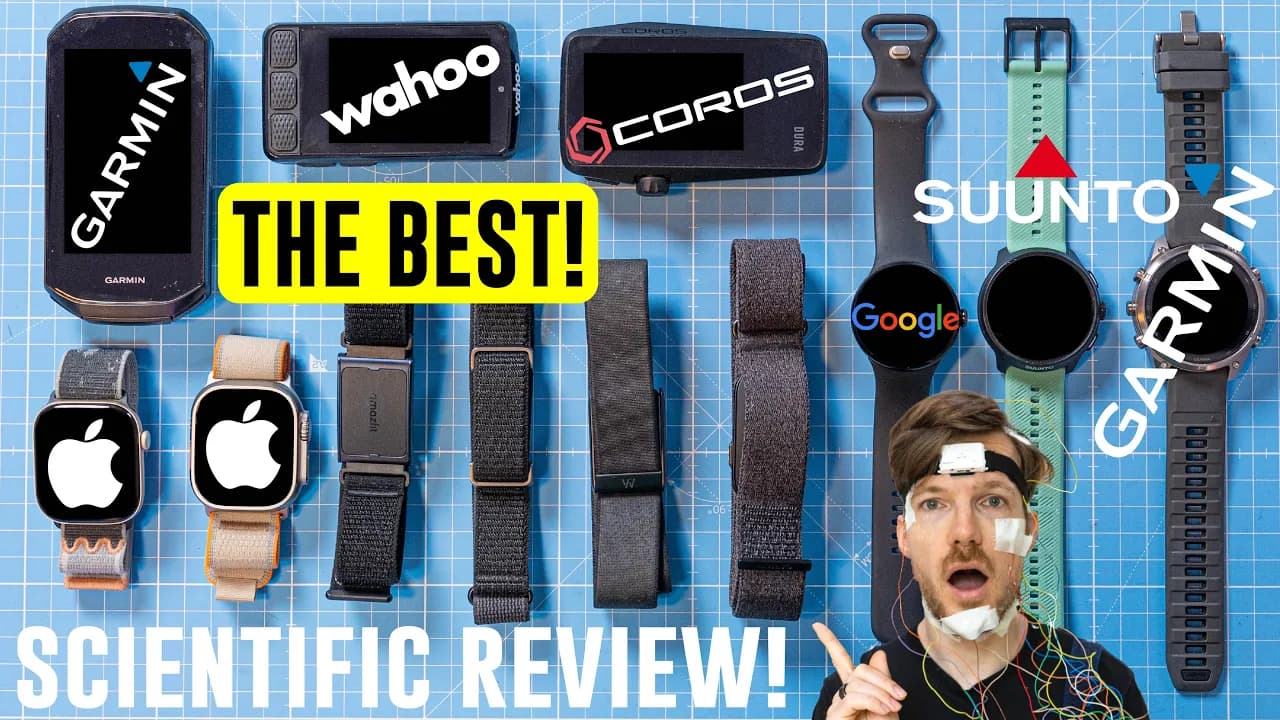
Garmin Forerunner 70 - Promising for CIRQA & other Garmin's! (Scientific Review)
In a Nutshell
The Garmin Forerunner 70 delivers strong value as the cheapest device in the 70-series, with excellent GPS tracking (90/100), good heart rate performance during running (0.99 correlation) and indoor cycling (0.98), and solid nighttime HR/HRV tracking. Sleep stage accuracy is moderate (68/100) with 89% deep sleep agreement but only 50% REM accuracy, while outdoor cycling and weightlifting HR tracking are notably weaker (0.84 and 0.78 correlations). The device earns a strong recommendation for runners and casual athletes who don't need maps or premium features, offering the best price-quality ratio in Garmin's lineup.
These notes were generated by AI and may contain inaccuracies.
The Garmin Forerunner 70 is the cheapest device in the 70 series and the one personally recommended by the reviewer with substantial data backing. The 70 series includes the 70, 170, 570, and 970, with the 265 still available and likely to be replaced by the 270. Price differences between these devices range from $100 to $300. The Forerunner 70 includes training readiness, training status, heart rate variability status, daily suggested workouts, Garmin coach, wrist-based power running, running dynamics, advanced sleep tracking, pulse ox, and over 80 sports modes.
Moving from the Forerunner 70 to the 170 adds sensors including a barometric altimeter, barometer, compass, gyroscope, thermometer, and Garmin Pay. These additions provide real-time elevation data, ascent and descent tracking, storm alerts, better navigation, support for cycling power meters, smart trainers, Garmin cycling coach, and open water swimming. The 170 music variant adds onboard music storage, Wi-Fi, offline Spotify and other music services, plus phone-free listening with Bluetooth headphones.
The Forerunner 265 adds multi-band GPS and SatIQ for improved accuracy in dense cities or forests, along with full multisport and triathlon modes, automatic transitions between sports, and more advanced course navigation. The 570 features Garmin's newer heart rate sensor platform with skin temperature tracking, a brighter AMOLED display, aluminum bezel, microphone and speaker, phone calls from the wrist, voice commands, Garmin triathlon coach, custom multi-sport workouts, and several new training and recovery tools.
The flagship 970 adds full-color offline maps, turn-by-turn navigation, dynamic round-trip routing, sapphire glass, titanium bezel, LED flashlight, ECG functionality, significantly more storage, and better battery life. New performance metrics include running tolerance, running economy, and step speed loss, though the last two require the HRM 600 chest strap.
The Forerunner 70 provides most essential Garmin running analytics. As you move up the lineup, you're paying less for basic running analytics and more for additional sensors, triathlon features, smartwatch capabilities, navigation, and premium hardware.
Indoor cycling testing showed excellent performance with a correlation of 0.98 against an ECG chest strap reference. Individual sessions demonstrated strong agreement between the Forerunner 70 and reference device, with only minor deviations throughout multiple intervals.
Running performance exceeded indoor cycling results with a correlation of 0.99 against the reference. Multiple individual runs showed very good agreement, with some minor deviations in heart rate detection during certain segments, but overall results considered good enough for reliable tracking.
Outdoor cycling showed significant struggles with a correlation of 0.84. Multiple sessions demonstrated delays in picking up heart rate changes, missed peaks, and instances of both too high and too low heart rate detection. The reviewer cannot recommend the Forerunner 70 for biking without an external chest strap.
Weightlifting performance was poor with a correlation of 0.78. The device consistently detected too low heart rate in higher ranges and missed most peaks during gym sessions. This aligns with most devices struggling with weightlifting heart rate tracking.
A single hike tested showed a correlation of 0.81. The device detected too high heart rate in the beginning and had deviations where it didn't detect all peaks. Performance was worse than running, possibly due to using hiking sticks.
The Forerunner 70 performed better than 55% of tested devices for indoor cycling, 73% for running, 34% for biking, and 31% for weightlifting. A composite cardio performance score of 93 was calculated from spinning, biking, and running correlations, resulting in a "good" heart rate rating.
Nighttime heart rate tracking showed very good results with a narrow range of 37-60 bpm and the device distinguishing well between different heart rates. Multiple example nights demonstrated strong agreement with the reference ECG chest strap.
HRV tracking showed nice agreement with Elite HRV measurements from an ECG chest strap. Garmin tended to estimate slightly lower HRV values when readings were higher, but general patterns matched very well between devices across multiple nights.
Sleep stage tracking was compared against EEG using the Zeemax EEG headband as reference. Deep sleep agreement reached 89%, light sleep 65%, and REM sleep 50%. The device detected some extra deep sleep compared to reference and struggled most with REM sleep, sometimes missing entire segments or showing duration and timing shifts.
The Forerunner 70 is not among the best sleep tracking devices but shows potential improvement over previous Garmin testing. It appears to be moving into a second-tier group that includes Amazfit devices and Galaxy watches. The device performed better than some older Huawei devices, Coros devices, and the U Band, but below Fitbit, Pixel devices, Whoop Strap, Oura Ring, Apple Watches, and the Eight Sleep Pod.
The speaker's testing of the Forerunner 170 shows much of the same performance characteristics, with video content coming soon. The overall assessment indicates Garmin is moving slightly higher in tracking performance, potentially leaving other brands like Polar behind. Other brands have also been improving, with Fitbit and Pixel devices getting better, and Galaxy watches showing improvement since last year.
Taking the average correlation over the three sleep stages produces a sleep score of 68, rated as good. This represents movement in the right direction for Garmin's sleep tracking capabilities, though not perfect performance.
GPS tracking performance testing involves running or riding the same route several times and checking if signals overlap. Overlapping signals indicate good GPS performance, while different signals suggest poor tracking performance.
Three running tests were conducted in a circular or rectangular pattern. A wall on the right side can interfere with GPS signals, typically resulting in cleaner signals on the left side. The Forerunner performed well on both sides of the route. The second run showed super close signals on both the right and left sides. The third run also appeared super clean, with solid results both near and away from the wall.
Nine cycling trips to work were tested. Signal acquisition was always quick. The signals remained quite close together with minimal deviation. Near the Oper Kasse Plads overhang, some struggle was visible. One signal accidentally disappeared during analysis, but the remaining eight signals stayed super close together. Two different routes were tested with overall very good results and only a little deviation.
Eight or nine cycling trips back from work were analyzed. Signal acquisition was almost instant. Signal consistency showed signals quite close together with only a little deviation. The roundabout area looked very clean. Near the overhang, there was a little deviation but nothing too bad. One signal deviated slightly near the radio tower, with signals going a bit further apart in that area, but overall performance remained good.
Given the price point, especially compared to other Garmin devices, the GPS tracking performance is impressive. The Forerunner 70 lacks the most premium sensor but delivers solid results. This device is recommended for runners who don't need maps. The Forerunner 170 Music is available for those wanting music without their phone, but since the speaker always carries a phone during exercise and prefers not to pair Bluetooth earphones to multiple devices, the standard Forerunner 70 is preferred.
The Forerunner 70 offers the best price-quality ratio among Garmin devices for running, and likely among Garmin devices in general. The speaker would personally choose this device. GPS tracking receives a score of 90 out of 100, rated as great.
- GPS tracking: 90/100 (great)
- Sleep stage tracking: 68 (good)
- Heart rate tracking during exercise: 93 (good)
- Heart rate and HRV tracking during night: rated as great (no official scoring system yet)
The device is described as very well-rounded. The speaker would get this device personally and would recommend it to friends. The Forerunner 970 is acknowledged as better but significantly more expensive, making it not a direct recommendation.
The Forerunner 70 is recommended for people getting into running or cycling who don't mind using an ECG chest strap for cycling. Given Garmin's solid build quality with no reported device failures, this is recommended for casual athletes or those focused primarily on running.
Users might consider the Forerunner 170 Music for added music capability, or the Forerunner 970 or 570 for those with higher budgets. For outdoor activities, the Garmin Fenix or Epix series are alternatives. Affiliate links are available in the description for various products including the Oura Ring, Whoop Strap, and Eight Sleep Pod, with some providing the best discount possible. A general Amazon affiliate link supports the channel without additional cost to buyers.
Thanks are given to Ugreen for sponsoring the video, with recommendation to check out their charger for its ease of use. Related video content includes a running watch alternative from Amazfit and information about the Eight Sleep Pod.
Keep The Quantified Scientist in your library
Save the videos and channels worth coming back to, and find them again in one place.