Best HEALTH TRACKER DEALS For Prime Day!
In a Nutshell
The video recommends specific health trackers by category: Suunto Run 2 and Huawei GT series for sports watches with top heart rate accuracy, Apple Watch Series 9+ and Pixel Watch 5 for smartwatches with superior health software, and screenless options like Fitbit Ace, Amazfit Helio, and Whoop for biceps/arm wear. Garmin dominates GPS tracking in both watches (Forerunner 970) and bike computers (Edge 1050, Wahoo Element Roam), while the Eight Sleep Pod leads sleep tracking but requires a subscription. For most users, previous-generation devices offer the best value during sales, with third-party apps like Bevel providing enhanced data analysis across ecosystems.
These notes were generated by AI and may contain inaccuracies.
As 2026 draws to a close, the focus is on identifying the best smartwatches and smart bracelets available at affordable prices. With numerous new releases throughout the year, current recommendations for health and fitness trackers have been compiled. Recommendations are divided into four categories: sports watches, smartwatches, screenless wearables, and wristbands that can be worn on the biceps or wrist, along with additional devices such as bicycle computers.
Top picks are discussed with their main advantages and disadvantages. Recommendations are primarily based on data and analysis. Discounts on devices vary by region, with focus on reasonably priced devices and those currently on sale, either generally or specifically during Prime Day.
Sports watches are characterized by long battery life, multiple sports functions, and the ability to connect to external heart rate sensors and other peripherals. Focus areas include heart rate and GPS tracking. Suunto has shown impressive recent performance with newer devices equipped with new heart rate sensors.
The Suunto Run 2 at 300 euros demonstrates excellent heart rate measurement performance. Testing during running showed a correlation coefficient of 0.99 against a chest strap with electrocardiogram (ECG) reference, with most points on or near the reference line. For outdoor cycling, the correlation coefficient was 0.98. The watch outperformed 60% of devices for stationary cycling, 80% for cycling, and 90% for running, though performance was weaker in weightlifting.
GPS tracking showed good overlap between multiple runs in the same position, with only minor deviations near larger walls. The Suunto Run 2 is considered an excellent running and sports watch, particularly if found at a discount, though availability during Prime Day is uncertain as a relatively new product.
Huawei GT series watches represent the brand's sports performance line and are relatively affordable, with previous generations often available at good prices. The GT 7 Pro performed excellently in heart rate tracking except for weightlifting, achieving 70th percentile for stationary cycling (correlation 0.99), 77th percentile for bicycle cycling (correlation 0.98), 77th percentile for running (correlation 0.99), and 70th percentile for weightlifting (correlation 0.93).
The GT 6 Pro and GT 6 models showed similar performance percentages and correlation coefficients. All GT 6 series watches deliver excellent performance. The main limitation is that these devices are not officially available in the United States, requiring alternative acquisition methods, though they are readily available in Europe and elsewhere at reasonable prices.
For GPS tracking specifically, Garmin devices are preferred. The Forerunner series is particularly recommended, with the Forerunner 970 representing Garmin's best running watch. GPS tracking showed excellent performance with minimal deviations, even near walls and obstacles, and satellite views confirmed close adherence to 3D maps. Any modern Garmin device with dual-frequency GPS provides good tracking performance.
Lower-spec Forerunner models like the 570 offer similar GPS performance but lose some mapping features. Older models like the Forerunner 965 also provide good GPS tracking. The Forerunner 70, one of the cheapest current-generation Forerunners, shows good signal consistency for its price point, though with greater deviation than the 970.
Garmin's heart rate sensors do not perform as well as competing devices. External chest straps with electrocardiography (ECG) are recommended for connection to Garmin devices. Higher-end models support connecting to multiple devices, while lower models have software restrictions on device connections.
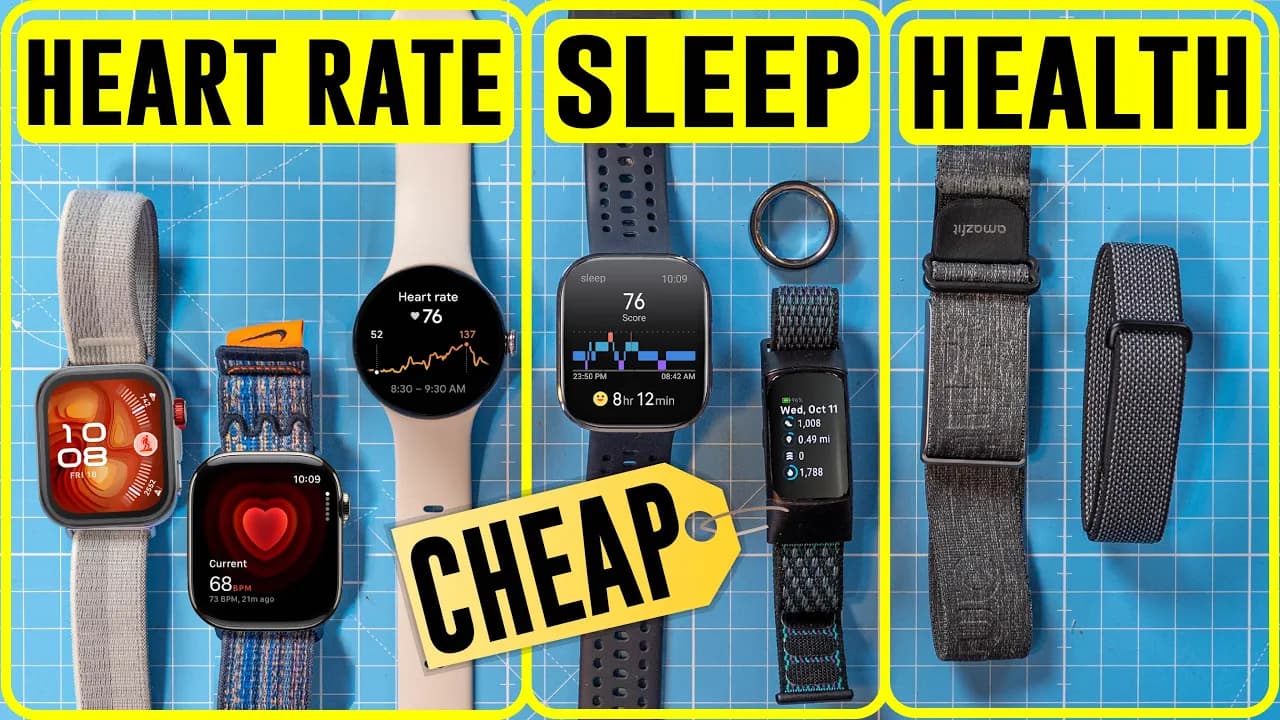
Smartwatches focus more on health, recovery, and sports functions, often at the expense of battery life. Apple and Google are the top-performing brands, with numerous software and application updates released in recent years. Many improvements are available in older models rather than requiring hardware updates.
Battery life typically lasts one to two days with normal use, though extremely active users might complete a marathon. Older Apple Watches from one or two previous generations and last year's Pixel Watch are sufficient for many users.
The Apple Health app received a major update with new "Analysis" features summarizing heart health, sleep, fitness, vital signs, and menstrual cycle tracking. A new "Longevity" tab displays healthy age by comparing metrics like maximum oxygen consumption (VO2 max), resting heart rate, sleep, and heart rate variability with actual age.
Movement assessments including balance, strength, and flexibility can be performed using iPhone camera with heart rate data. VO2 max estimation is available but remains experimental. The redesigned Health app runs primarily on iPhone and requires Apple Intelligence compatibility, initially launching in the United States and American English only.
New watchOS 27 features require Apple Watch Series 9 and later, Ultra 2 and later, or the new SE3. The Series 12 and Ultra 4 feature Apple's new health sensing system measuring heart rate every 5 seconds and heart rate variability up to 24 times daily, enabling daytime vital signs, detailed recovery heart rate variability, and a new readiness indicator (0-10 scale combining activity, training load, sleep, and vital signs).
Apple claims this technology is the most accurate heart rate sensing among wearables based on a study of over 1,000 people. Existing Series 9, 10, or 11 watches, or Ultra 2 or 3 watches, provide sufficient access to the new Health app improvements without requiring upgrades.
Google has developed a similar approach with the new Google Health app replacing the old Fitbit app. The app organizes data into four sections: fitness, sleep, and health, integrating wearable device data, compatible medical records, and third-party information. The optional Google Health Coach feature requires a Google Health Premium subscription and uses Gemini for personalized insights, exercise plans, and sleep advice.
Google has continuously improved the application based on user feedback, including making Gemini responses shorter and easier to interact with. Most improvements are not exclusive to the latest Pixel Watch 5.
The Pixel Watch 5 features GPS claimed to be twice as accurate as previous generations in challenging environments, using 3D building models and atmospheric information for signal correction. Performance improved over the Pixel Watch 4, approaching Garmin levels while still showing some flaws. The Pixel Watch 4's GPS performance was not optimal, though it may receive similar GPS improvements later.
Screenless wearables have seen significant popularity growth. The Fitbit Ace at approximately $100 provides a small, comfortable device with up to one-week battery life, excellent sleep tracking, accurate heart rate tracking especially when worn on the biceps, and access to enhanced Google Health experience. Data can be switched between Fitbit Ace and Pixel Watch without data loss.
The main drawback of Google-based devices is potential privacy concerns when providing sensitive health data to one of the world's largest data companies. Google states this data is not used for advertising purposes, though this may be a barrier for some users.
The Garmin Circa is recommended for Garmin system users, entering data directly into Garmin Connect without requiring additional systems. At nearly double the Fitbit Ace price, it is less effective for sleep and heart rate tracking. Wearing it on the upper arm muscle significantly improves heart rate tracking accuracy.
The Amazfit Helio band at around $100 offers excellent heart rate tracking when worn on the biceps, performing better than many more expensive sports watches. The Zepp app is functional, though combining with third-party apps like Battle may provide more comprehensive recovery experience.
The Polar Loop is a screenless wearable worn on forearm or wrist. While Polar was among the first classic sports watch companies to embrace the screenless trend, the Loop lags behind stronger competitors in raw heart rate and sleep data accuracy. It may be preferable for users already in the Polar Flow ecosystem or those preferring European data processing.
Whoop pioneered the screenless wearable trend and maintains one of the best and most motivating apps. The device is particularly effective at encouraging sports-minded users to improve training, recovery, and health habits. Initial measurements are good when worn on the bicep, significantly improving accuracy and comfort during long-term use. However, it is no longer the best in all aspects, with very good sleep stage tracking and adequate heart rate tracking, though alternatives may better serve many users given current market options.
The Whoop band performs well at tracking sleep stages and adequately tracks heart rate, but given the abundance of alternatives available, many users will find what they're looking for in much cheaper devices like the Fitbit Air. However, Whoop still keeps its promises most of the time and performs them perfectly. It's difficult to describe it as the best in terms of value for money. If a few hundred dollars a year isn't a problem, then it doesn't really matter, but for many people, that's a lot of money.
I love my Whoop bracelet. It's my main motivator, personally, but it's rather expensive.
Whatever device you choose—whether it's the Amazfit Helios band, Fitbit Air, Garmin Circa, Whoop band, or even a smartwatch with a screen like the Apple Watch—affiliate links below support the channel. They will not cost extra money but will give the best possible discount. Clicking on these links when purchasing supports the channel. For Amazon purchases during Prime Days, clicking the Amazon link first supports the channel with every purchase. The link can be saved to favorites by pressing Command or Ctrl + D before purchasing and made the default way to access Amazon.
Bicycle computers that don't necessarily belong to a specific category but are among favorite devices used regularly include the Element Roam 2 from Wahoo, the Garmin Edge 1050 from Garmin, and the Coros Dura. They have all served well, and GPS tracking will be discussed specifically. The experience with dedicated bicycle computers is much better than using a phone for navigation, especially since phone batteries used to run out very quickly during long trips, within a few hours. Having a dedicated device that can also connect to a power meter and a heart rate monitor and display this data is truly remarkable.
GPS tracking data for the Wahoo Element Roam shows nine times cycling home from work on the same route. The signs were exactly the same with slight differences, but still excellent. One of the nine signals deviated slightly, but overall, compared to competing devices, the signals are very close. Performance is brilliant. Checking Google Earth shows the signals match perfectly. The moment of deviation occurs near large buildings, which may be the reason. Some signals may be genuine since different paths are taken on different trips. The signals are very close together again with slightly greater divergence between tall buildings. Overall, excellent performance with signals converging again.
The Garmin Edge 1050, the latest model from Garmin, was tested with ten times cycling home from work. The signals are very close with slightly larger deviations at certain points, but still very good compared to most competitors, especially smartwatches. Switching to Google Earth makes the viewing process easier. The results from the Garmin Edge 1050 look very good. The moment of deviation occurred where construction work was underway, making it a real signal. The bike was ridden more on the right side for some trips or more on the left side for others. The signals returned to normal, but among buildings there is greater difficulty. Around the roundabout, the signal is very clear. Compared to smartwatches, this is very good. The extra space available when manufacturing a bicycle computer compared to smartwatches really pays off, providing better GPS signals.
Garmin and Wahoo are the two best devices tested so far. The Coros device is still being researched further. A more detailed review of the Global Positioning System (GPS) in bicycle computers will be provided later. Overall, satisfaction with this category is very high.
The Eight Sleep Pod is the most expensive individual health device owned to date, specifically Pod 6, the version recently reviewed. The Pod device is not worn but is placed around the mattress and can cool and heat each side of the bed independently. It also includes an optional temperature-control blanket, so you and your partner can choose the temperature independently. This device was great on hot summer days, and in winter, it's nice to go to a warm bed without disturbing a partner by opening the window when feeling too hot. This is the primary use of the Eight Sleep Pod.
Tests have shown that the Eight Sleep Pod has a sleep-stage tracking feature that is among the best of all. The Eight Sleep Pod is a mattress cover that houses the sensors and can be powered from a wall outlet, making it unlimited in terms of data transfer rate or the amount of measurements. Unlike battery-powered smartwatches, which do not measure continuously and at a very high frequency, the Eight Sleep can measure continuously. This is believed to be one of the reasons why it was the best sleep tracking device in tests. The Eight Sleep Pod 6 is perhaps slightly better than the Pod 5, although both performed excellently. A major update was made to the sleep-stage tracking system, so there's a new model that works on the Pod 6 compared to the Pod 5. If a Pod 5 is already owned, the tracking is good, so the upgrade may not be worth it. The device also tracks respiratory rate, heart rate, and heart rate variability.
A marketing link for Eight Sleep is available for a discount, but the device is very expensive and requires a subscription. It should only be purchased if the heating and cooling features are really wanted. It was the best system tested so far. For tracking sleep or heart rate variability only, a watch or bracelet is probably enough for most people. A Fitbit Aura for $100 is probably a much better deal.
Third-party health tracking applications can extract data from wearable devices, especially those with less-than-ideal user interfaces, to give a better view of data. If an Amazfit Helio bracelet is owned but the Zepp app is not preferred, it can be linked to the Bevel app. Bevel extracts data from compatible sources and transforms it into an experience similar to the Whoop app, providing an overview of sleep, recovery, stress, tension, and possibly energy level throughout the day. Bevel now connects directly to the Google Health app, as well as Garmin, Oura, and others. As long as the device can send its data to one of Bevel's supported sources, users will not be limited to a single wearable ecosystem. The free version of Bevel is now surprisingly complete. The core app includes recovery, sleep, stress, tension, nutrition, and fitness tracking. Bevel Pro adds an AI-powered coach, integration with health records, biological age calculation, and generated training plans. The cost is $15 per month or $100 per year. Trying the free version first is recommended.
Athlytic offers a similar approach to recovery and training, especially for Apple Watch users, and costs $5 a month or $30 a year. Apple and Google have developed their own apps and do much of this themselves. Some of these paid apps may face competition if major companies offer more services for free.
These are the devices that are really liked and would be recommended. For most of these devices during Black Friday sales, it doesn't matter much to go back to a previous generation. For Suunto, the latest generation of heart rate sensor is definitely wanted, which was a big improvement. For many other well-known brands, the previous generation is usually already good, and the improvements are very minor. The development of this field is very pleasing, with improvement in the quality of measurements and the abundance of cheaper devices now available that provide affordable health tracking. The word "reasonable" is relative—some people in India may still be able to buy a Fitbit Air, but there are other devices on the market there with developers keen to provide affordable devices with good performance for the cheaper market.
If deciding to buy an Apple Watch, the Wahoo Element ROAM 3, the WHOOP band, the Eight Sleep Pod as the favorite sleep-enhancing device, or anything else on Amazon, even something as simple as toilet paper or coffee beans, the channel can be supported and the best possible discount obtained by using one of the affiliate marketing links below. The channel will be supported, and gratitude is expressed for this support. After watching this video about the best recommendations, enjoyment may be found in the video about the updated Apple Health app in its beta version and the video about the favorite device for improving sleep, the Eight Sleep Pod.
Keep The Quantified Scientist in your library
Save the videos and channels worth coming back to, and find them again in one place.