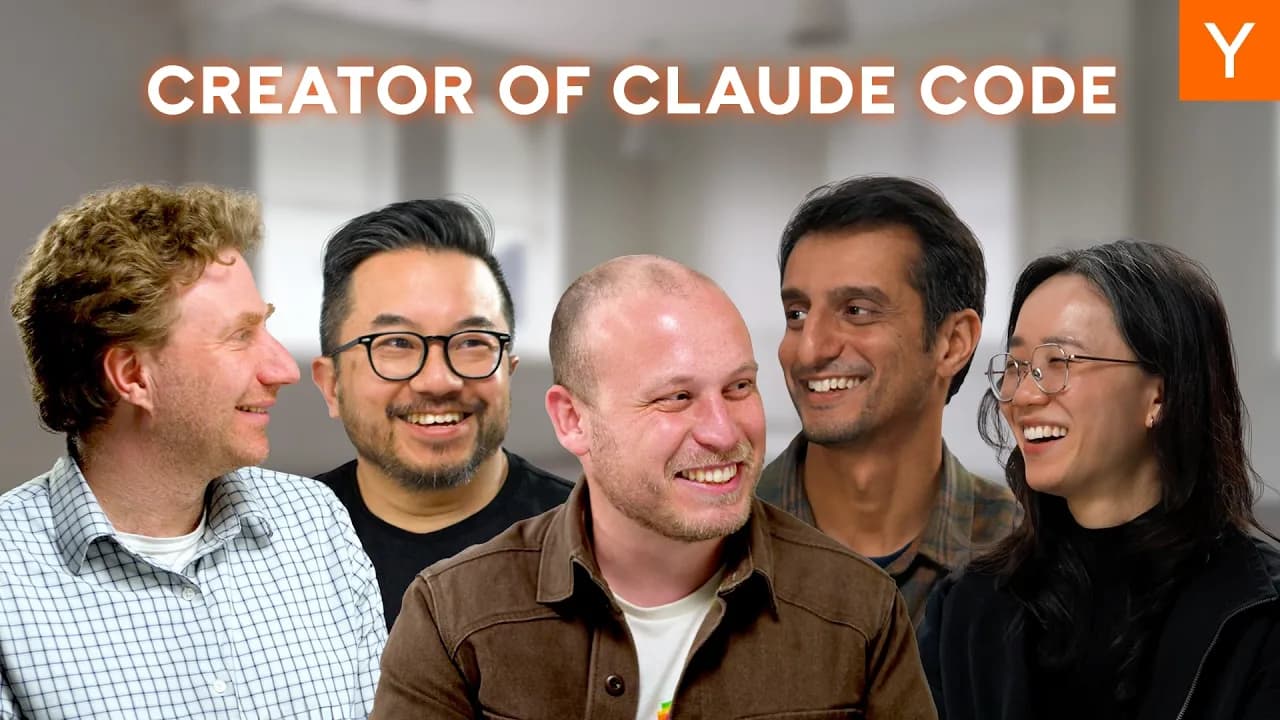
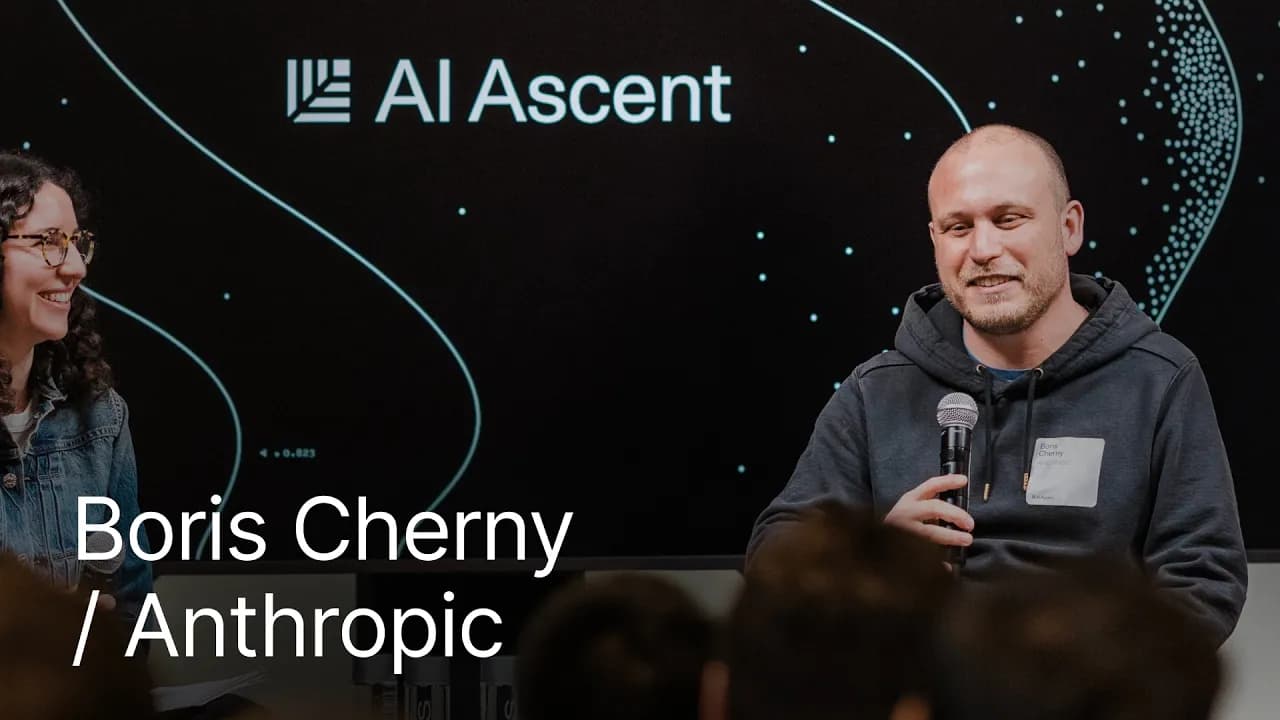
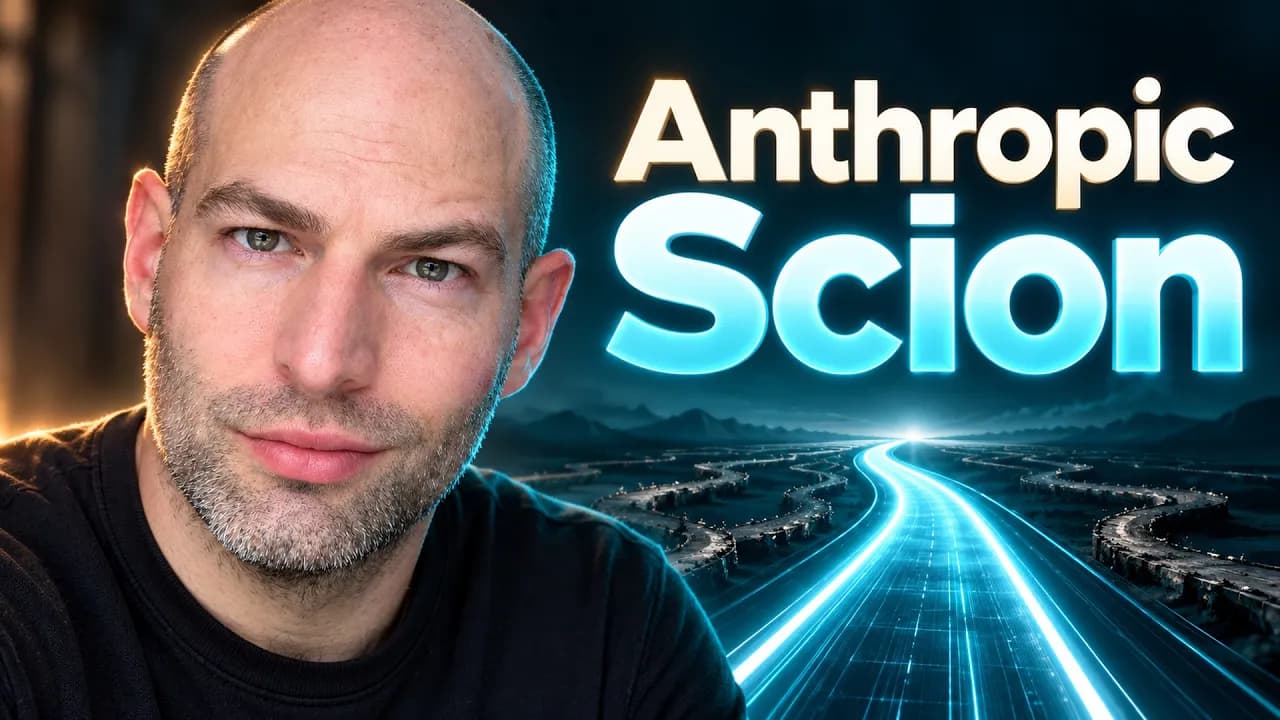
Head of Claude Code: What happens after coding is solved | Boris Cherny
These notes were generated by AI and may contain inaccuracies.
100% of Boris Cherny's code is written by Claude Code. He has not edited a single line by hand since November. Every day he ships 10, 20, 30 PRs. Currently, five agents are running while recording. Productivity per engineer has increased 200%.
I have never enjoyed coding as much as I do today because I don't have to deal with all the minutia.
Coding is largely solved. In a year or two, learning to code won't matter. Everyone will be able to program and build software anytime.
Claude Code is starting to come up with ideas by looking through feedback, bug reports, and telemetry for bug fixes and features, acting more like a coworker.
Product managers may sweat as everyone becomes a product manager and everyone codes. Title software engineer will be replaced by builder, painful for many.
Boris Cherny is head of Claude Code at Anthropic. Around the one-year anniversary of Claude Code, it has transformed software engineering and other tech functions. It drives Anthropic's growth; they raised a round at over $350 billion. Claude Code growth accelerates; daily active users doubled in the past month.
Boris and host born in same city in Ukraine.
Thanks to Ben Man, Jenny Wen, Mike Griger for topic suggestions. Check lennisprodpass.com for deals.
DX: Developer intelligence platform. Companies like Dropbox, Booking.com, Adion, Intercom use it for AI value and engineering productivity insights. Visit getdx.com/lenny.
Sentry: Catches crashes, slowdowns, regressions. Shows commit, developer, line of code. Sentry's AI debugging agent finds root cause, suggests fixes, opens PRs, reviews PRs. Try at sentry.io/lenny with code Lenny for $100 credits.
Six months ago, Boris left Anthropic, joined Cursor for two weeks, then returned. Fastest job change. Joined Cursor as big fan of product and impressed by team who saw AI coding direction early. Missed Anthropic's mission of safety, which drew him initially from big tech to shape AI future. Everyone at Anthropic motivated by safety. Mission-drivenness essential for his happiness; exciting product work not a substitute.
Semi Analysis report: 4% of all GitHub commits authored by Claude Code, predicted 1/5 by year-end. "While we blinked, AI consumed all software development."
Spotify: Best developers haven't written a line of code since December thanks to AI.
Senior engineers like Boris don't write code anymore; all AI-generated, many not even looking at code.
Numbers crazy: 4% public commits, higher in private repos. Growth accelerating across metrics.
Claude Code started as little hack on Anthropic Labs team (Mike Griger, Ben Man restarted it). Built Claude Code, MCP, desktop app. Trajectory: coding → tool use → computer use, tied to safety as AI gets more capable.
For engineers, AI now uses tools, acts in world. With Cowork, non-technical folks see AI acting (Gmail, Slack).
Boris joined Anthropic, hacked prototypes for one month, did post-training research for one month to understand models. Prototyped ClaudeCLI (terminal-based), demo showed it using batch tool to detect music playing without explicit instructions.
Posted internally, got two likes; people thought terminal odd, not IDE-like. Built terminal as solo dev for ease. Product lesson: underresource at start.
Model improving fast, terminal kept up. Stuck with it as daily active users went vertical internally after release. Ben Man nudged for DAU chart early.
Released externally February, not instant hit; took months for understanding. Latent demand: brings tool to engineers' workflows, terminal surprising.
Now available in iOS/Android app, desktop app, website, IDE extensions, Slack, GitHub.
Humbling; learning from users worldwide (startups to FANG). Best signal: user feedback.
In one year, software engineering profession dramatically changed. Predictions of 100% AI code dismissed, now reality.
At Code conference May 2025, predicted no IDE needed by year-end; room gasped. Anthropic thinks in exponentials (co-founders authored scaling laws paper). Traced line: crossed 100% by November for Boris.
Innovation: no roadmap, give space, psychological safety to fail (80% ideas bad), hold accountable, cut losses.
Claude Code took time: 20% code in February, 30% in May (still used Cursor mostly), 100% in November. Felt onto something early.
100% code by Claude Code. Prolific coder: top at Instagram, still at Anthropic as head. Ships 10-30 PRs daily, none edited by hand since November. Looks at code for correctness/safety, especially with many running it. Claude does automatic code review on 100% PRs; human review after unless pure prototype.
Claude starting to generate ideas from feedback, bug reports, telemetry.
Coding largely solved for Boris's programming. Next: adjacent to coding, general tasks. Uses Cowork daily for non-coding: paid parking ticket, all project management (sync spreadsheets, Slack, email).
Industry-wide, coding solved across codebases/tech stacks in months.
For prioritization: point Claude Code/Cowork at Slack thread (e.g., internal feedback channel firehose since 2024). Fixes fast to encourage more feedback, make users feel heard.
Now Claude does much: suggests fixes, puts up PRs.
Improved a lot, especially Opus 4.6. Coding-specific training, transfer from other training. Anthropic engineering team ~4x'd, productivity per engineer up 200% in PRs.
Back at Meta, Boris Cherny was responsible for code quality across Facebook, Instagram, WhatsApp. Higher code quality improved engineer productivity by a few percentage points per year with hundreds of engineers. Now AI delivers hundreds of percentage points gains, which is insane and unprecedented in software development, product building, and tech. It's easy to normalize, but important to recognize the craziness.
Models change rapidly, causing old thinking patterns. New team members and grads think more AGI-forward. Example: Memory leak where memory usage quadruples and crashes. Traditional debugging: take heap snapshot, use special debugger and tools. Boris was doing this manually, but a newer engineer asked Claude (referred to as Quad Code) to figure it out. Claude took heap snapshot, wrote a just-in-time analysis tool, found the issue, and created a pull request faster than Boris. Long-time users must transport to current models like beyond Sonnet 3.5, which are completely different, requiring mindset shifts.
Team Principles
What's better than doing something? Having Claude do it.
This principle was forgotten in the memory leak case. Underfund projects slightly to force using Claude. Single engineers ship quickly due to intrinsic motivation to do good work and get ideas out. Claude automates much work.
Encourage going faster: if you can do something today, do it today. Early on, speed was the only advantage in crowded coding market. Still key principle; Claude enables more speed.
Underfunding leverages AI better than overstaffing. Great engineers figure it out when empowered. Advice to CTOs: Don't optimize or cost-cut initially. Give engineers unlimited tokens as a perk (now at Anthropic and other companies). Throw tokens at crazy ideas first; optimize later (e.g., switch from Opus to Sonnet or Haiku) once proven. Token costs low at small scale relative to engineer salary; optimize only when scaling.
Some engineers at Anthropic spend hundreds of thousands monthly on tokens; similar at other companies.
Learned engineering practically, self-taught (studied economics, not CS). Programmed in middle school to cheat on math tests: programmed answers into TI-83 Plus graphing calculator. Next year, wrote algebra solver program, shared via cable; whole class got A's but got caught.
Programming always practical tool to build things, not end in itself. Fell into beauty of programming: wrote TypeScript book, started world's biggest TypeScript meetup, deep into functional programming and type systems. Buzz from solving complicated problems similar to balancing types or beautiful programs. But coding is a tool.
Not everyone agrees: Team engineer Lena writes C++ by hand on weekends for enjoyment. Space remains for enjoying programming art manually.
No big worry about atrophy. Programming on continuum: from pen-and-paper human computers, switches, punch cards, to 1960s virtual machines (today's norm for 60 years). Understand lower layers helps short-term (next year), but soon irrelevant like assembly under programmer.
Always learning new frameworks/languages as programmer. Some feel loss/nostalgia.
Elon Musk: Why not AI writing straight binary? Possible if wanted.
Currently with agents like Quad Code, understand lower layer. In 1-2 years, won't matter.
Historical analog: Printing press. Mid-1400s Europe: <1% literacy, scribes for lords/kings. Gutenberg printing press: 50 years later, more printed material than prior 1000 years; cost down 100x. Literacy rose to 70% globally over 200 years (needs education, free time).
1400s scribe interview: Excited about printing press freeing time from copying books (hated task) to drawing art and bookbinding (liked tasks).
Similar for engineers: AI frees from tedious coding, git, tools. Fun parts: figuring what to build, talking to users, big systems, future thinking, collaboration.
Quad Code enables non-technical people: get unstuck instantly vs. past library/dependency/Stack Overflow struggles. Example: Engineer built Go service in a month without knowing Go deeply; if it works correctly/efficiently, details unnecessary.
Adjacent to engineering: product managers, design, data science. Expands to any computer-based work as models improve. Co-work product introduces agentic AI to newcomers.
Agents: LMs using tools (not just chatbots). Interact with Google Docs, send email, run computer commands.
Urgent societal/industry issue; Anthropic involves economists, policy, social impact folks.
Quad Code team hiring (check Anthropic jobs page). AI makes work enjoyable, no minutia. Customers love it; coding delightful again.
Printing press democratized literacy from elite scribes; enabled Renaissance via knowledge spread (no phones/internet). Unlocks unimaginable: microphones, coordination of large groups impossible without.
Future: Everyone programs, builds software anytime. Disruptive/painful meantime; society must converse.
Advice to succeed:
- Experiment with AI tools, get proficient, be on bleeding edge, don't fear.
- Be generalist: Cross disciplines.
Quad Code team: Everyone codes (product manager, engineering manager, designer, finance, data scientist). Strongest: hybrid product/infra, product with design, business-savvy, user-talking engineers.
Rewarded people: AI-native + curious generalists thinking broadly beyond engineering.
Do engineering, design, product management roles persist long-term, even if all code?
In the short term, role overlaps will persist with about 50% overlap where people do similar tasks but have specialties like coding versus coordination, planning, forecasting, or stakeholder alignment. By year-end, roles will get murkier; titles like software engineer may disappear, replaced by 'builder' or everyone becoming product managers who code.
Founders and hiring managers face pressure to hire the best talent fast amid time-consuming recruiting, hard alignment, and tight competition. Teams like 11 Labs, Brex, Replit, Deal, and 5,000 others use Metaview, an AI company providing recruiting co-workers. AI agents find candidates by exact criteria, take interview notes automatically, gather hiring insights, and identify top candidates. This saves hours per hire, focuses teams on winning candidates, and helps close roles 30% faster. Try Metaview free at metaview.ai/lenny for an extra month of sourcing.
Informal Twitter survey: Engineers and PMs—70% enjoy jobs more, 10% less since adopting AI tools. Designers—55% more, 20% less. At Anthropic, everyone is technical, screened via technical interviews even for non-technical roles. Designers largely code and enjoy AI as it lets them code instead of bugging engineers; some non-coding designers now code to unblock themselves. Designers use Claude desktop app more, with a code tab next to co-work using the same Claude code agent. Supports multi-quading—running multiple sessions in parallel without terminals, native for non-engineers. Principle: Bring product to users, make workflows easier—key to better products people enjoy.
Latent demand: Build products that can be hacked or misused for unintended but desired uses to learn next steps.
- Facebook Marketplace: 40% of Facebook groups posts in 2016 were buying/selling; built buy/sell groups, then Marketplace.
- Facebook Dating: 60% profile views were opposite-gender non-friends.
Co-work originated from non-coding uses of Claude code (e.g., growing tomato plants, genome analysis, recovering wedding photos from corrupted drive, MRI analysis). Data scientist Brendan used terminal for SQL analysis; soon all did. Second dimension: Make what the model wants to do easier—expose model with minimal scaffolding, let it choose tools/order ('on distribution').
Co-work built in 10 days using Claude code, launched rough as research preview for feedback. Claude code wasn't instant hit—inflected with Opus, November, ongoing steeper growth. Co-work immediate hit due to strong team (Felix, Sam, Jenny) spotting latent demand. Implemented sophisticated security: ships virtual machine, guardrails. Release early to learn product/safety.
- Alignment/mechanistic interpretability: Monitor neurons (e.g., deception neuron activation).
- Evals: Lab setting, synthetic situations.
- In the wild: Real-world behavior—crucial as models sophisticate.
Claude code studied internally 4-5 months pre-release as first major coding agent. Co-work similar: good on layers 1-2, tested internally/customers, now real-world as research preview. Improves constantly.
Have Chris Olah on podcast—he invented mechanistic interpretability. Study model neurons like brain neurons: map layers/neurons to concepts, planning, thinking ahead (beyond next-token prediction). Larger models use superposition—neuron groups represent concepts.
Anthropic open-sources/publishes to inspire safe practices (race to the top). Released open-source sandbox for Claude code—runs agents safely, works with any agent.
Anxiety when agents stall exists but Boris runs multiple constantly (e.g., checks via iOS app code tab). Codes across terminal (1/3), desktop app (1/3), iOS app (1/3)—didn't expect iOS coding by 2026. Coding now: describing wants, AI implements.
Analogy: Punch-card programmers (Boris's grandpa, one of first in Soviet Union) wouldn't call modern methods 'coding'; kids drew crayons on cards. Field always evolves.
Both speakers from Odessa, Ukraine. Boris's family left 1995; interviewer's 1988. Feel lucky growing up in America.
- Give team unlimited tokens to experiment.
- Build toward where models are going, not current state.
- Don't box model in—avoid forcing specific behaviors; let it roam.
They're treating models as components of bigger systems, layering strict workflows like step one, then step two, then step three with fancy orchestrators. Almost always, better results come from giving the model tools, a goal, and letting it figure it out. A year ago, scaffolding was needed, but now it's not. Principle: ask not what the model can do for you—give it tools to do things. Don't overcurate, put it in a box, or give bunch of context up front. Give it a tool to get the context it needs for better results.
A more general version is the Bitter Lesson from Rich Sutton's blog post 10 years ago: the more general model always outperforms the more specific one, like in self-driving cars. Corollary: always bet on the more general model long-term. Don't use tiny models, fine-tune, or similar—bet on general if possible. Workflows with scaffolding aren't general models. Scaffolding improves performance 10-20%, but gains get wiped out by next model. Better to wait for the next one.
Quad Code bet on building for the model six months ahead, not today. Early versions wrote little code because models like Sonnet 3.5 or 3.5 New weren't good yet—used git, automated some things, but not much. Bet paid off with Opus 4 and Sonnet 4 (first ASL3-class model in May), causing inflection where everyone started using it, leading to exponential growth that stayed. Advice for startups: build for model 6 months out—product market fit poor first 6 months, but then it clicks.
Build for model 6 months out by assuming it gets generally better at things—if almost good enough, it'll improve. Within AI lab, see specific improvements like better tool use and computer use. Models get better at running for long periods: Sonnet 3.5 a year ago ran 15-30 seconds before going off rails, needing handholding. Now Opus 4.6 runs 10-30 minutes unattended, often hours or days—some examples many weeks.
No one right way—developers differ, find your path. Ask Quad Code for recommendations; it edits settings, knows itself.
- Use the most capable model (Opus 4.6) with maximum effort always. Less expensive models like Sonnet take more tokens, often not cheaper—most capable does tasks faster with less correction.
- Use plan mode for 80% of tasks: injects one sentence "please don't write any code yet." Model plans back-and-forth; once good, auto-accept edits—Opus 4.6 oneshots it right first time. Terminal: Shift+Tab twice. Desktop/web: button. Soon mobile, SWAC integration.
- Play with interfaces: terminal (all supported), iOS/Android apps, desktop app, Slack. Same quad agent everywhere—find what feels right.
Haven't used much, but looks like Quad Code—flattering. Good to have competition for choice, forces improvement. Team focuses on solving user problems, talking to users, acting on feedback—not spending time on competitors.
Before Anthropic, lived in rural Japan—only engineer and English speaker in town. Biked to farmers market past rice paddies, opposite of San Francisco. Built friendships trading pickles and miso. Got good at making miso: white takes 3 months, red 2-3-4 years—teaches long-time scales, patience: mix and let sit. Post-AGI, probably making miso.
Anthropic's path: start at coding, to tool use, to computer use—way models develop, learn safety, study, improve. Quad Code became huge multi-billion dollar business unexpectedly (didn't know it'd start in terminal), but unsurprising as core belief. Still very early—most world doesn't use Quad Code or AI, 1% done. Raised billions, Claude Code $2B revenue, Anthropic $15B—crazy early. Growth from passionate users giving feedback—keeps improving.
Recommended Books
- Functional Programming in Scala: best technical book—elegance of functional programming, thinking in types; levels up coding even if not using Scala.
- Accelerando by Charles Stross: sci-fi, fast-paced liftoff to singularity, collective lobster consciousness orbiting Jupiter over decades—captures current moment's speed.
- The Wandering Earth by Liu Cixin (Three-Body Problem author): short stories better than novels, Chinese sci-fi perspective different from Western.
Sci-fi prepared thinking about future. Reading sci-fi in rural Japan (long-time scales, seasons, farmers market) led to joining Anthropic to contribute positively.
Recent Movie/TV
Doesn't watch much. Loved Netflix Three-Body Problem series—great book rendition.
Favorite Recent Product
Co-work (Claude Work?): life-changing, running all time. Chrome integration excellent—paid traffic fine, canceled subscriptions. Now models ready, actually works (year ago didn't). Similar to Quad Code a year ago, growing faster.
Quad Desktop app, Co-work tab next to code tab:
- Start with tools: clean desktop, summarize email, respond top 3 emails.
- Connect tools: e.g., top emails to Slack/spreadsheet; project management—spreadsheet per engineer, weekly status, Mondays messages Slack non-fillers (one prompt).
- Run many quads in parallel, get coffee while runs.
Inspired by post of 50 non-technical use cases for Claude—PM used as eval, hit 48/50.
Life Motto
Use common sense. Failures from not using it: following process/product without thinking, momentum over first principles. If smells weird, probably bad idea.
Host notes that Boris has become more active on Twitter/X and asks why, along with his experience, given the high engagement.
Boris explains he used Threads exclusively for a long time because he helped build it back in the day and likes its clean design.
He started using Twitter because he was bored during a December trip to Europe with his wife, nomading around places like Copenhagen and other countries. It was a coding vacation where he coded all day, his favorite kind. One day, he ran out of ideas for a few hours, opened Twitter, saw people tweeting about Claude Code (likely Cursor based on context), and started responding.
He decided to look for bugs or feedback, introduced himself, and asked if people had issues. People were surprised by the pace at which feedback is addressed nowadays. For him, fixing a bug takes minutes using Cursor if the description is good—he prompts it, lets it fix, then moves on. This surprised many users.
His Twitter experience has been great, engaging with people, hearing what they want, bugs, and features. He saw complaints to Nikita Bier about threads breaking and fixed the bug, hoping it's resolved now.
Host asks where folks can find him online and how listeners can be useful.
Boris says find him on Threads or Twitter—easiest places. Tag him on stuff, send bugs, feature requests, what's missing, what can make products better, what people like or want. He loves hearing it.
Host thanks him profusely and wraps up. Boris thanks host Funny and says bye to everyone.
Podcast outro: Subscribe on Apple Podcasts, Spotify, or favorite app. Give rating or review to help others find it. All past episodes at lennispodcast.com.
Keep Lenny's Podcast in your library
Save the videos and channels worth coming back to, and find them again in one place.